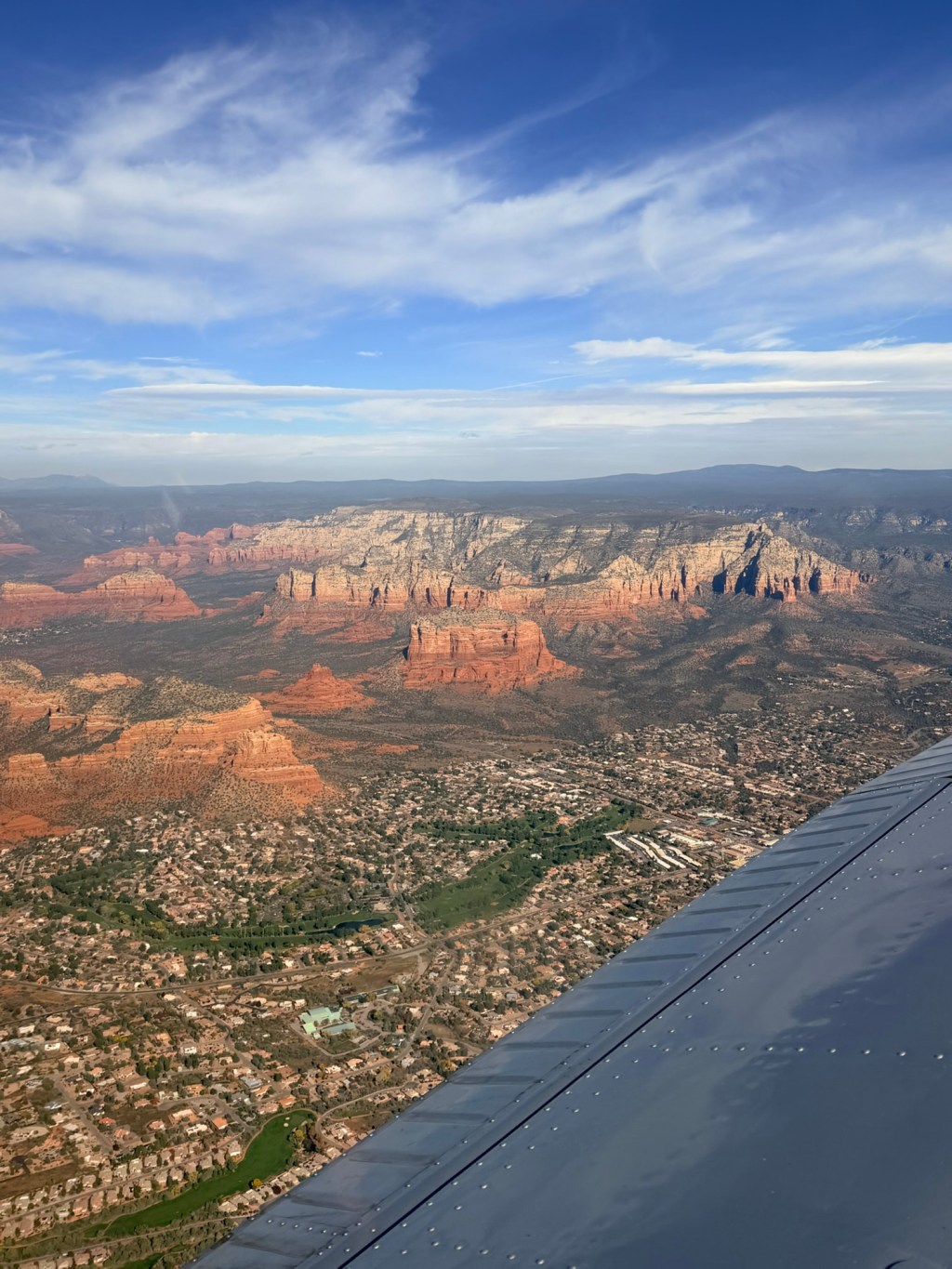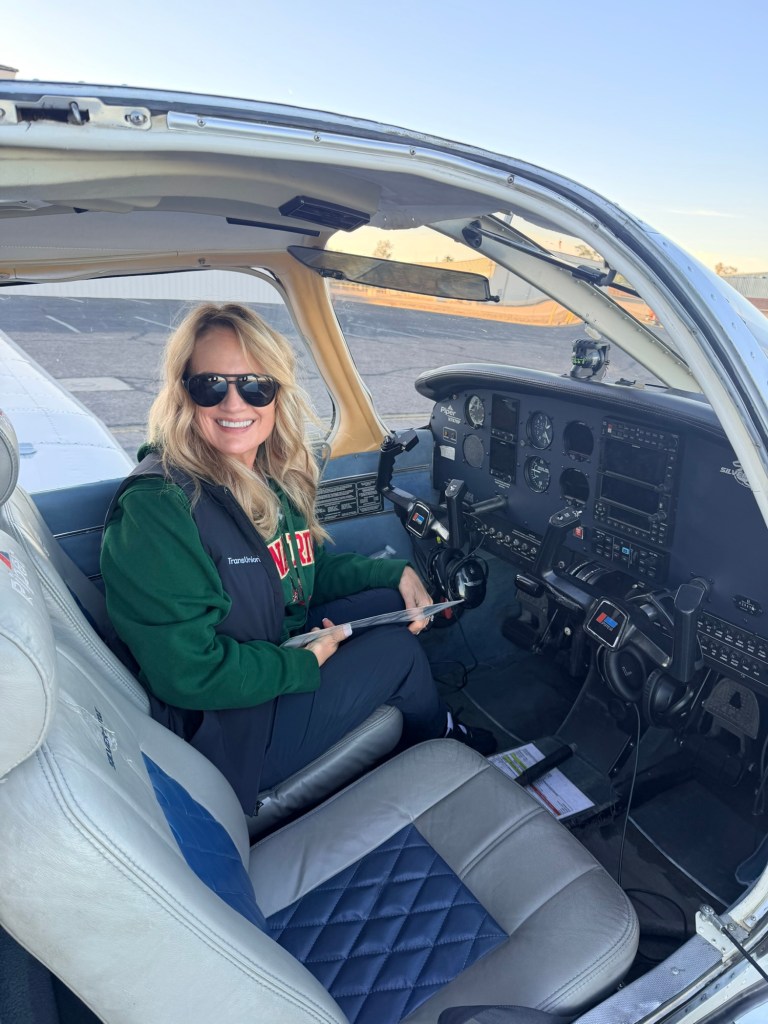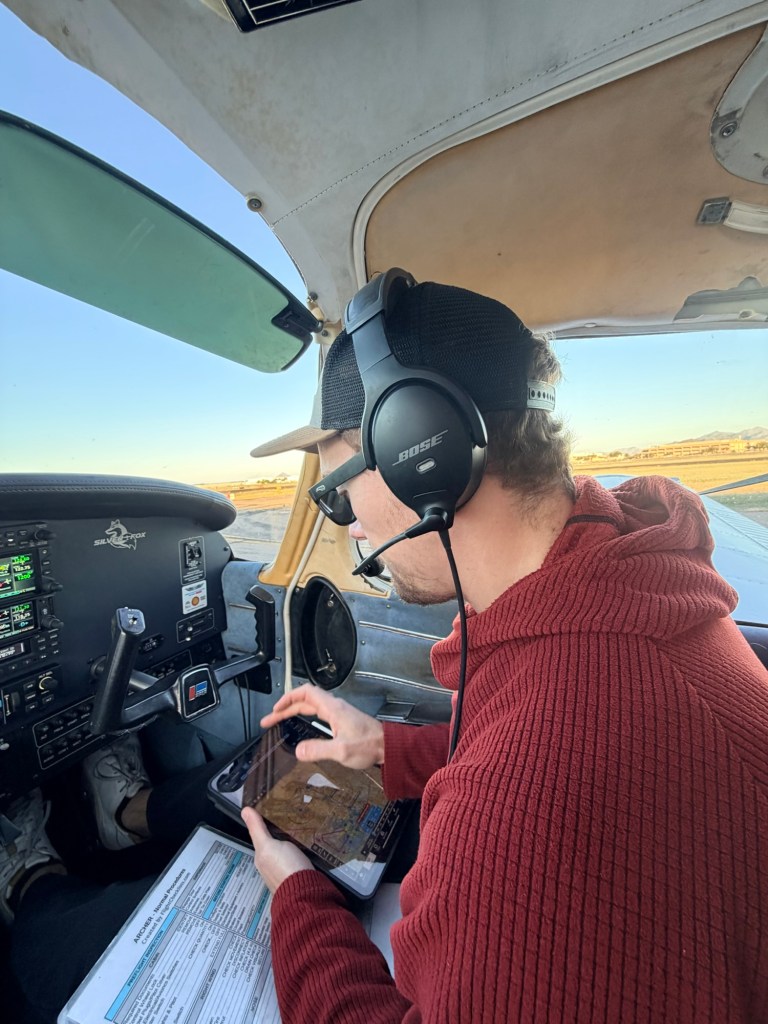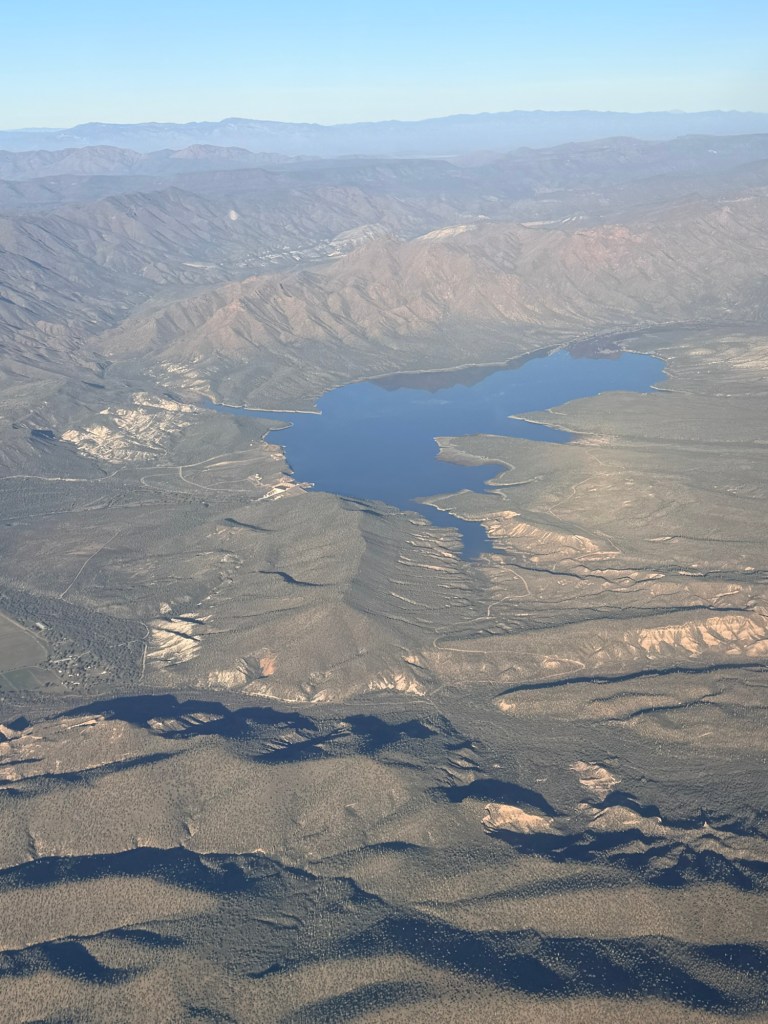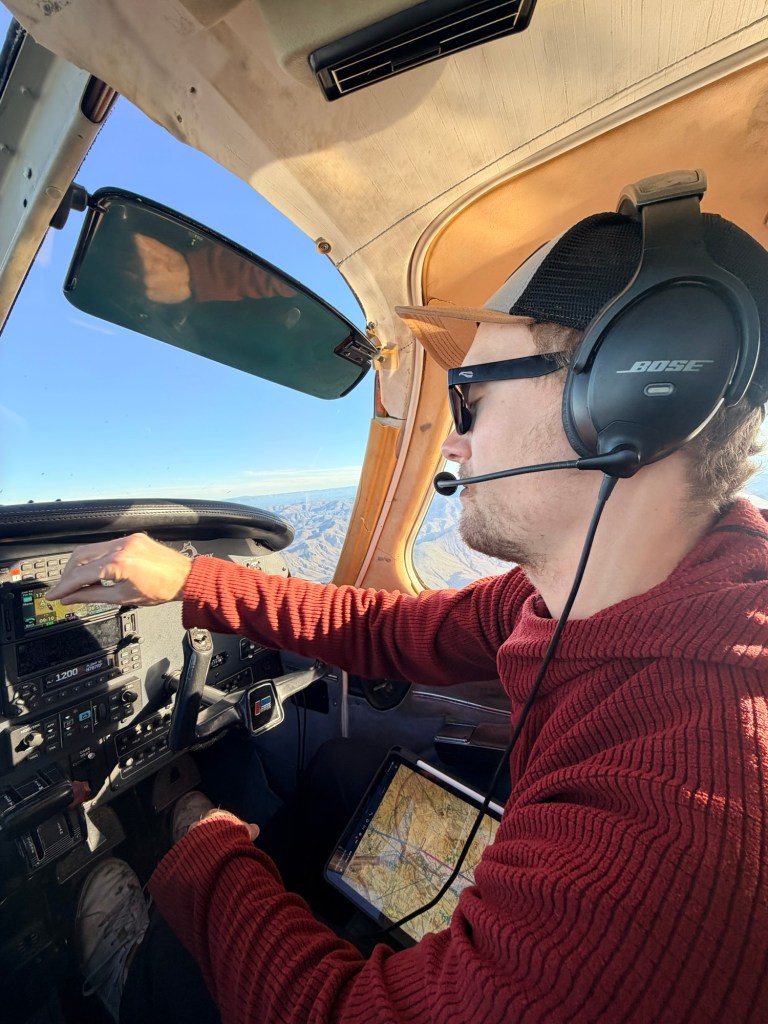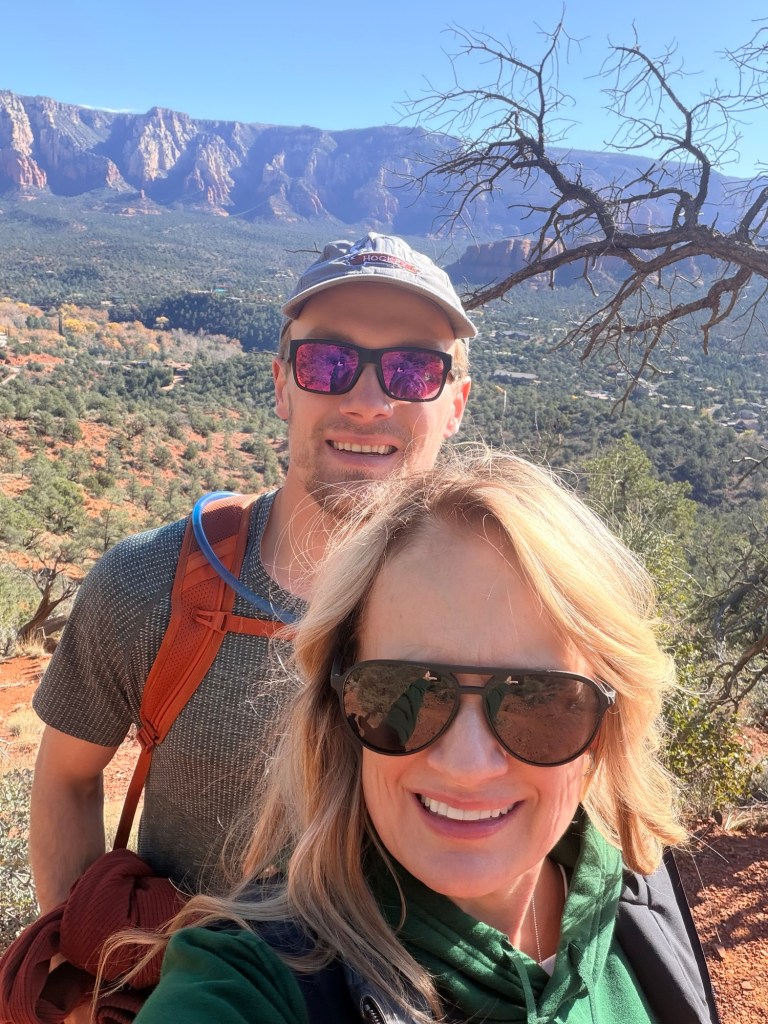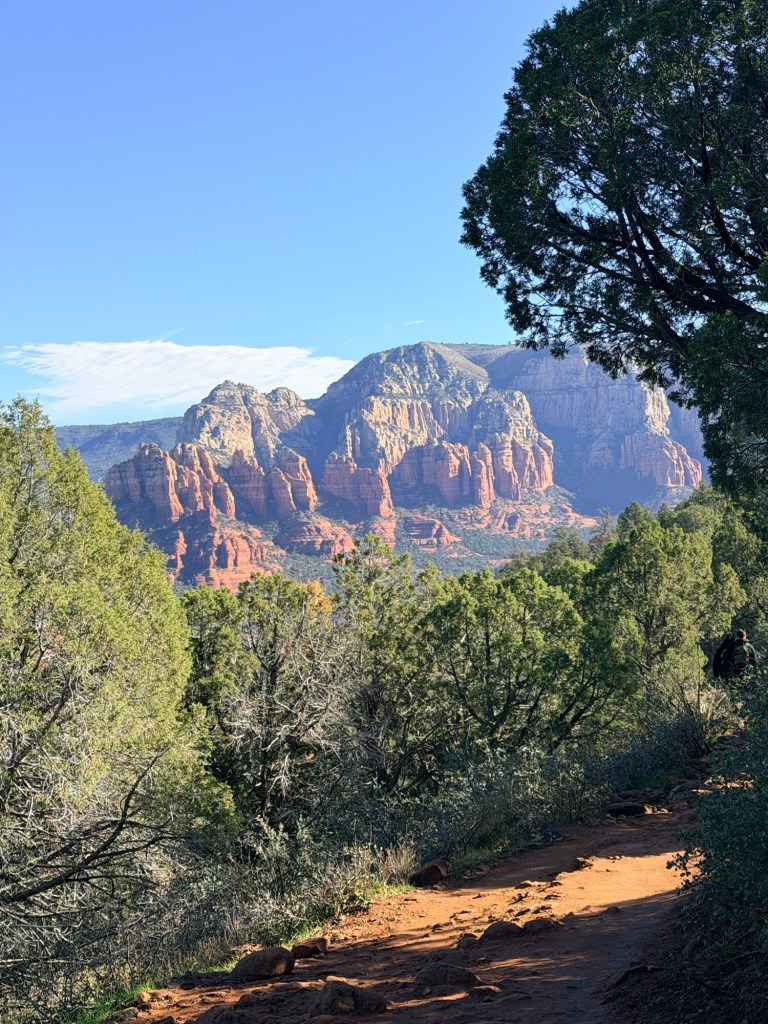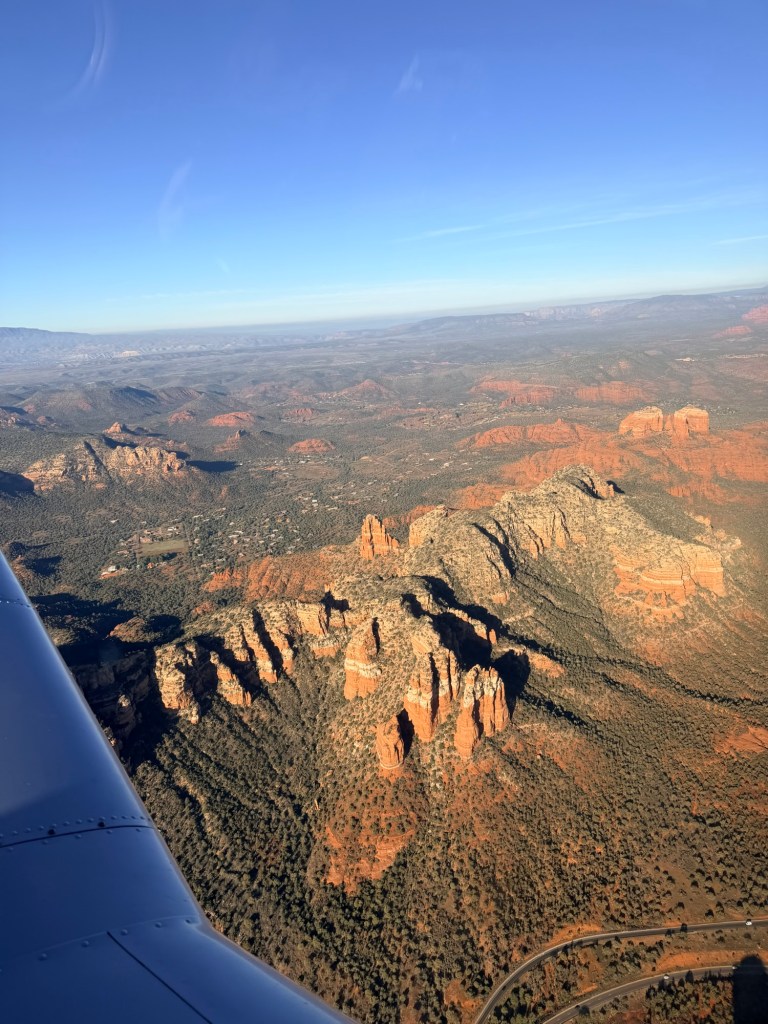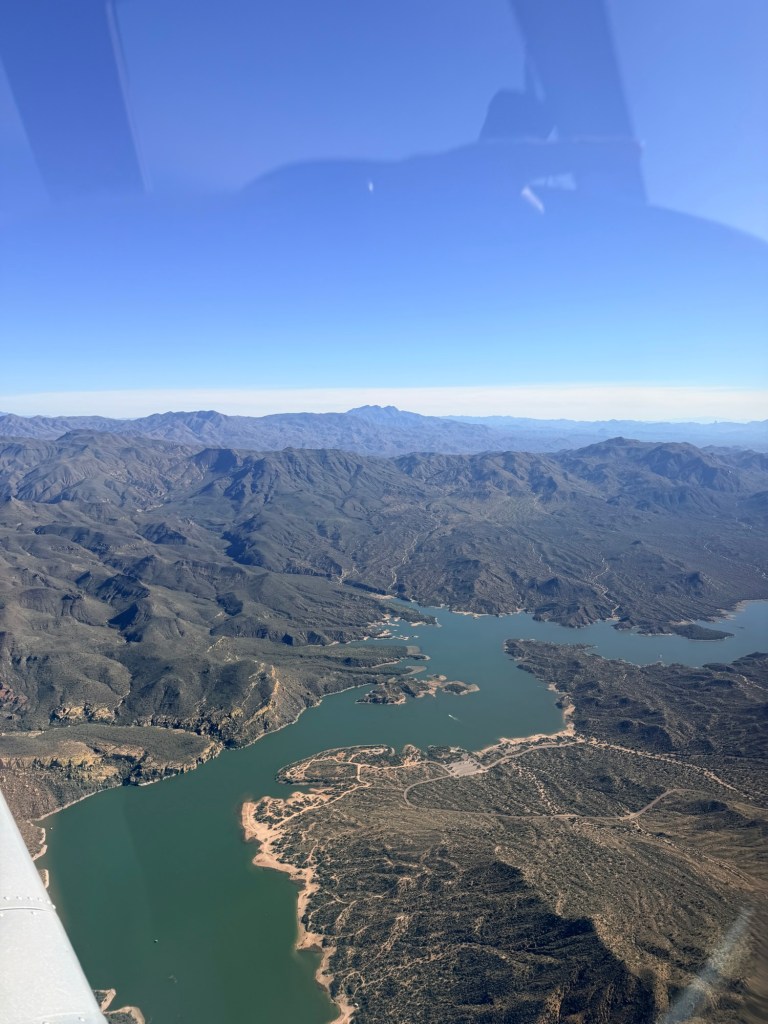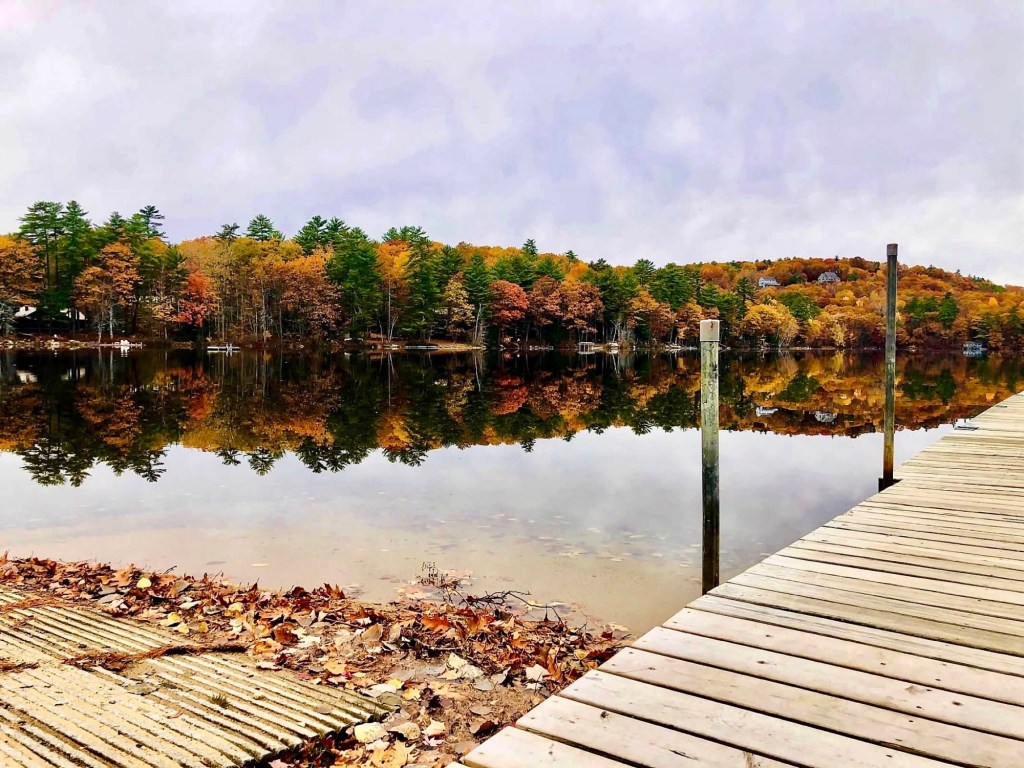
I had the best Thanksgiving weekend 🦃 which included the adventure of flying with my son from Falcon Field in Phoenix, AZ to Sedona, AZ. The red rocks from the air were stunning and landing on a mesa was surreal!🧡 Breakfast at the delicious Mesa Grill 🍳, a hike on the airport vortex, and then back in the air! Sedona is one of my favorite places. I have seen Sedona from a hot air balloon and it’s such an elevated experience from a plane!
My son, the Pilot!
Ready to take off 🛫Going through the check listCruisin’ at 9,000 feet!
Hiking on the airport vortex.Views from the ground aren’t too bad either 😉
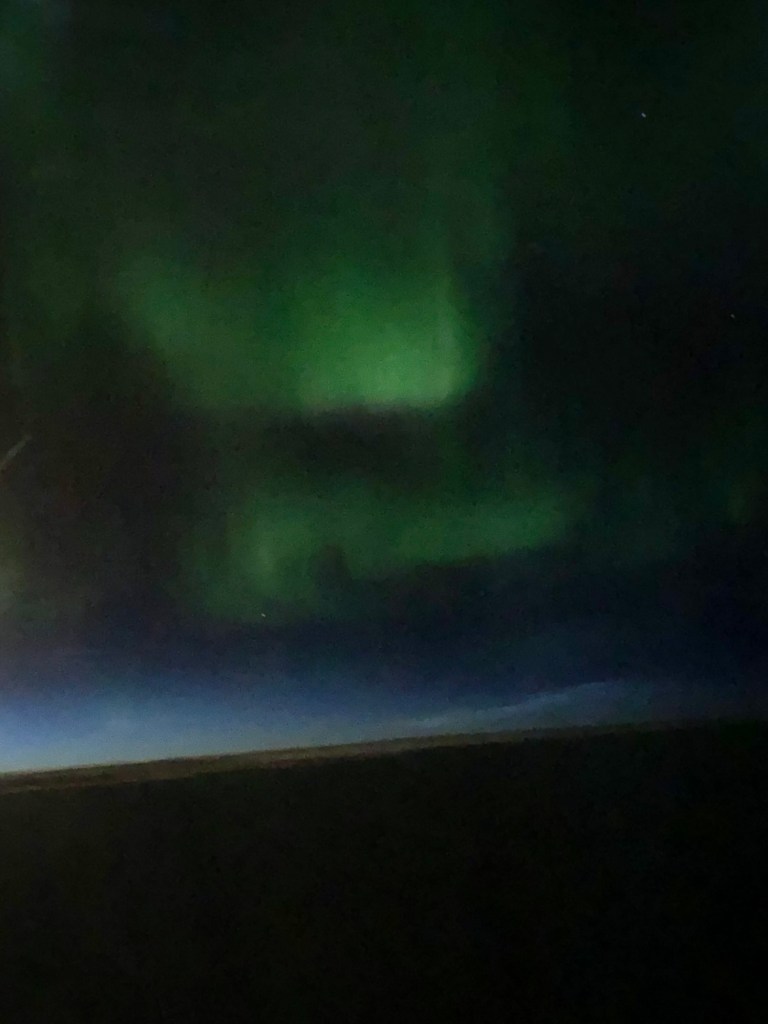
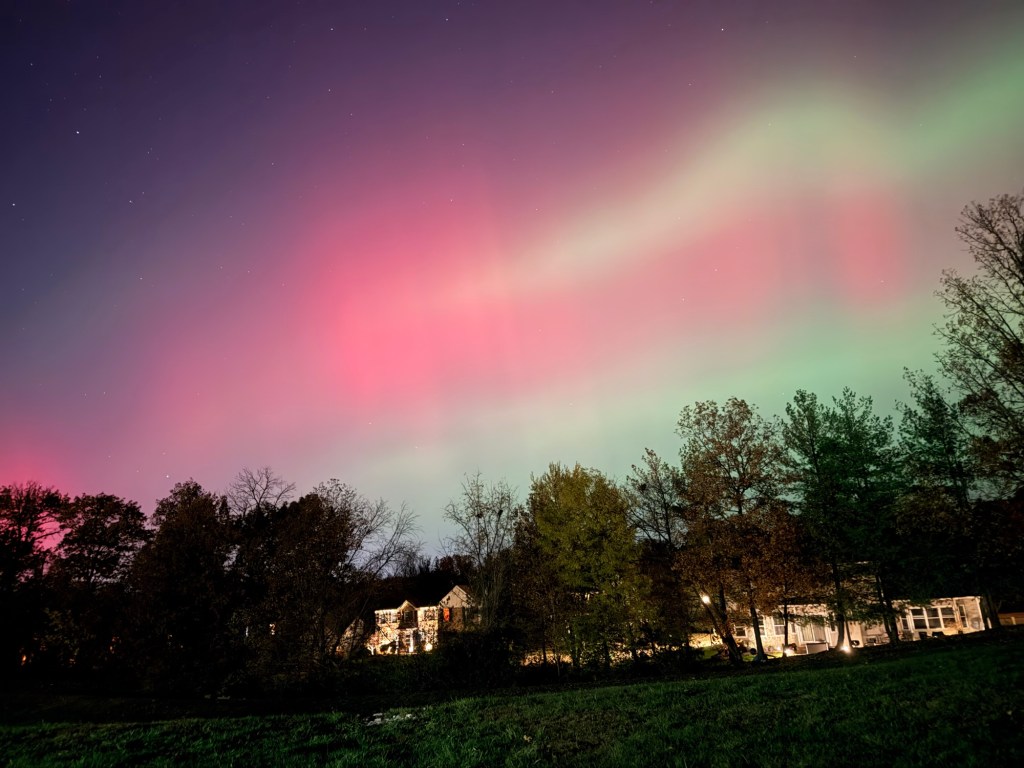
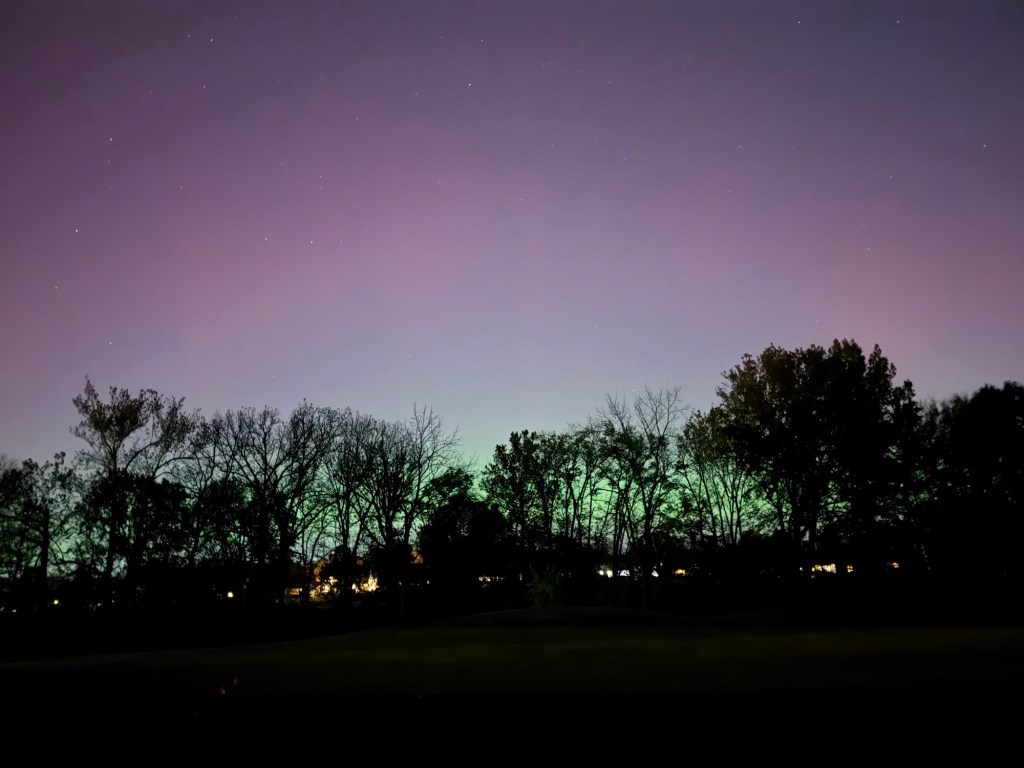
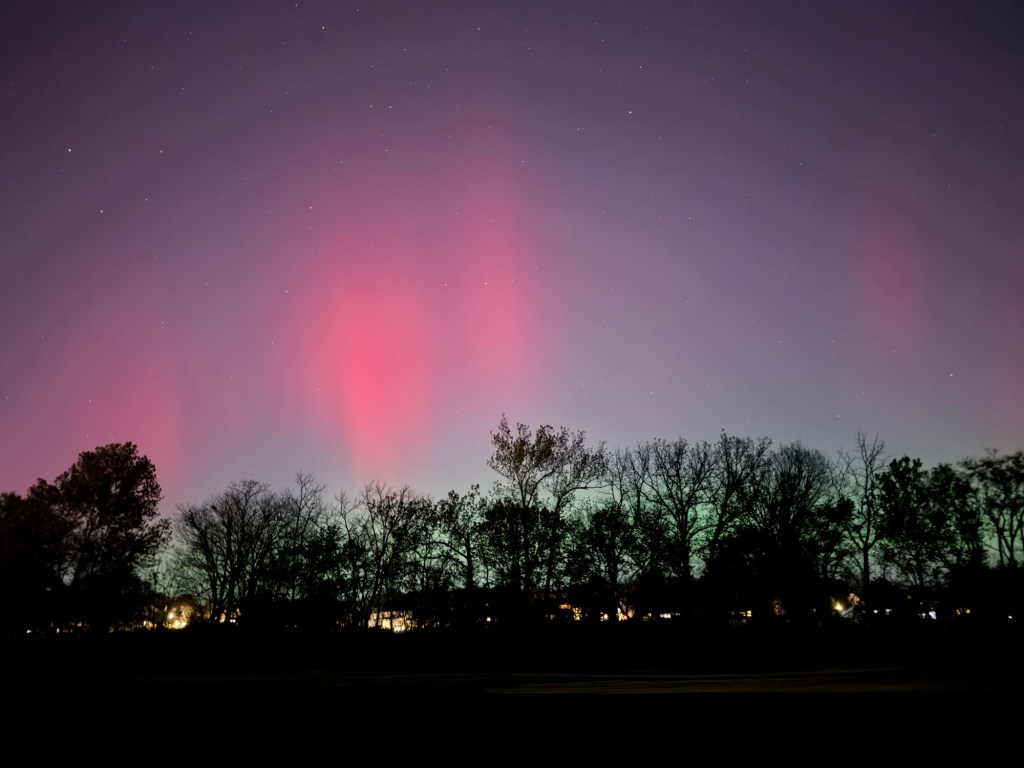
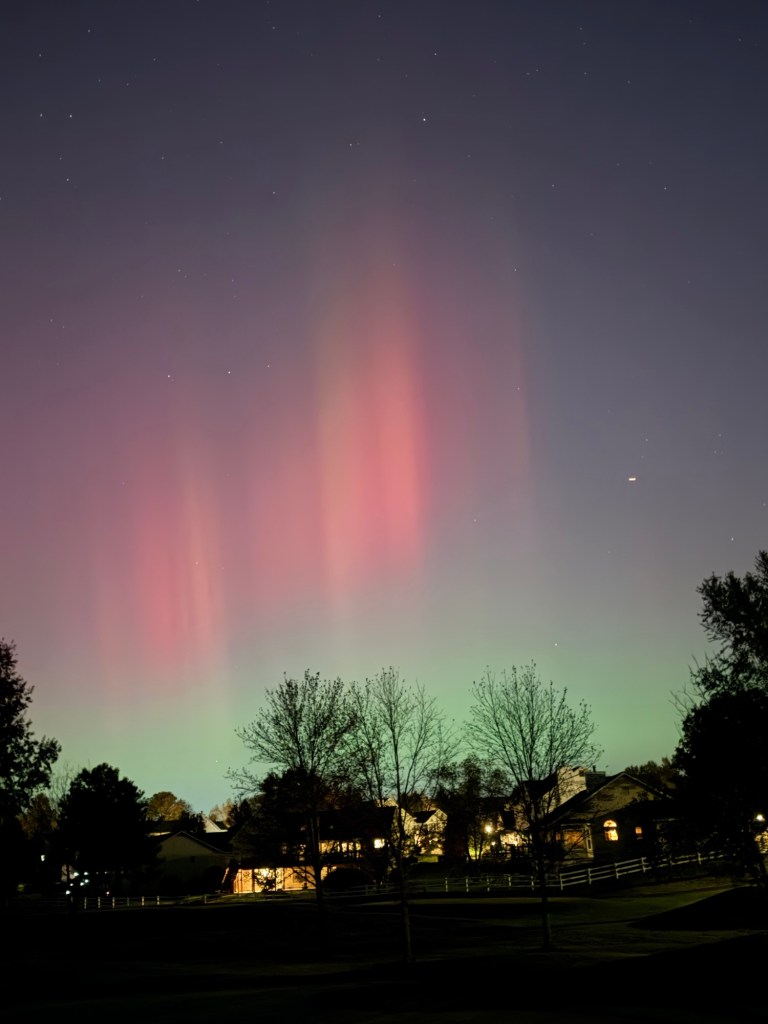
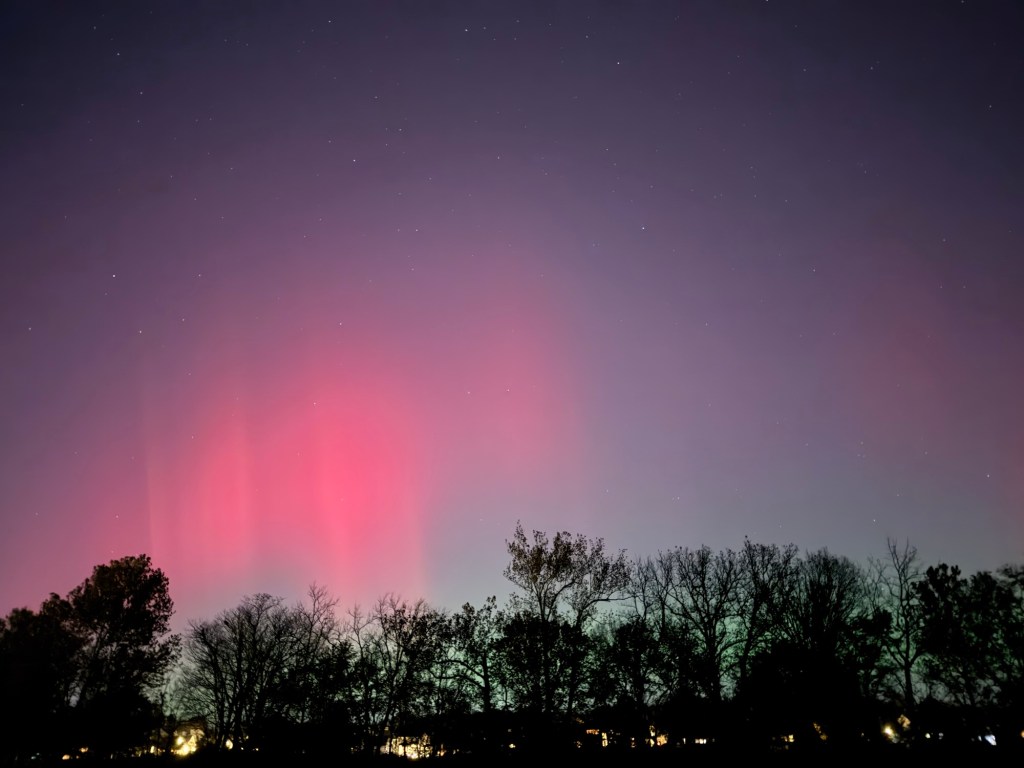
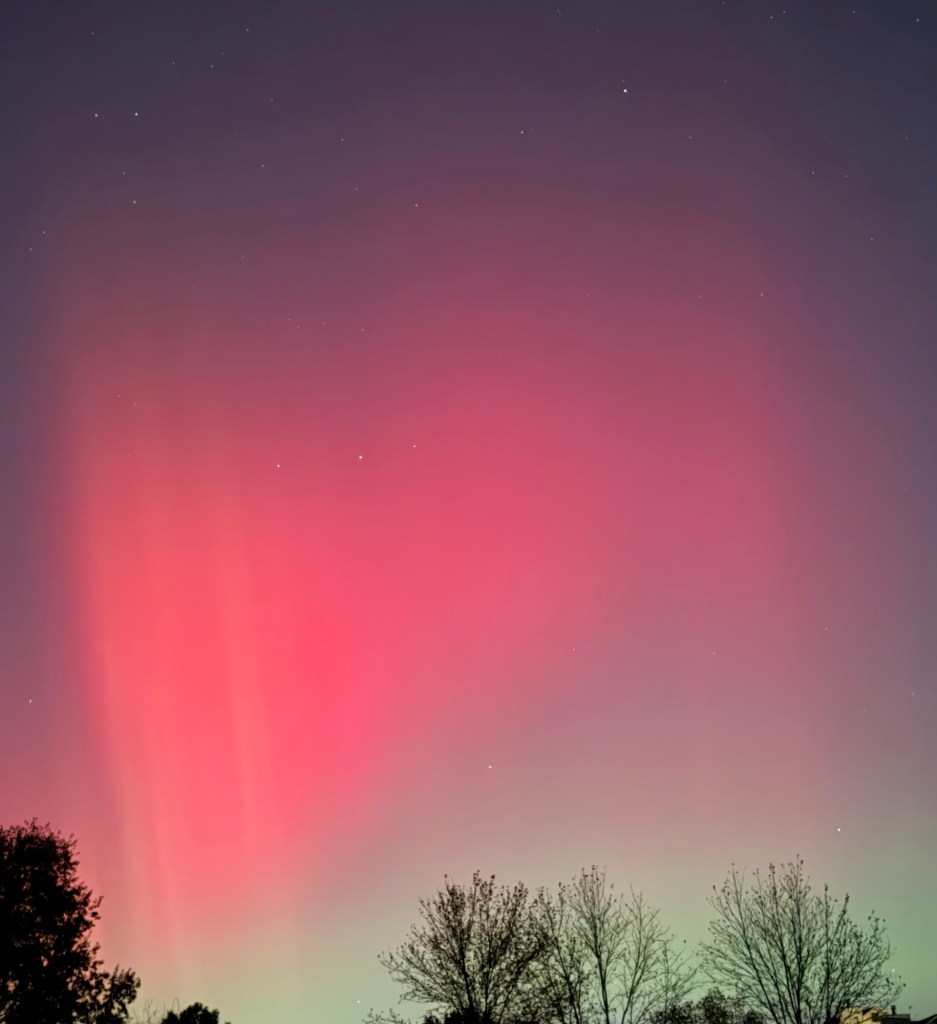
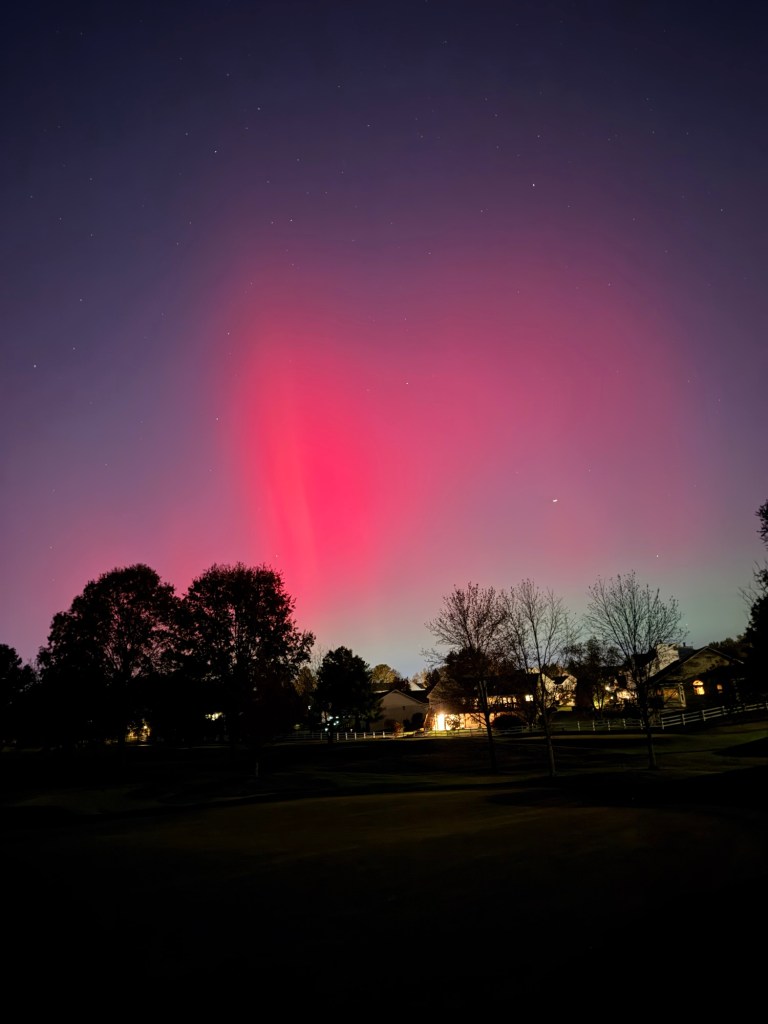
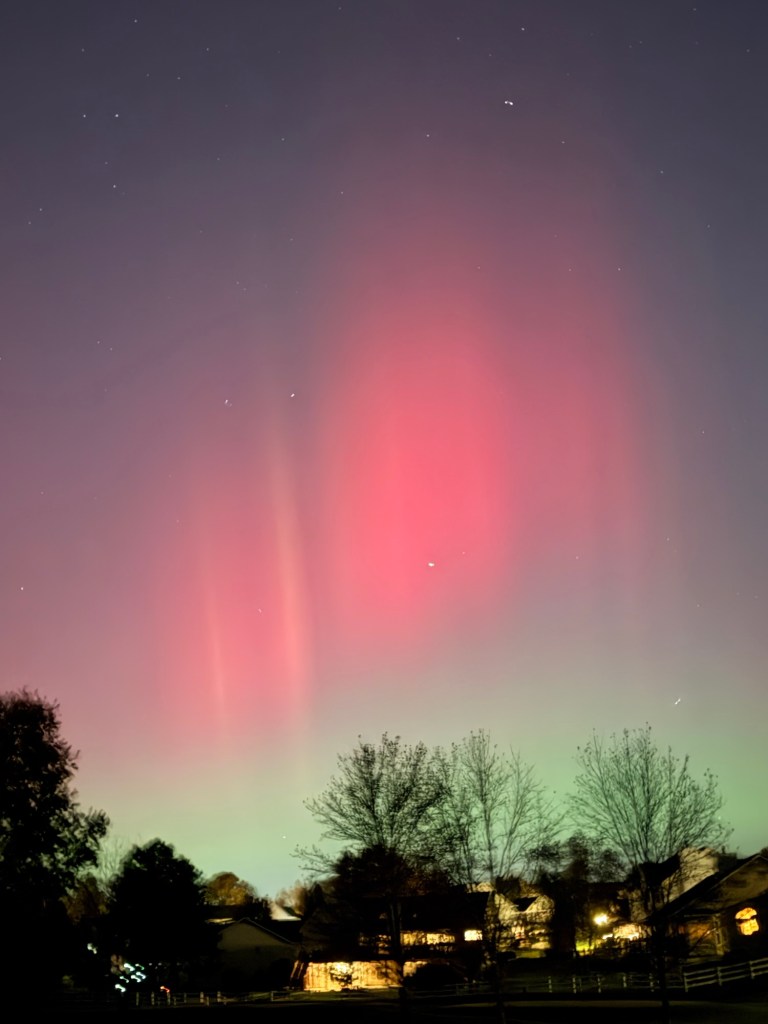
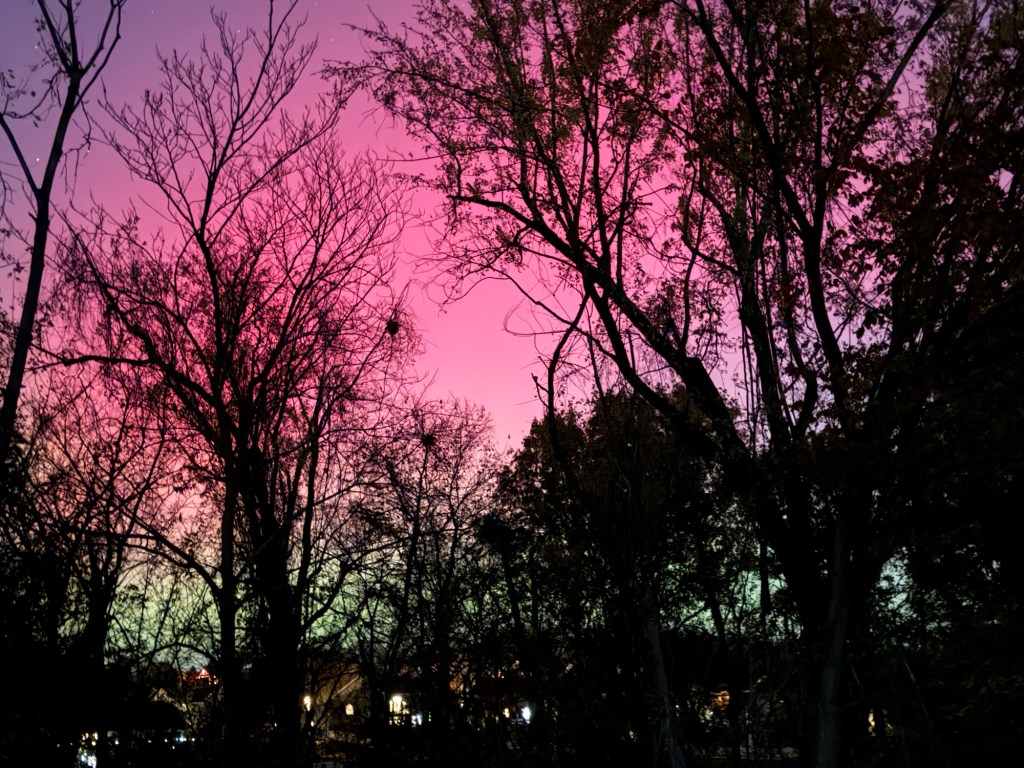
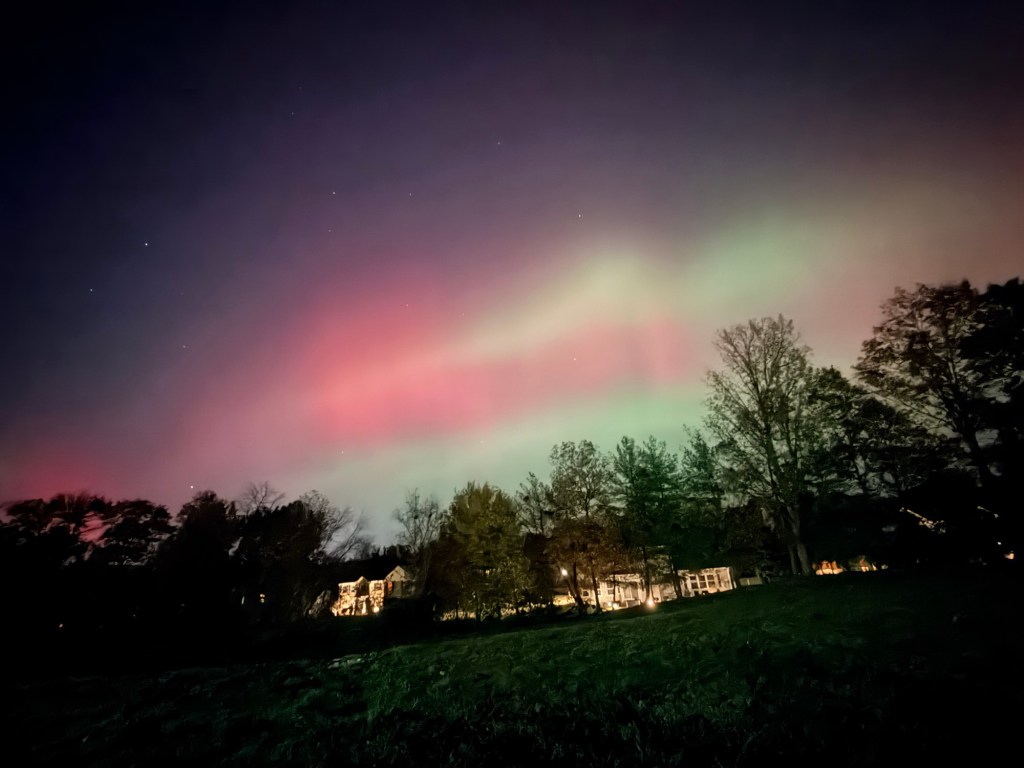
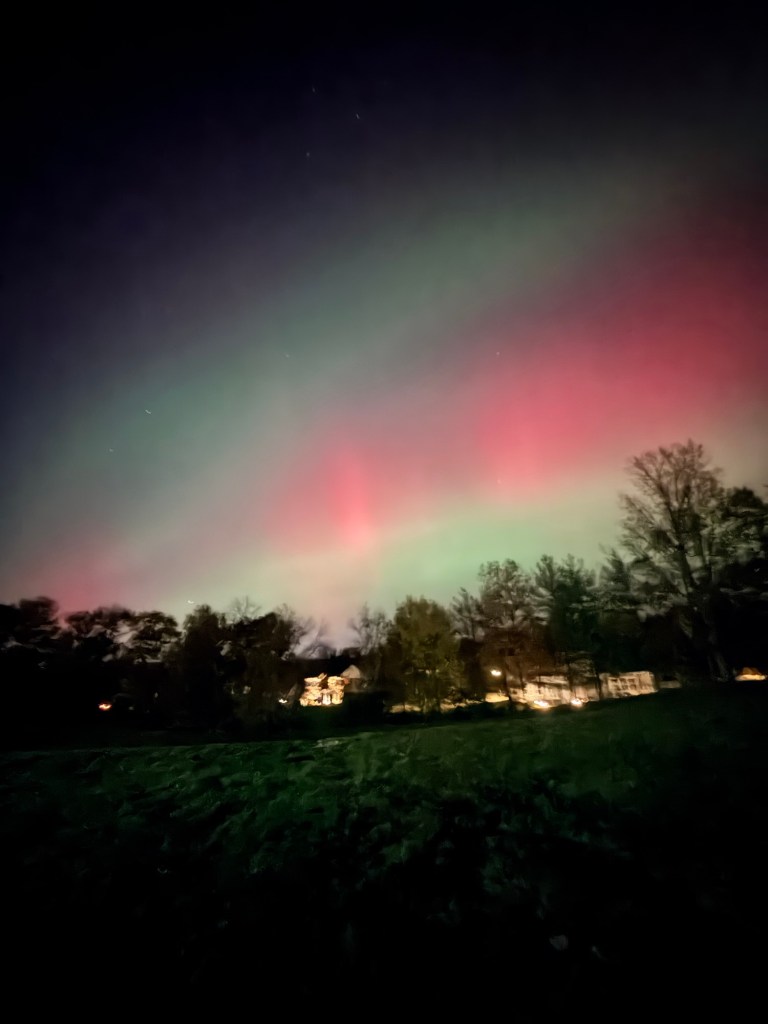
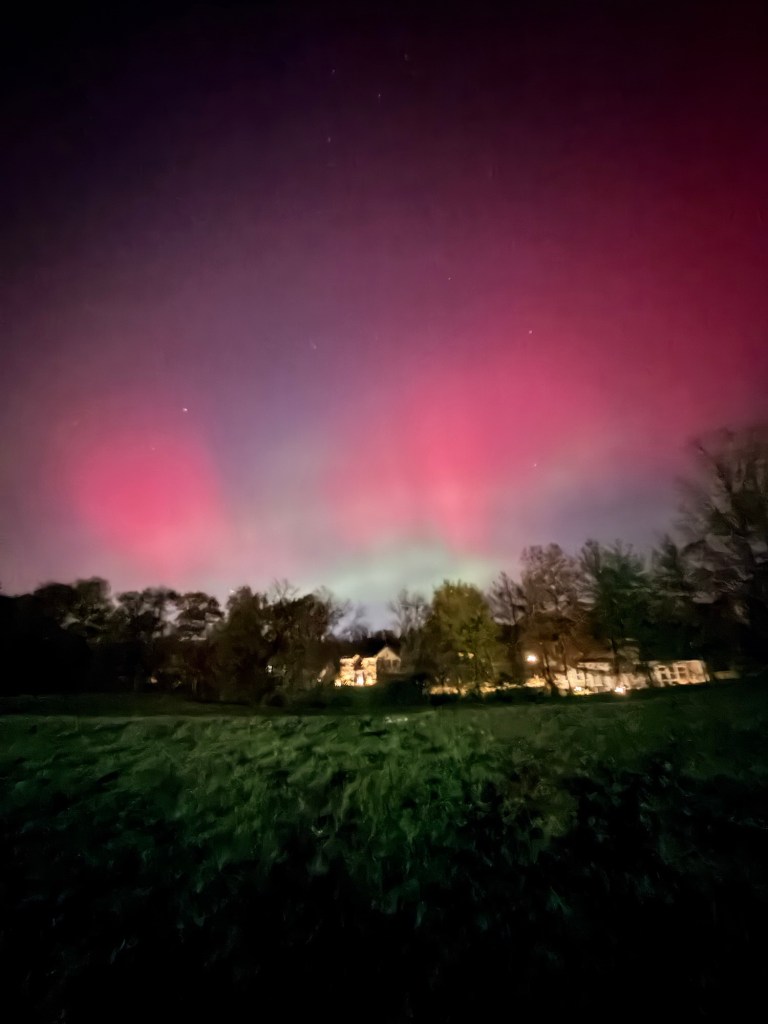
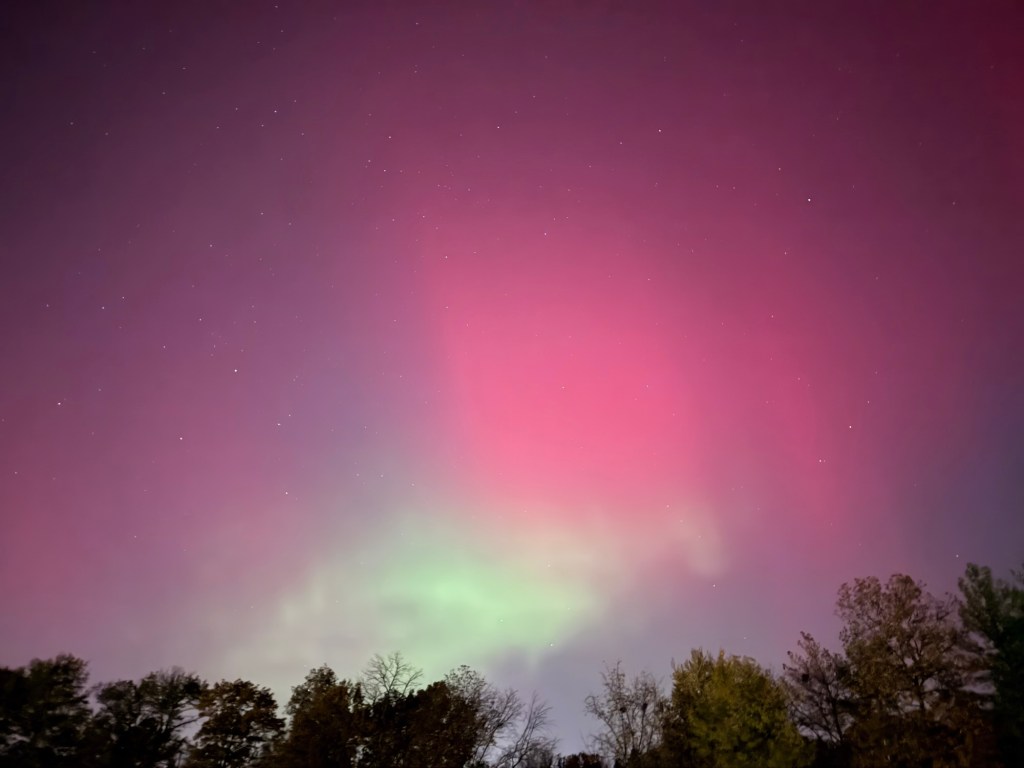
When I want to see the Northern Lights, I plan my dream Aurora Borealis vacation to Norway, Canada, Alaska, or Iceland. Of the 6 times I have seen these magnificent lights, 3 have been in Missouri above my house! The best time was November 11, 2025. The Northern Lights were seen across much of North America that evening, as far south as Florida and Texas. This was due to a powerful G4-rated geomagnetic storm that was caused by coronal mass ejections (aka CMEs) from the sun. Our gift from that storm was the Northern Lights—green, pink and red, complete with pillars and a few emotional tears.
I am going to let the pictures speak for themselves. Taken with my iPhone 17 Pro Max, night mode from my neighborhood in O’Fallon, Missouri. I went out twice that night to capture the beauty of the lights!
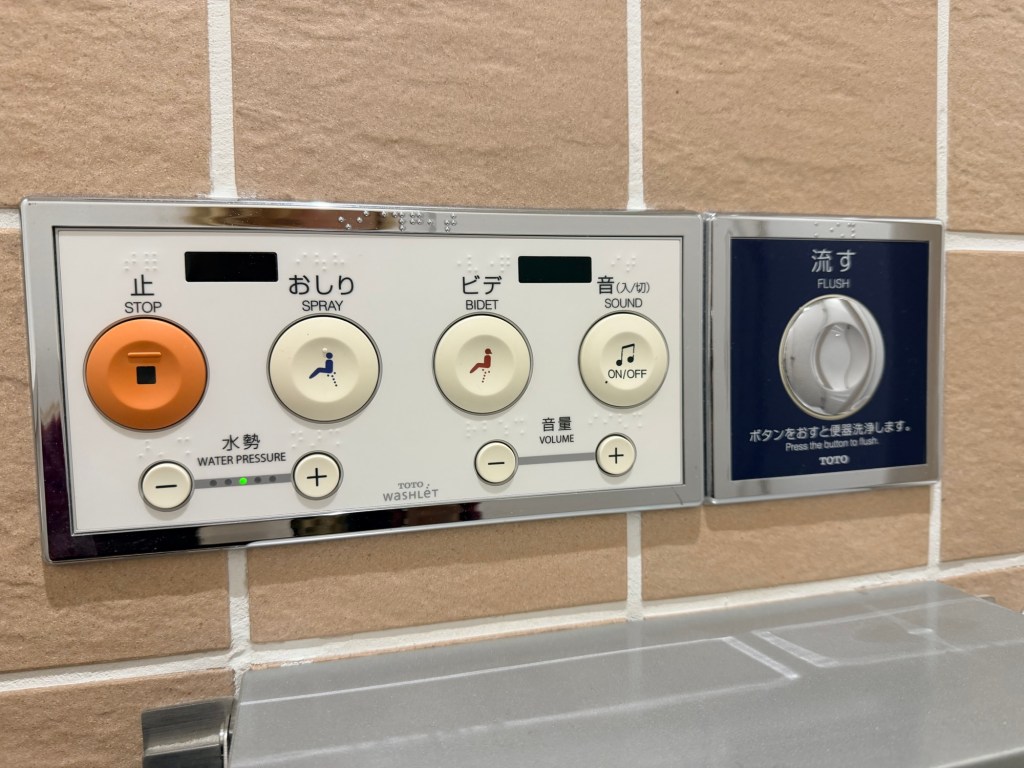
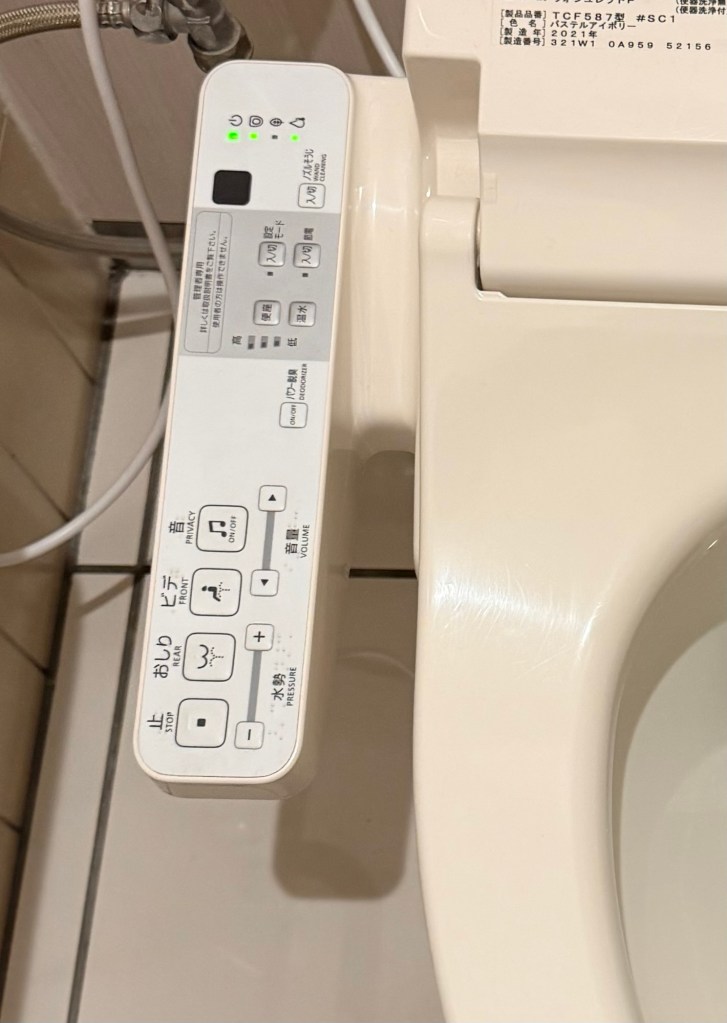
A friend told me that I would thoroughly enjoy the Japanese toilets and want to come home and install one! I’ve used a bidet before in Europe, however, the toilets in Japan are on another level. I never had a cold tushy because of the heated seat, and the controls on almost every toilet I sat on had a whole host of options. From pressure controls to noise cancellation, these toilets are high tech, clean, and comfy! I usually do my business in the bathroom and get out; but I could have read a 900 page novel with each bathroom trip.
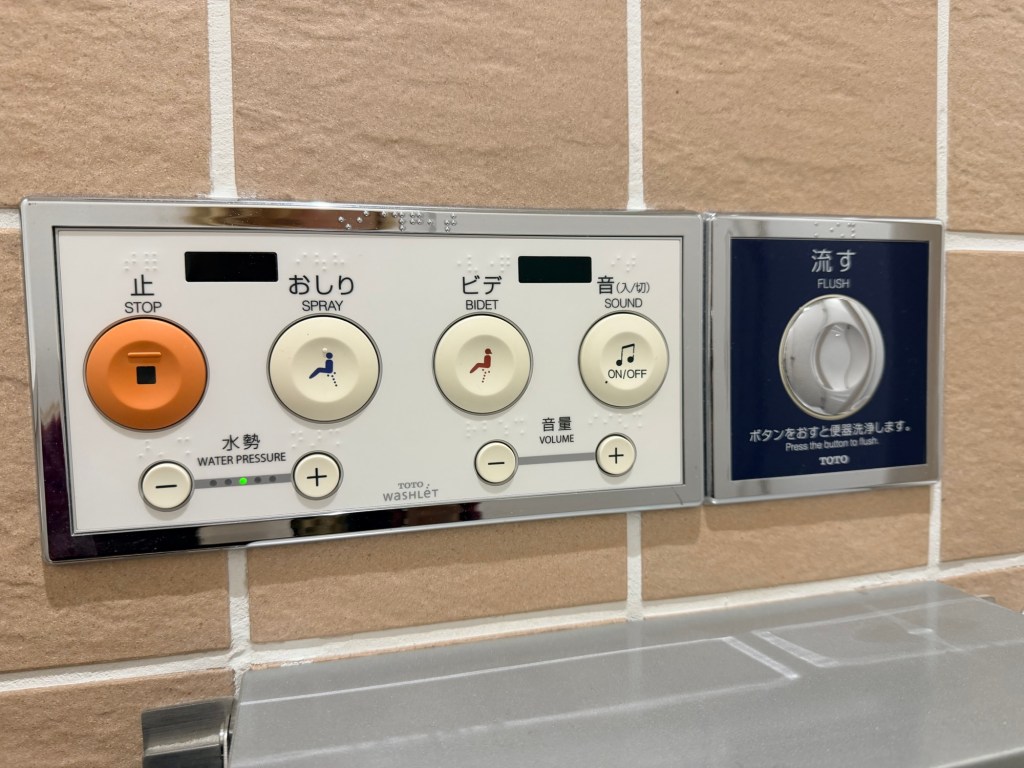
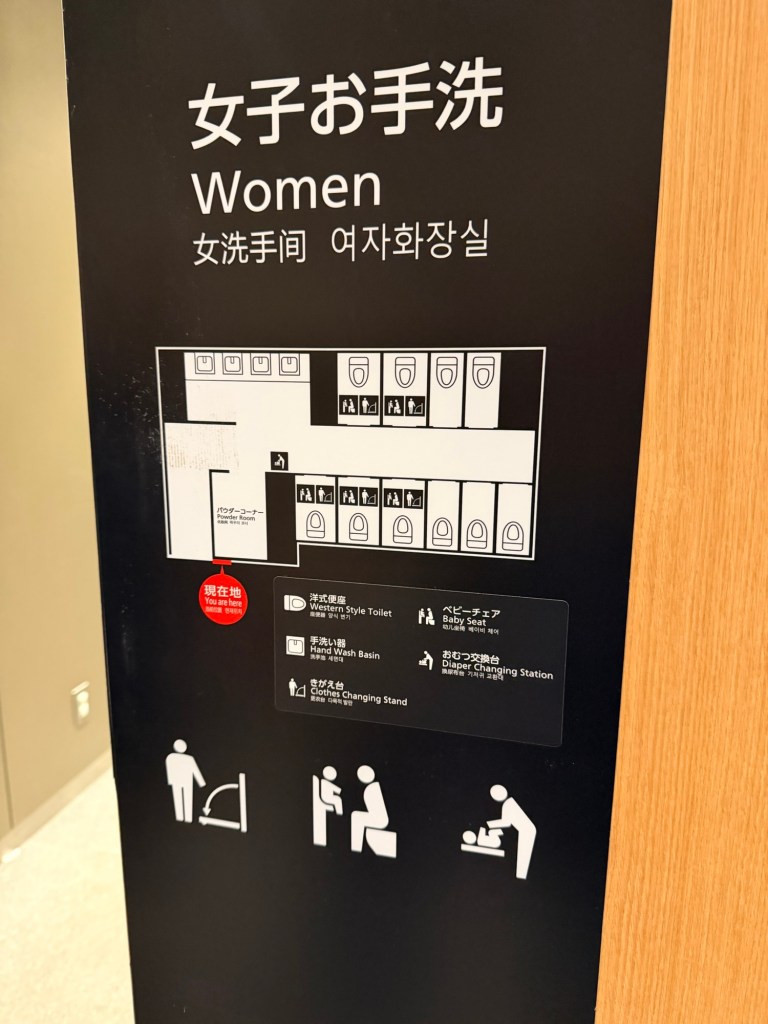
That’s a child seat on the right.This one has relatively few buttons; other toilets look like your remote control! Just remember to sit first before you start playing around. And use Google Translate so you know exactly what you’re pressing!Here’s a map of the bathroom so you can pick your own adventure.
Yes, they still have washiki (squat) toilets but I didn’t see many of them this time compared to 29 years ago. And why would you want to squat when you can sit and warm up??
This whole toilet experience caused me to research bidets. Did you know that the modern electric bidet was a 20th century invention that was developed in the USA by Arnold Cohen who was helping his father with a medical condition? Where the heck are these toilets today in the U.S.? Well Mr. Cohen licensed the patent to the Japanese company, TOTO, and there you have it! Funny enough, I have a TOTO toilet but it doesn’t do anything except flush.
Bidets in homes are mandatory in Italy and Portugal. While not mandatory in Japan, I read that approximately 80% of homes have an integrated bidet-style Washlet. A Washlet is a high-tech TOTO toilet seat with lots of bells and whistles, essentially a spa for your tush—hygienic, warm water washing, heated seats, and air dryers (not the hand kind). Many of these toilets have self-cleaning nozzles, automatic opening lids (see my first video), and deodorizers. Come to think of it, no public bathroom I visited ever smelled bad.
This one had some translations to English.
At first I was nervous about pressing buttons..I didn’t know what surprise awaited my rear😳. However, it didn’t take long before I was experimenting. By the end (pun intended), I would have brought home a washlet as a souvenir. It could have been my emotional support potty on the airplane!
Side note, unless you’re using the lobby restroom in a hotel, not many bathrooms have paper towels to dry your hands. Some may have a token air dryer, but many don’t (a smaller portion don’t have soap). It’s common practice to bring your own towel in your bag to dry your hands in a public restroom. We ended up buying a Hello Kitty washcloth to use.
I already miss the toilets—my tush hasn’t been the same since.🚽❤️
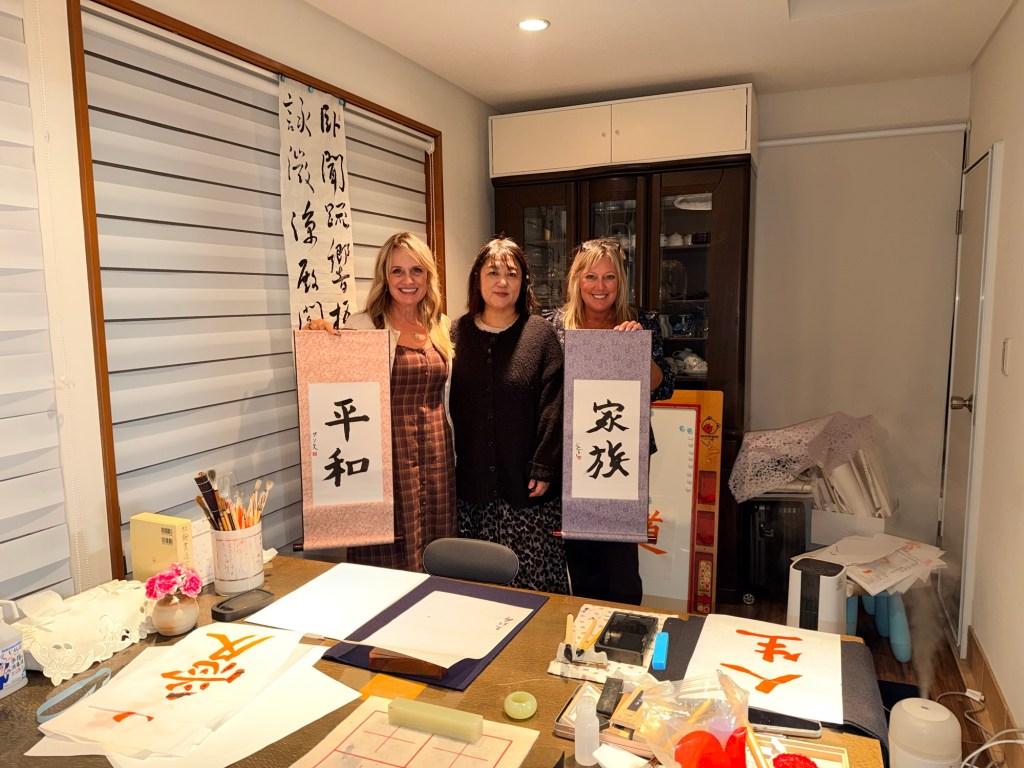
One encounter that resonated deeply with me during this trip was a lesson in the Japanese art of calligraphy, known as “shodo.” This practice is truly memorizing as it is more than just writing; it is an expression of artistry, philosophy, and spirituality that has evolved over centuries.
Japanese calligraphy is rooted in the Chinese characters (kanji) and Japanese syllabaries (kana). Its roots are influenced from the 7th century cultural exchanges with China.
Shodo emphasizes the beauty of brush strokes, the flow of ink, and the harmony between the artist and the paper. Each character conveys emotion through a meditative experience, promoting mindfulness and focus. And that’s exactly the way I felt as I was trying my hand at Shodo.
First, we had to prepare for the lesson.The tools included:
Brushes (fude): I found that I do so much better using a smaller brush.
Ink (sumi): Ink is created by grinding an ink stick on an ink stone with a small amount of water. This process itself is an art form, as the quality of the ink affects the final piece. FYI-we tried our hand at creating the ink, but then we used prepared ink. 
Paper (washi): Japanese washi paper is prized for its texture and durability and allow ink to flow gracefully to enhance the visual quality of the calligraphy.
Seal (hanko): Calligraphers use a personal seal to stamp their work, adding a final touch to the art work. My sister and I each had our own seal! (and I brought it home so I can continue to stamp my calligraphy).
We are so lucky that one of our Japanese friends is a shodo sensei (teacher). According to our friend, kanji characters are designed to be written with the right hand. I gave it my all as a left-hander, but it wasn’t easy.
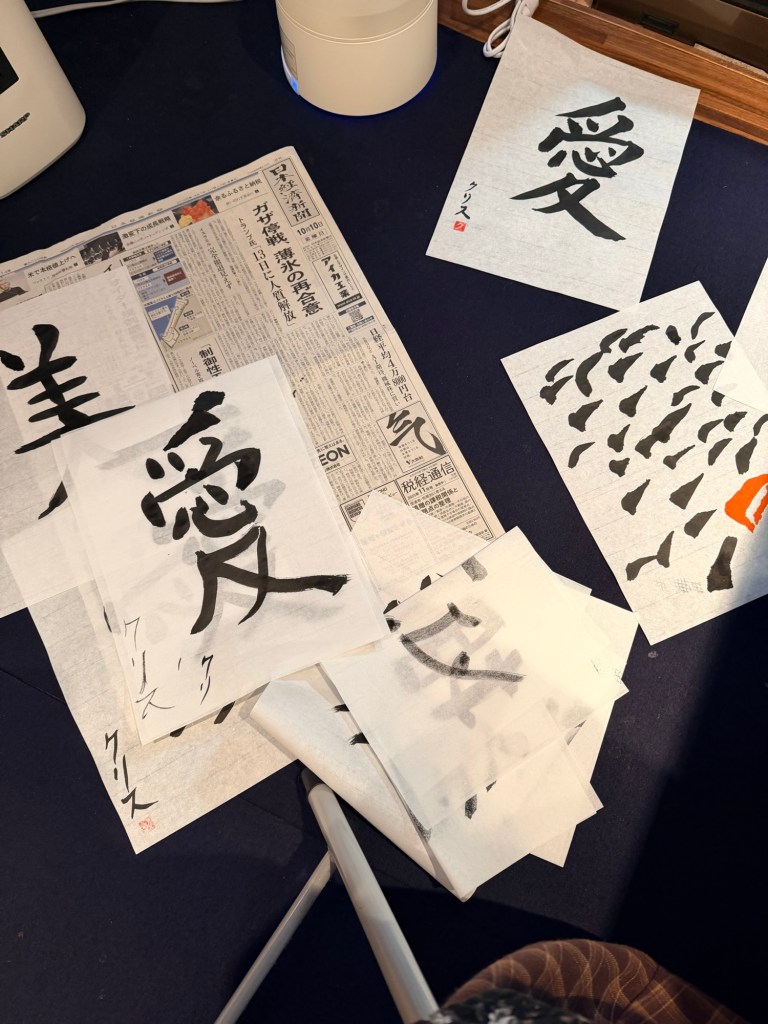
Practice, practice, practice!
Beyond its aesthetic appeal, Japanese calligraphy has a deep cultural significance. It accompanies poetry, spiritual writings, and meaningful life events. In addition, it is a common practice during New Year celebrations when people write phrases to invite good luck and prosperity for the coming year.
Shodo also plays an important role in Zen Buddhism, where it’s seen as a form of meditation. The act of writing is intended to manifest the essence of one’s thoughts and beliefs, making it both a reflective and creative practice. And, I truly felt that way while I was practicing.
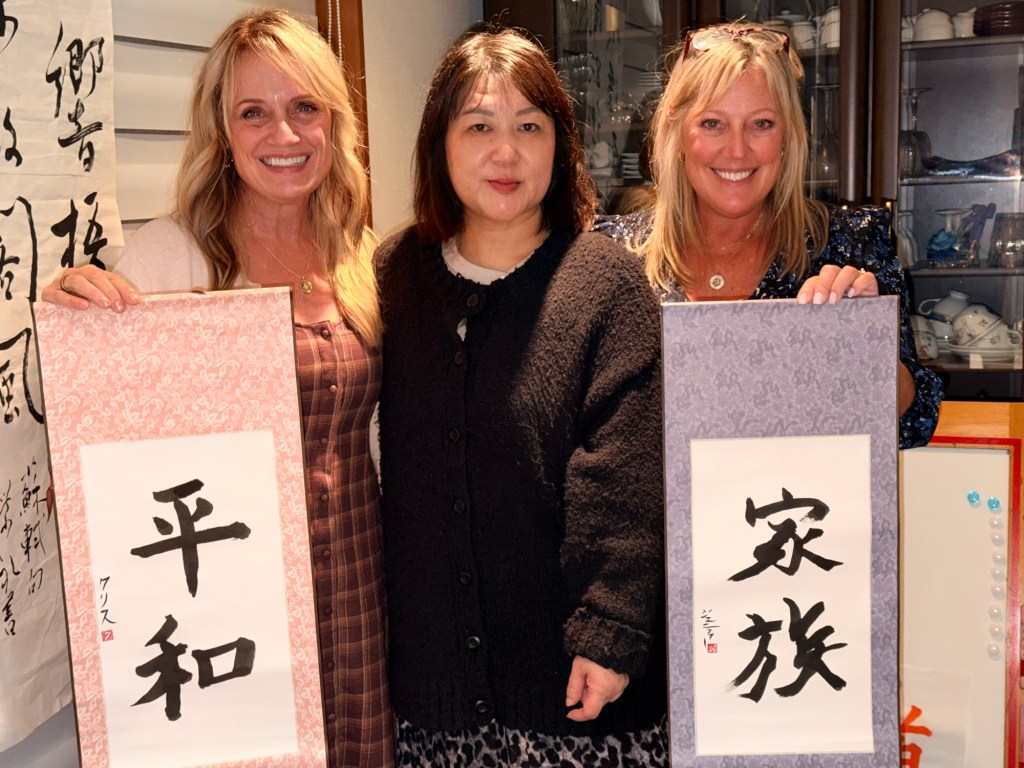
The most meaningful souvenir I brought home is my calligraphy artwork—words like peace, love, and beauty—memorialized on paper…an opportunity to learn from a Japanese calligrapher. Kuniko gave me so much more than a souvenir; it was a gift…a rare chance to slow down, practice mindfulness, and be inspired by beautiful art.
Our final day in Toyama was a fun fusion of art—through glass, food and clothing! Unforgettable experiences that left us with lasting memories.
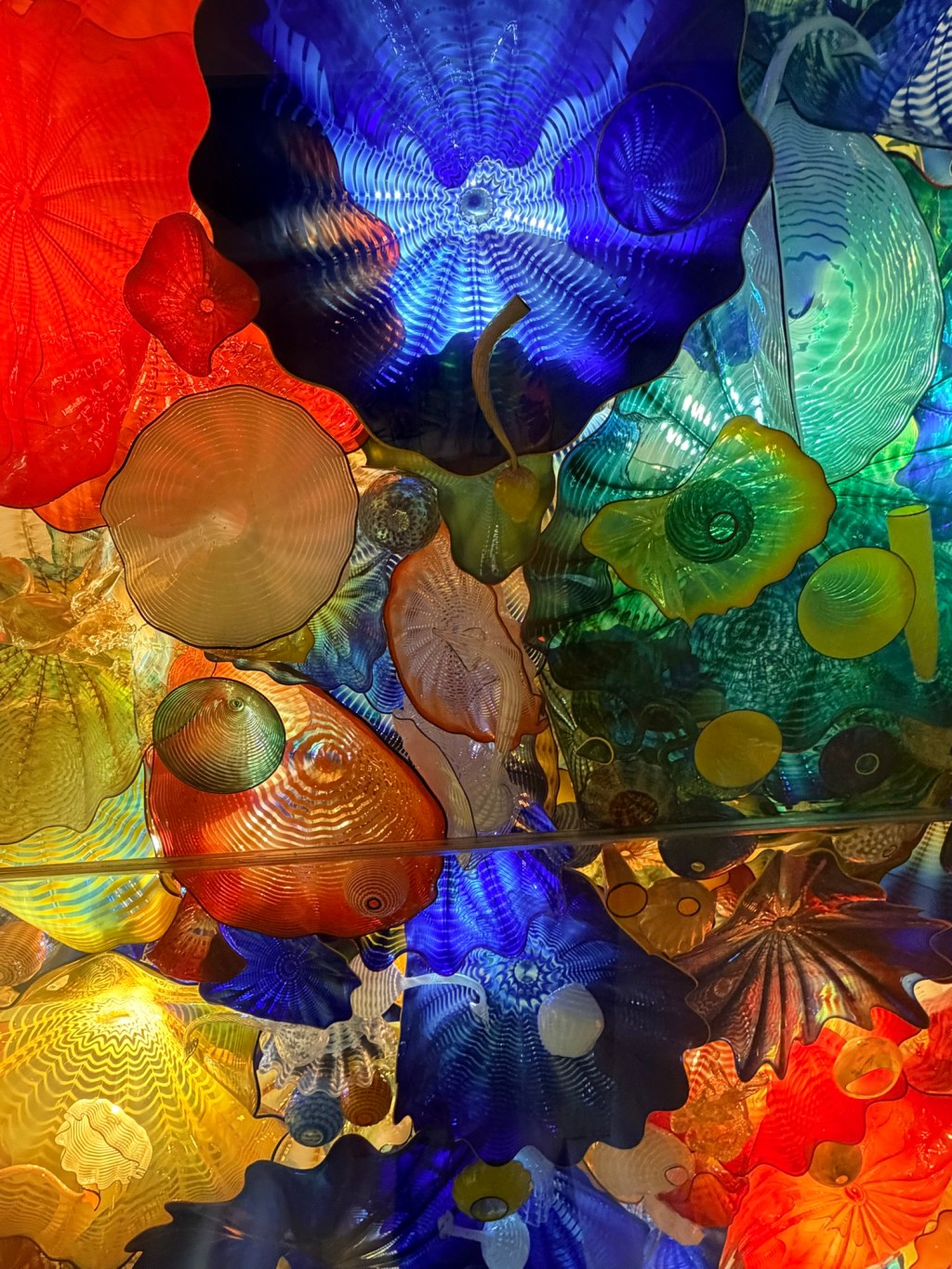
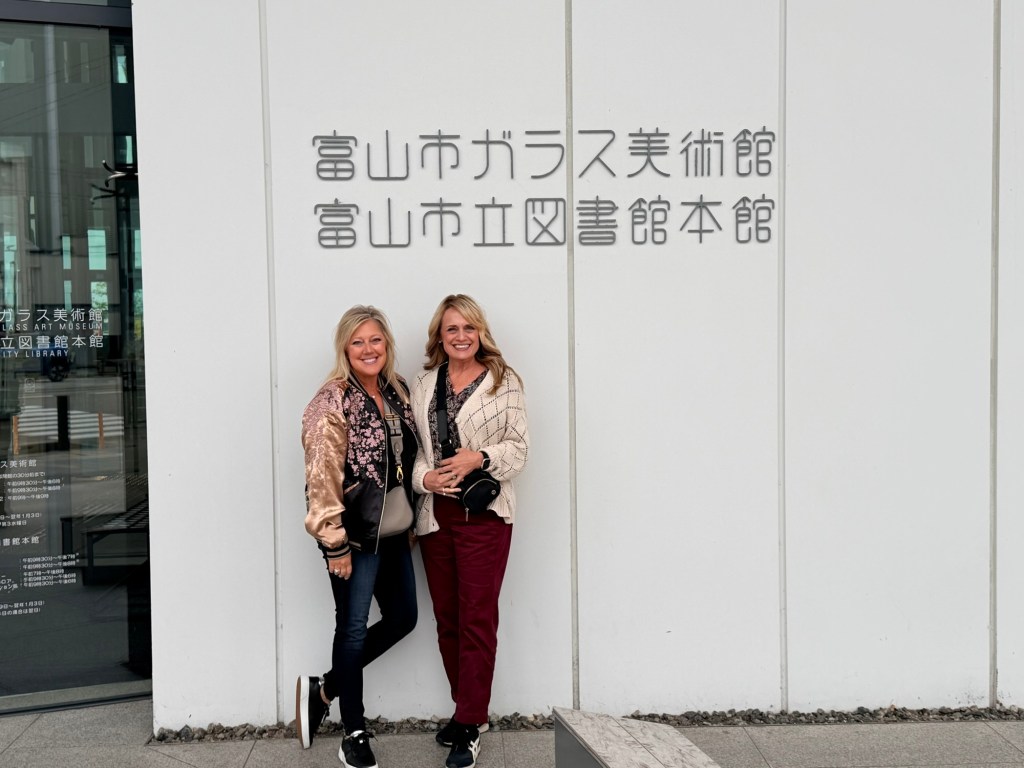
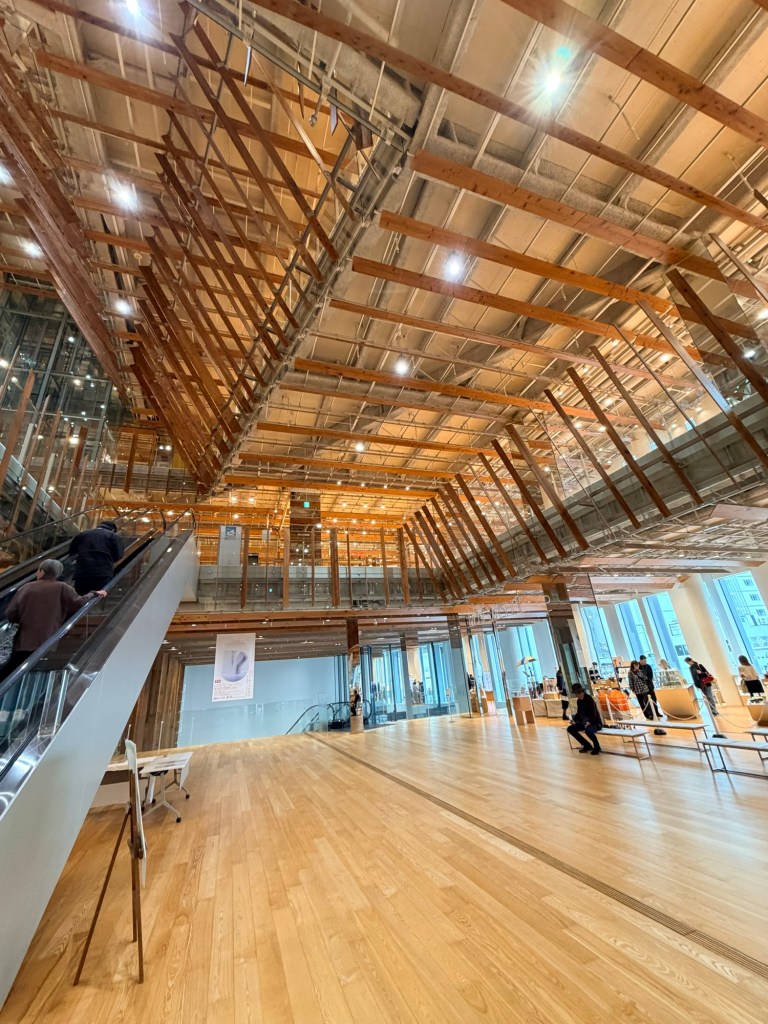
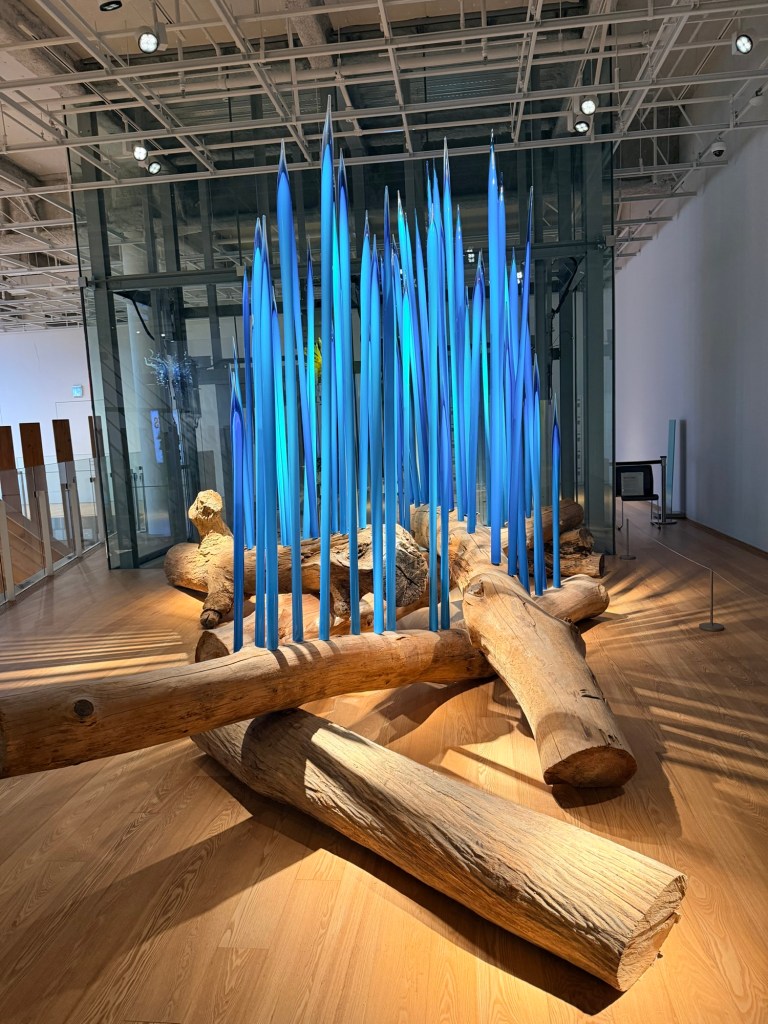
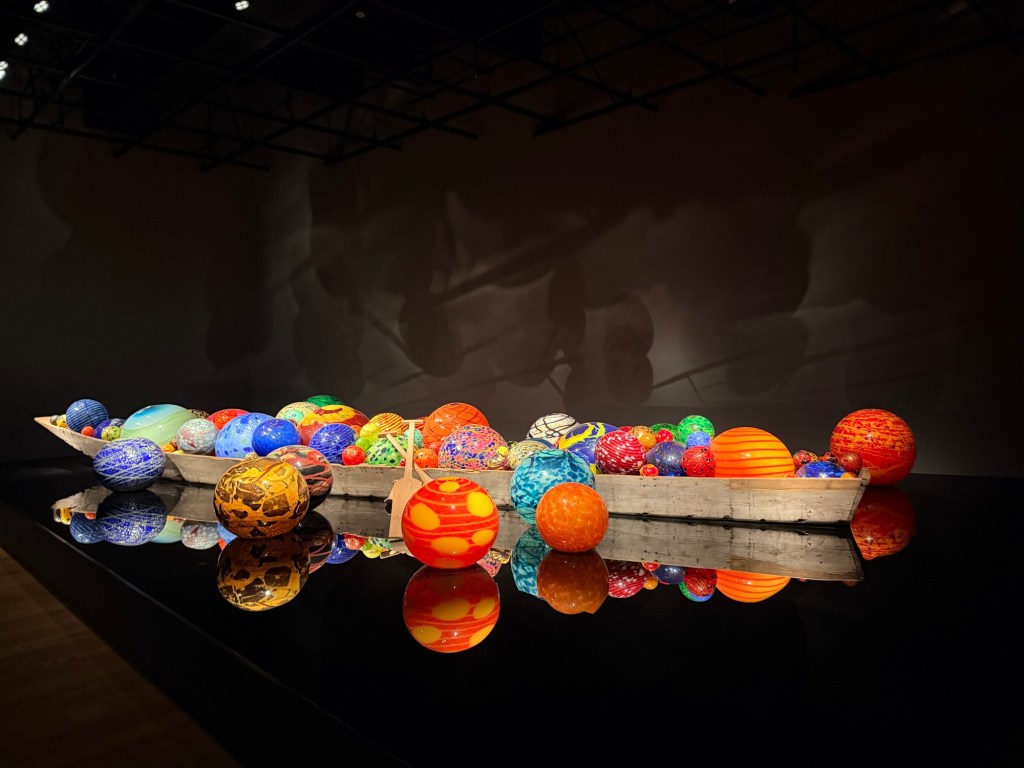
First Stop: The Toyama Glass Museum🪷 We began our day at the stunning Toyama Glass Museum, a haven for both local and international artists. The museum’s impressive collection showcases a variety of glassworks, including breathtaking pieces by the renowned artist Dale Chihuly. His intricate designs and vibrant colors truly captivated our senses.
The Toyama Glass MuseumThe Glass Museum is also occupied by the Toyama City Public Library Main BuildingToyama Reeds, 2015(Chihuly)Toyama Float Boat, 2015 (Chihuly)Toyama Mille Fiori, 2015 (Chihuly)
Lunch: An Exquisite Teppanyaki Feast🥢 Next, we indulged in a culinary adventure featuring teppanyaki, where skillful chefs prepared the most succulent fillet we had ever tasted. The meal began with a warming bowl of soup, followed by a savory medley of fresh vegetables, and then the expertly grilled steak.
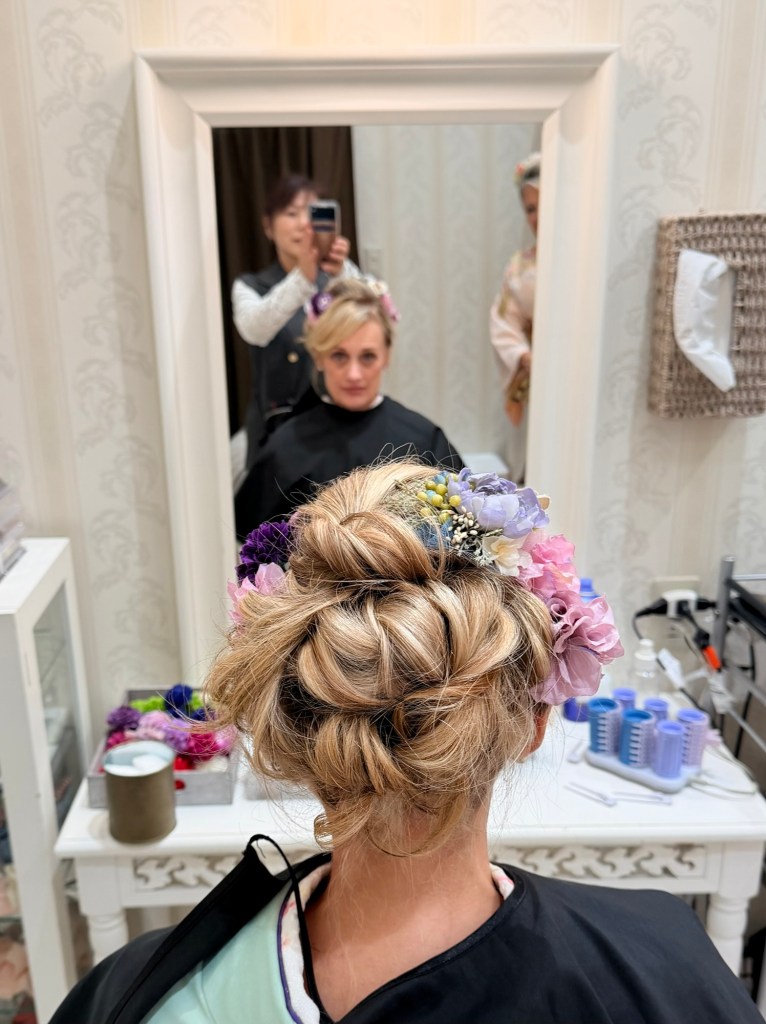
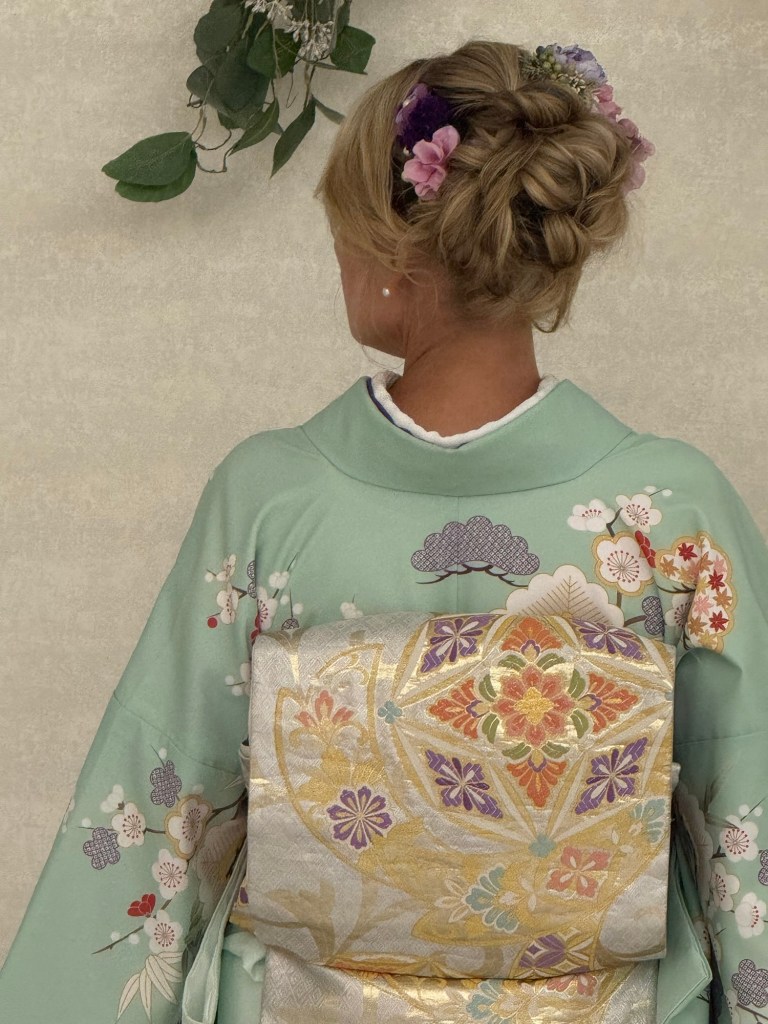
Cultural Touchpoint: Kimonos! 👘 To wrap up our day, we participated in a traditional kimono experience. It was fascinating to learn about the evolution of this beautiful garment; while modern kimonos typically feature just three layers, centuries ago, they boasted an impressive twelve layers, each serving its own purpose and signifying status. Adorning ourselves in these elegant fabrics allowed us to connect with Japan’s rich cultural heritage, making for a truly immersive experience. They also styled our hair!
Kimono – ki means “to wear” and mono means “thing”—literally translating to “thing to wear”. Kimonos are worn for special / ceremonial occasions.Kimonos are worn left side wrapped over right (unless the wearer is deceased)Kimono colors have different meanings. For example, bright colors are associated with spring or youth, while the darker colors (black and navy) are used for formal occasions and winter. Red and purple used to be reserved for the elite.🪭💜🌸Obi knot – the large knot of the Obi (sash)
After soaking in all that Toyama had to offer (including the hot springs), we embarked on the return journey aboard the bullet train🚄. The two-hour ride back to Toyoko was spent writing this post!
My friends married in the Japanese city of Toyama. I was fortunate to attend and witness the beautiful cherry blossoms 🌸 that spring. After close to 30 years, we are heading back to that part of the country. 🗾
Where is Toyama on the map? It is across Japan’s main island of Honshu, nestled between the Japanese Alps on one side and the Sea of Japan on another. This picturesque city of approximately 400,000 people is starkly different from the other locations on this trip. In 2025, The New York Times ranked Toyama #30 on their annual “52 Places to Go” list.
Ueno Station in Tokyo
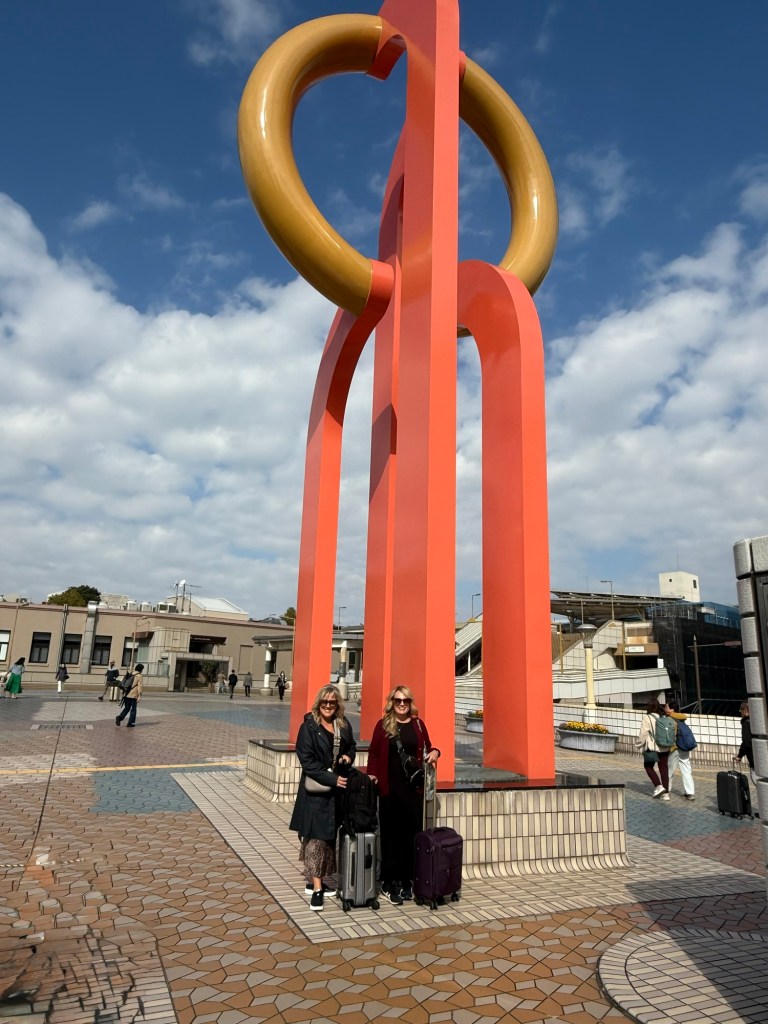
The day began at Ueno Station (Tokyo), where we boarded the train for a scenic two-hour ride across the island and through the Japanese countryside. The changing landscapes, with lush greenery and quaint villages, set the perfect tone for our soon-to-be adventure.
The city of Korube in the Toyama Prefecture is home to the Korube Gorge, important Dams, and the Unazuki Onsen, a natural hot springs resort.
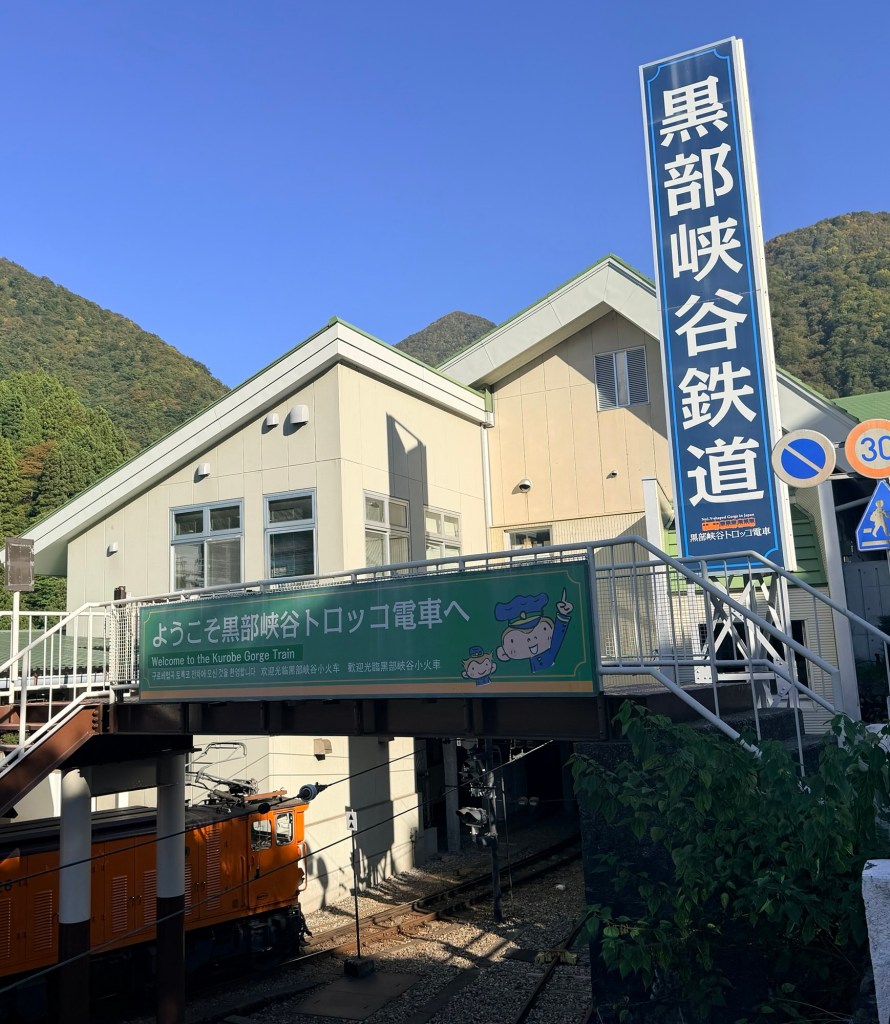
One of our friends met us at the Kurobe station and carted us away to our first stop—Kurobe Gorge Trolley Train tour. The starting point for this ~2 hour round trip tour is Unazuki Onsen, a charming hot spring town. Due to an earthquake in 2024, the trolley train goes as far as Nekomata station (fun fact—this station is the only one in Japan with a “neko”/cat in its name).
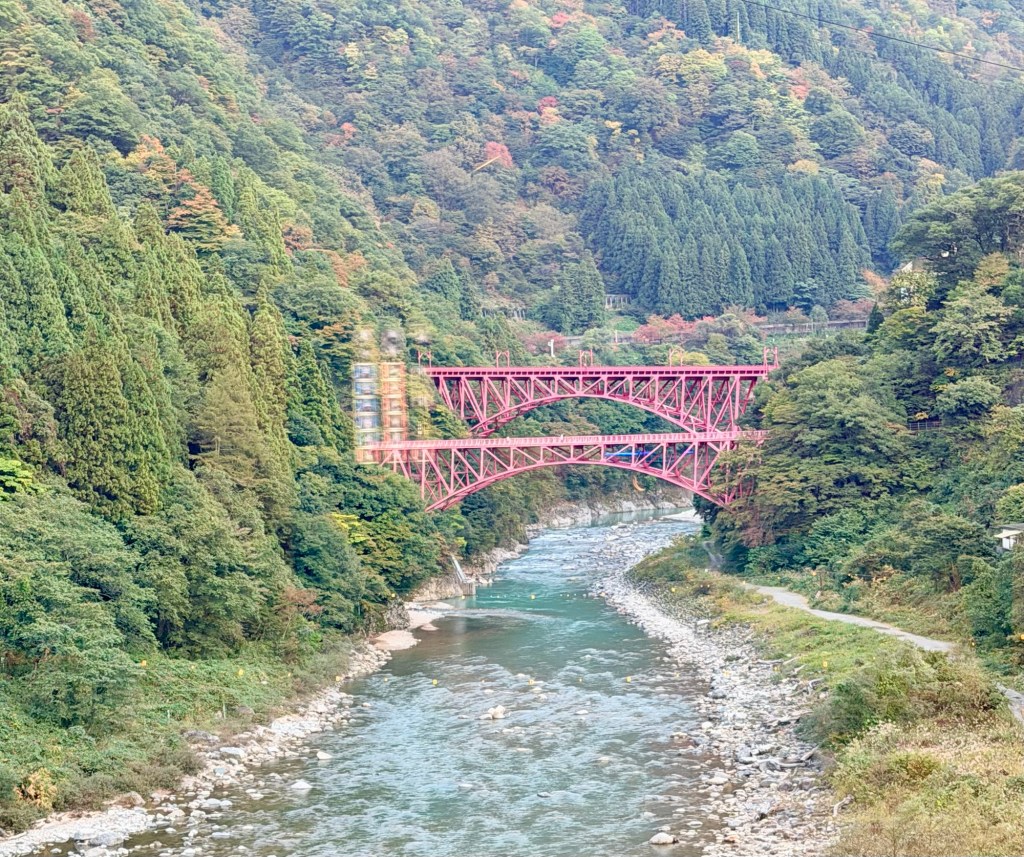
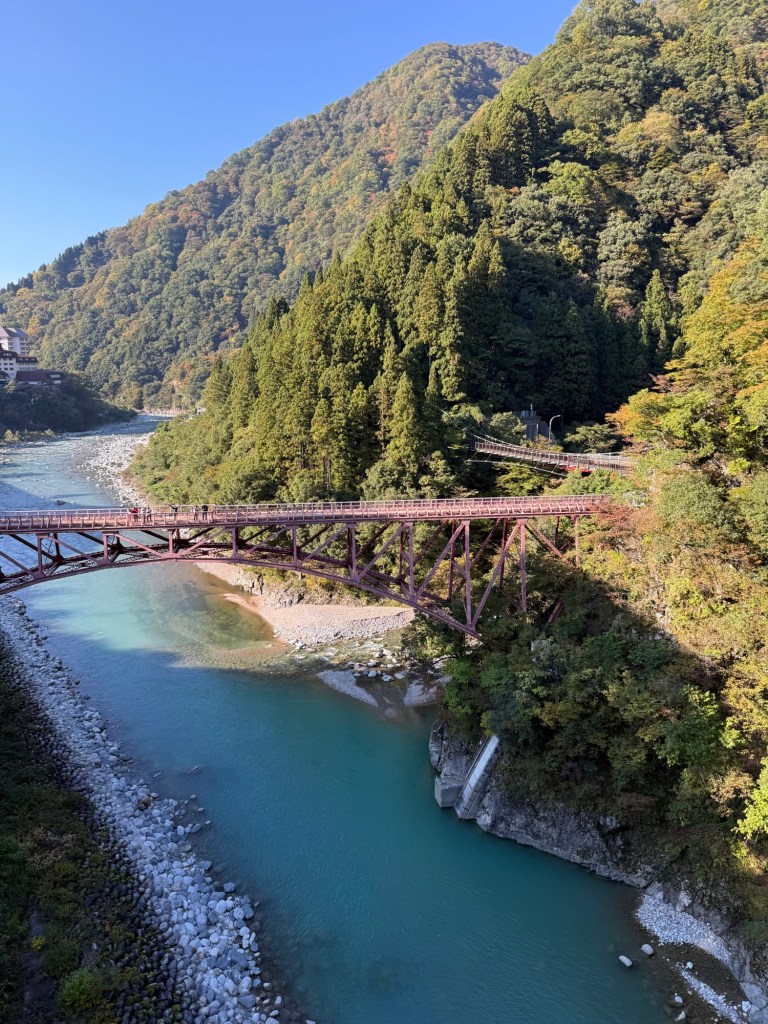
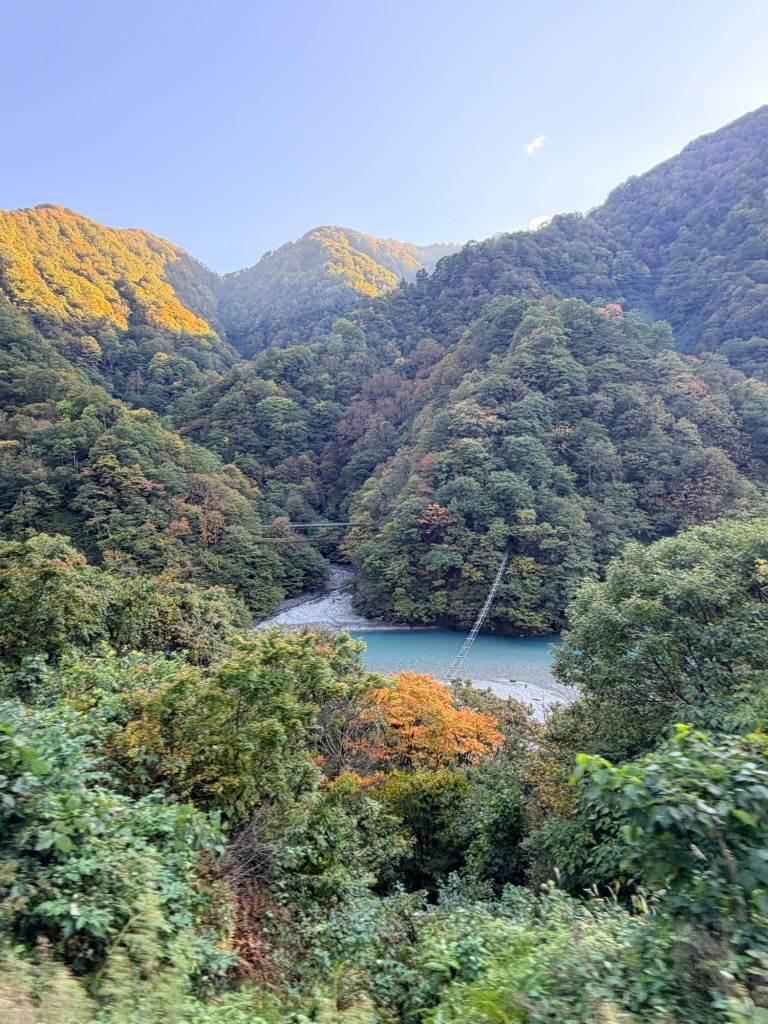
The Trolley Train took us on a scenic journey through beautiful gorges, deep valleys, and snow capped mountains, showcasing the dramatic beauty of the area. The leaves are just starting to change—another week and the colors will peek. The views were breathtaking and each picture was postcard-worthy.
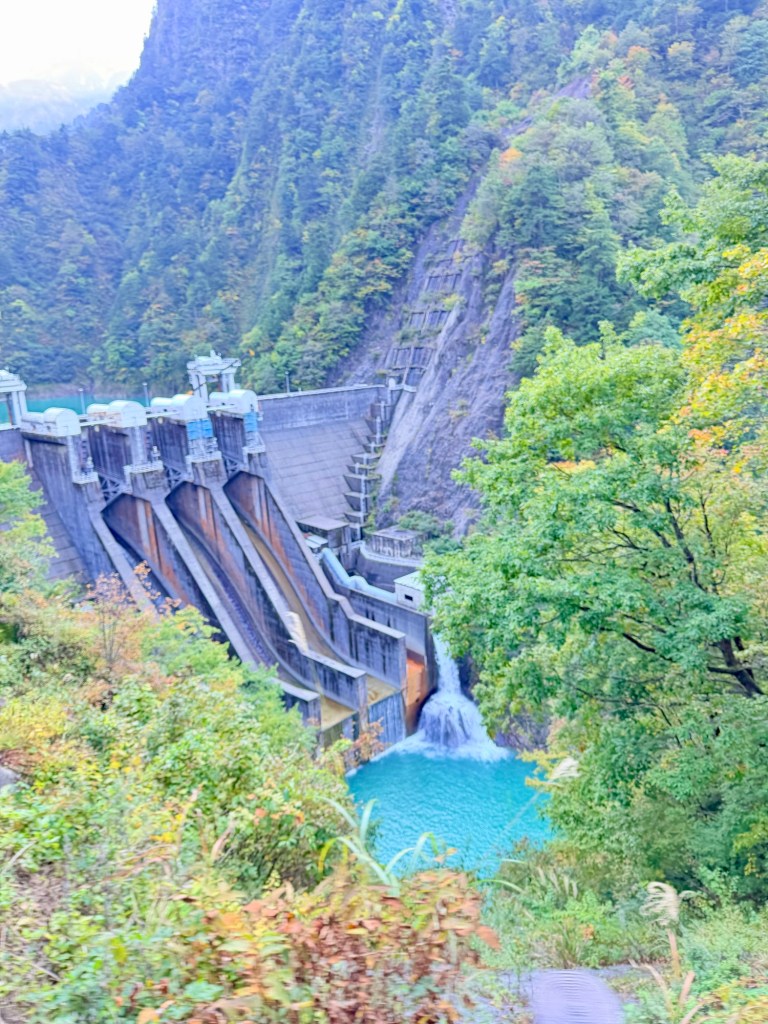
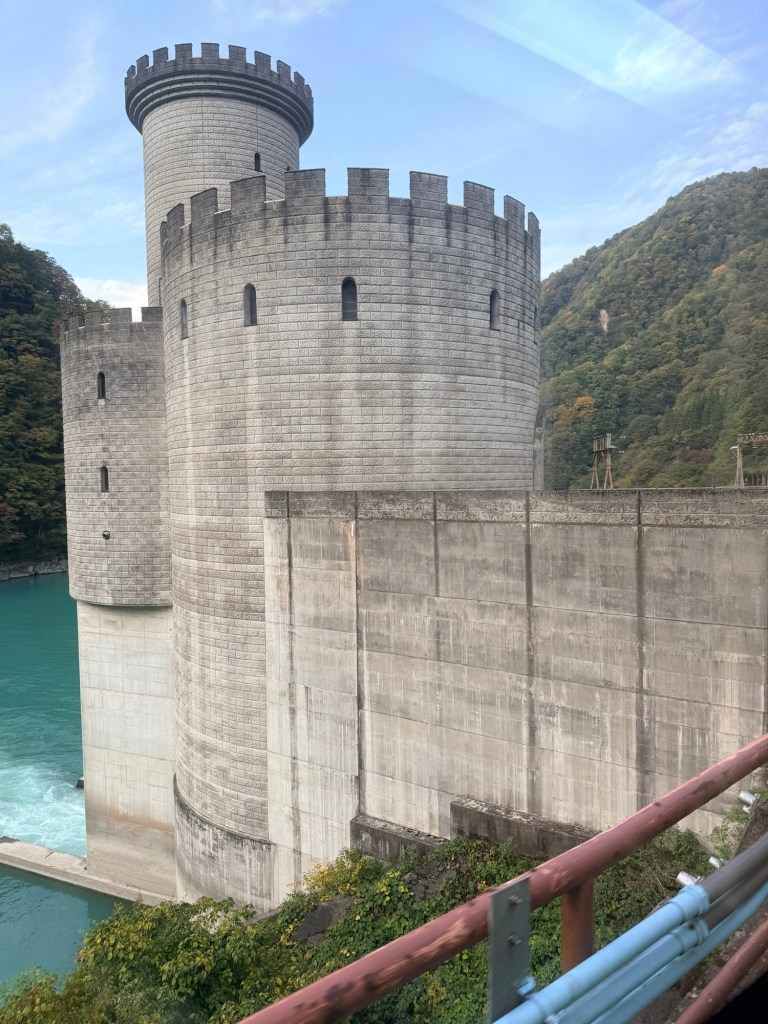
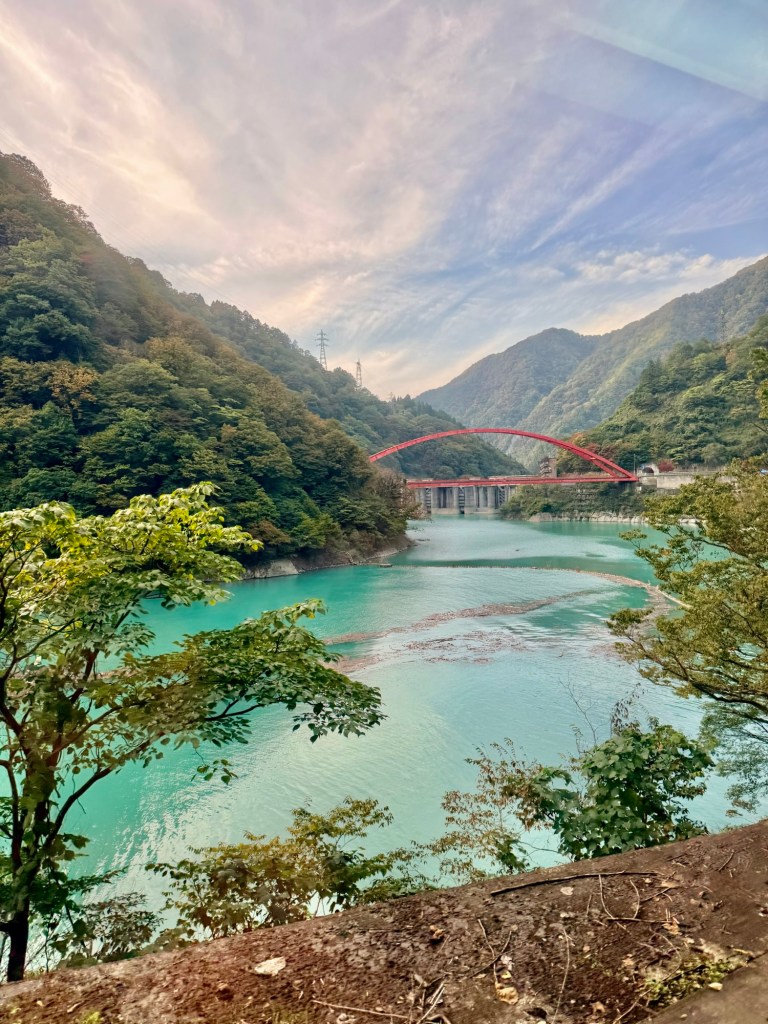
Dashidaira DamThe leaves 🍁 are starting to change colors.Train with a view! The Shin-Yamabiko (Mountain Echo Tree Spirit) BridgeKurobe Gorge is Japan’s deepest V-shaped gorge. There is a bridge that crosses the gorge that is used solely by monkeys! (There is a nearby town where the monkeys relax in the hot springs).Construction on the railway began in 1923 and completed in 1937. Sightseeing began in 1953…and today the trolley is nicknamed the “Torokko Electric Train”The Yanagibashi Station Shin-Yanagawara Power PlantIn 💚 with the trees!View of the Lake Unazuki – Komen Bridge from our hotel lobby. Yes, the water really is that green due to due to blue-green algae.
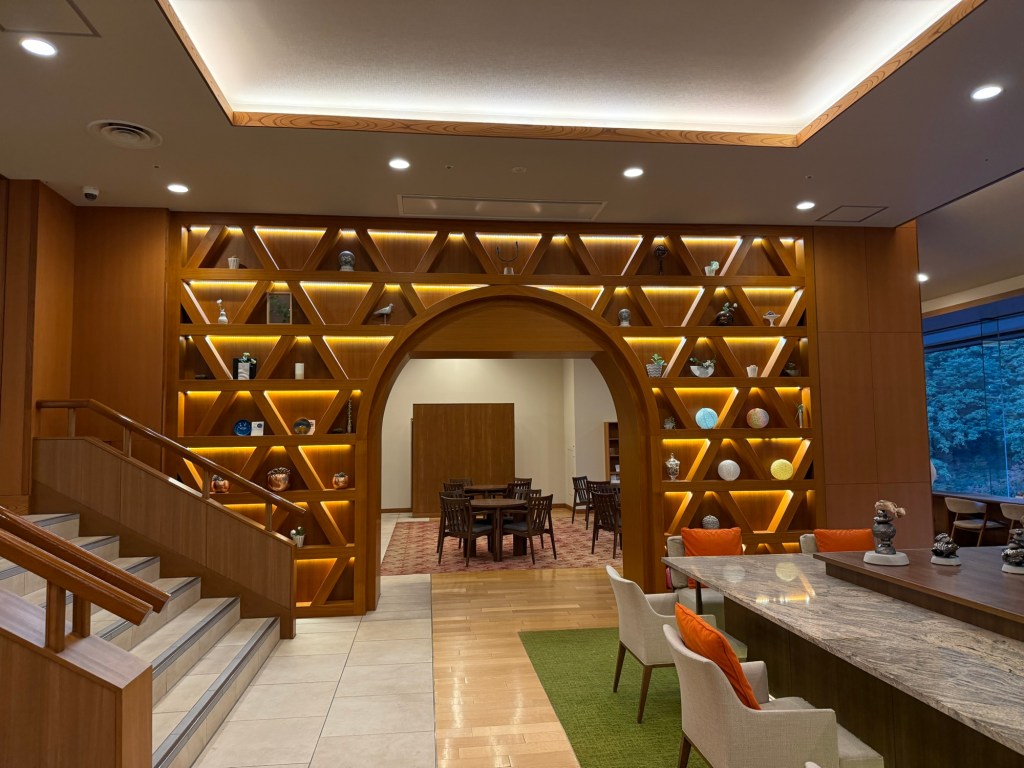
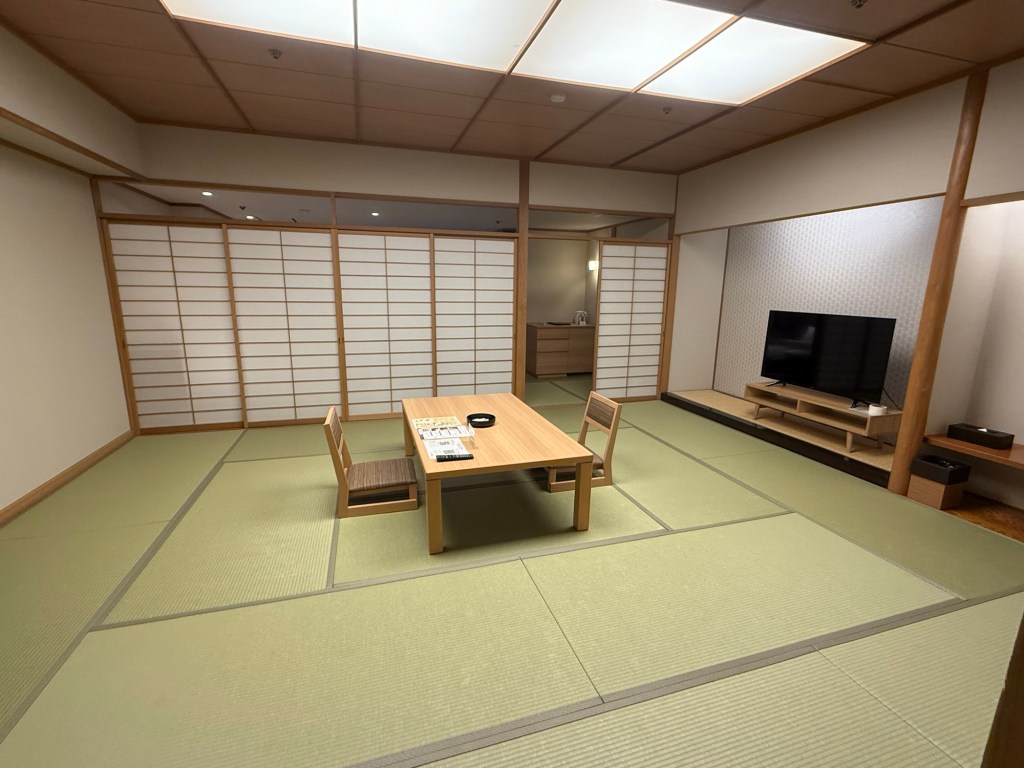
After the train ride, we checked into our charming hotel, Unazuki Yamanoha. The traditional Japanese style rooms and ambiance made me feel part of the culture.
The lobby of the Unazuki Yamanoha Hotel Our bedroom
As the evening approached, I was eager to experience something quintessentially Japanese: an onsen. So, I slipped into my yukata (like a robe only better!) and made my way to the female side of the onsen. Relaxing in the natural hot spring baths was blissful as the warm waters eased the tension in my tired legs and provided a moment of true peace as we gazed at the mountains. And yes, you are wearing your birthday suit in the water. (Tattoos must be covered, if even allowed, and we washed thoroughly before entering the water.)
Dinner was next on the agenda, and I was excited to indulge in local cuisine—still wearing my yukata! The hotel buffet featured fresh seafood and seasonal produce, and rice that Toyama is famous for.
To cap off this incredible day, I treated myself to a 90-minute massage in the traditional Japanese style (fully clothed in my yukata). It was an experience I would highly recommend.
Stay tuned for more adventures in this beautiful part of Japan! I am too relaxed (and exhausted😴) to write anymore tonight.
When my friend asked me where I wanted to go in Japan, Hiroshima was at the top of the list. In my view, it’s essential to remember the past in order to learn from it and shape a better future.
After we returned from Miyajima Island, we headed for a special lunch. I am gluten-free plus I cannot eat seafood due to an allergy. It takes some work to avoid both in Japan but my friend had me covered. She found the one Okonomiyaki restaurant in Hiroshima that can make it gluten free! Ken-San, the chef, has a wheat allergy as well. He even wears a mask when cooking so he doesn’t breathe in all the wheat.
Gluten free Okonomiyaki
I love Okonomiyaki and miss it terribly since I went gluten free. Ken-San used a separate pan and rice flour instead of wheat flour. He even shared stories (translating via our phones) about his family. His mother is a A-Bomb survivor. She was 9 when the bomb was dropped but she was protected by the side of the mountain. However, she has an auto immune disease that makes moving very painful. Her disease was caused by the after effects of the radiation.
FYI- Okonomiyaki is a Japanese teppanyaki pancake-like dish consisting of wheat flour batter and other ingredients (cabbage, meat, seafood) mixed in and cooked on flat griddle. It’s served with a special sauce.
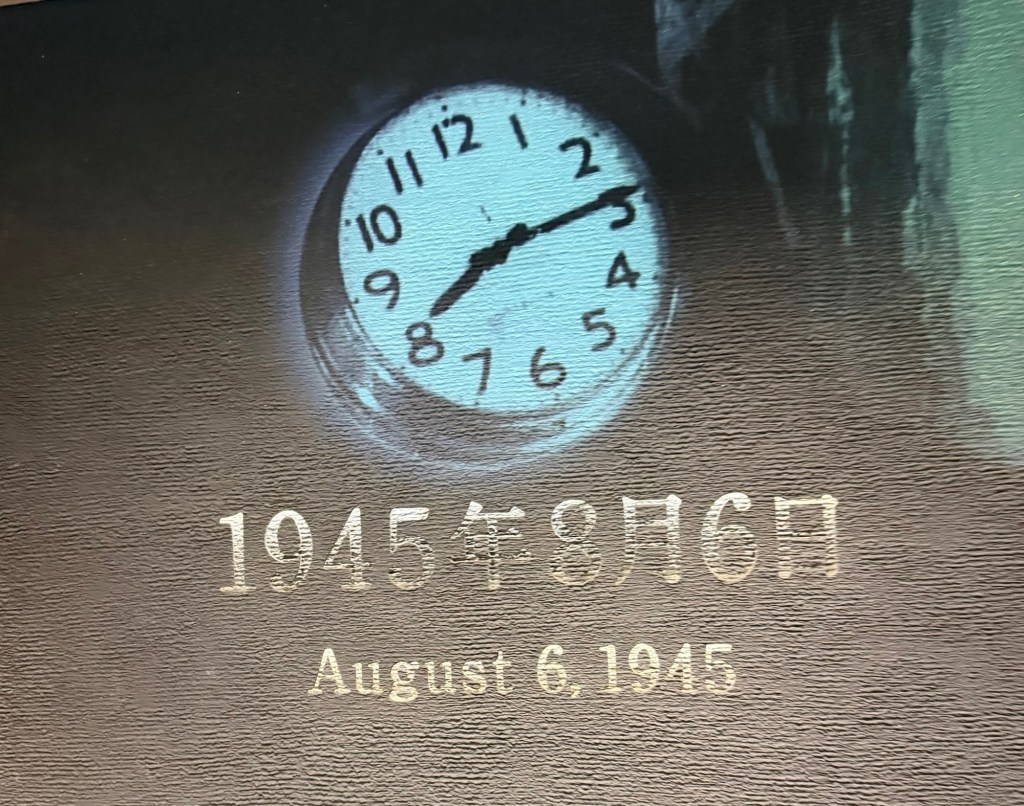
After lunch we visited the Hiroshima Peace Memorial Museum. If you visit Hiroshima, I can’t stress enough how important it is to experience this museum. Before entering, there is a sign for parents and teachers, encouraging them to prepare children for the exhibits. Adults—take that same advice and prepare yourselves. It is informative, moving, and, at times, very difficult to digest, but the museum is essential for understanding the full impact of the atomic bombing on August 6, 1945. Artifacts from the time (including children’s clothing), personal stories of survivors, and detailed historical accounts bring the past to life in a way that is both heartbreaking and eye-opening. When the bomb was dropped, 200,000+ people perished that day or after due to radiation exposure. Some died years later from diseases caused by the bomb. Ken-San recommended a Japanese documentary called Silent Fallout and talked about how we were all victims of the atomic bomb—including those in the USA. We know this first hand due to Cold Water Creek where I grew up in Florissant, Missouri.
Next we went to the Hiroshima Peace Memorial Park. This beautiful park is dedicated to the memory of the lives lost during the atomic bombing on August 6, 1945.
Hiroshima Peace Memorial Park – The Cenotaph for A-bomb victims contains the names of those who perished and symbolizes a resting place for their souls.The Hiroshima Flame or the Peace Flame represents the spirits of the victims of the atomic bombing and hope for world peace. The eternal flame is intended to stay lit until all nuclear weapons are abolished.Monument to the Victims of the Atomic Bombing – This memorial pays tribute to those who lost their lives.Children’s Peace Monument honors the memory of the children who died as a result of the bombing. There is a statue of Sadako Sasaki, a young girl who developed leukemia due to radiation exposure. Her story is featured in the museum. The monument is surrounded by colorful origami cranes folded by children from around the world.
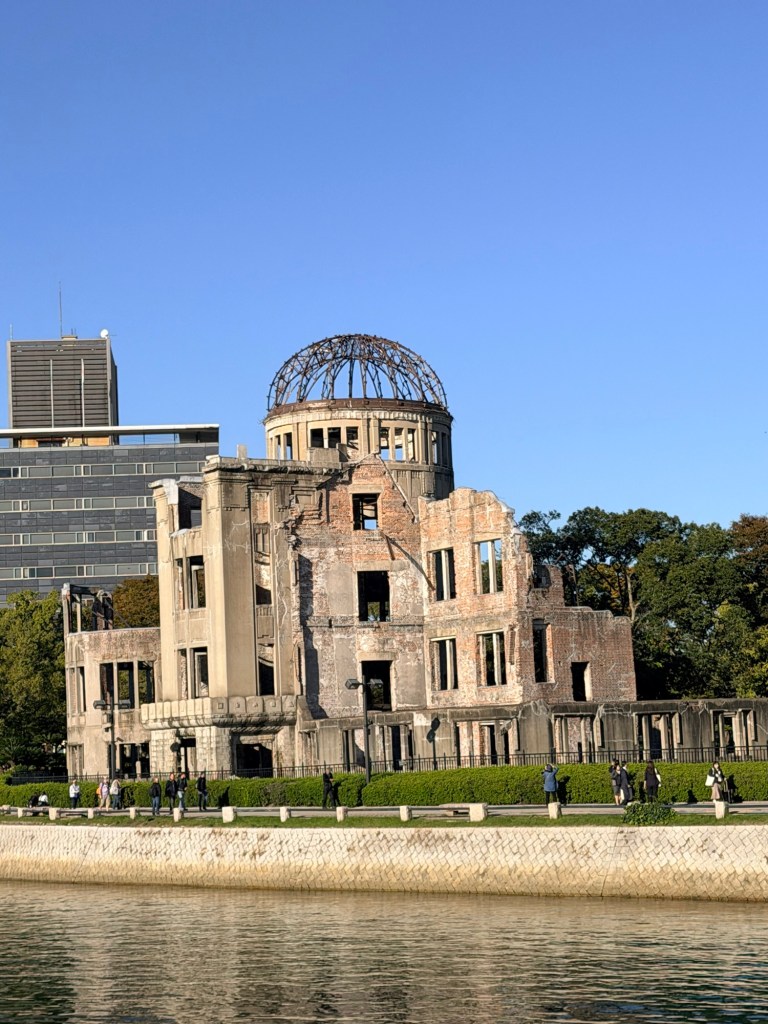
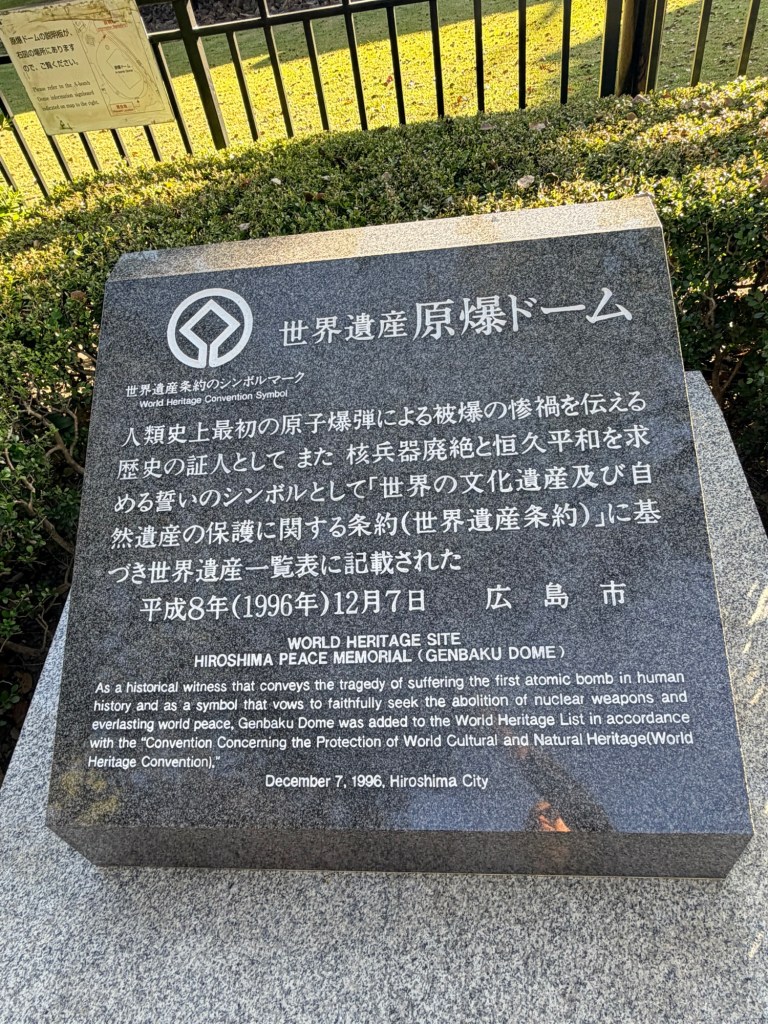
The focal point of the park is the Atomic Bomb Dome, which stands as a haunting reminder of the destruction the bomb brought to the people of Hiroshima. It is a UNESCO World Heritage Site and one of the few structures that partially survived the atomic bombing. Built in 1915 as the Hiroshima Prefectural Industrial Promotion Hall, it was a symbol of Hiroshima’s industrial and cultural life. On that fateful day, the bomb exploded approximately 600 meters (1,968 feet) above the dome, making it one of the few buildings close to the hypocenter that remained standing.
The Atomic Bomb Dome is a powerful symbol of remembrance and peace.
Atomic Bomb Dome was preserved as a memorial to the victims of the bombing. It represents the horror of nuclear weapons and the resilience of the human spirit.
We all felt the weight of history pressing down as we moved through the memorials. While the people of Hiroshima continue to inspire hope, it’s up to all of us to advocate for a world without war.
From Himeji we made our way to Hiroshima via the bullet train and checked into the Grand Intelligence Hotel near the station. After a bite to eat at a popular restaurant called Caffe Ponte, and ice cream cones 🍦 that put all other ice cream cones to shame, we fell into bed!
Caffe Ponte in Hiroshima🍊🍋 where they have a gluten free menu!Yes, they were as good as they look!🍦 Chocolate ice cream and lemon sorbet.
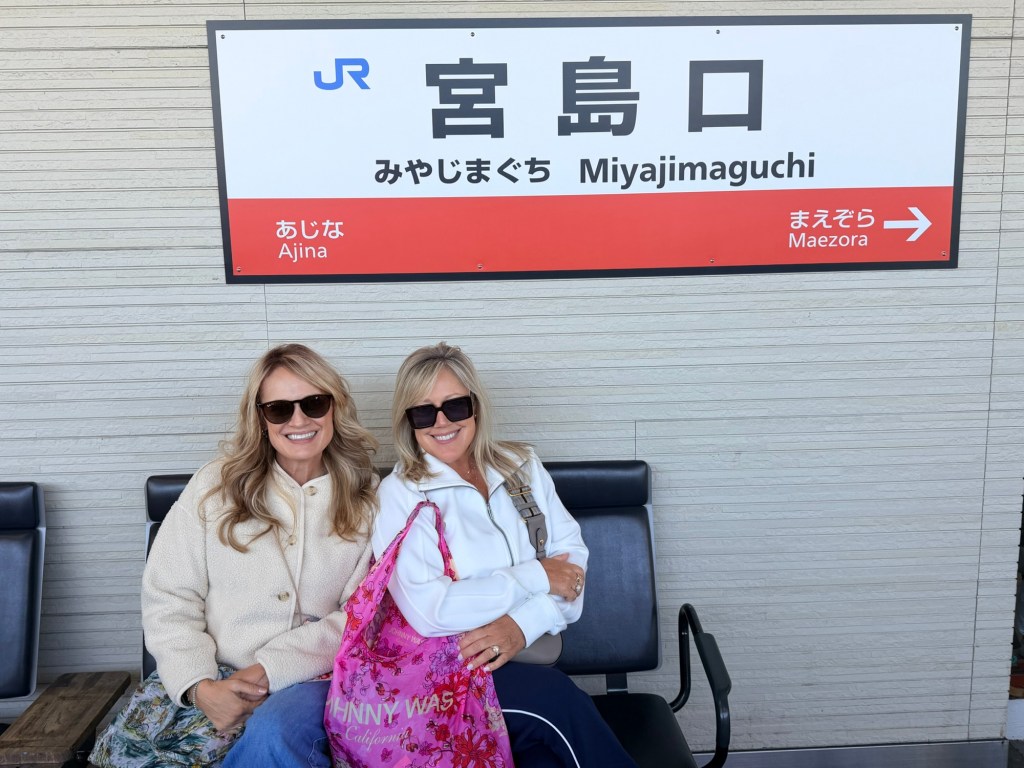
We were ready to go by 8:00 am, taking the train to the ferry station for the short ride to Miyajima Island.
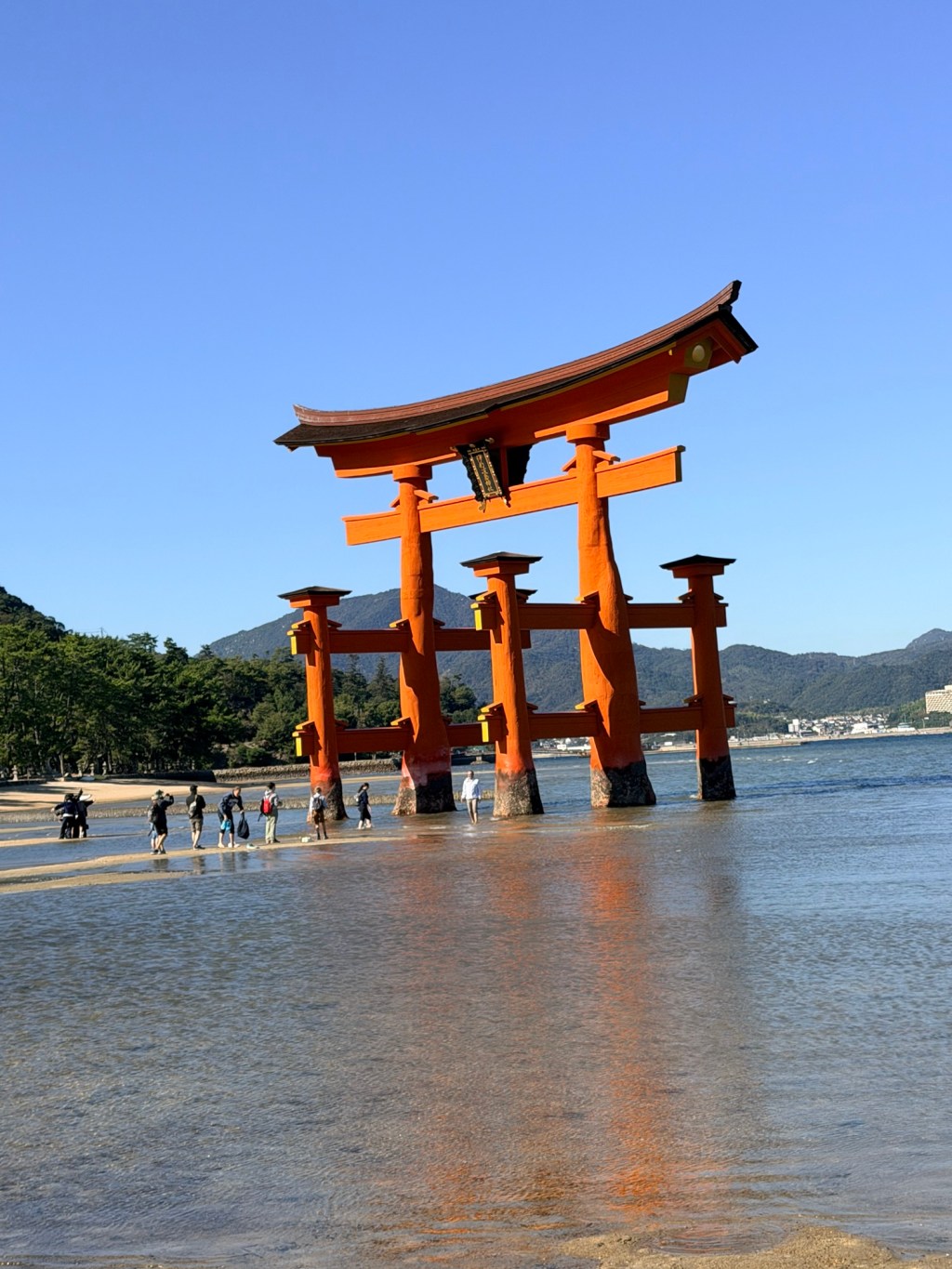
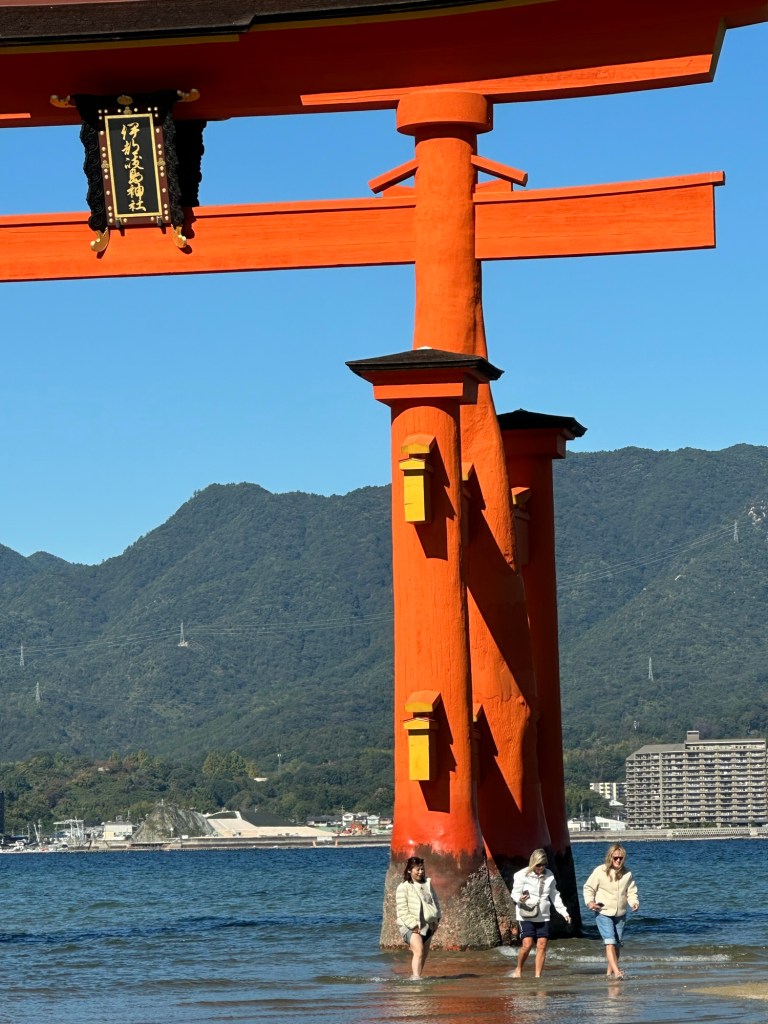
I don’t know how this trip could get any better…but it just did. As we approached, the famous floating Torii Gate of Itsukushima Shrine came into view. During high tide it appears to float on the water, during low tide, roll up your pants and walk out to touch it (we did!)
The floating torii gate of Miyajima is known as the Otorii. It’s approximately 16 meters tall (52 feet) and was originally built in 1168. Otorii represents the transition between the physical and spiritual worlds in Shinto belief. Mount Misen is the highest peak on Miyajima Island, standing at 1,755 feet, with a history of pilgrimage dating back centuries. The mountain is sacred in Shinto belief. ⛰️
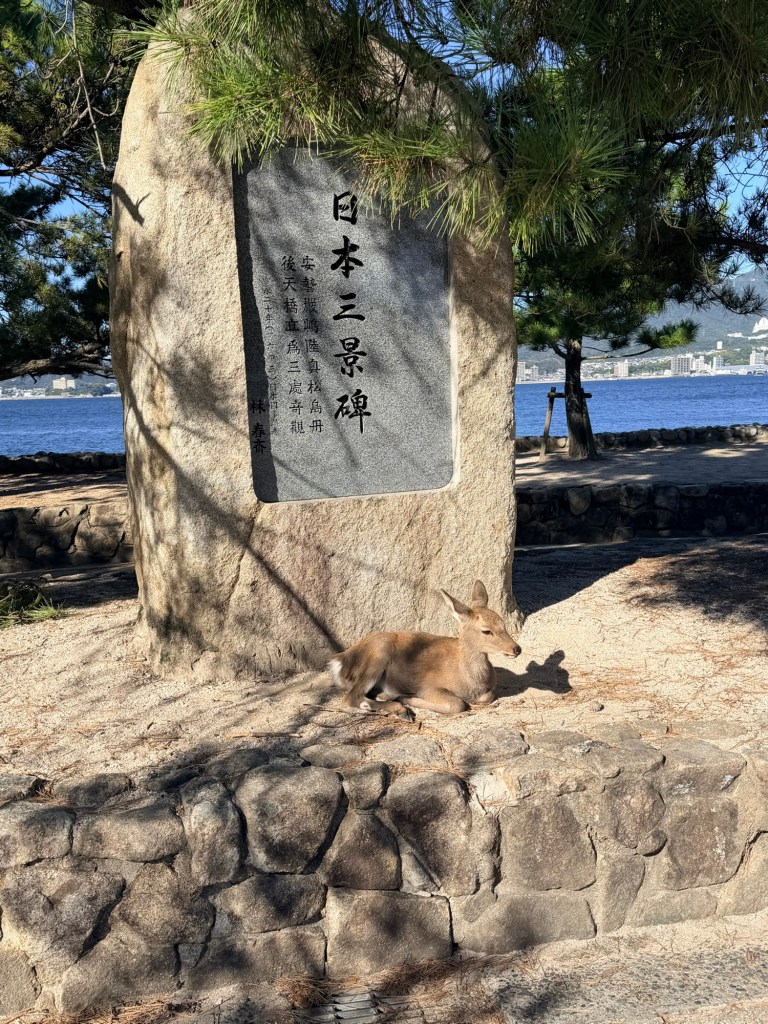
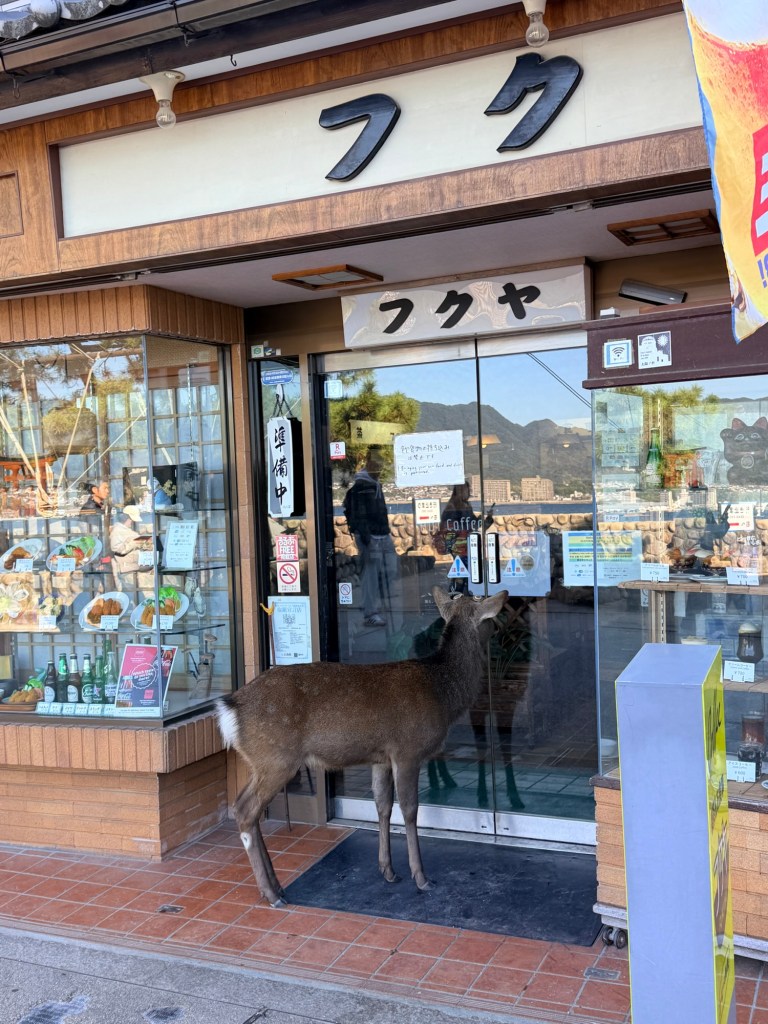
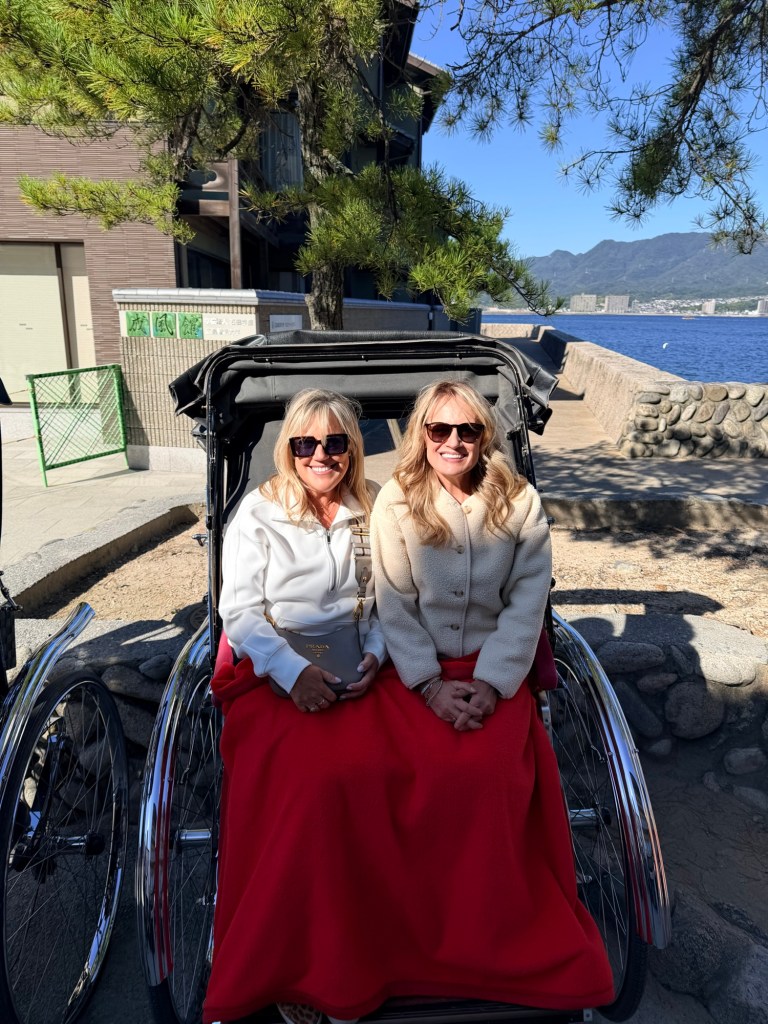
The deer greeted us upon arrival (don’t touch them!) and we hired rickshaw drivers to show us around. Fun experience with our “drivers”, Keigo and Akimu.
The deer on Miyajima Island are a beloved and iconic feature of the landscape that roam freely around Itsukushima Shrine area. They’re friendly yet wild deer (in other words, don’t touch) that are considered sacred and believed to be messengers of the Shinto gods.Window shopping 🦌 Ready for our rickshaw adventure!
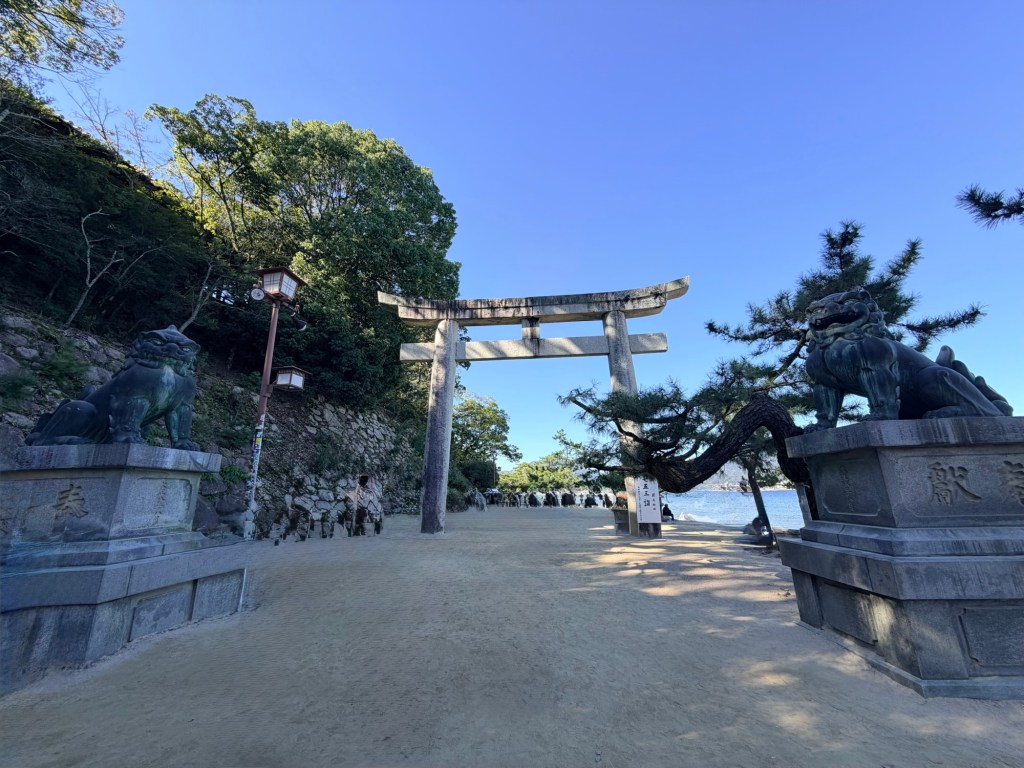
After wading out to touch the torii and take pictures, we high tailed it back to the beach as the tide was starting to rise. We then toured Itsukushima Shrine, a UNESCO World Heritage Site.
Entering Itsukushima Shrine to go touch the floating torii.
Tip: Arrive early during low tide to touch the torii! By the time we were touched it, we were the only ones left in the sea and the tide was rising quickly.
The floating torii gate has been through several reconstructions over the centuries due to natural disasters like typhoons and earthquakes, as well as wood decay. The current version we saw dates back to 1875, and is maybe the 6th version of the gateWhile fairly shallow this early in the morning, the torii appears to hover above the water during high tide.Touching the torii in the Seto Inland Sea.
Itsukushima Shrine is a UNESCO World Heritage Site. In addition to the iconic floating torii gate, the stunning shrine was originally built in the 6th century and dedicated to the goddess of seas and storms, Benzaiten. Surrounded by a traditional Japanese gardens and set against the backdrop of Mount Misen, Itsukushima Shrine is a unique blend of cultural heritage and natural beauty. The vibrant vermilion structures, exquisite craftsmanship, and picturesque setting made this one of my favorites (I have been saying that a lot!).
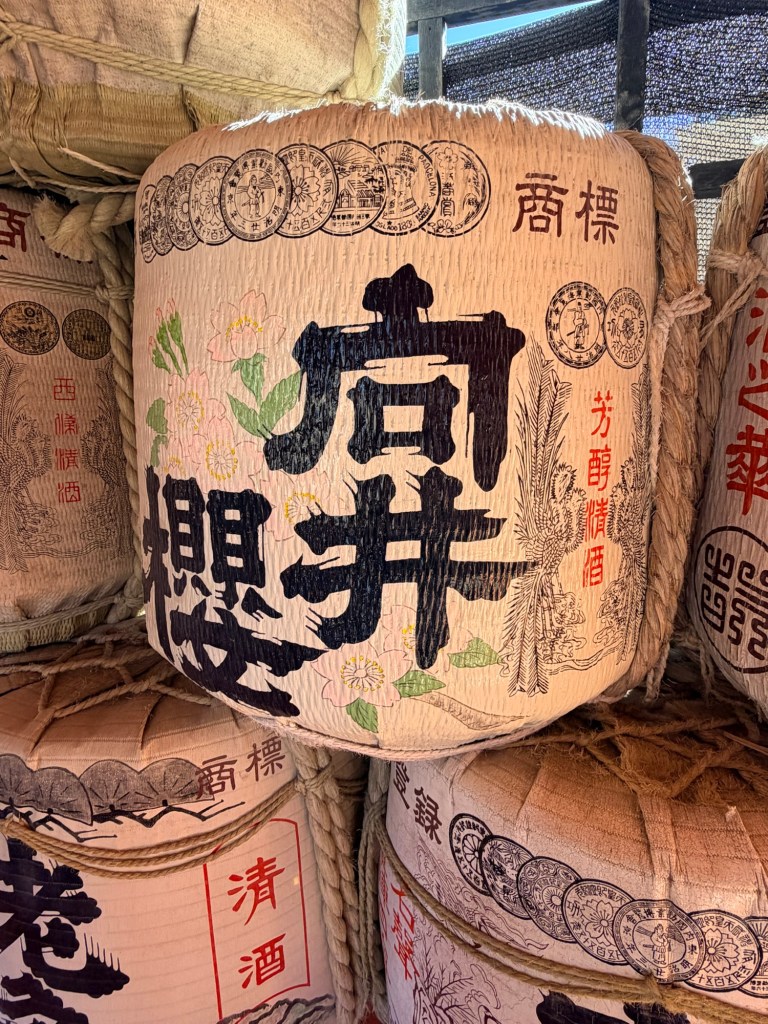
Sake wrapped in straw—a sacred offering to the gods.
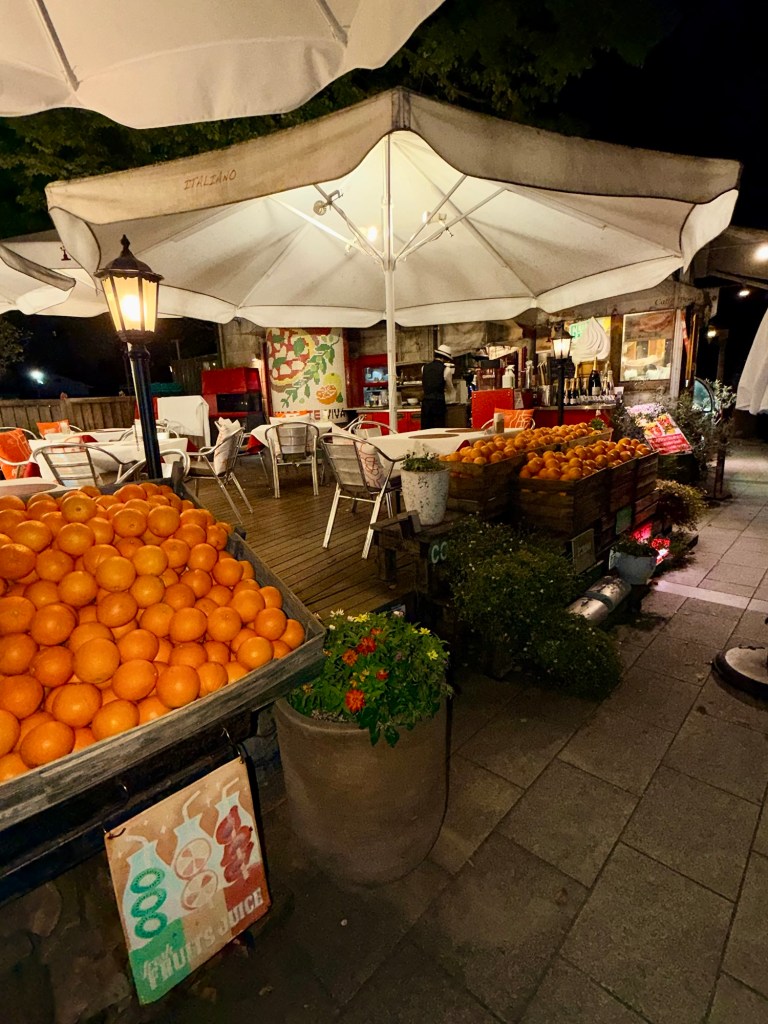
Now, let’s talk about the food! Miyajima is famous for its delicious local specialties, particularly grilled oysters, everything lemon, and momiji manju—maple leaf-shaped cakes 🍁 filled with sweet red bean paste or custard. Strolling through the streets, we found charming vendors selling these treats, along with everything lemon.🍋
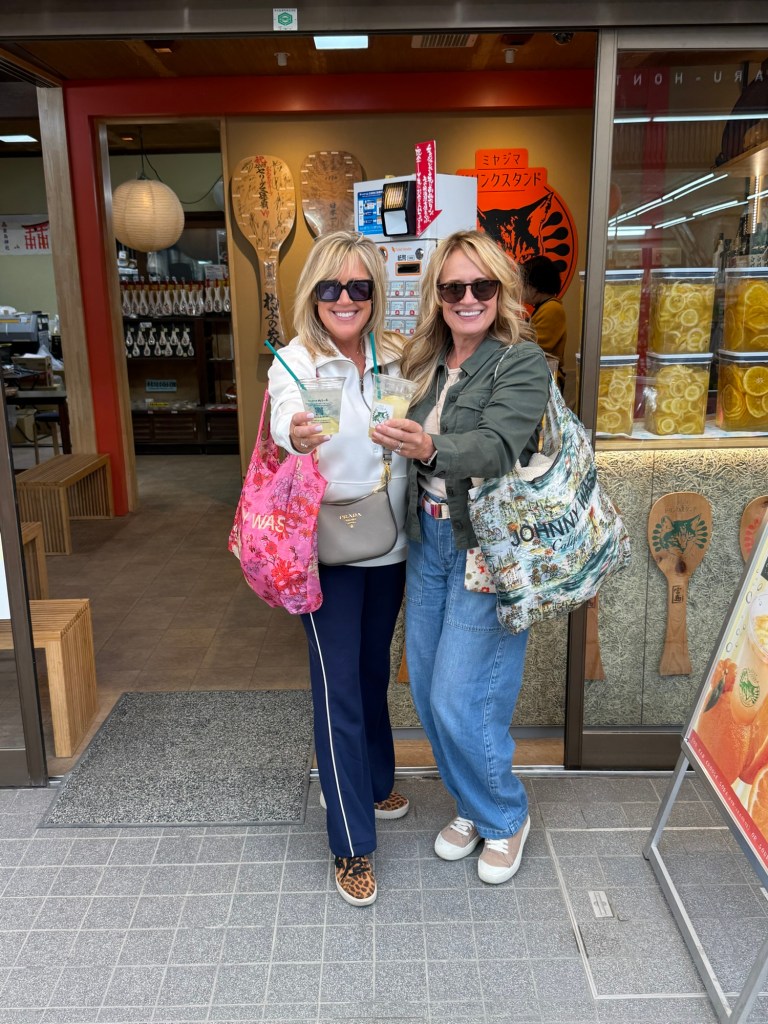
A lemon probiotic drink for me and a lemon sake for Jen! I am already craving another one 🍋
Part 2 in Hiroshima, and a much heavier topic, continues in the next post.
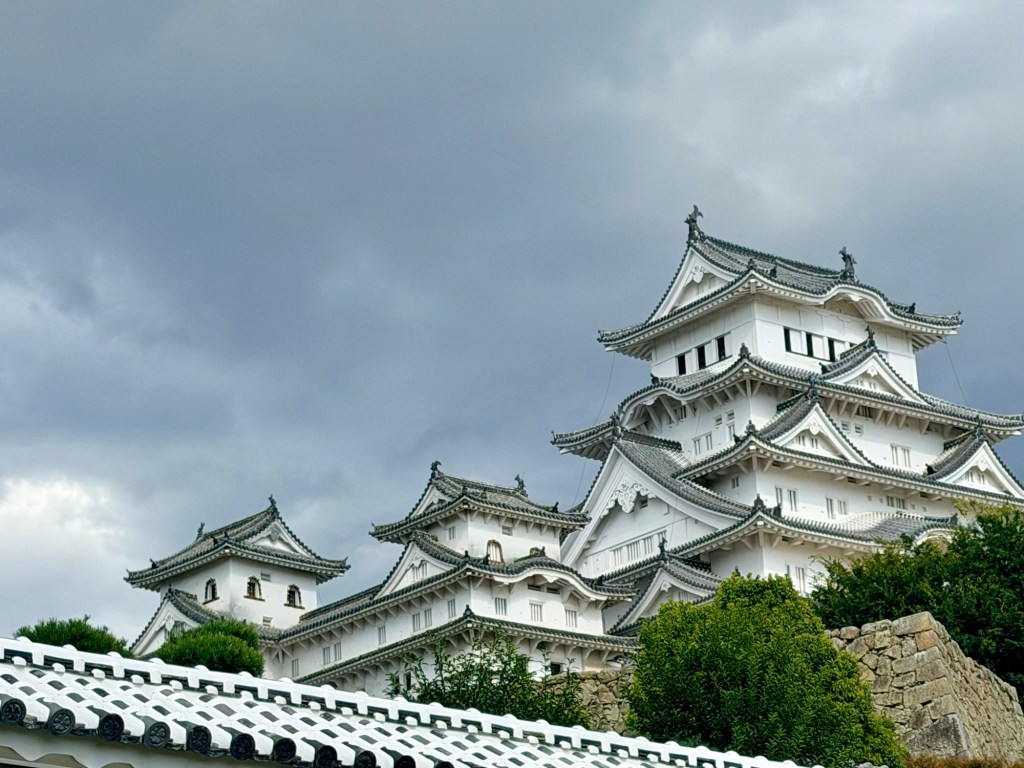
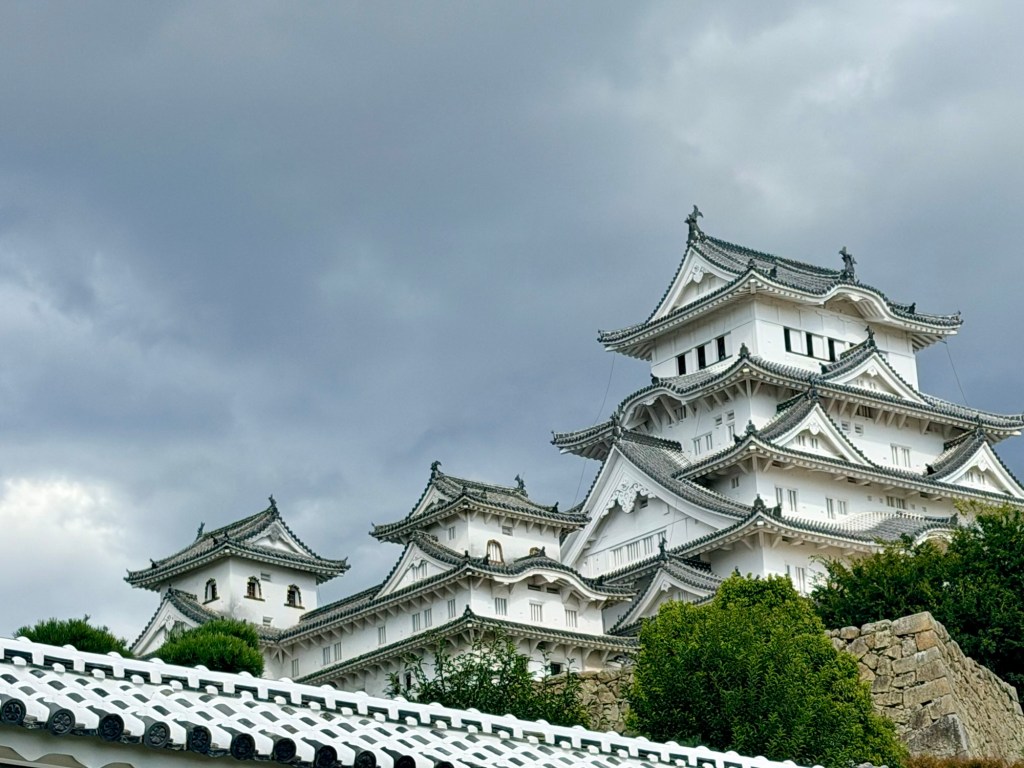
I had never been to the city of Himeji but my Japanese friend said it’s a must. She was right—it’s an absolute must! Tucked away in this charming city is a stunning fortress and UNESCO World Heritage Site that is steeped in history and magic, making it one of my favorite places to see. Let me tell you a fairy tale that is Himeji Castle!
Built a long long time ago (14th century, although disputed) in the far away land of Himeji, where feudal lords roamed the hallways and *Sachihoko protected the castle from fire…
What we see today is mostly from the early 1600s and the castle is nicknamed, “Shirasagi-jo” or “White Heron Castle.” There is a definite WOW factor with the white plaster exterior making it look like a heron gracefully taking flight!
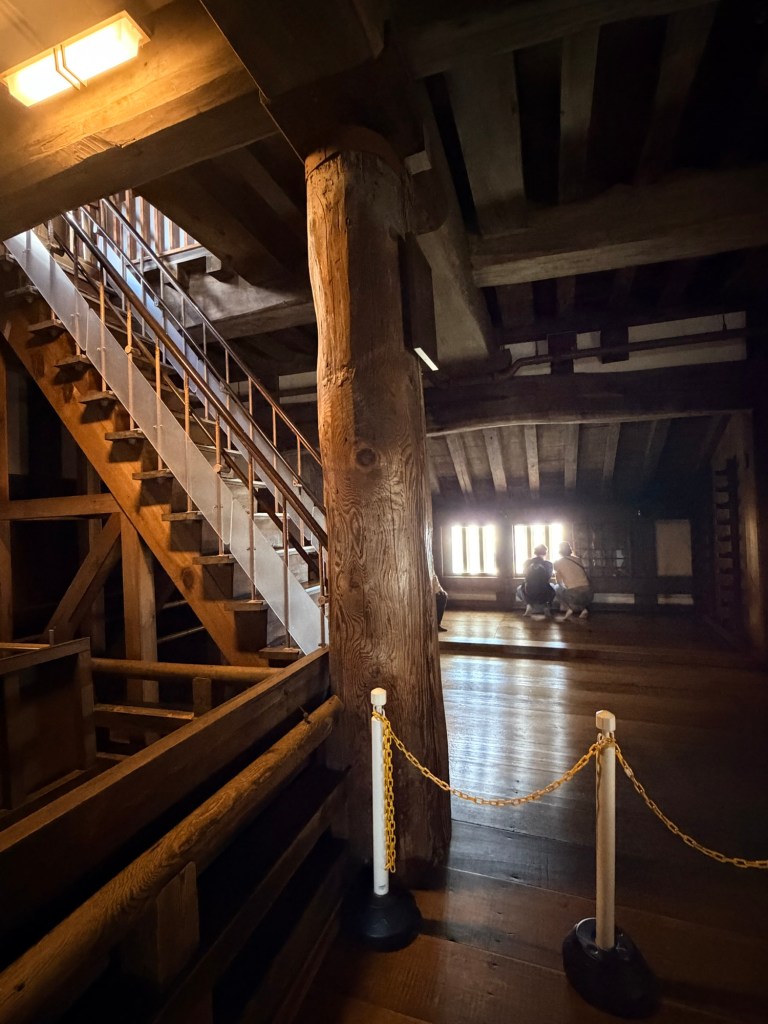
There are some 80 buildings within the castle complex, linked by winding paths and gates. We actually climbed to the top of the main keep exploring each floor and it’s original use along the way. There are even some ghost stories to shiver at! FYI, be prepared to take off your shoes and those steps are steep!
For the guns and spears
The views are nothing short of breathtaking and the Nishinomaru Garden surrounding Himeji Castle is enchanting.
Travel there: We took the JR line from Kyoto and walked down the main street, looking at the castle the entire time. Seriously, you can’t get lost. The only “lost” you’re going to get is in the beauty of this fairy tail castle!
The end.🧚
*Sachihoko = mythical Japanese creatures that have the head of a tiger and the body of a carp fish. They were used as roof ornaments on castles like Himeji to protect them from fire 🔥.
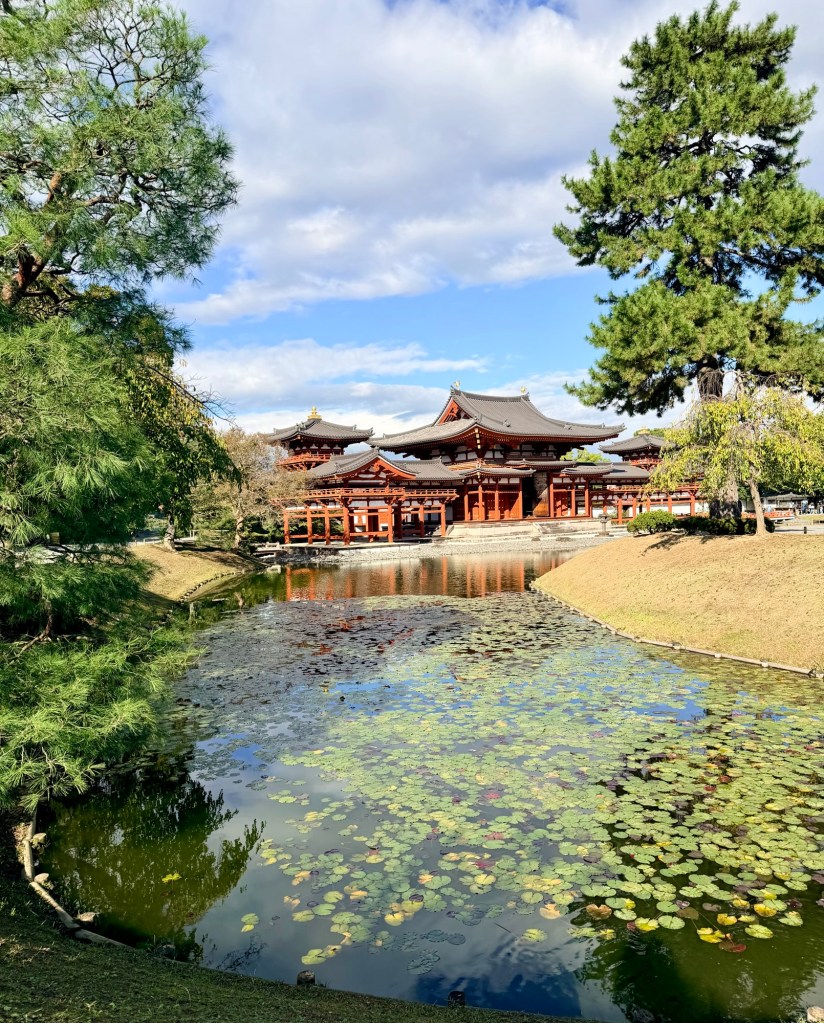
Just a short train 🚄 ride from Kyoto, then a 10 minute peaceful stroll through a neighborhood, and voila—you will find Byōdō-in, a Buddhist temple built in the late Heian period. It’s another UNESCO World Heritage Site, originally built in 998 as a temple for the powerful Fujiwara clan.
This!!!🧡
The stunning Phoenix Hall (Hoo-do) was constructed later in 1053 to serve as a mausoleum for Fujiwara no Yorimichi. It’s considered a National Treasure and adorned with exquisite carvings and gold leaf accents. This hall is shaped like a phoenix, symbolizing rebirth and eternity. We admired the hall from across the pond and could see the Amida Buddha statue, which stands over 3 meters tall (close to 10 feet). Although we were too early to go inside, they say it is surrounded by beautiful murals.
To say this is an architectural marvel is an understatement. The design, the intricate artwork, the serene gardens…it all works together and the result is stunning. Over the centuries, Byōdō-in has survived fires and disasters. It is so important, it can be found on the 10 yen coin.
Don’t miss Byōdō-in if you go to Kyoto…you will never regret your visit.
Also, on the short walk back to the train station, grab a drink at the most serene Starbucks I have ever been to!
The gardens at the Uji Starbucks
Note—here is where we stayed in Kyoto: Via Inn – Loved all facial products they set out for their guests to use!
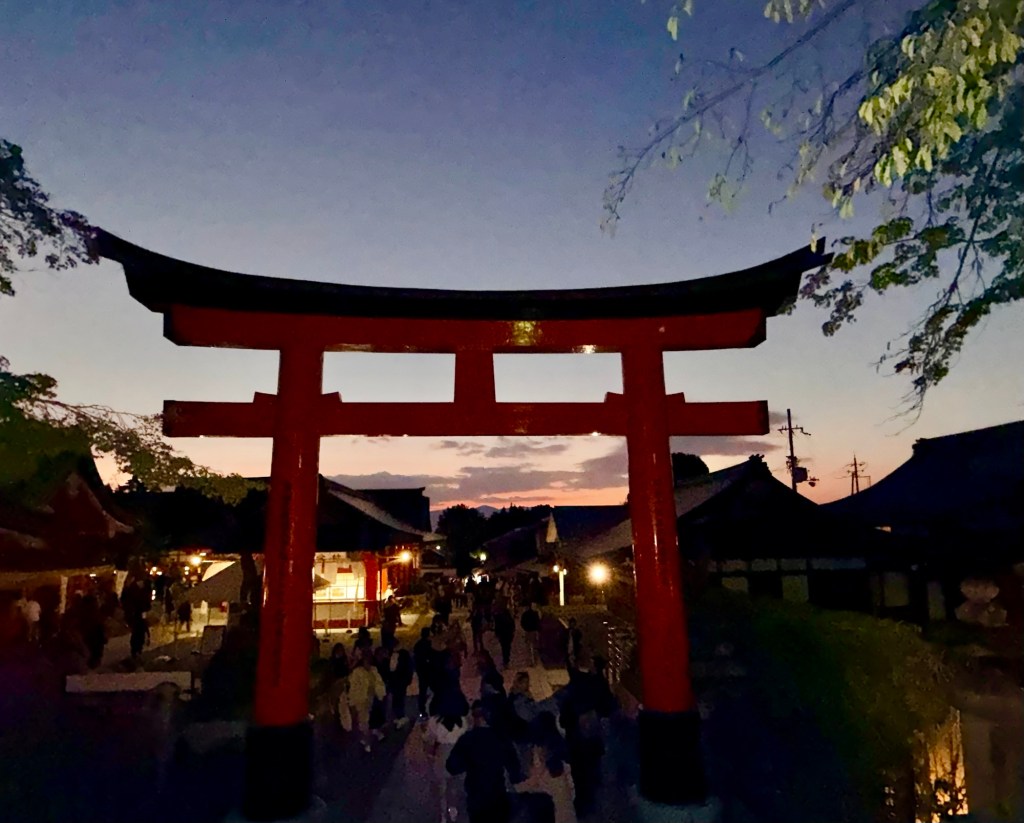
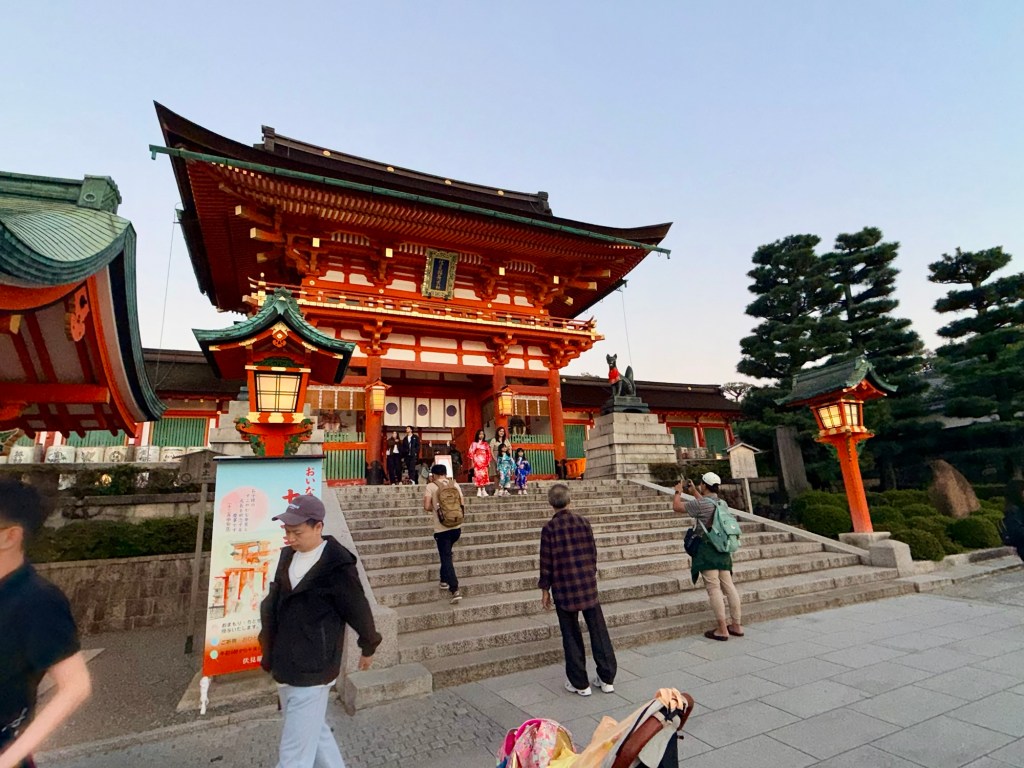
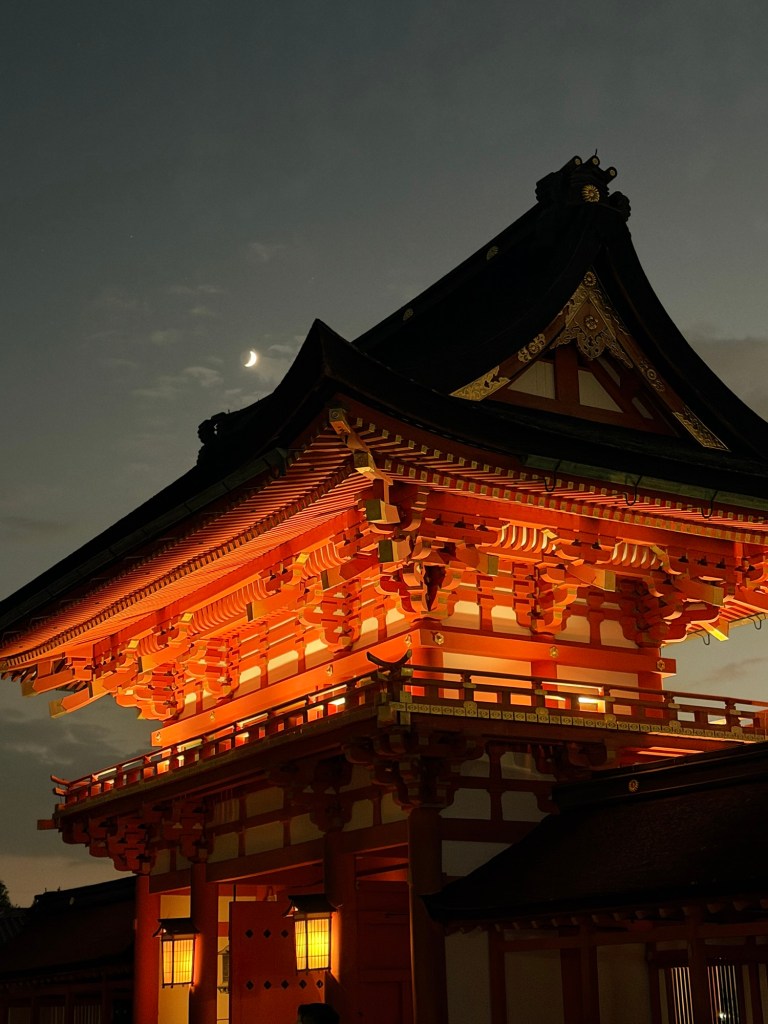
We visited Fushimi Inari Taisha early evening and we stayed for the sun set, adding a mystical element to our visit.
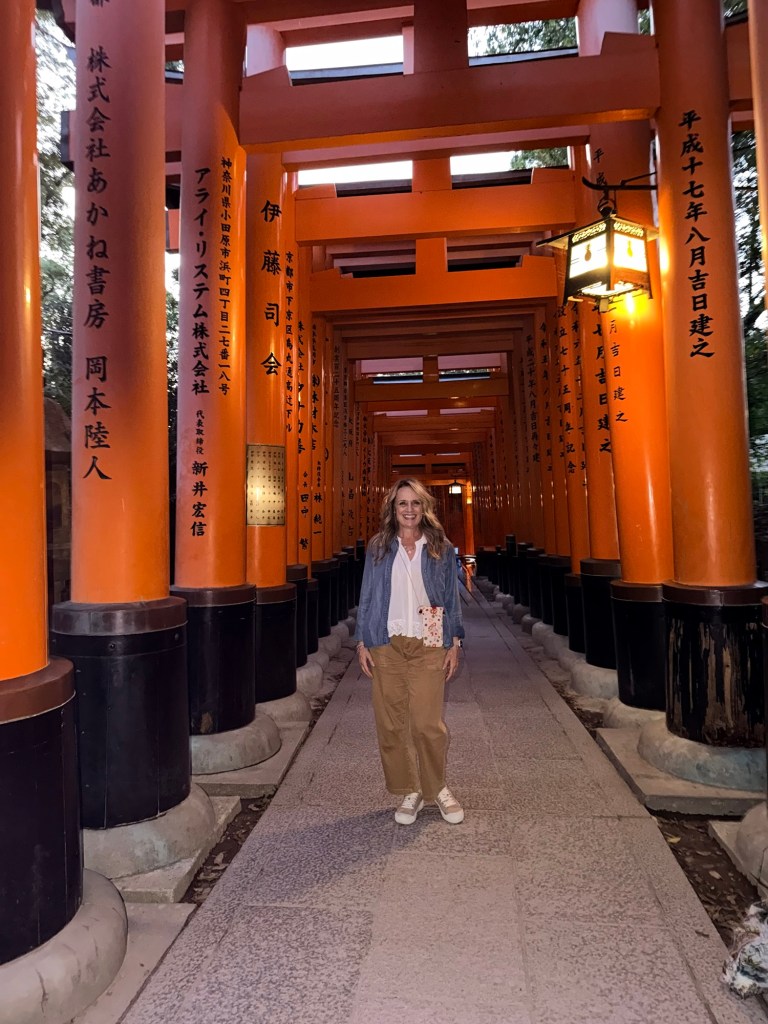
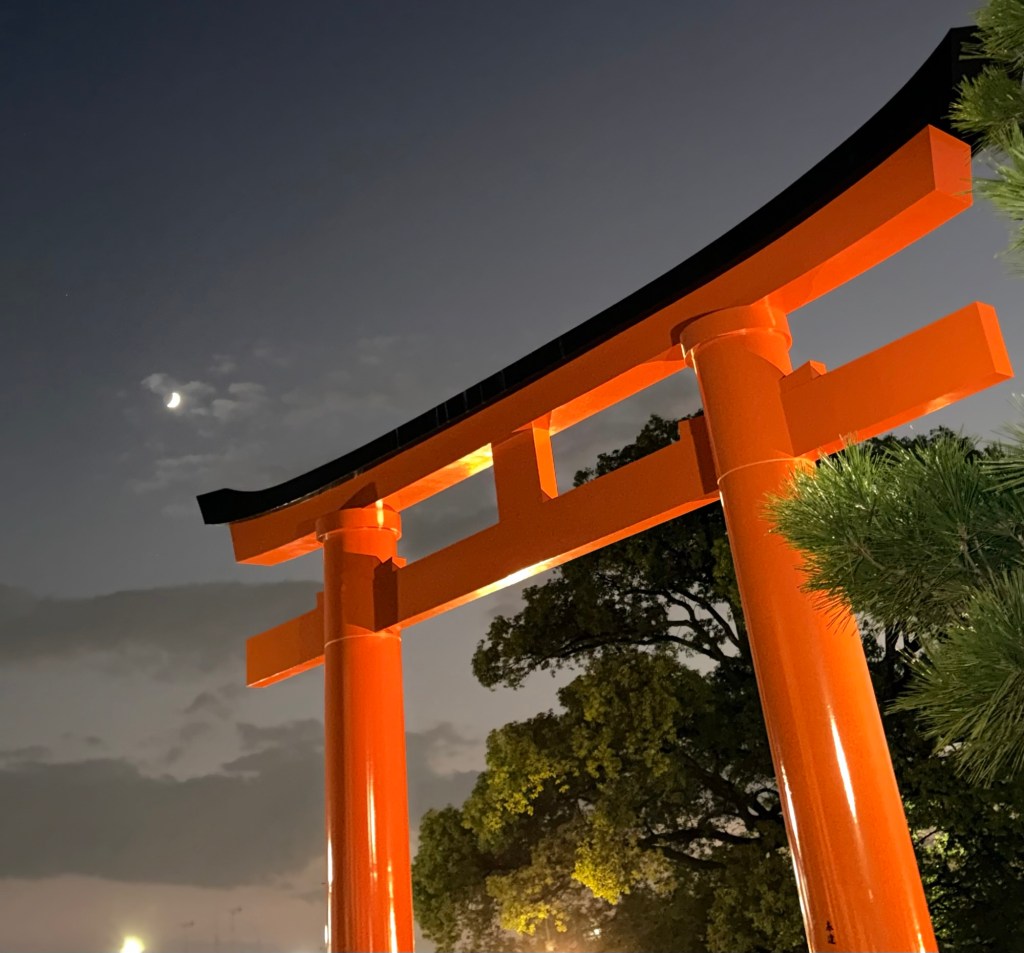
At the base of Mount Inari in Kyoto, Fushimi Inari Taisha is a visually striking Shinto shrine with thousands of vermilion torii gates donated by individuals and businesses seeking blessings for wealth and success. The shrine is dedicated to Inari, the Shinto god of rice, agriculture, and prosperity and dates back to 711 AD.
We didn’t have time to walk the entire 2 hour path up the mountain, although it’s open 24/7 (Kayoko said there are bears) but we did journey through a tunnel of hundreds of the vibrant orange torii gates, each inscribed with the name of the donor and the date of the donation. Next time we will explore more of the trails through the forest.
The complex is expansive and we encountered various smaller shrines, stone fox statues (messengers of Inari), and breathtaking views of Kyoto as the sun went down, a finger nail moon came out, and soft golden light illuminated the torii gates and surrounding trees.
There is a deep cultural significance to Fushimi Inari Taisha and we were able to observe the rituals performed by worshippers, such as ringing the shrine bell or making a wish at the main altar (toss a coin in the box, bow 2 times, clap 2 times, pray, and bow). FYI photography is not allowed at the main alter in any of the shrines.
Fushimi Inari Taisha is visually and spiritually unforgettable. I may have walked around for an hour with my jaw dropped in wonder.
Also, make sure to check out the food vendors outside of the shrine—I had a fresh strawberry wrapped in chocolate mochi with a chocolate cream inside the mochi! 🍓🍫
We spent two days in Kyoto, a city that makes me feel like I stepped back in time…way back in time to its founding as the imperial capital in 794. Thanks to the Japanese Shichifukujin (Seven Lucky Gods), much of the city was spared from bombing during WWII.
Sitting in a basin surrounded by mountains on 3 sides, Kyoto is literally bursting with shrines, temples, gardens, 17 UNESCO World Heritage Sites, and historic neighborhood like the geisha district of Gion. It’s a special place that continues to steal my heart 🧡.
Sigh…where to begin? So much has been written about each of the places we visited. Pictures don’t do them justice. Nor can I post the hundreds of pictures I took (yes, hundreds). Therefore, I’ll share a bit about what I found special about 4 of these breathtaking attractions, two per post.
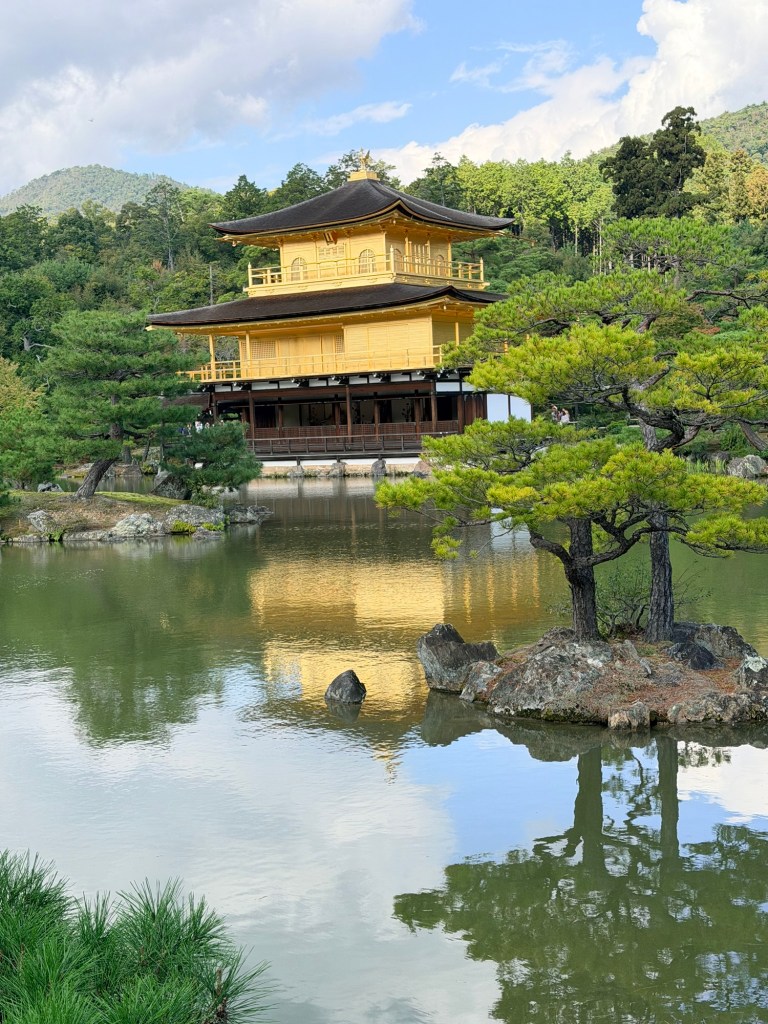
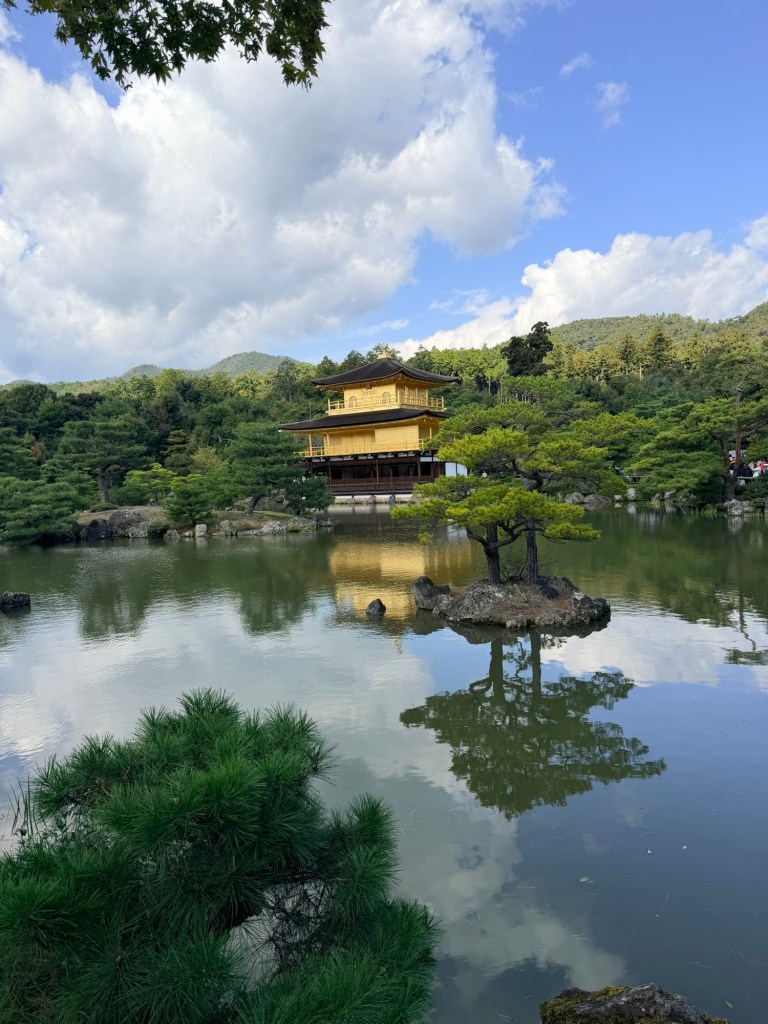
Kinkaku-ji, the Zen Buddhist temple known as ‘The Temple of the Golden Pavilion’. The top 2 floors are coated in gold leaf. 🍁
Let’s start at Kinkaku-ji. This was my second time awing this unbelievable temple officially called Rokuon-ji. I could see it 1,000 more times and it wouldn’t change the way I feel about it. And it’s not just me that thinks that way—it is designated as a UNESCO World Heritage Site, a National Special Historic Site, a National Special Landscape, and one of the 17 Historic Monuments of Ancient Kyoto. The original Golden Pavilion is thought to have been built in 1399, with the gold designed to stamp out any negative feelings toward death. When the sunlight hits the temple, the shadows on the water produce a mesmerizing mirror effect.
The pavilion you see today was rebuilt in 1955 to closely resemble the original. It stands three stories high and 40 feet tall.Sorry, not sorry, for posting so many pictures of this little slice of Heaven!
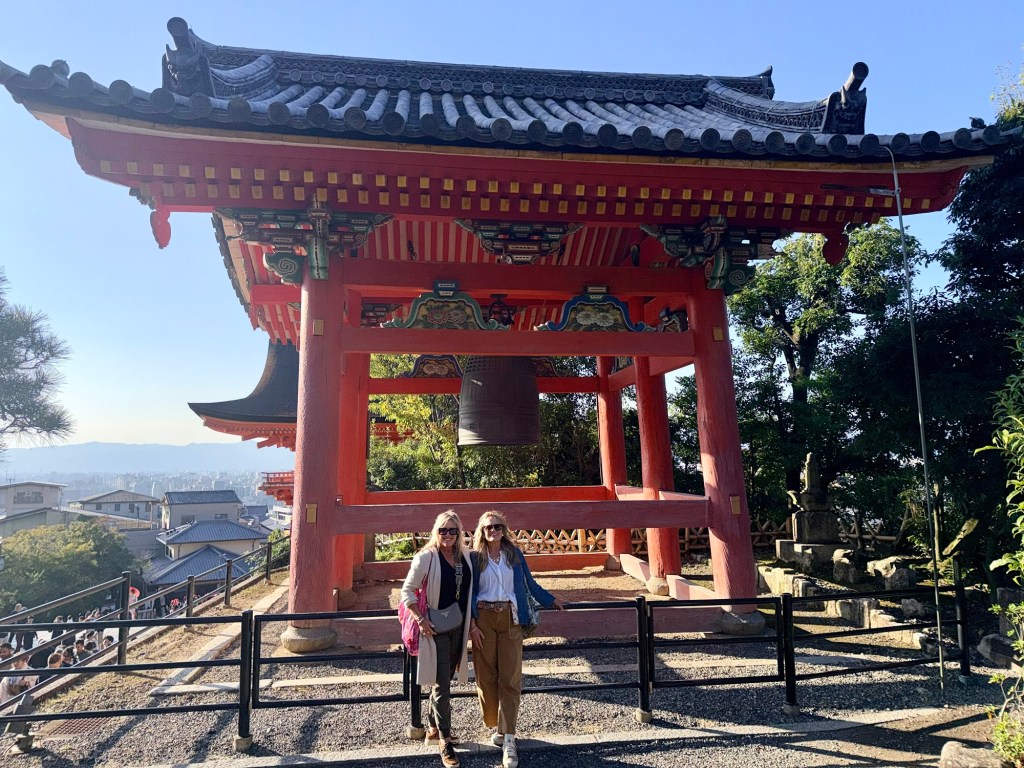
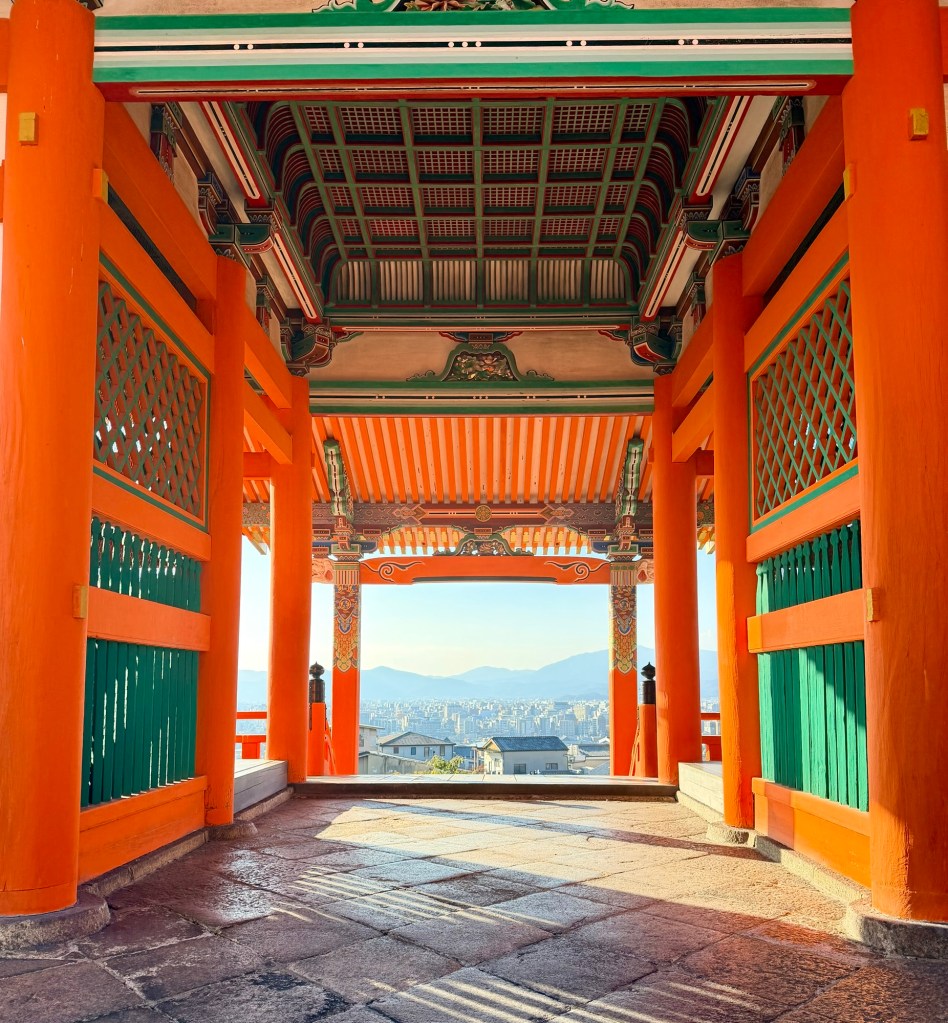
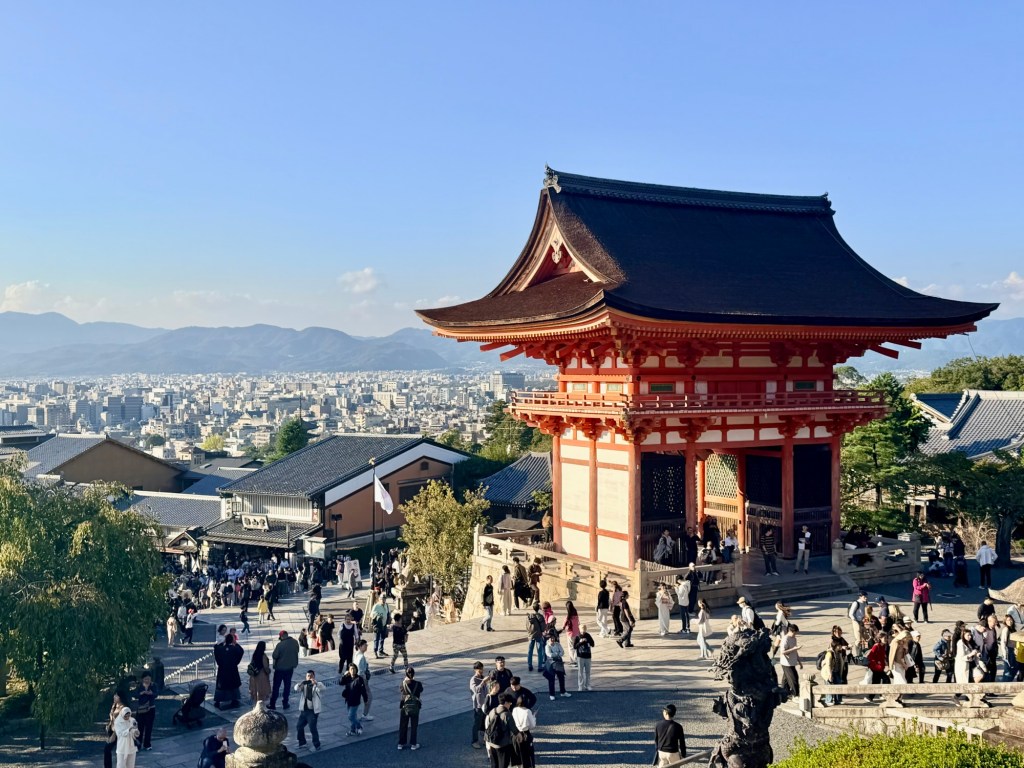
Next stop—Kiyomizu-dera, a Buddhist temple founded in 778 CE by Enchin Shonin, with the present buildings constructed in 1633 by order of Shogun Tokugawa Iemitsu. Pure Water Temple”, as it is translated to English, nestled at the basin of Mt, Otowa in Eastern Kyoto.
With over 1200 years of history, it belongs to the Kita-Hosso sect of Japanese Buddhism. We took the train and then walked 20 minutes, uphill on narrow roads, passing by souvenir shops, to the entrance of this masterpiece.
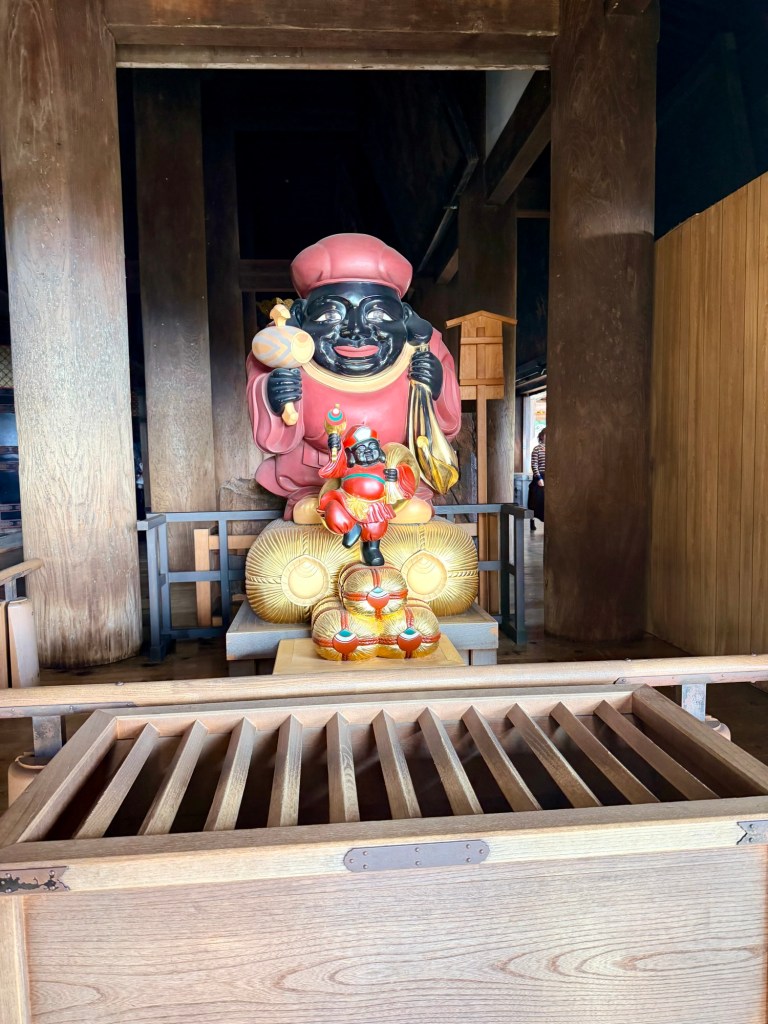
With over 30 buildings at Kiyomizu-dera, this is the entrance called Niōmon GateThe Shōrō (Bell Tower) is famous for the ritual known as ‘joya no kane’. Per Buddhist ritual, the bell is rung 108 times just before midnight on New Year’s Eve, representing the cleansing of the 108 earthly desires that cause pain. It cleanses the soul and creates enlightenment with the 108th ring, ushering in the New Year free from those sufferings. The three-storied pagoda is called Koyasu Pagoda, and is dedicated to safe childbirth.Talk about a view…World, meet Kyoto!The Otowa Waterfall has three streams and each grants a different benefit — longevity, success in school, or a fortunate love lifeDaikokuten – one of the Seven Lucky Gods of Japan. He is the god of wealth, commerce, and prosperity.A view of the Main Hall (Hondo), the most famous structure built on a steep cliff with a large wooden stage overhanging the hillside. The construction is a joinery method and no nails were used.The main hall’s wooden stage sits 13 meters high (again, no nails were used). No pictures are allowed inside the main hall where we were able to ring the bonshō (temple bell) with a mallet.
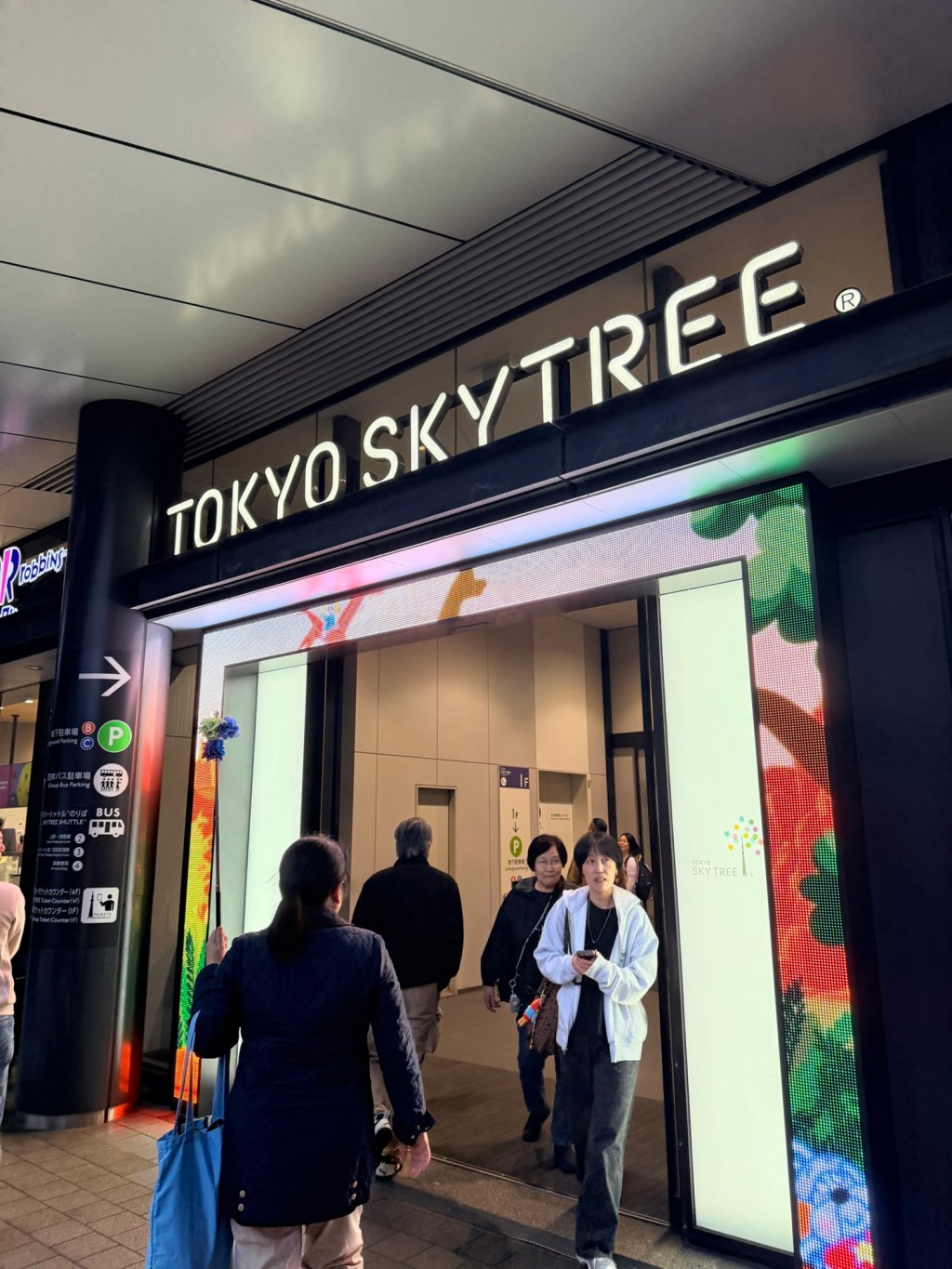
After visiting Sensō-ji we went to the Tokyo Skytree—a 2,080 ft tower that opened in 2012. It’s the tallest structure in Japan and serves both as a broadcasting and observation tower in Sumida, Tokyo (fyi Sumida is the name of the river running through the city). Fun fact—it’s also the 3rd tallest structure in the world after Merdeka 118 and the Burj Khalifa.
The tower is illuminated at night using LED lights that change colors.A view of Tokyo and the Sumida River that runs through central Tokyo. On a clear day you can see Mt. Fuji but unfortunately, we did not have a clear day.
We went back to Tokyo Station and shopped until our dinner reservations.
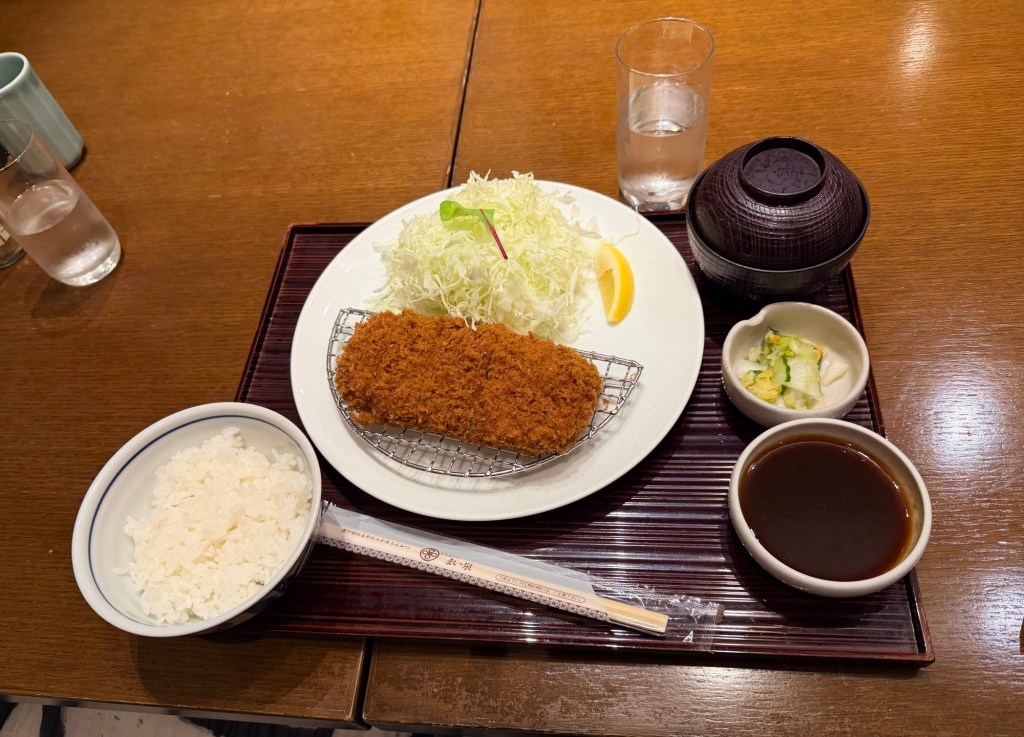
The Tokyo Station opened in 1914 and some say was patterned after the Amsterdam Centraal Station with its red brick facade.A rainy evening at the train station. The Tokaido Shinkansen was the world’s first dedicated high speed rail system and opened service from the station to Osaka in 1964.Dinner has never tasted so good after a full day of sightseeing. We ate at the top of a department store by Tokyo Station.In my opinion, the best pork in the world — Tonkatsu. It’s a Japanese cutlet made from pork loin or fillet, coasted with panko and then deep-fried in oil. It originated in the Meiji area and has its roots in French cuisine.Walking home with a view of the Tokyo Skytree from Kayoko’s home. What an amazing first full day in this beautiful city!🇯🇵
After Meiji Shine, we continued our tour and the day kept getting better and better, even as the rain fell…
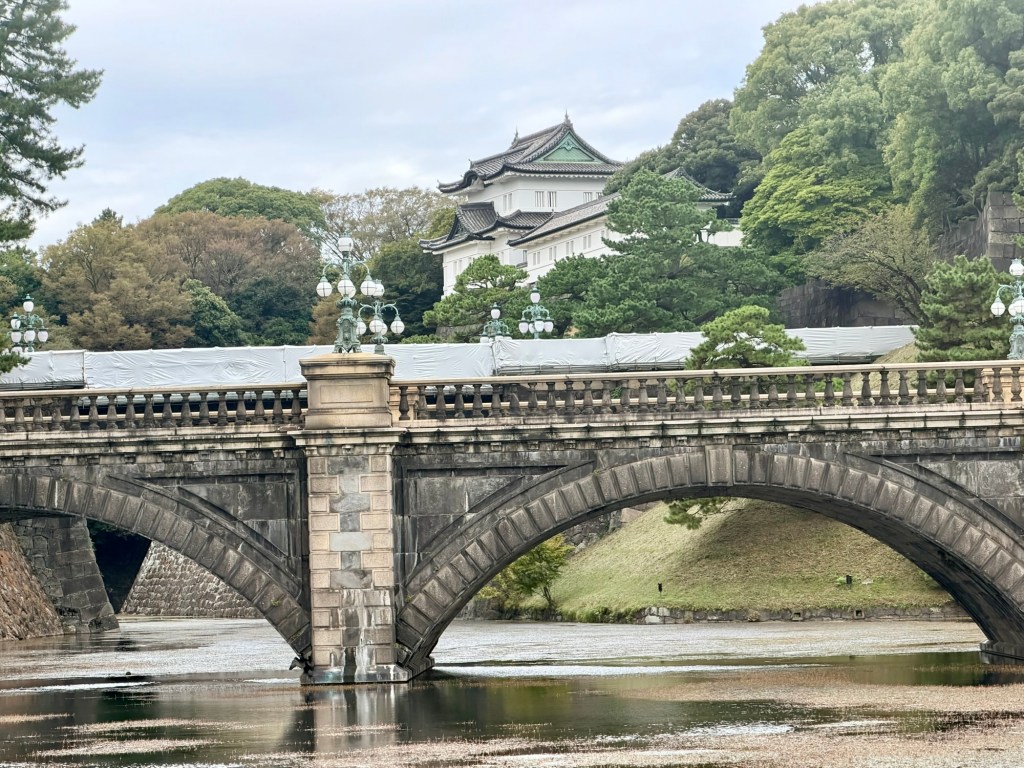
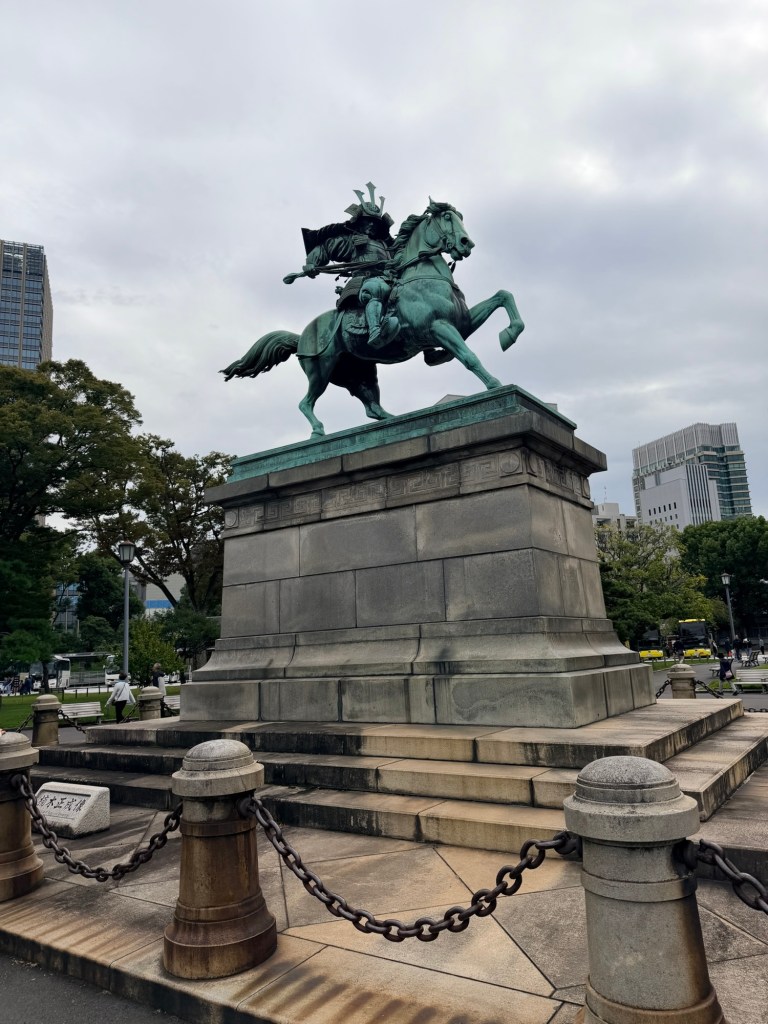
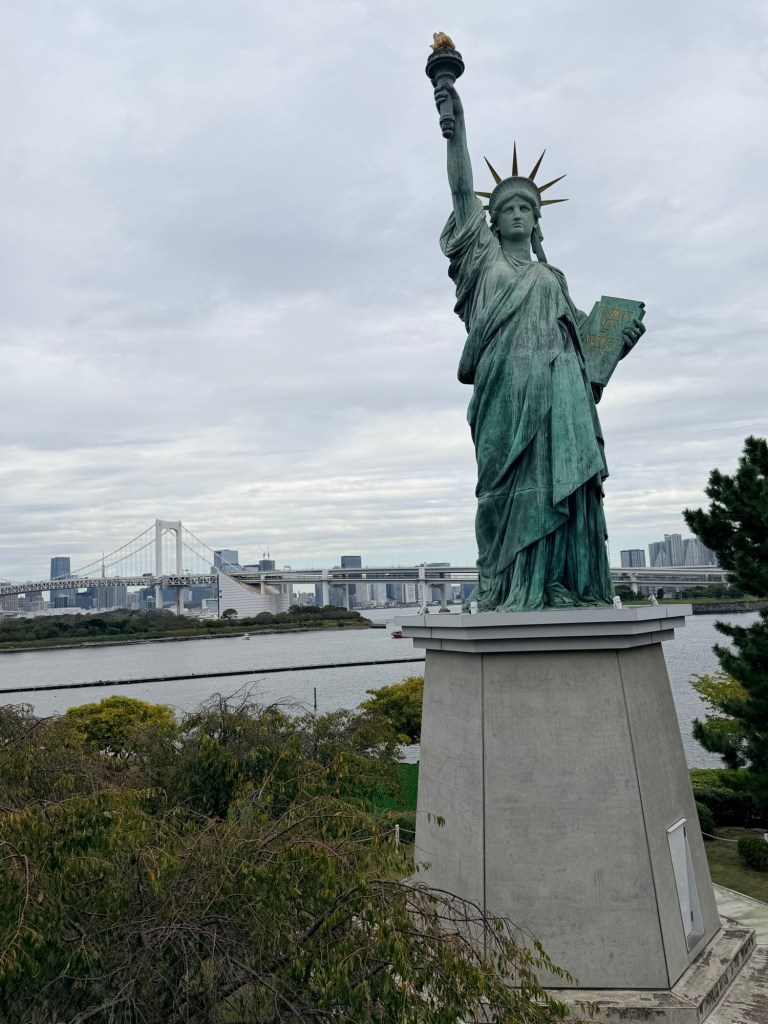
The Imperial Palace is beyond this moat and the Nijunashi Bridge, which means “Double Bridge”. There are actually two bridges—the stone arch bridge in the front, which is called Meganebasgi (or Eyeglass Bridge in English), and a steel bridge behind it. The name comes from the original wooden bridge it replaced, which was two-levels. The emperor of Japan is symbolic, serving as the head of state and a symbol of the Japanese people. The imperial dynasty dates back to 660 BCE with the legendary emperor, Jimmu, descended from the sun goddess, Amaterasu.The Kusunoki Masashige was a loyal samurai dedicated to Emperor Go-Daigo. He ultimately sacrificed his life in battle.Next stop was the man-made island of Odaiba in Tokyo Bay, across from the Rainbow Bridge. Originally built for defensive purposes in the 1850s, it’s now a major recreation area. There’s even a 40 foot Statute of Liberty in the Odaiba Marine Park, given by the French in 1998 as a sign of friendship between the two nations.
After stops at the Imperial Palace and Odaiba, we ate a buffet lunch at a local hotel by the airport. Then we went to my one of favorite places in Asakusa, Tokyo—the Buddhist temple called Sensō-ji. Built in the 7th century, it is Tokyo’s oldest temple and draws some 30 million visitors each year. It is also known as the Asakusa Kannon.
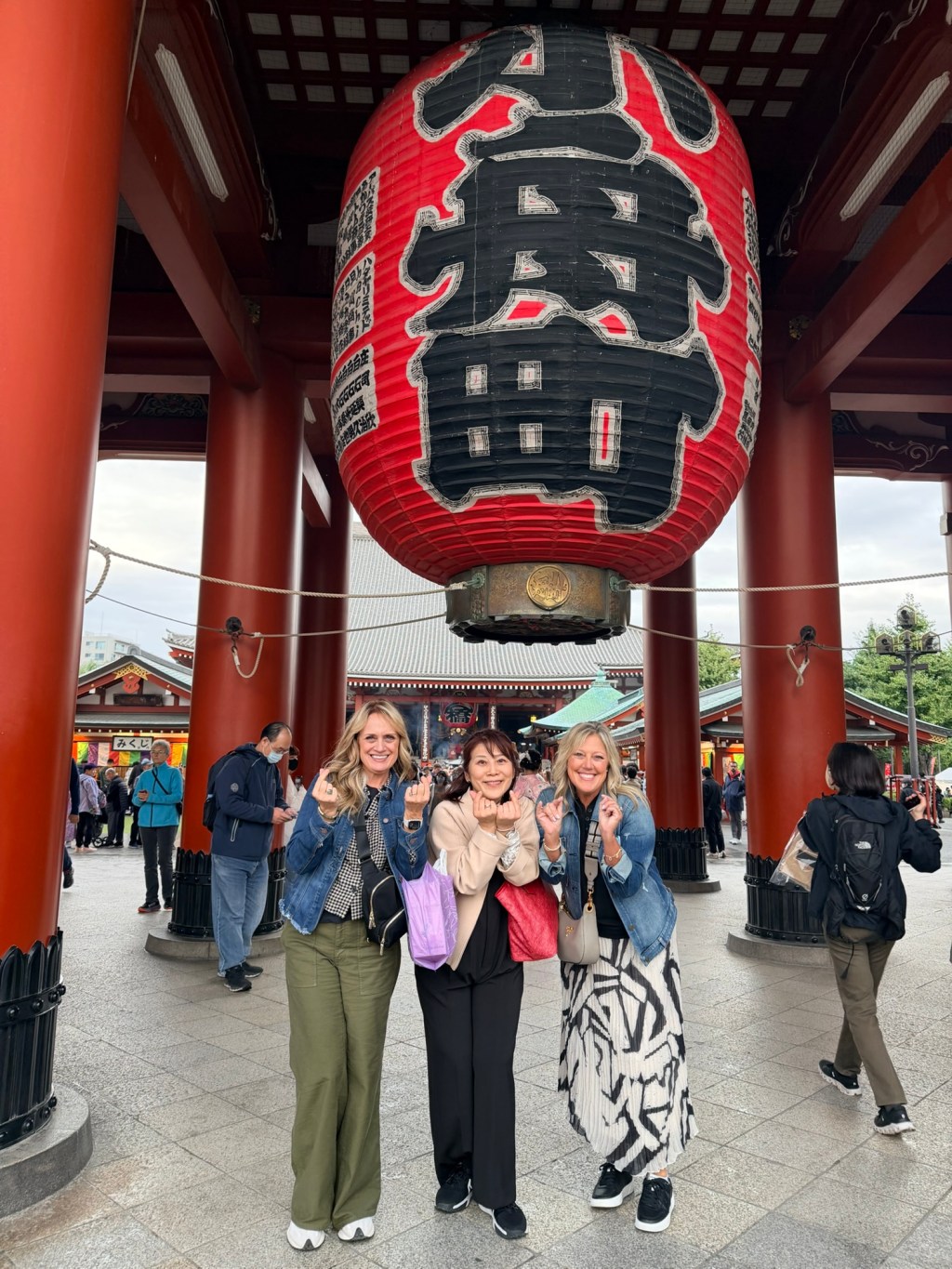
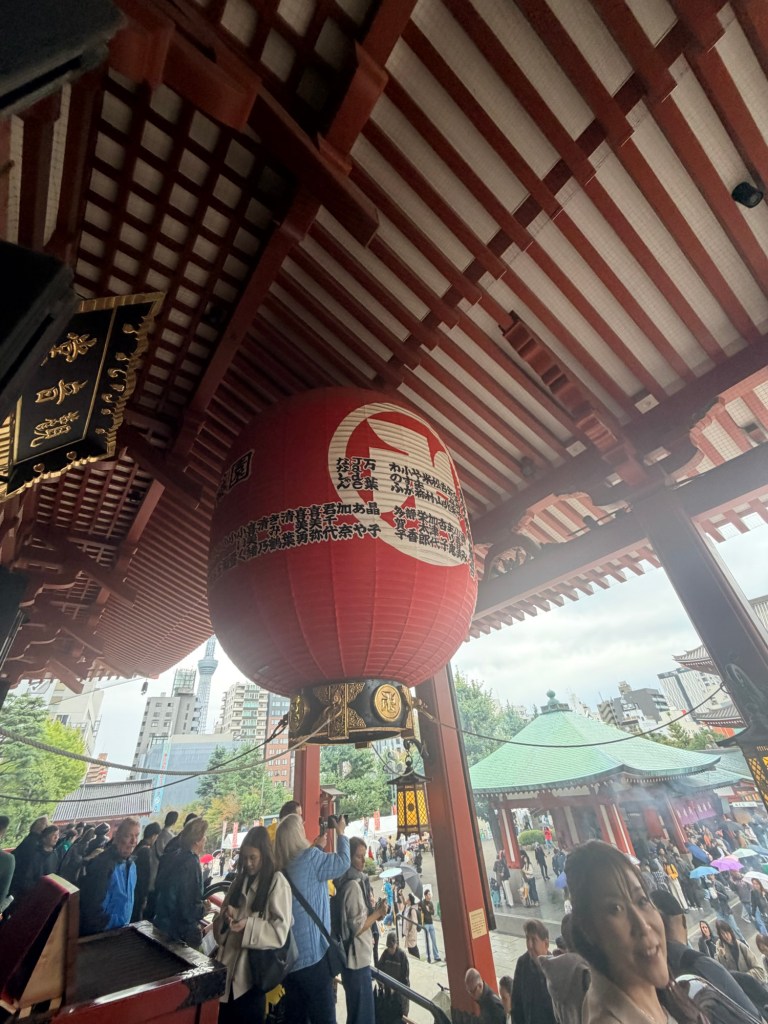
The grounds are as colorful as they are stunning and it’s difficult to capture the beauty with my camera. The entrance is called the Kaminarimon or “Thunder Gate”, and showcases a massive paper lantern painted in red-and-black tones symbolizing thunderclouds and lightning.
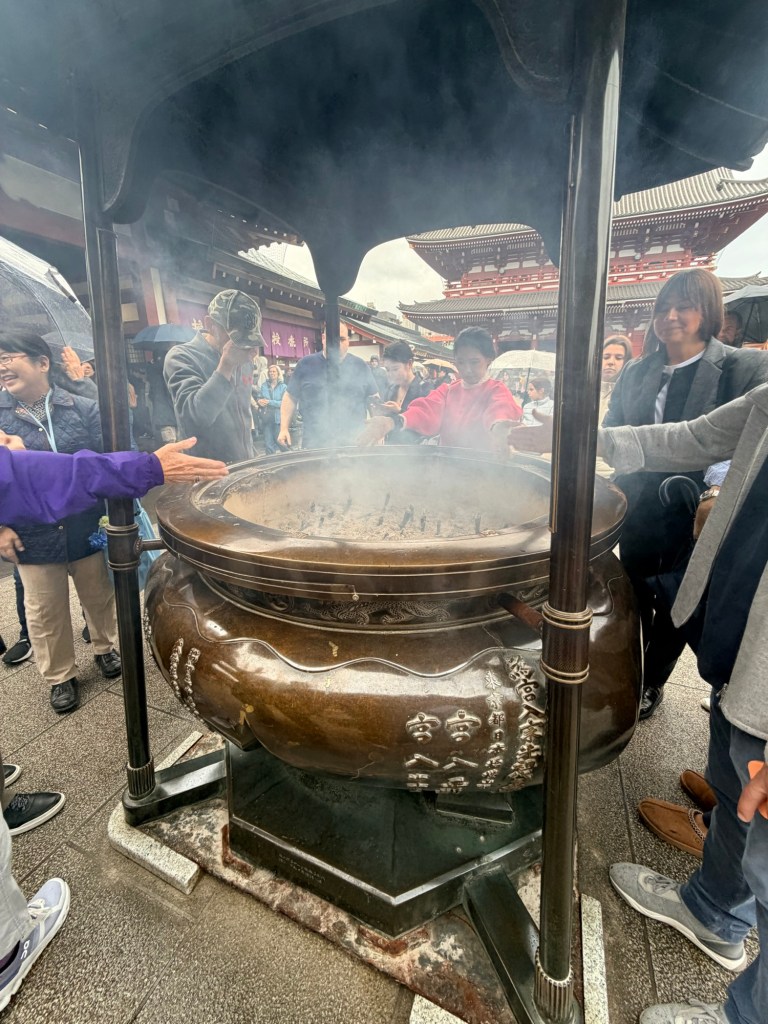
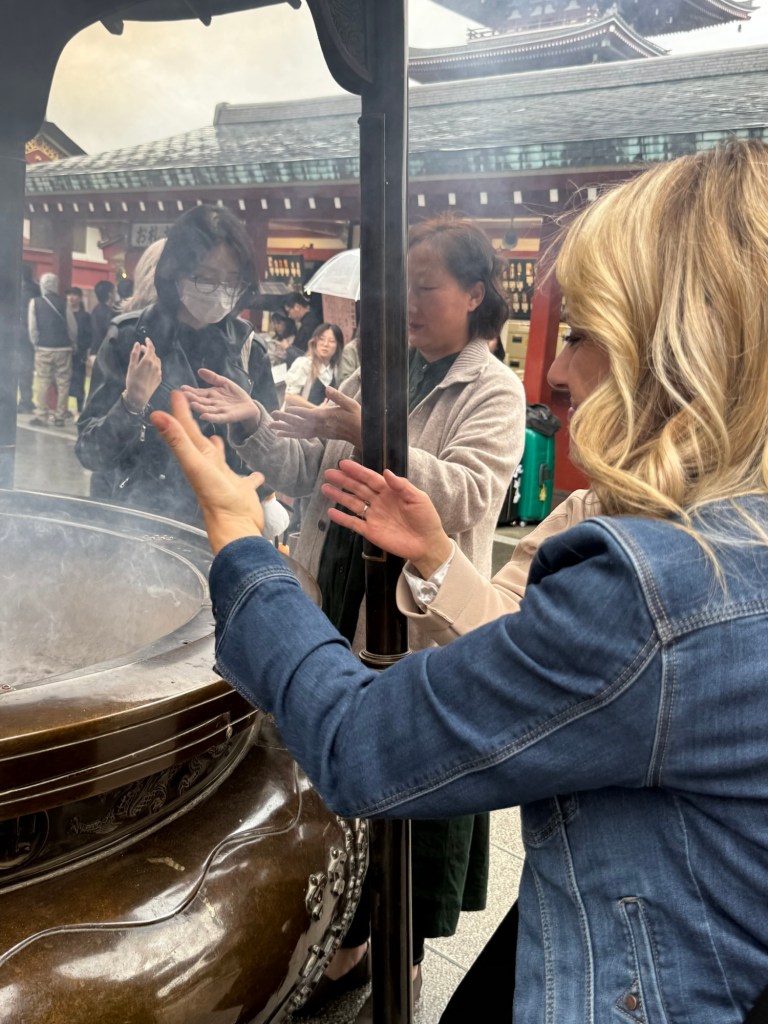
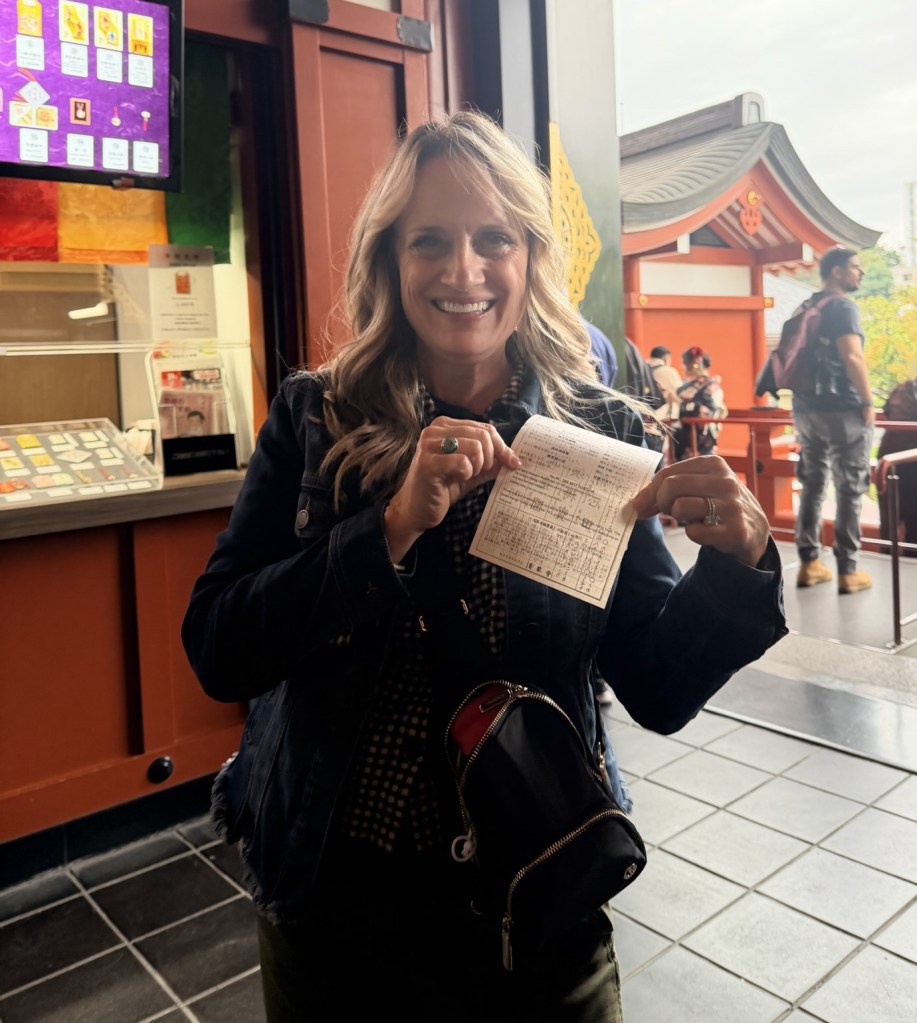
The beautiful koi pond on the grounds of the Senso-ji temple. The stone bridge, built in 1618, is considered the oldest stone bridge that remains in Tokyo.Hozomon Gate (Treasure House Gate) is the inner of two large entrance gates that lead to the Senso-ji. The outer is the Kaminarimon. The Kaminarimon, known as the Thunder Gate, marks the entrance to the historic Senso-ji Temple.Entering the Main Hall (Hondo)Inside the Main Hall (Hondo), which is the primary building where the statue of Kannon is enshrined. This statue is not visible to the public. Five-Story Pagoda is a prominent landmark on the grounds and stands 55 meters tall. It houses the relics of Buddha. Buddha’s Breath—The smoke from the incense burner (jokoro) at Senso-ji symbolizes purification and healing. We use it to cleanse the body and mind. You’re supposed to direct it toward a part of your body you wish to heal or toward the head to gain wisdom.Directly the smoke to gain wisdom.Fortune time! You pay a small fee, shake the box, draw a stick with a number on it and then draw your fortune (omikuji) from that numbered box. My fortune was the best…yes, it said it was The Best Fortune. If you get a bad one, then you “kami wo misubu”—fold the paper and tie it to one of the designated racks to “leave behind” the bad luck.One of the Buddhas on the temple groundsThe Nakamura-dori is the historic 250-meter-long shopping street that runs from Kaminarimon to the Hozomon Gate (Treasure House Gate) leading to the main hall. It is lined with shops selling souvenirs and traditional snacks —where I bought delicious senbei!
What’s the difference between Shinto and Buddhism? It was explained to me while we were in high school by my friend, Kayoko, and I have referred back to this teenage explanation many times—Shinto is Japan’s native religion that focuses on this life while Buddhism centers on the afterlife and enlightenment.
Interesting observations: When you travel to Japan, it’s best to bring your own hand towel in your bag. This towel can is used to wipe your hands after you wash them in public restrooms as many times there are no paper towels nor dryers. 
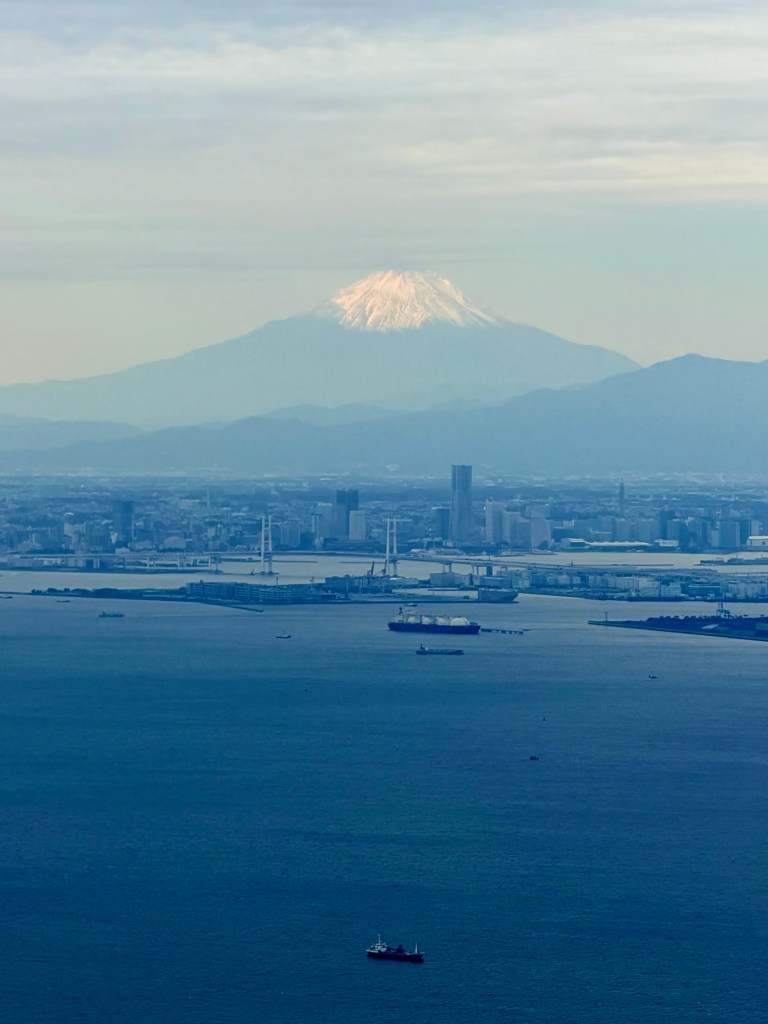
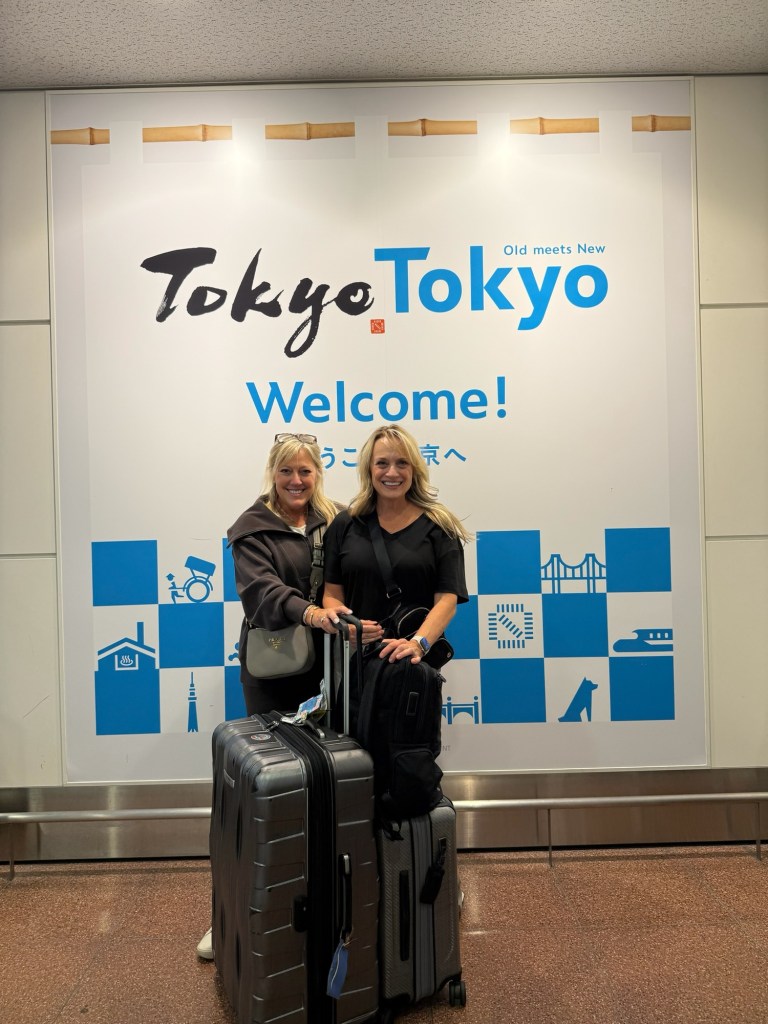
We arrived on Thursday afternoon, October 23, 2025, feeling both exhausted and exhilarated. This is my third visit to this wonderful country, and it never ceases to amaze me. There’s a unique blend of ancient traditions and modern life at every turn. From the first glimpse of Mt. Fuji as we landed at Haneda Airport to the tranquility of the Japanese gardens, this remarkable destination truly takes my breath away.
My sister and I land in Tokyo.
Without a doubt, the highlight of my experiences in Japan is the warmth and kindness of its people. Their emphasis on group harmony, politeness, respect, and cleanliness creates incredible interactions each time.
I have the privilege of being friends now for 44 years with my childhood penpal, Kayoko, and her family. We are staying with her while in Tokyo this time. I am grateful to have this immersive cultural experience.
After setting in, we went to a neighborhood yakitori grill, where we kicked off dinner with champagne (Kanpai!) and a 6 course meal of different part of the chicken on a skewer. Then it was off to bed after being up for over 24 hours.
Friday was a very full day on our Tokyo Panoramic Tour, one of the best ways to start to understand a city. From first thing in the morning until dinner, we learned about the history and culture while visiting the Meiji Jingu (Shrine), the Imperial Palace, Odaiba, Sensō-ji Temple in Asakusa, Tokyo Skytree. We capped off the evening with a delicious tonkatsu dinner by the Tokyo station.
Hey kitty kitty! Starting our bus tour watching this famous billboard.
I will break up this day with a few posts, below are more details about the Meiji Shrine.
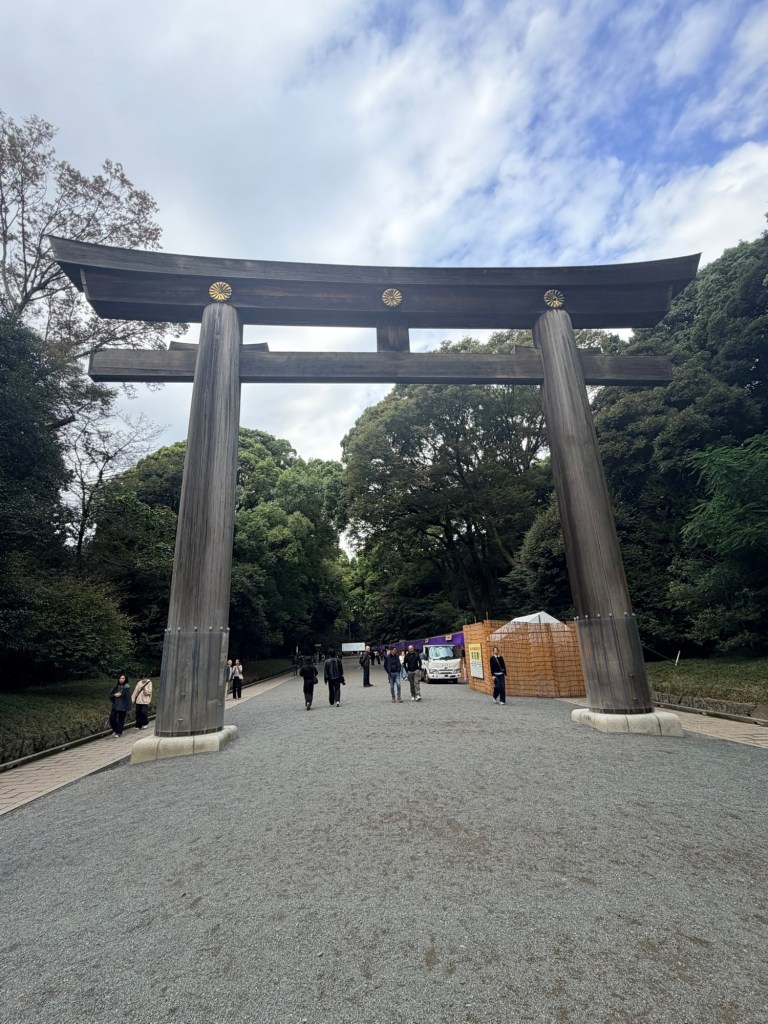
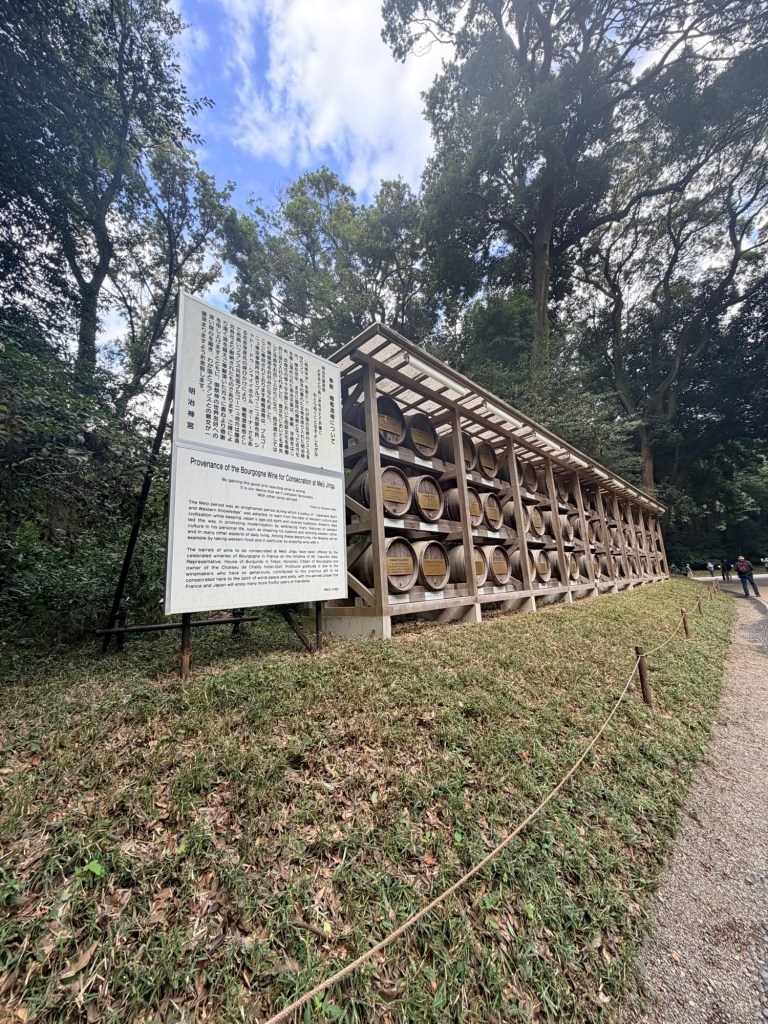
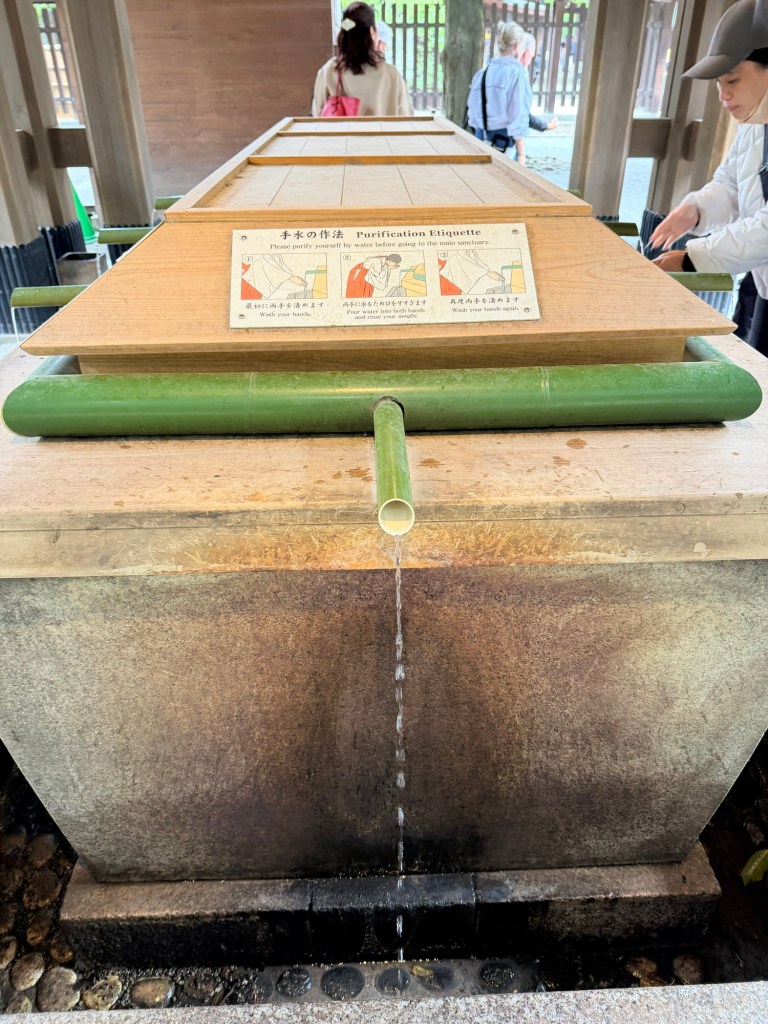
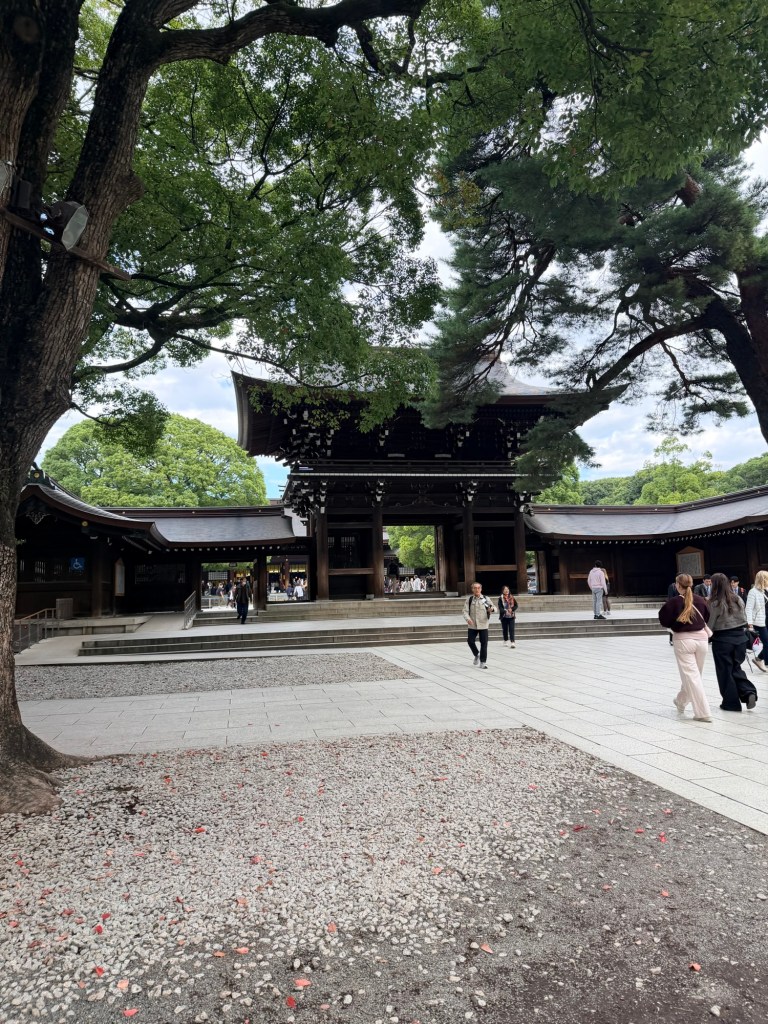
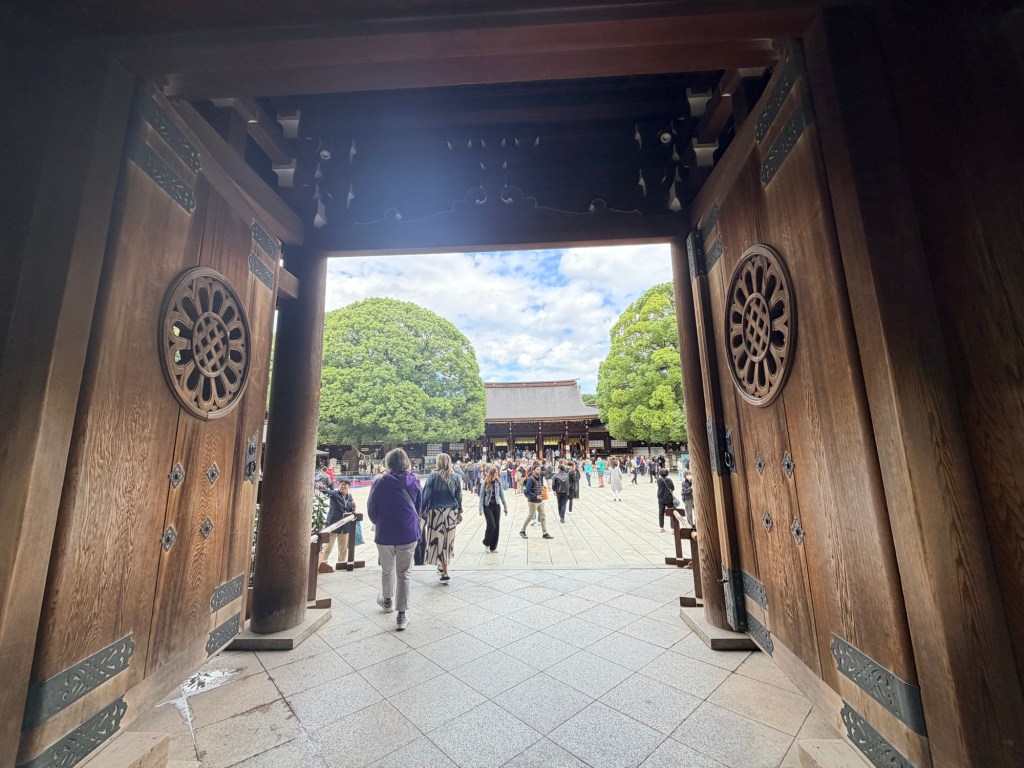
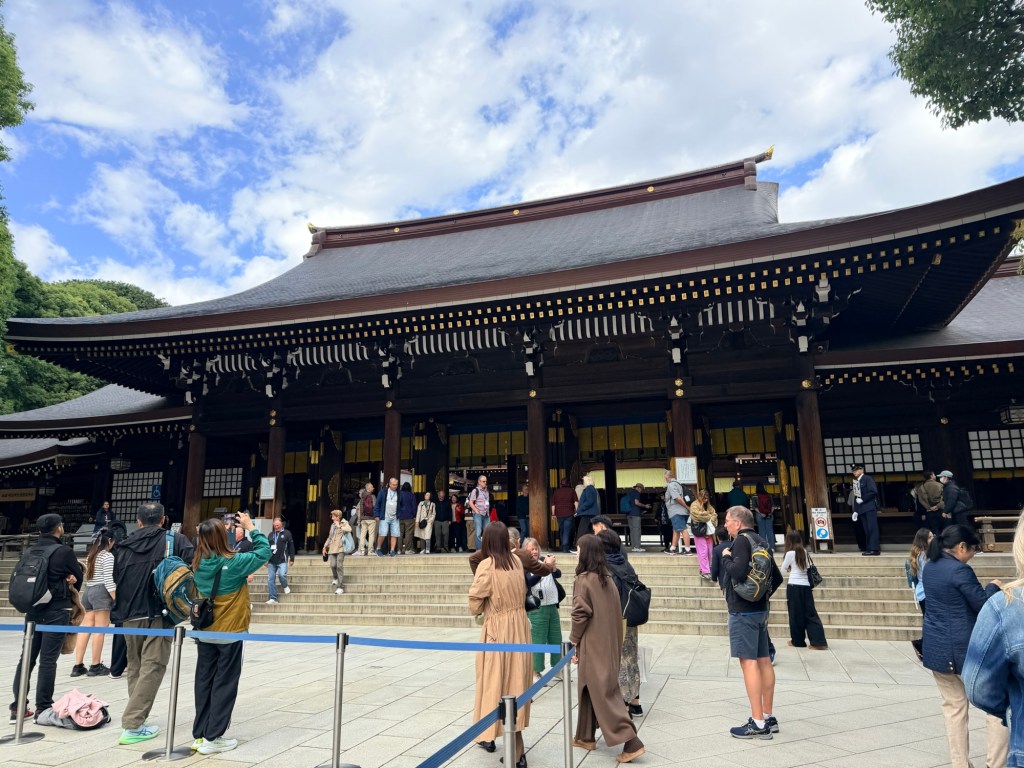
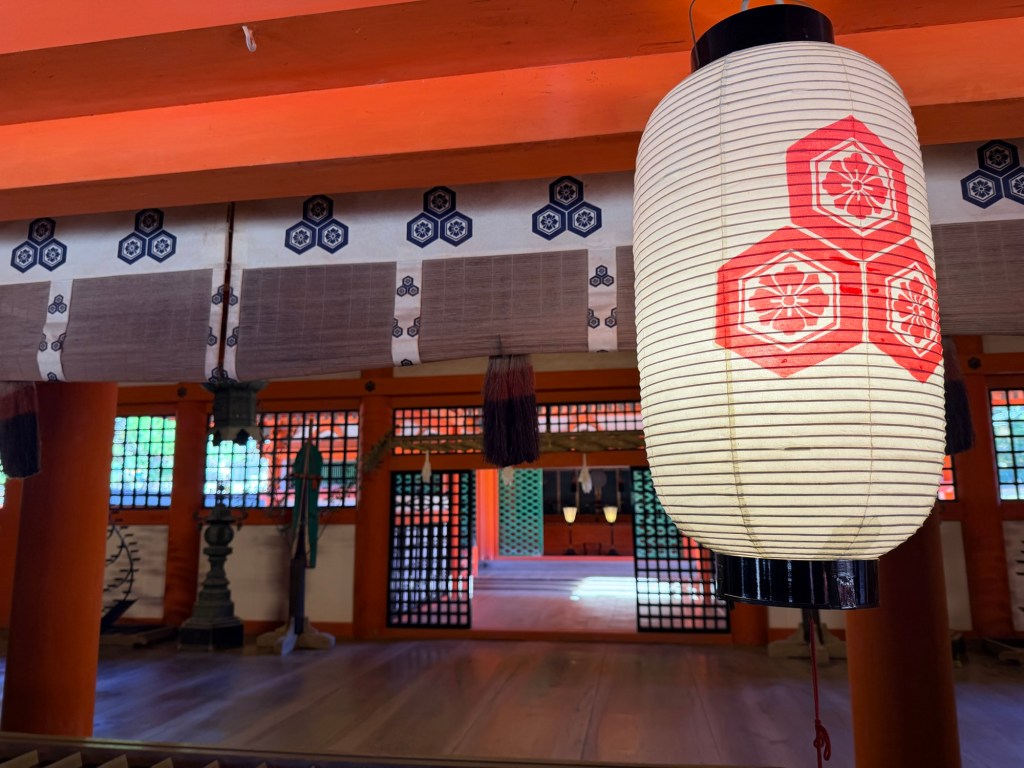
The largest Torii gate in Japan serves as the entrance to the Meiji Shrine. The Shinto shrine in Shibuya, Tokyo sits on a 170 acre forest with 120,000 trees of 365 different species. All of the trees were donated by the Japanese people. The shrine is dedicated to the deified spirits of the former Emperor Meiji and his wife, Empress Shoken. When you pass through the gate, it is customary to bow as you walk from the ordinary world to the sacred, and begin your path to the shrine. It was reconstructed in 1975.Barrels of Sake wrapped in straw that are offered each year to the memory of the emperor and his wife.And across from the sake barrels are wine barrels from the Burgundy region of Eastern France, offered as a remembrance of the emperor who brought Western culture and food to Japan, particularly wine.Preparing our bodies to enter the shrineMeiji Jingu – Construction began in 1915 using timbers from Kiso in Nagano and Alishan in Taiwan, once a Japanese territory. Materials were used from every Japanese prefecture (there are 47 today in Japan). It was dedicated in 1920, although the grounds were officially completed in 1926. The original building was destroyed during WWII and rebuilt in 1958. The cost of the construction was ¥5,219,00 in 1920 (which is roughly $26M today). This was actually about a quarter of the actual cost as much of the materials and labor were donated. Photography is not allowed once you ascend the stairs.
We flew into Denver and drove 4.5 hours to see my niece perform her summer musicals at Post Theater in Crawford, NE. We stayed in Chadron, NE—which is a short 1 hour 40 minute drive from our hotel to Keystone, South Dakota. This town lies just outside the entrance of Mount Rushmore National Memorial.
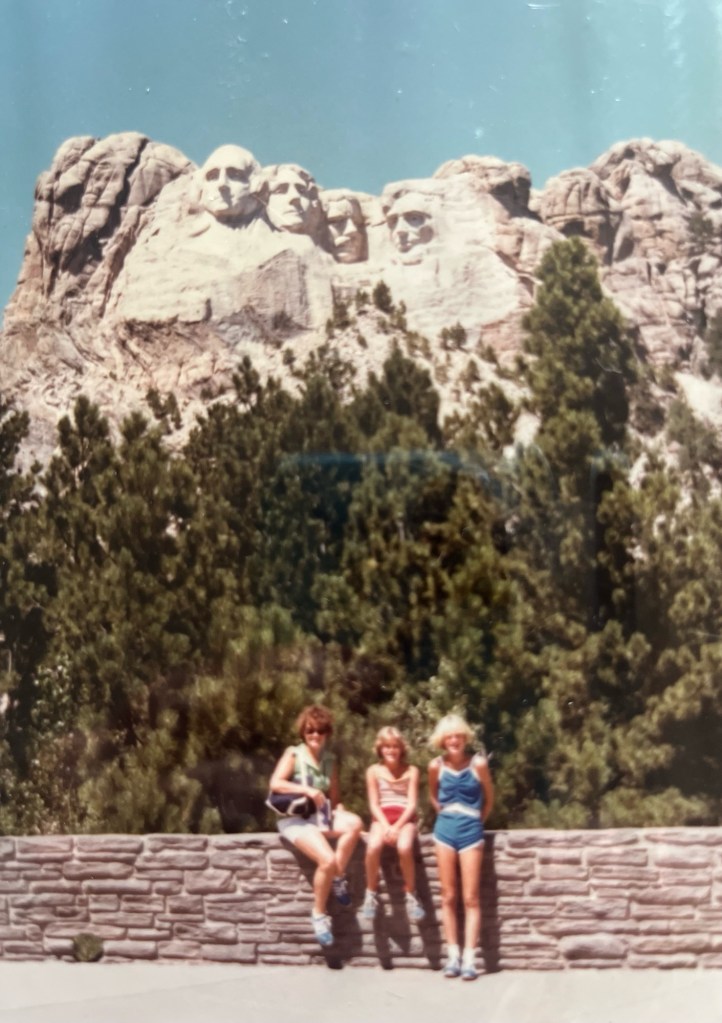
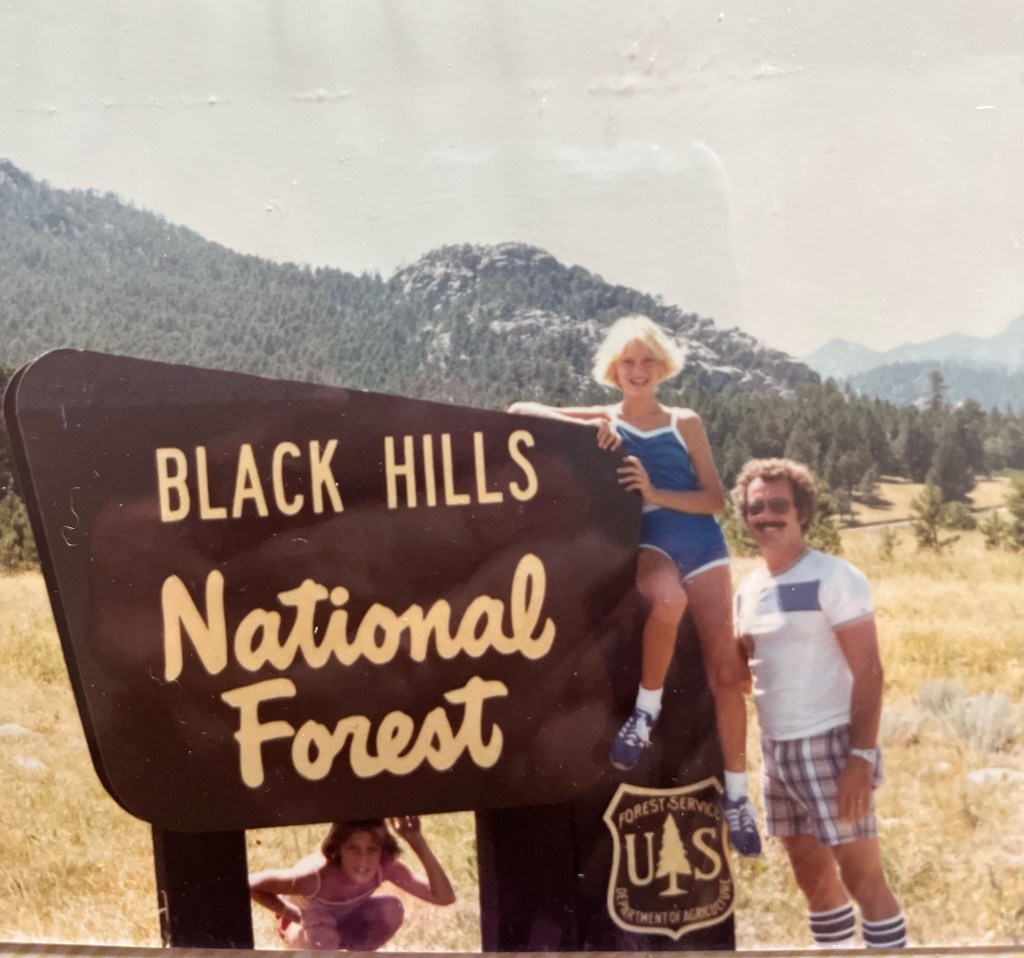
I visited Mount Rushmore as a kid in the summer of 1980–it was one of my favorite vacations. Mom, Dad, my sister and I piled into my dad’s pick up with a camper attached to the bed of the truck. We drove the 15+ hours from St. Louis, Missouri through the Badlands, stopping to see such iconic sites as Mitchell’s Corn Palace, the Flintstone’s Bedrock City in Custer, and watched a reenactment of Wild Bill Hickok’s murder in Deadwood. We camped along the way.
Camping with the family – Summer 1980 (Thanks for the memories, Mom & Dad!😘)
I remember the awe I felt as a 12 year-old seeing those gigantic president faces carved on Mount Rushmore.
First sighting of the Presidents. Hey, I think those terry short sets are back in style!🤣
That sense of wonder was experienced again today with my husband, who has never been to Mount Rushmore (he also got a new state in the process!). You enter the Memorial through The Avenue of Flags, a walk way representing the 50 U.S. States, the one district, 3 territories, and two commonwealths. It was built to commemorate our bicentennial celebration in 1976 and leads visitors to The Grand View Terrace and Presidential Trail.
Here’s a quick history lesson/timeline of the things I re-learned on this visit:
1. Mount Rushmore’s history is complex and controversial. It includes the gold rush, displacement, and broken treaties. The Black Hills, where you find Mount Rushmore, belonged to the indigenous peoples of the area, specifically the Lakota Sioux. While Mount Rushmore received its name from Charles Rushmore, a NY attorney who inspected mining claims, the original name was Six Grandfathers, a sacred site used for prayer and spiritual ceremonies. The mountain symbolizes the Lakota’s ancestral deities associated with the six cardinal directions – North, South, East, West, Above (sky), and Below (earth).
Beautiful Lakota Hoop Dancers
2. Early 1920s: South Dakota’s historian, Doane Robinson, suggested the idea to sculpt presidents into the side of a mountain to bring in tourists, although the original site was in another area called The Needles.
3. 1927: Sculptor, Gutzon Borglum was chosen and work began to find the right mountain. They settled on Mount Rushmore.
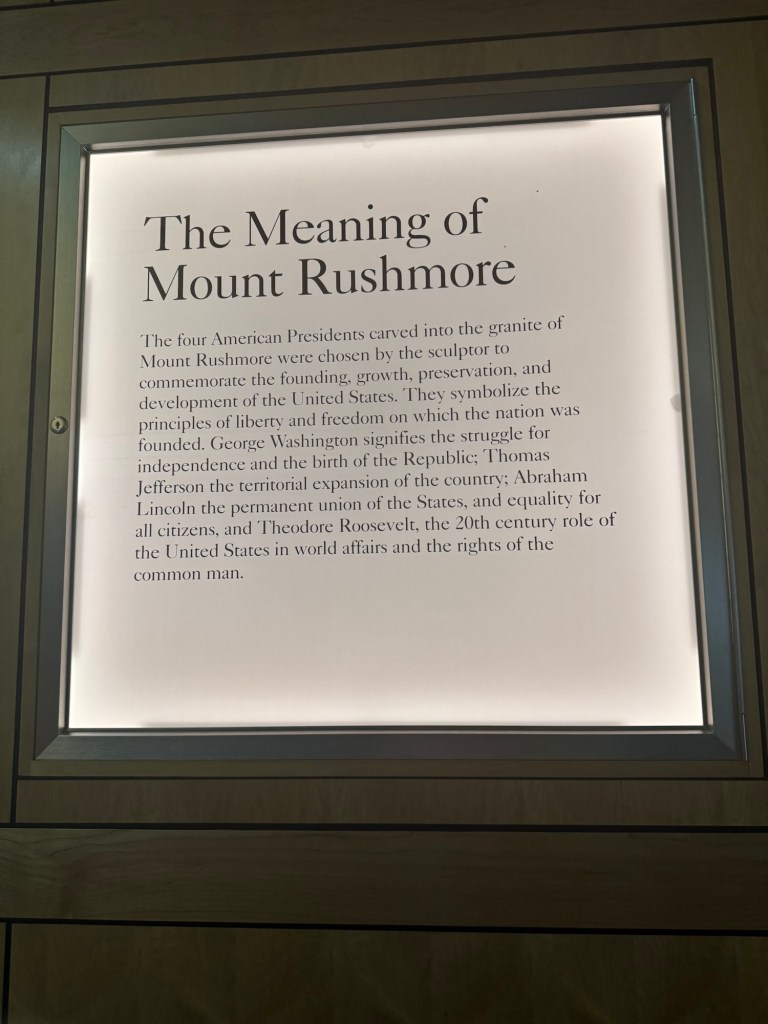
4. The Chosen 4: The four U.S. Presidents on Mount Rushmore were chosen for founding (Washington), growing (Jefferson), preserving (Lincoln), and developing (T. Roosevelt) the U.S.A.
5. Oct. 31, 1941: Construction completes after funding challenges, the looming WWII threat, and the death of Borglum in March. FYI—his son, Lincoln, took over for his father to finish. While it looks complete to me, I watched the film in the visitor’s center where they said it best—the the faces may be defined but it’s rough around the edges, which a metaphor for the USA—while we have accomplished and overcome so much, we are still sculpting our history. How we choose to do that is up to us.
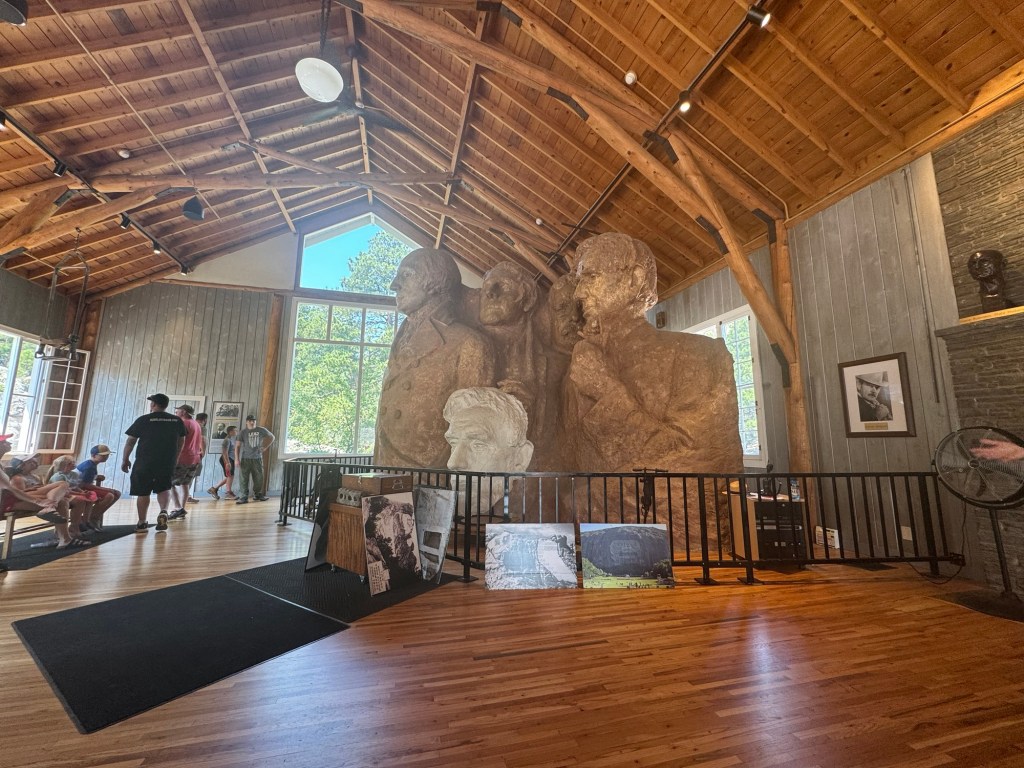
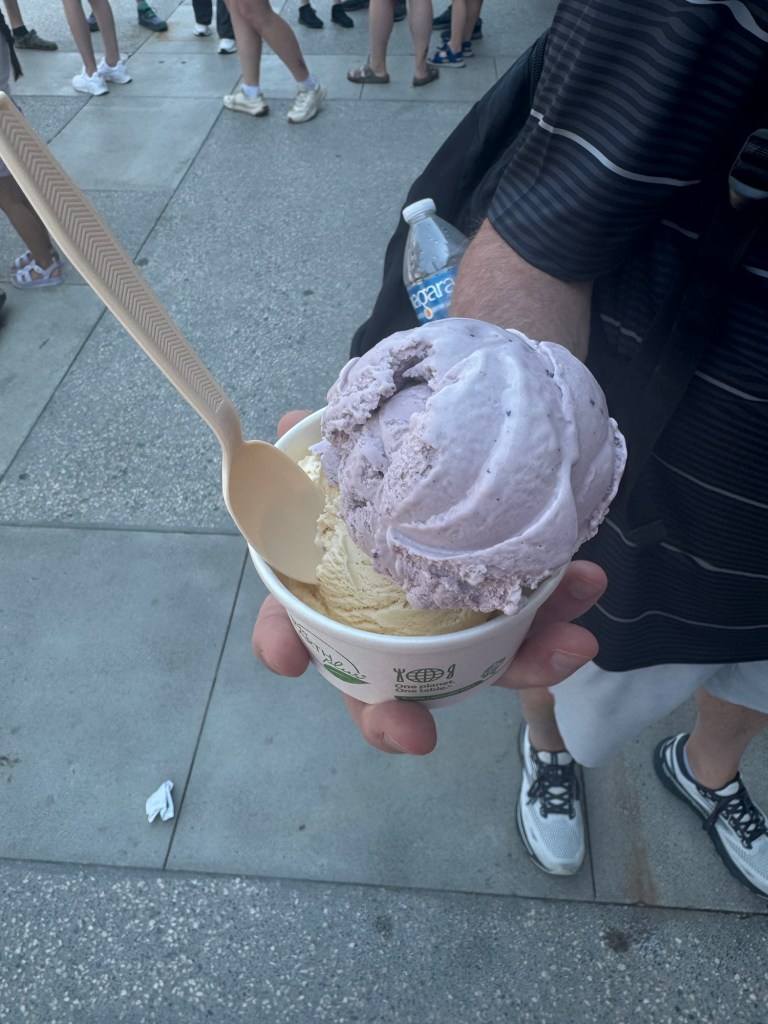
On the Presidential Trail, an easy walk through a mostly shaded area to see different angles of the monument.The Sculpter’s Studio where Borglum worked from 1939 to 1941. It houses the 1/12th scale model of Mount Rushmore.Make sure to stop by the cafe and get two scoops—Thomas Jefferson Vanilla and Huckleberry!Today! Summer 2025Then! Summer 1980
A note on facilities—we found the parking, The Lincoln Borglum’s Visitor Center, Gift Shop, Cafe, and the grounds to be extremely convenient, clean, accessible, and the park staff friendly! For those with a gluten sensitivity, the cafe even has two options for GF bread 🤯
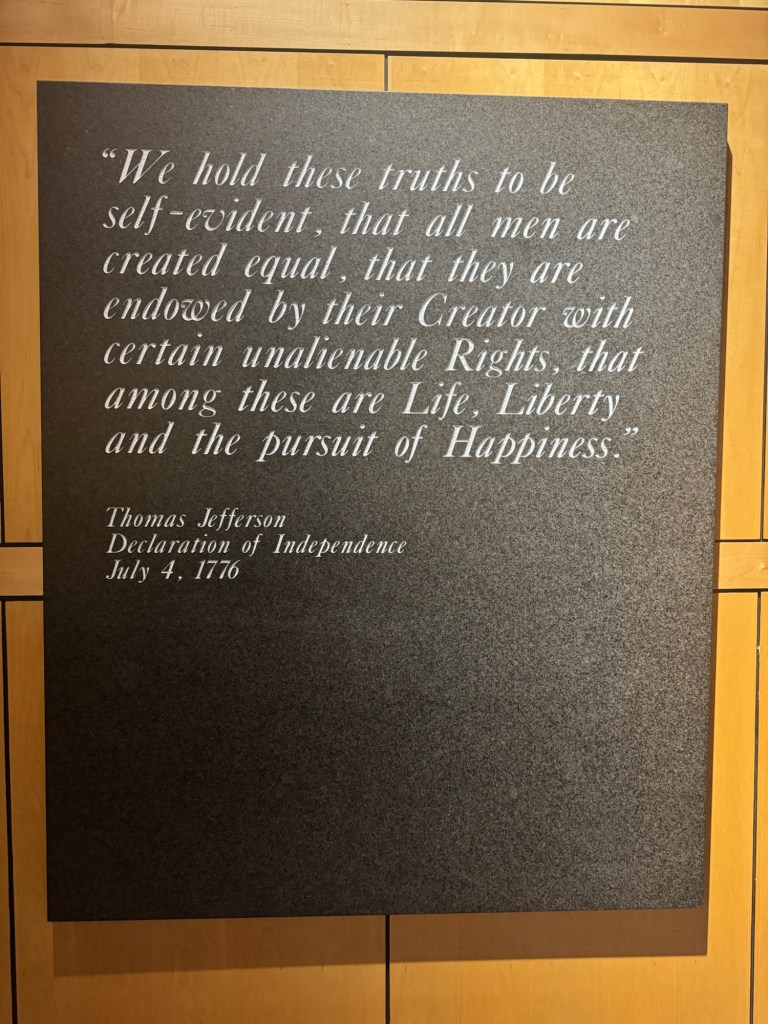
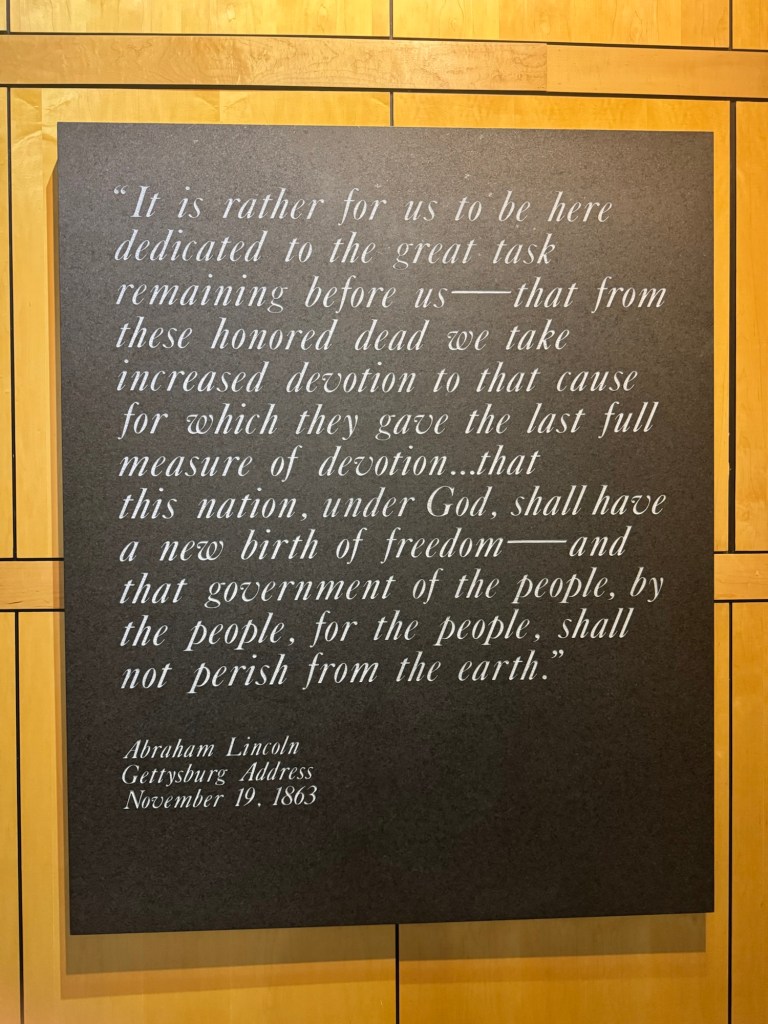
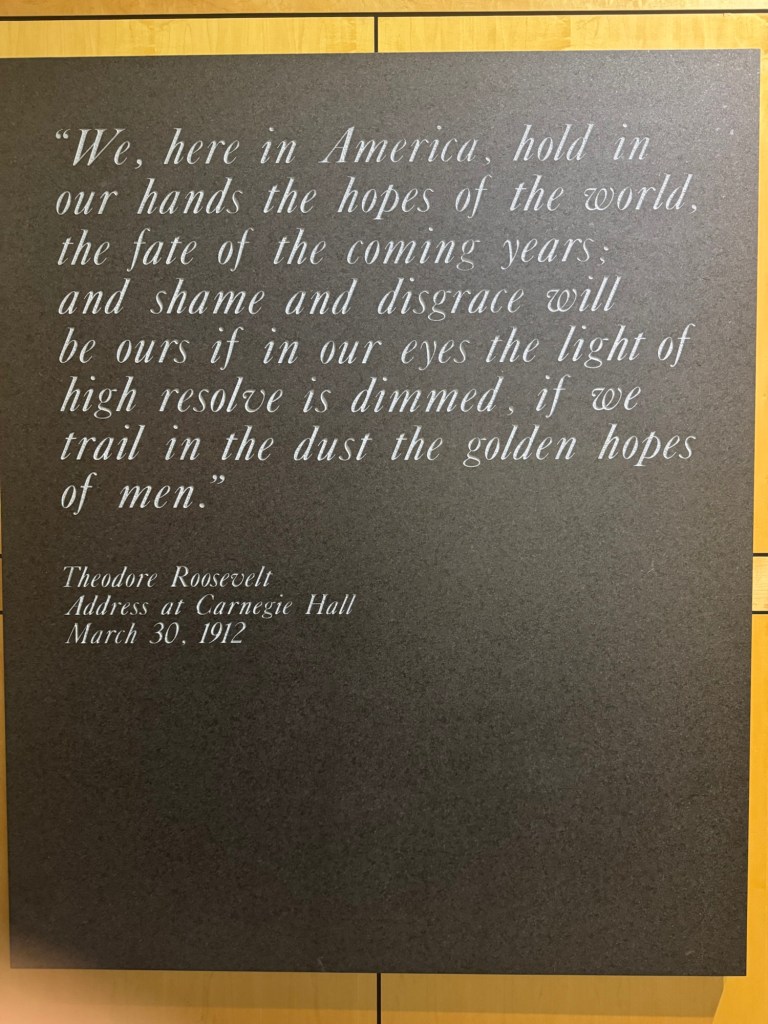
Bonus words—I love the details as to “why” these presidents were chosen. Here are their voices:
The Founding of our NationThe Growth of our NationThe Preservation of our NationThe Development of our Nation
Fascinating (and mysterious) Fact—
Borglum’s grand plan included an 800 foot staircase ascending the Mount Rushmore to the Hall of Records, a large room within the mountain, to house important U.S. documents such as the Constitution and the Declaration of Independence. Also, there would be busts of famous Americans and a list of U.S. contributions to the world in science, industry and the arts.
The plan was abandoned for a variety of reasons and what remains today is the hall’s 18-foot-tall doorway that looks like the entrance to an ancient tomb of an Egyptian Pharaoh and small chamber (75 feet long with a 35-foot-tall ceiling), located behind the head of Lincoln.
If you’d like more details, including what is housed there today😊, here is the full story on the park’s website.
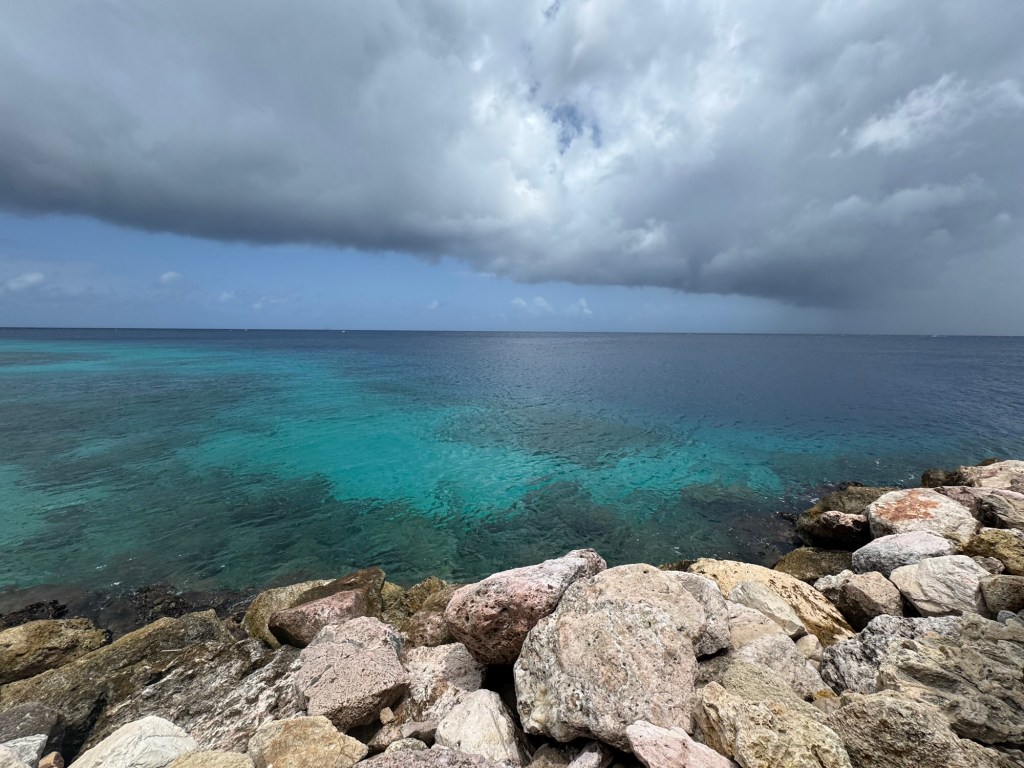
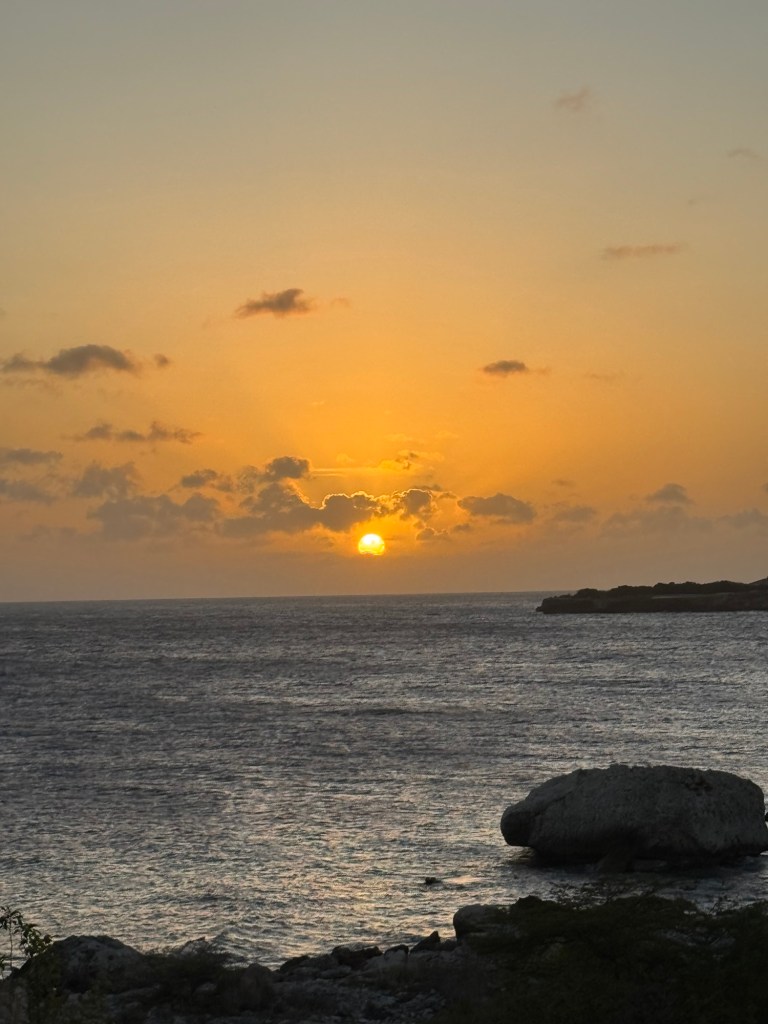
I can’t get enough of this amazing island in the Caribbean, where sunshine☀️ is the best daily vitamin. A quick trip gave me the opportunity to explore some of their famous beaches this time around…and let’s just say there wasn’t a beach I didn’t like!
Blue Bay Beach💙🩵 – this is an easy one because it’s where we stay. The Brass Boer rents Palapas for the day (make a reservation) and it’s a treat worth splurging on.
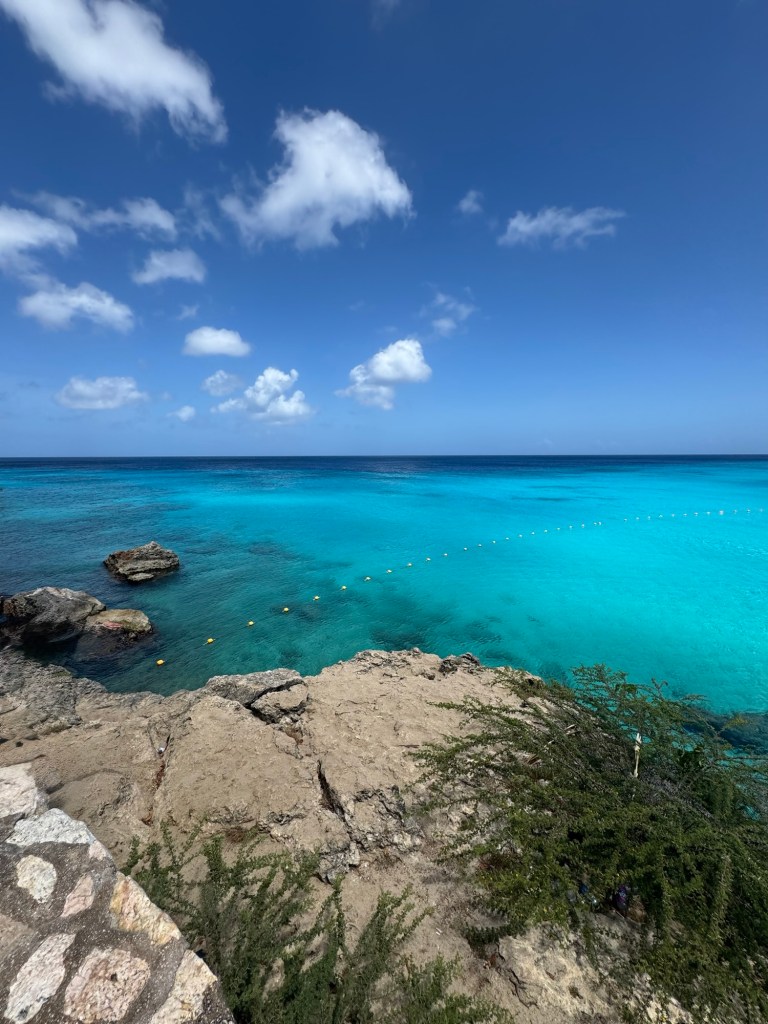
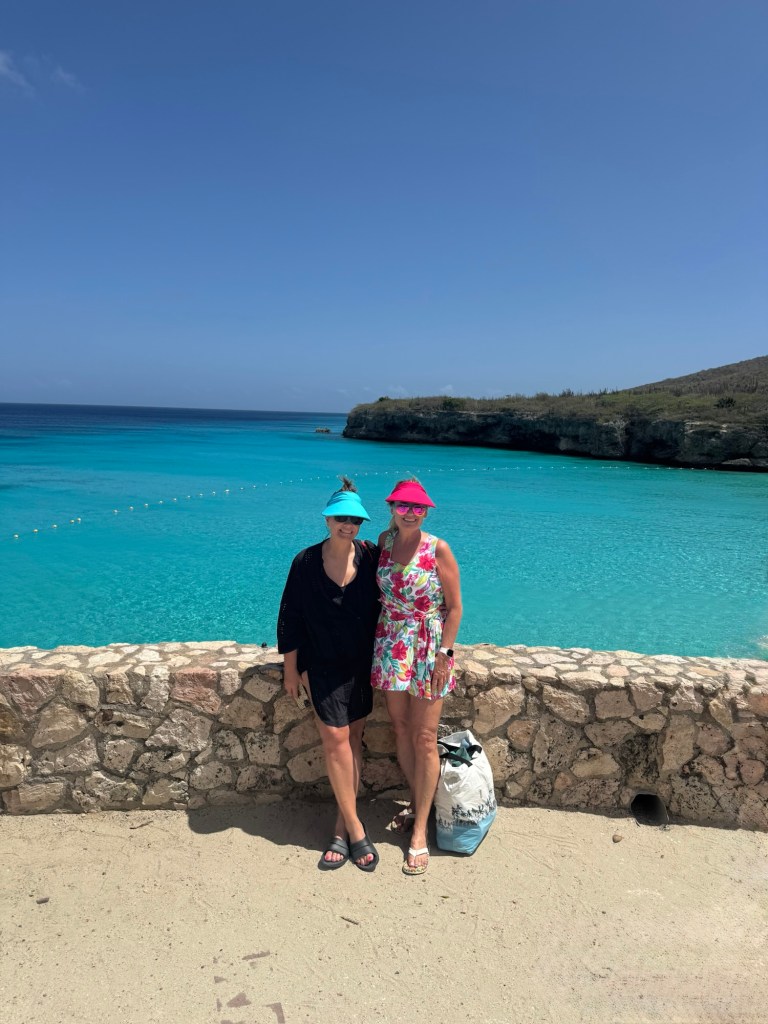
Looking at the Palapas…the ones to the right have hammocks over the water.🦎View from the Palapas where it poured down rain 🌧️ for about 15 minutes and then was sunny for the remainder of the day.What a way to end the day at Blue Bay Beach!First on the day’s agenda— Grote Knip Beach 🏝️… I am not sure I have ever seen water this turquoise and clear! No entrance fee, but a $15 charge for two chairs and an umbrella. You can bring in your own food/drinks. There’s a yummy smoothie place right by the parking lot.Beaches are the best with friends! 🩷🩵
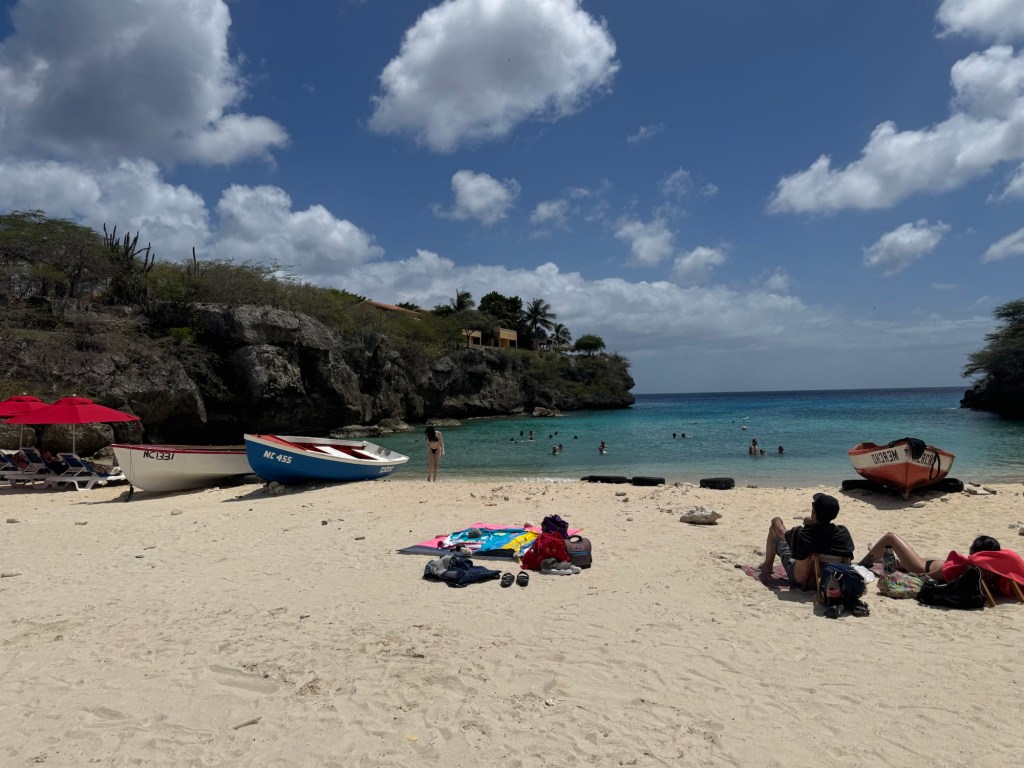
From the lookout point (which serves as a jumping off point for some brave divers), you then walk down a couple flights of stars to the beach below. On to Playa Lagun 🏝️ for a quick peek. The fishing boats make a great backdrop.Next up – Cas Abao Beach!🏖️ We paid $6 a car (and you then travel via a gravel road for 5 minutes). You also pay for chairs. They have a snack bar/bar, and your chair ticket gets you a token for the shower.
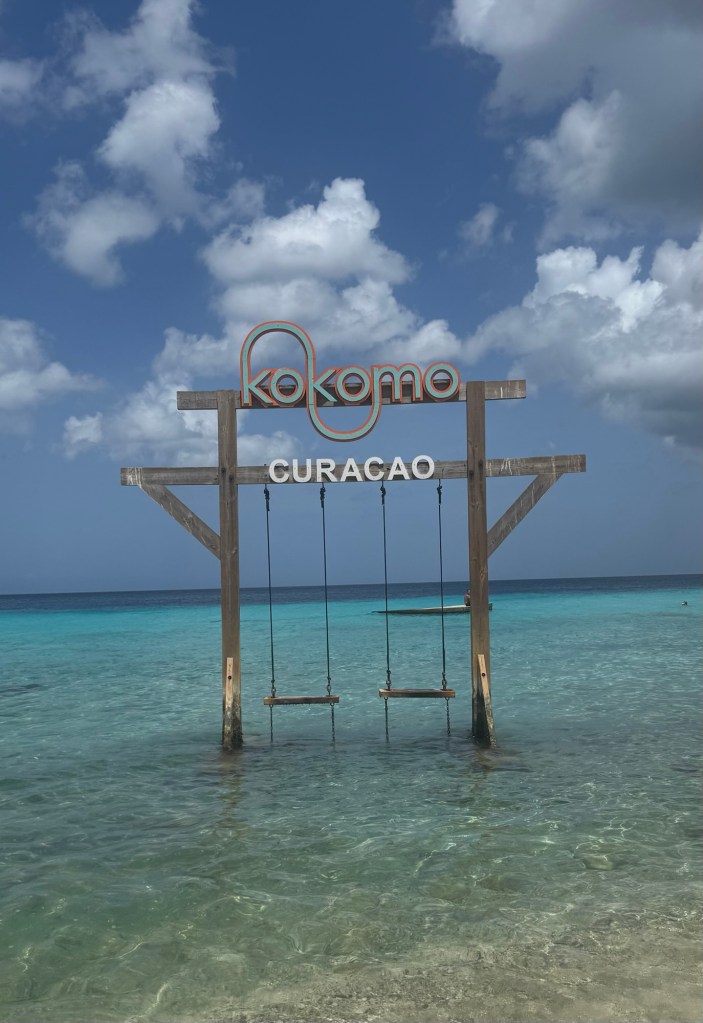
The next day we drove about 10 minutes from Blue Bay, passed a Flamingo preserve, and went where The Beach Boys sang it best… “There’s a place called Kokomo, that’s where you wanna go to get away from it all. Bodies in the sand, tropical drink🍹melting in your hand, we’ll be falling in love🩵 to the rhythm of a steel drum 🥁 band, down in Kokomo…”
Kokomo Beach, Curacao🧡
Kokomo Beach has swings! Careful getting out there as it’s a bit slippery. Then there’s a short pier and a floating deck we swam out to as well. This beach was one of my favorites. I felt like I really could get away from it all!
In addition, there’s a dive shop with finds from the USS Erie, a ship that was torpedoed and beached off Curacao during WWII on November 12, 1942.
And we finish the trip with pina coladas mixed with the famous Blue Curacao liquor. Until next time!🩵
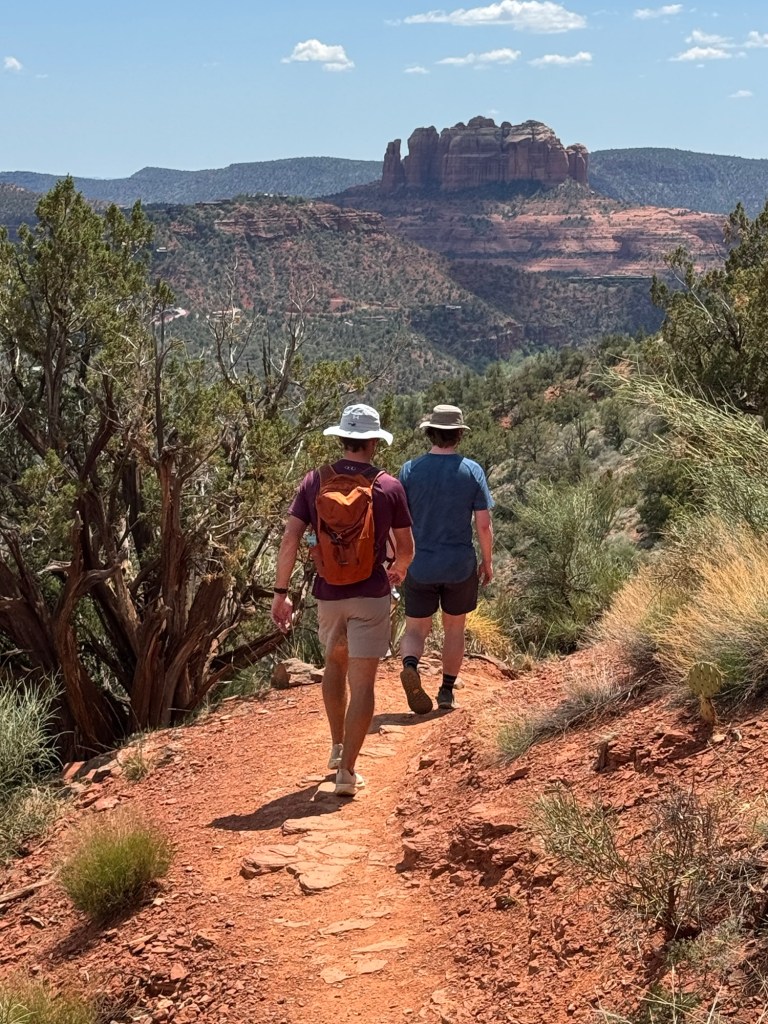
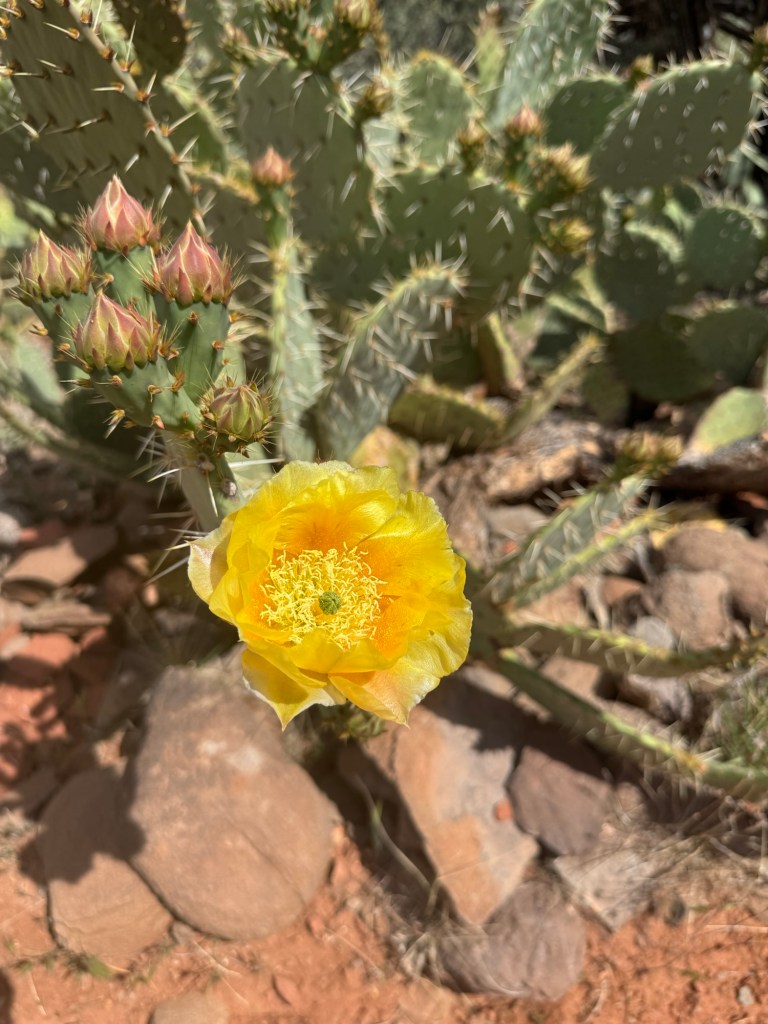
This is my 4th time visiting the beckoning red rocks of Sedona and if I can help it, it won’t be my last. There are few places where I could actually live vs visit…Sedona ranks right up at the top of the list.
Sedona has 4 vortexes—energy sources concentrated in specific areas that impact spiritual, emotional and physical well-being. Although not proven scientifically, there are several sites around the world that also claim vortex status— the Great Pyramid in Egypt, Machu Picchu in Peru, Stonehenge, Bali, Uluru/Ayers Rock in Australia to name some of the more popular ones. Whether you believe it or not, it’s a magical town, where buildings must blend into their background, the food is top notch, hikes are unforgettable, and the red rocks take your breath away.
This Mother’s Day, I had the opportunity to meet both of my sons in Phoenix (one already lives there) and we drove two hours to Sedona. While we didn’t have a lot of time, we got some of our favorites in. And, most importantly, we spent time together. It couldn’t have been a more perfect weekend.🧡
We stayed in a place that was new for us—The Wilde Resort & Spa. I would highly recommend it. Wonderful grounds with hammocks, cornhole, fire pits, swimming pool with bar, hot tubs, an onsite spa (Victoria got out the hiking knots!), and restaurant. I will definitely stay there again.
I really wanted to eat at Elote Cafe when we arrived but reservations book up months in advance. Luckily, they had a cancellation when I called and we kicked off the weekend at one of the best restaurants in town. Don’t forget to get the Elote Dip!
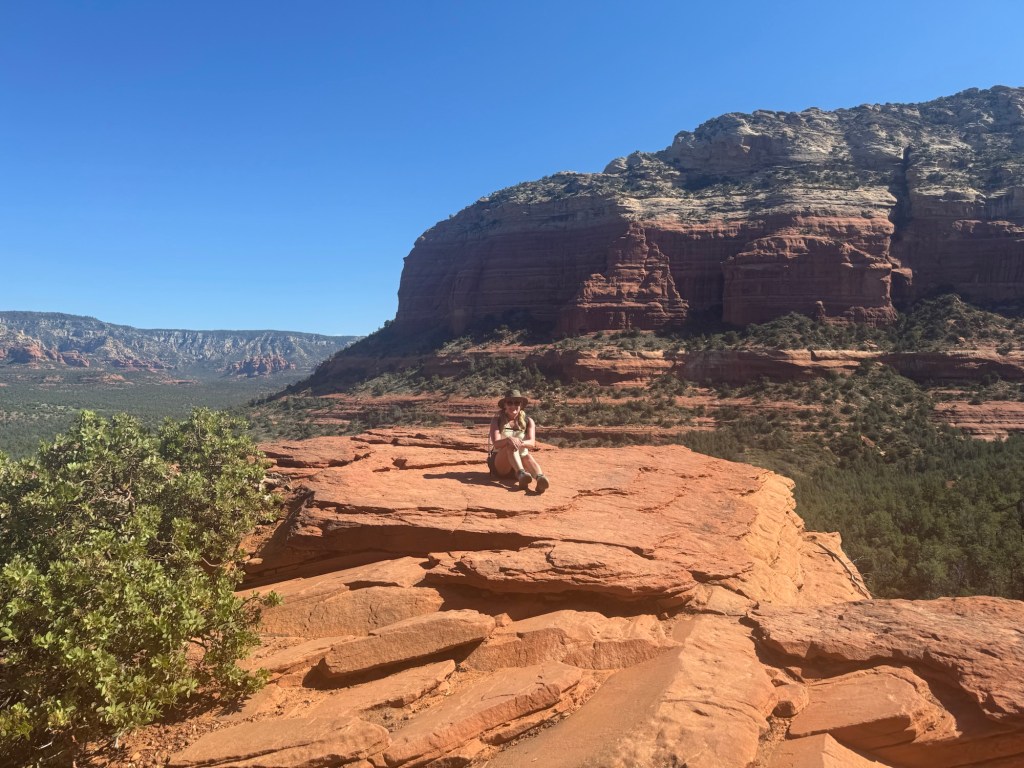
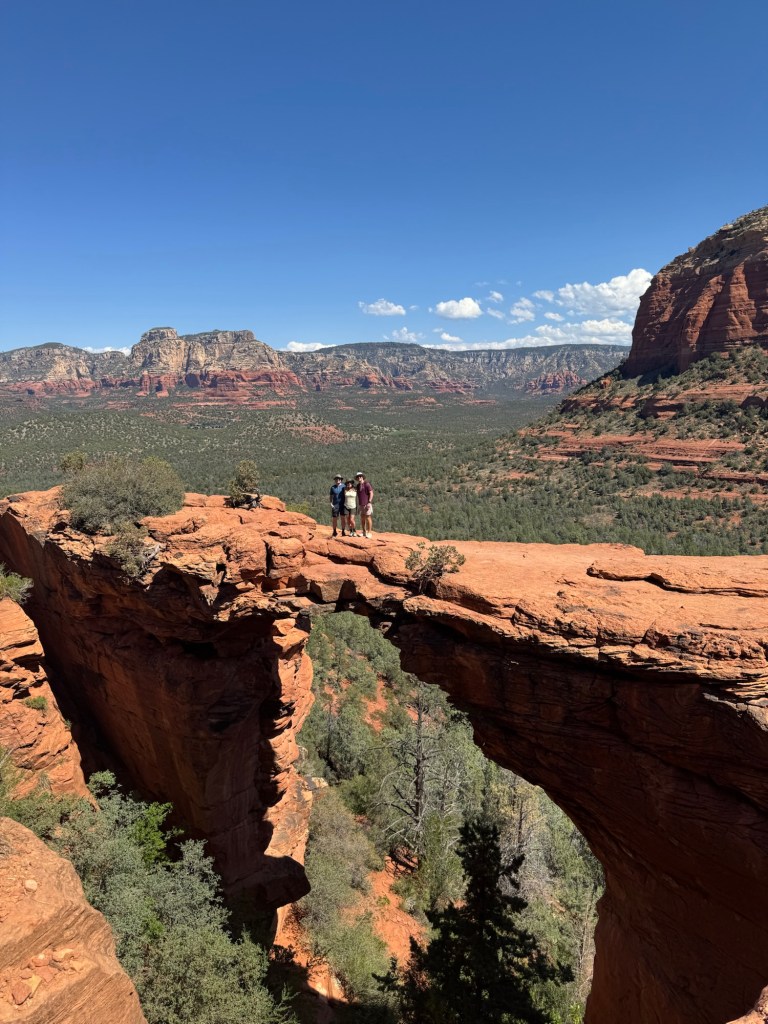
Hiking to Devil’s Bridge—moderate hike about 4 miles out and back. We started from Mescal.Devil’s BridgeAirport Loop hike – one of the vortexes is at the Airport Mesa. The other 3 can be felt at Cathedral Rock, Boynton Canyon, and Bell Rock.
We stopped for lunch at Mesa Grill —the airport’s restaurant (make reservations!). This is one of our very favorites…the table side guacamole 🥑 is some of the best I have ever had at a restaurant
Admiring the planes that land/take off on top of the mesa
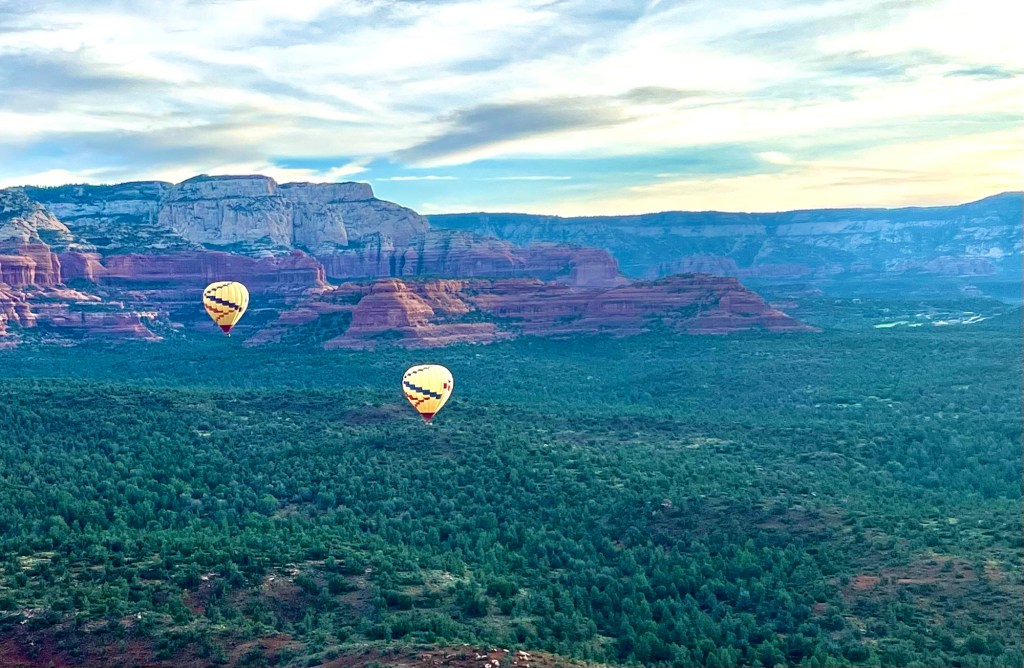
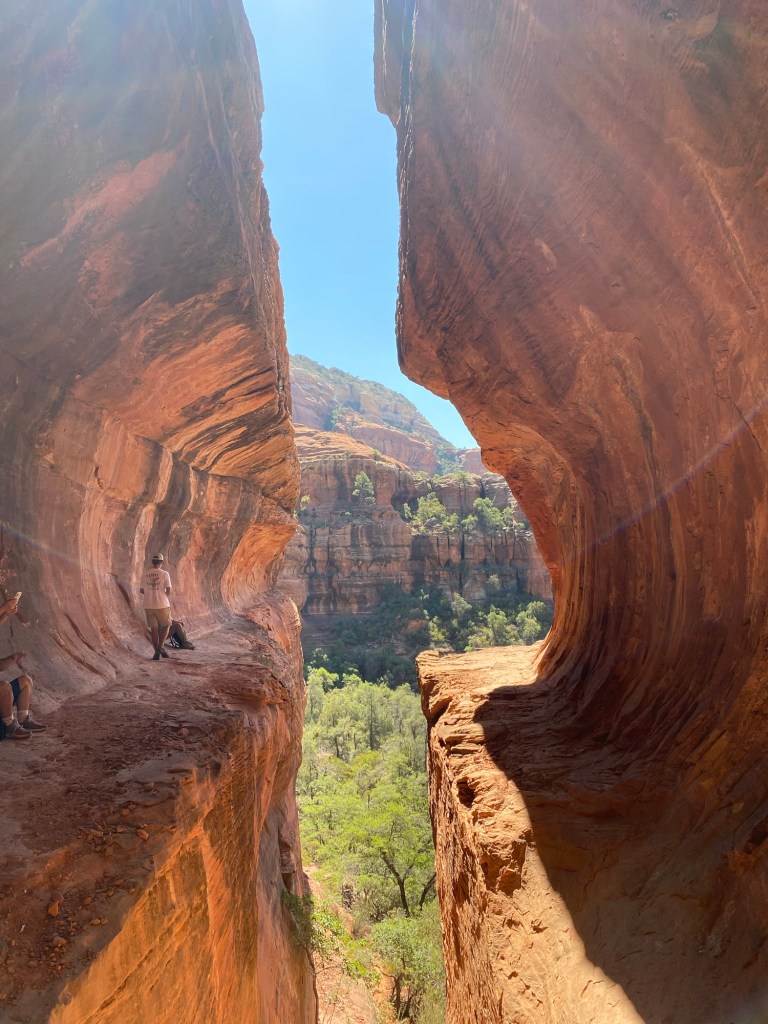
Here are a few pictures from when I have been in Sedona previously…
Floating over the Red Rocks in 2022 – such a perfect place for a hot air balloon rideSubway hikeSubway CaveBell RockCathedral Rock
So many pictures, and I cannot post them all. Here are a few other important sites in the capital of Catalonia. Catalonia is an autonomous community of Spain. Catalan is the official language in Catalonia, the Balearic Islands, and the Valencian Community (also called Valenciano), along with Spanish.
La Catedral de Barcelona in the Gothic Quarter Mercat de la Boqueria – I could eat here every day for a year and still not eat everything that they have. One day I had a delicious cup of strawberries drizzled with Nutella A traditional street in the Gothic Quarter Port of Barcelona on a sunny spring day!