Today was the day that Brendan and I went our separate ways. He’s here for another 6 days and I leave tomorrow from Auckland. Therefore, after he left to drive to Kaikoura, I explored Christchurch in the daylight before flying back to Auckland.
Here are the top 10 things that I learned and enjoyed about this inviting city:
1️⃣ Christchurch is the largest city on the South Island and second largest in New Zealand with 407,000 people and 556,000 in the metropolitan area.
2️⃣ It’s been an Antarctic gateway since 1901 (of special interest to me!)
3️⃣ Christchurch suffered a series of earthquakes starting on September 2010, with the worst occurring on February 22, 2011. 185 people were killed and thousands of buildings suffered severe damage. Many of the central city’s building collapsed, and there are still rebuilding projects happening today.
While this wasn’t New Zealand’s largest earthquake, it was devastating due to a perfect storm: middle of a work day, struck right under the city, the ground itself failed, older buildings were not designed to withstand earthquakes due to unreinforced masonry (stone/brick), and the aftershocks continued to weaken the structures.
4️⃣ Because of the earthquake, the city is a blend of old and new with historic stone buildings standing alongside modern architecture, all stitched together with art, great food, and a sense of reinvention after the earthquake.
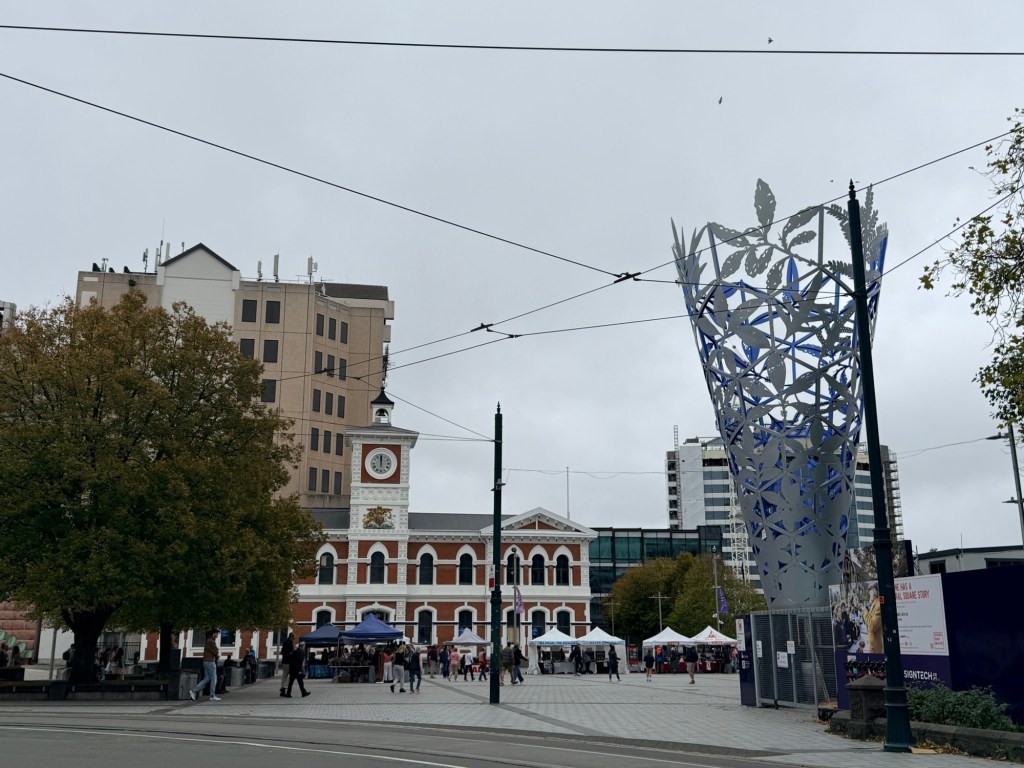
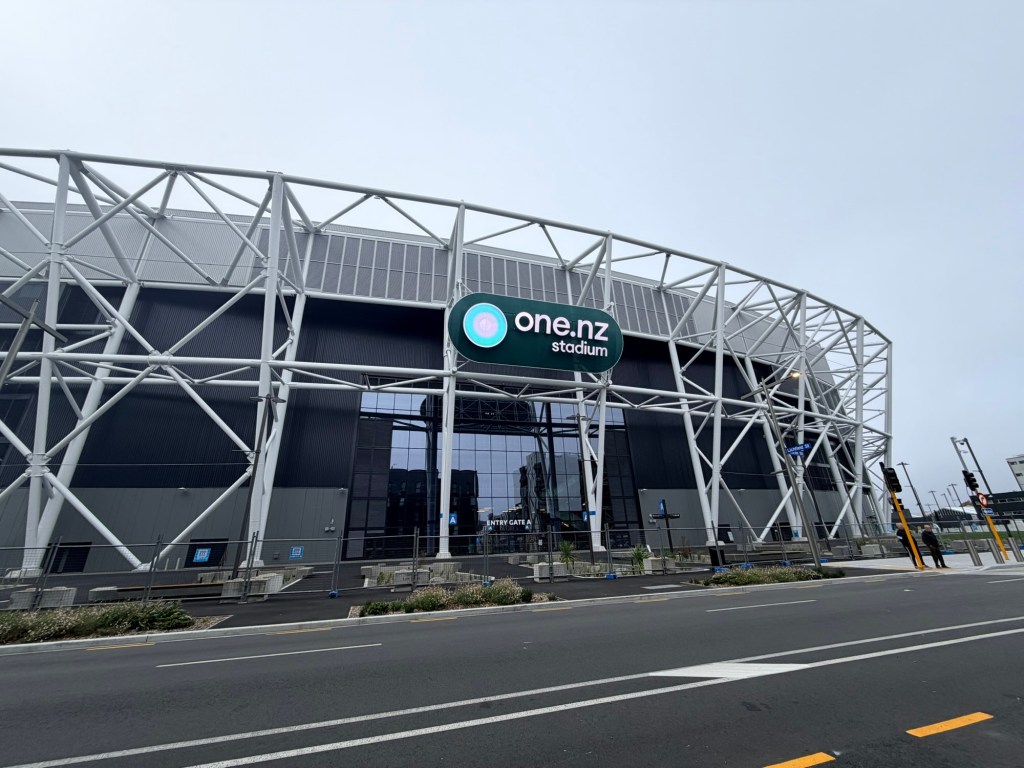
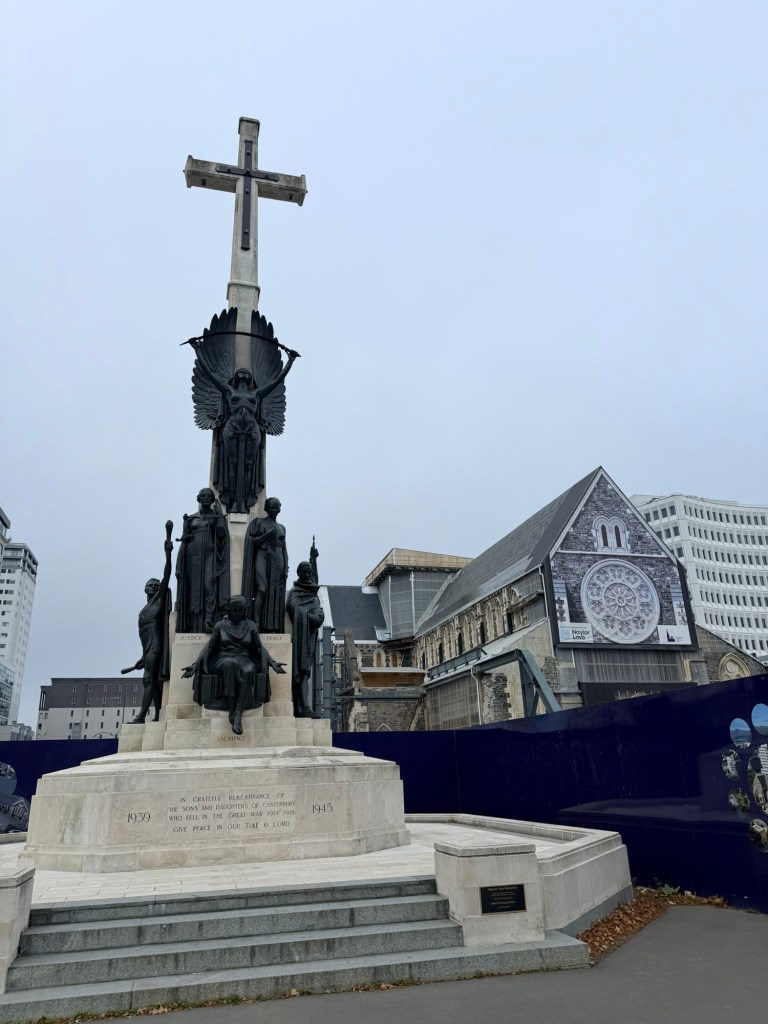
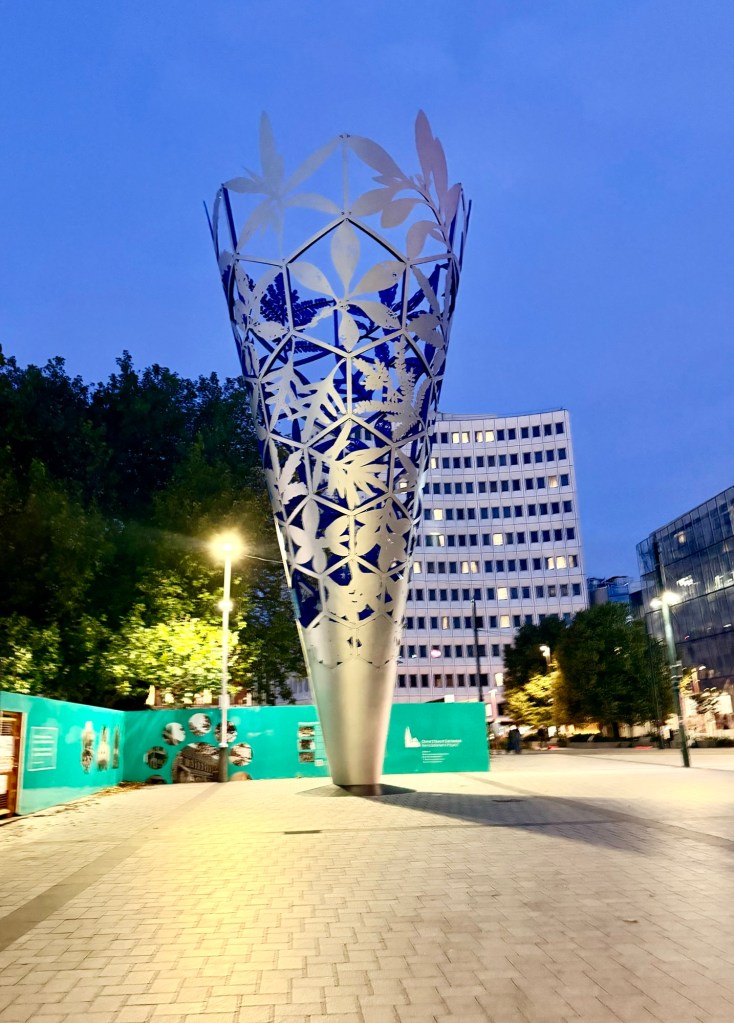
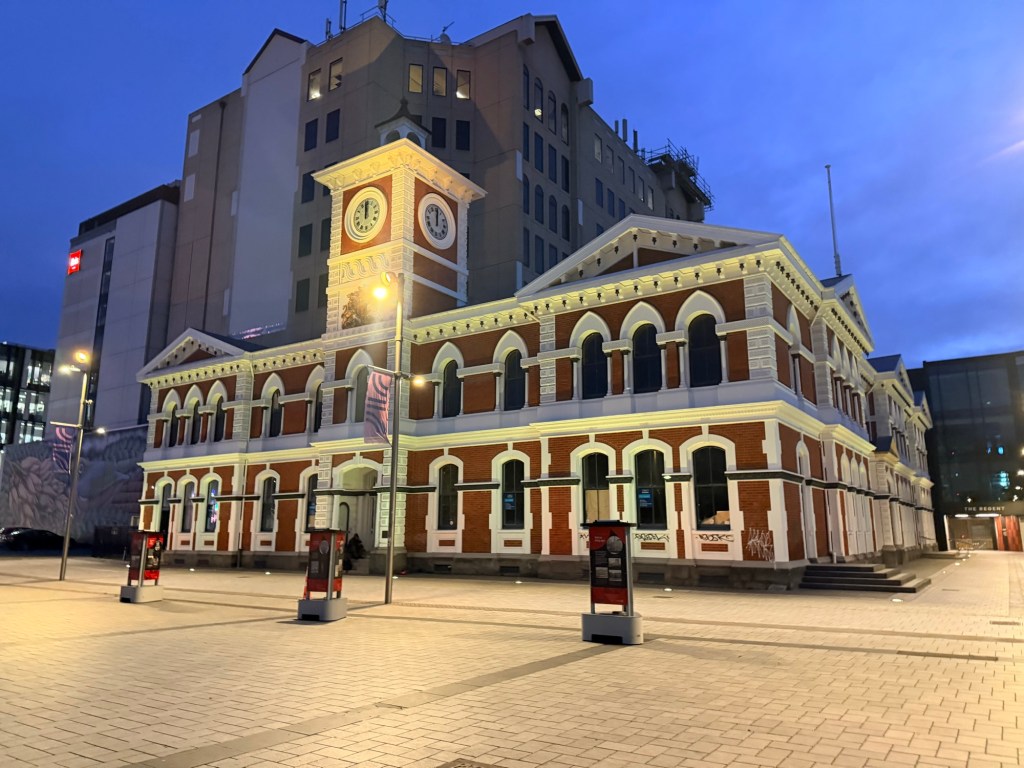
The Chalice Sculpture from 2001 with the former Chief Post Office from 1879. Both are located in Cathedral Square. One.NZ Stadium will open this year. It’s a multi-purpose arena that features a fixed roof and seats up to 36,000 people.
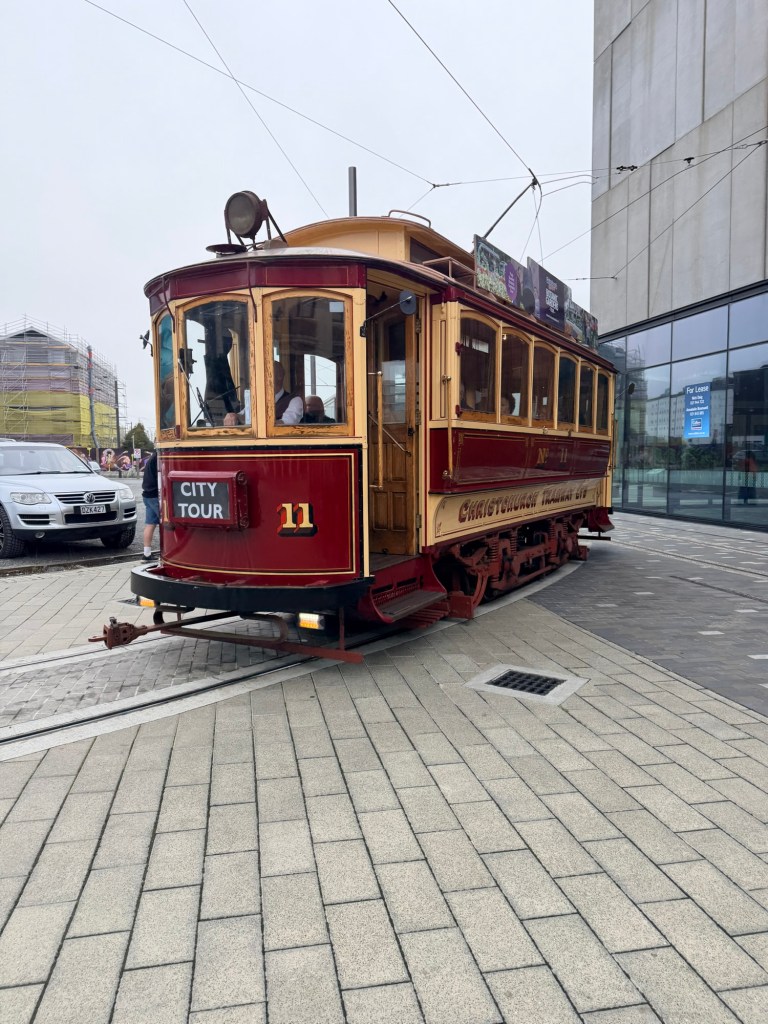
5️⃣ I hopped on-off the tram to learn more about this incredible city centre.
The Tram, which goes to 18 different stops throughout the city centre.
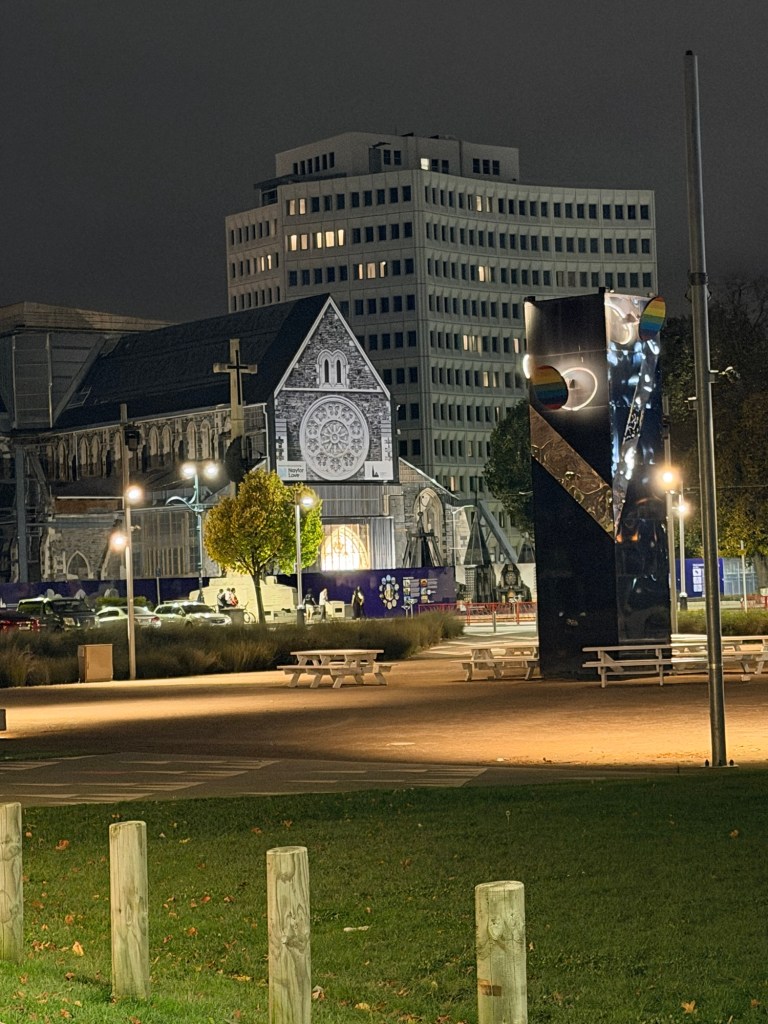
6️⃣ The focal point is the Christchurch Cathedral which stands in the heart of the city. It suffered tremendously after the earthquake and was closed.
Today it’s part ruin, part rebuild, and a powerful reminder of everything this place has been through and where it’s going.
They had an option to demolish it or refurbished it. The city chose to refurbish it, but it’s been far more expensive than originally thought. They didn’t exactly run out of money, but the rebuild got so expensive that funding couldn’t keep up, so the project had to pause. Now it’s being reworked in stages to with construction expected to restart and an aim for partial reopening by ~2030.
The face of the cathedral is a fake façade (a printed version). This is how it looked and how it’s going to look when finish.
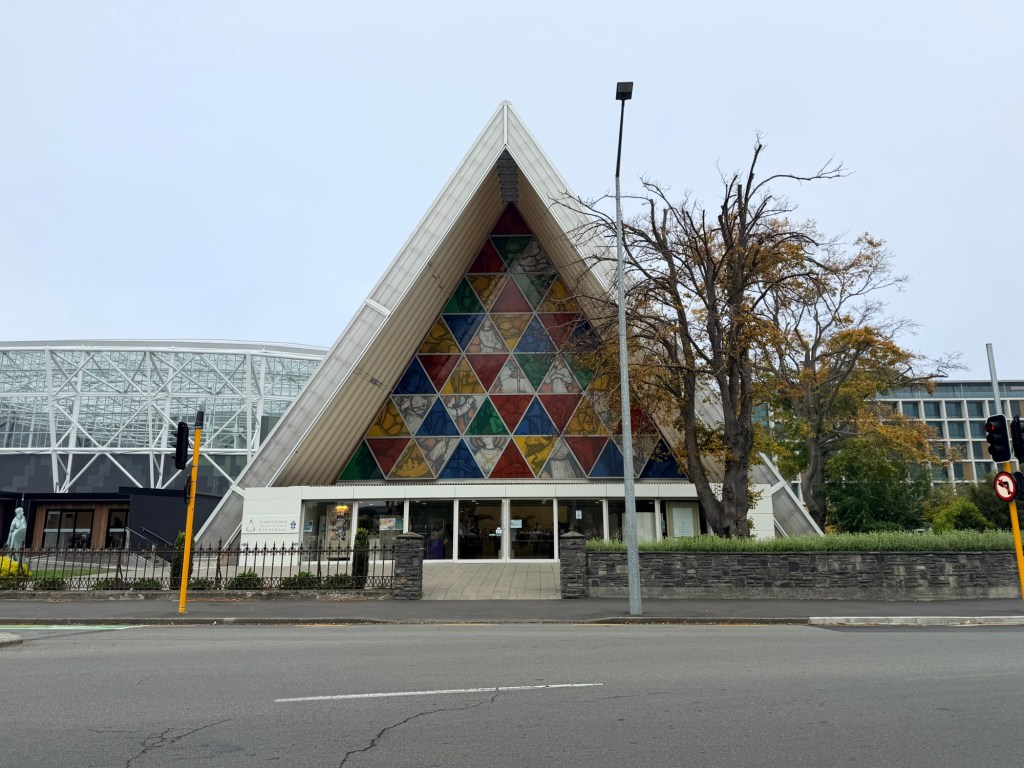
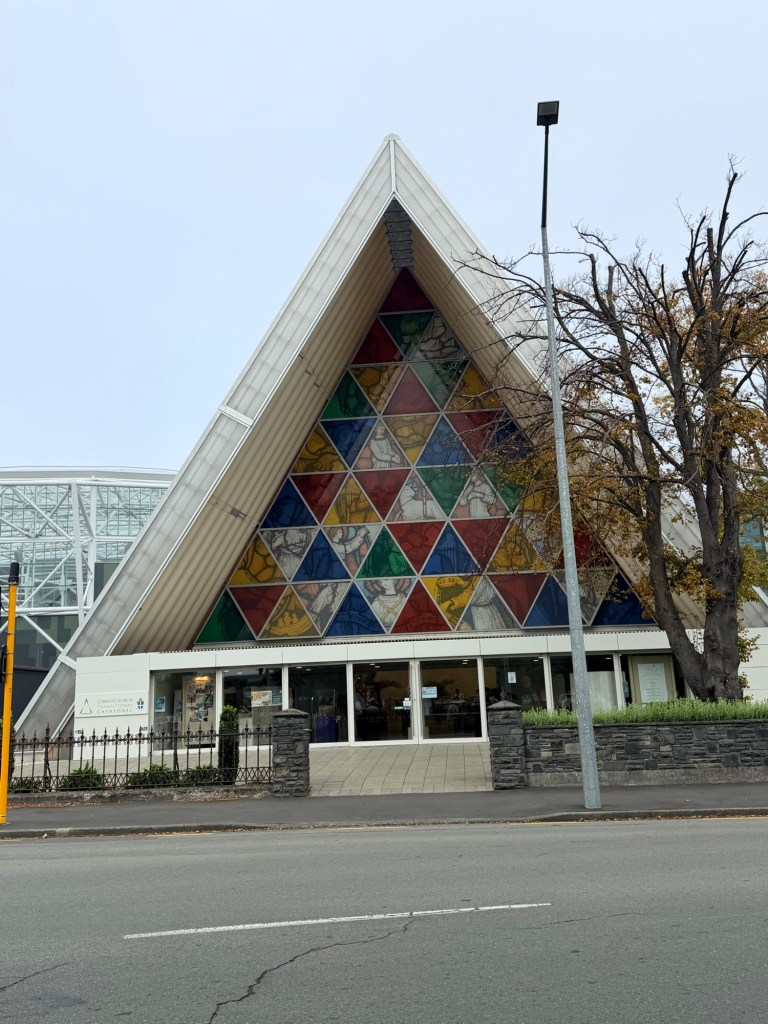
7️⃣ The Cardboard Cathedral (Transitional Cathedral) —They didn’t have a working church after the earthquake in 2011 and the city needed a temporary home for worship and bringing to people back together.
Japanese architect, Shigeru Ban, is known for using unconventional materials (like cardboard) in disaster zones and designed a cardboard church!
Built in 2013, it’s made with 98 massive cardboard tubes that have been reinforced with both timber and steel. It’s a A-frame and built to last 50+ years.
It’s also water and fire resistant.
I could not go inside as there was a worship in progress but I did walk around it and could see how it’s a symbol of creativity after disaster.
The Cardboard Cathedral
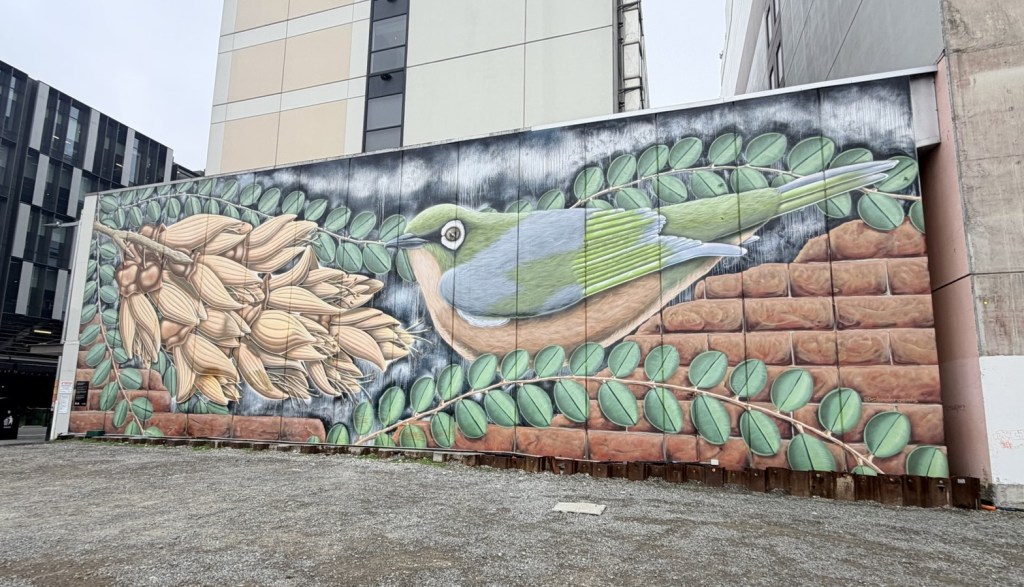
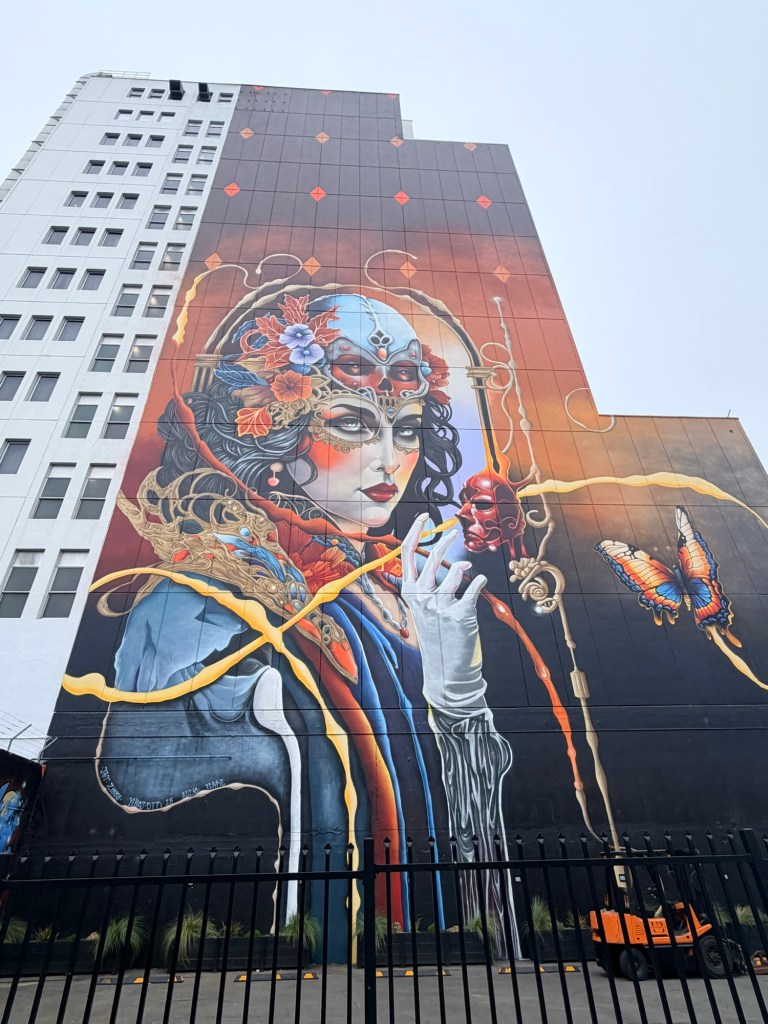
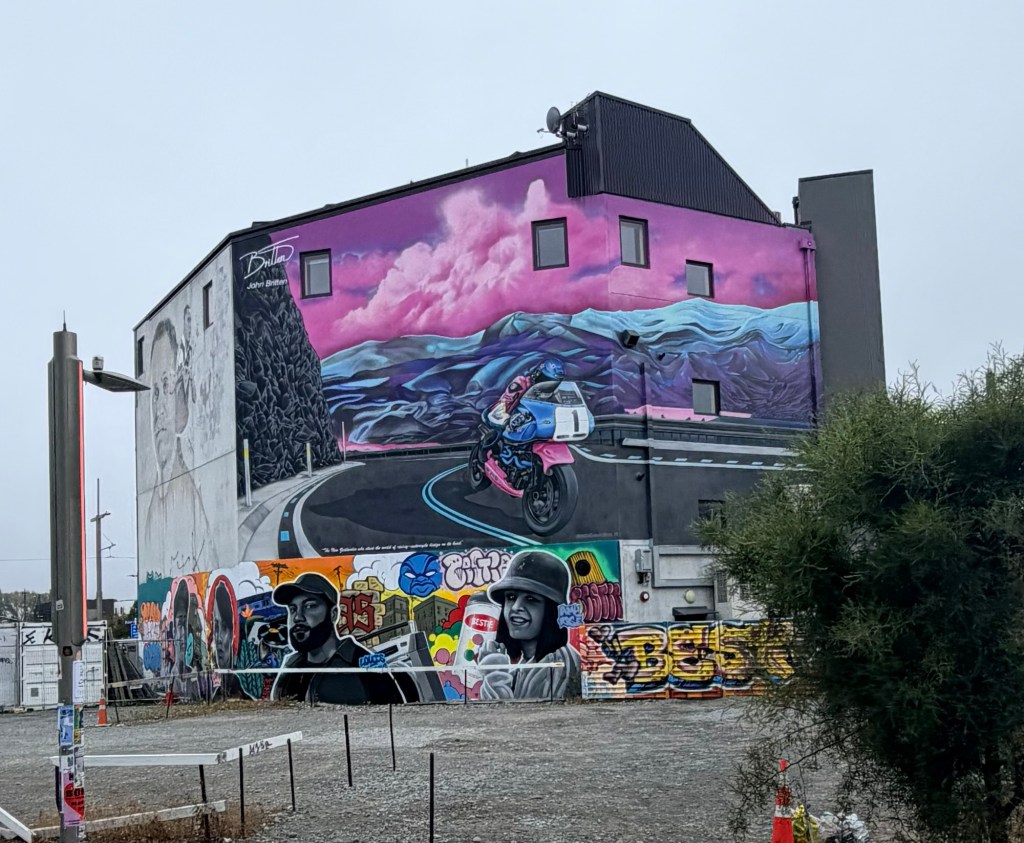
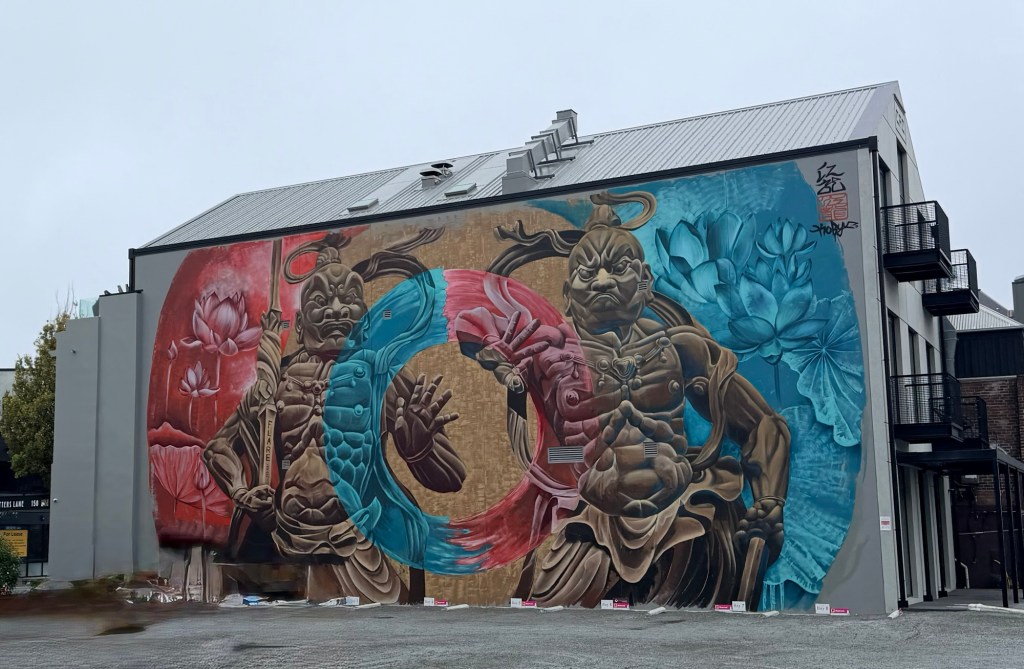
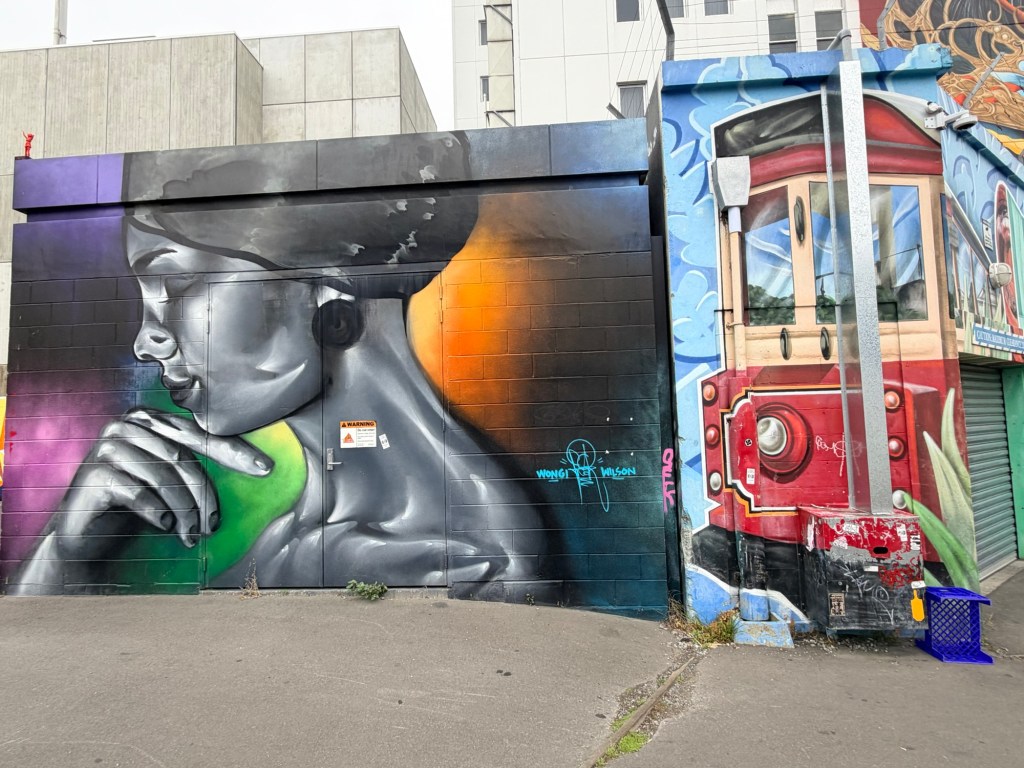
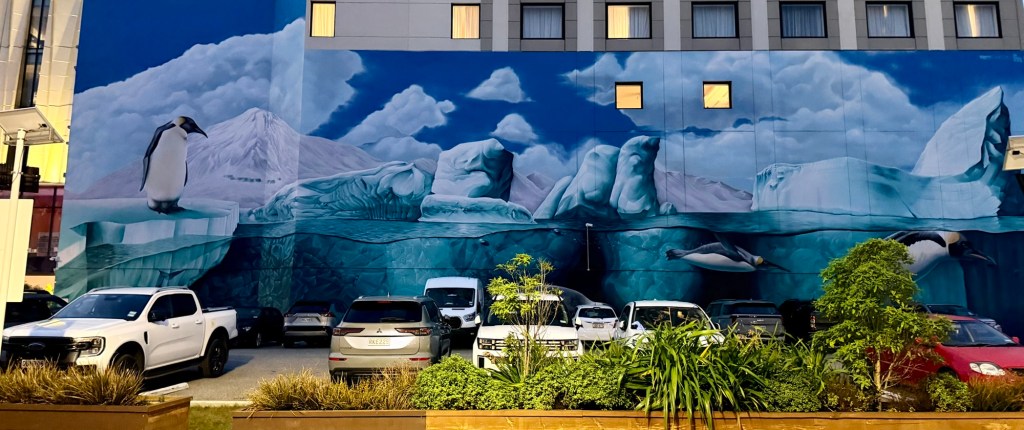
8️⃣ The murals are incredible! These are also a result of the earthquake in 2011. Christchurch doesn’t hide its rebuild, it paints it. From native birds to faces of locals, these blank walls tell stories of resilience, creativity, and starting over.
9️⃣ The food. Wow.
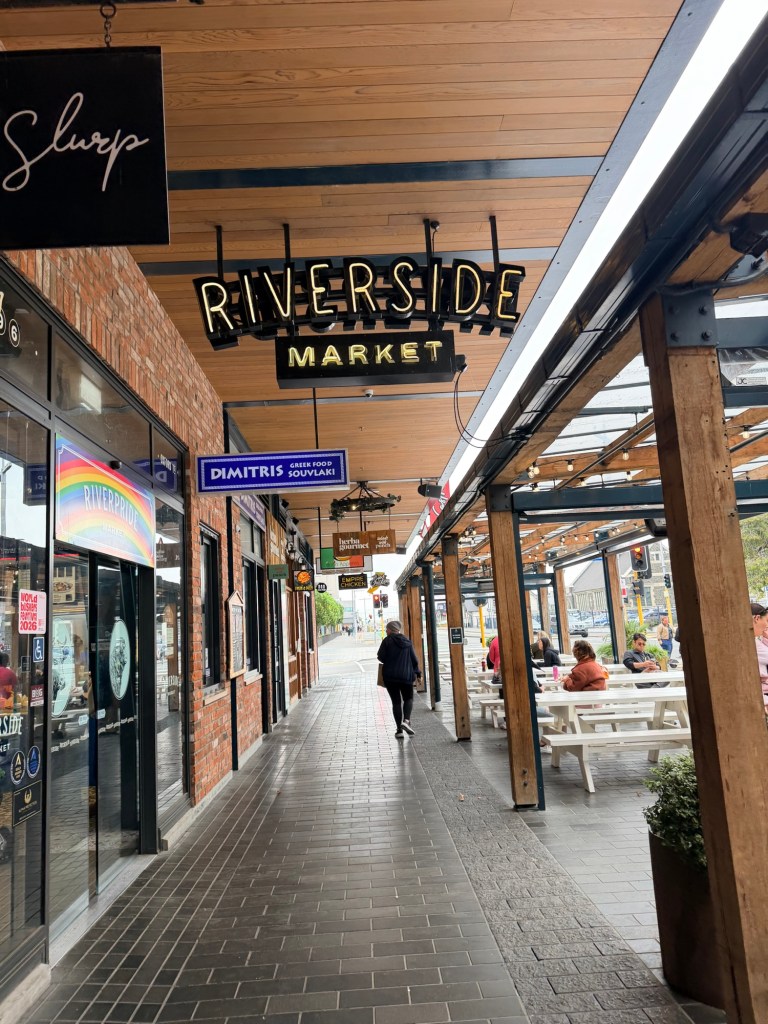
In less than two days, Christchurch completely delivered (see last night’s dinner under post from yesterday). Today I wandered through Riverside Market and sampled local cheeses (thank you, Charring Cross Cheesery!). This city takes its food seriously.
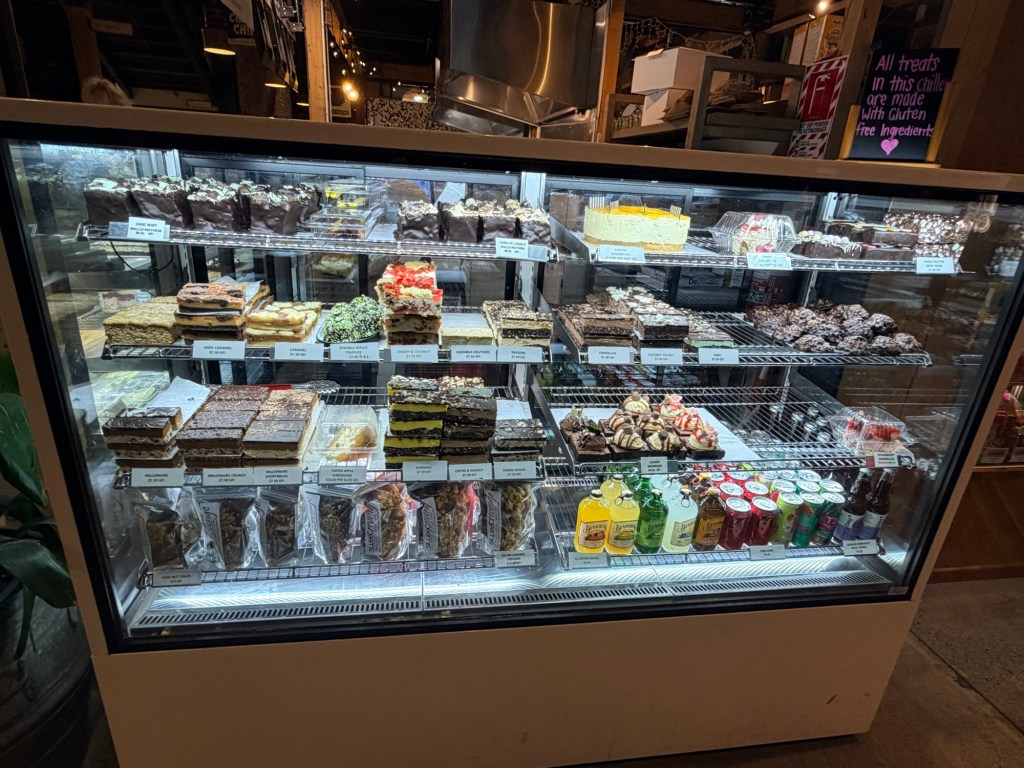
Then I found it—the holy grail of gluten-free pastries.
An entire case, all GF (yes, really), and I just stood there trying to decide where to begin. If you’re gluten-free, you already know…this was a moment.
Sweet Revenge in Riverside Market. I had their cookie/chocolate slice!
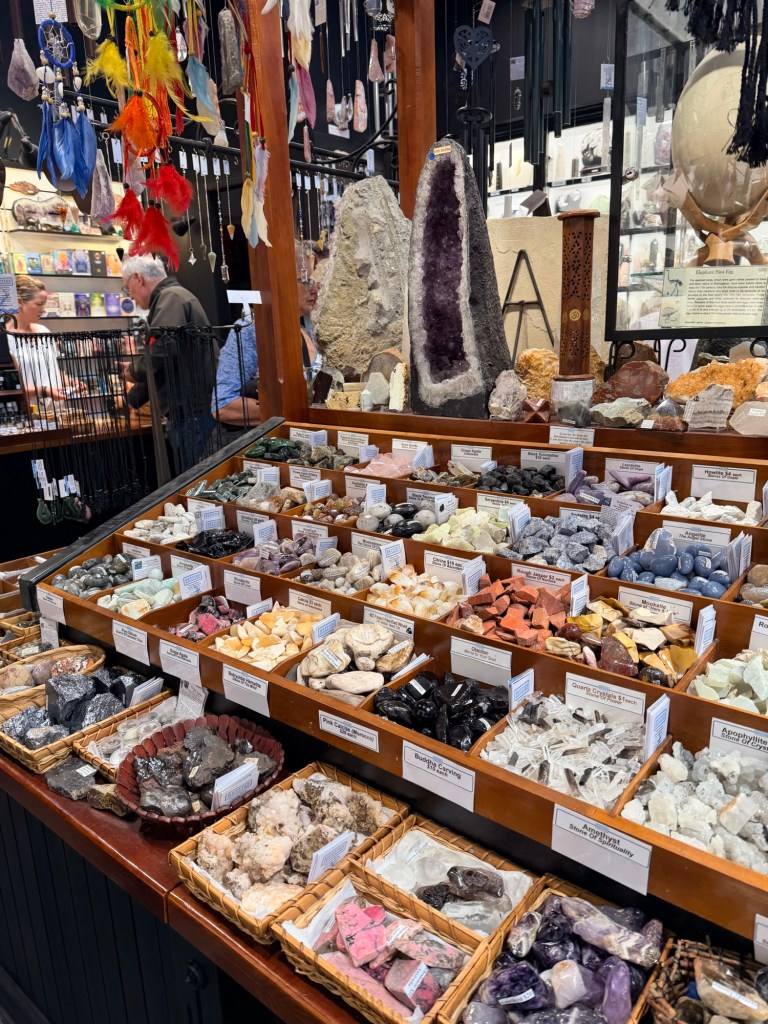
🔟 I found a rock and crystal shop! It’s always a good day when I can look at rocks!
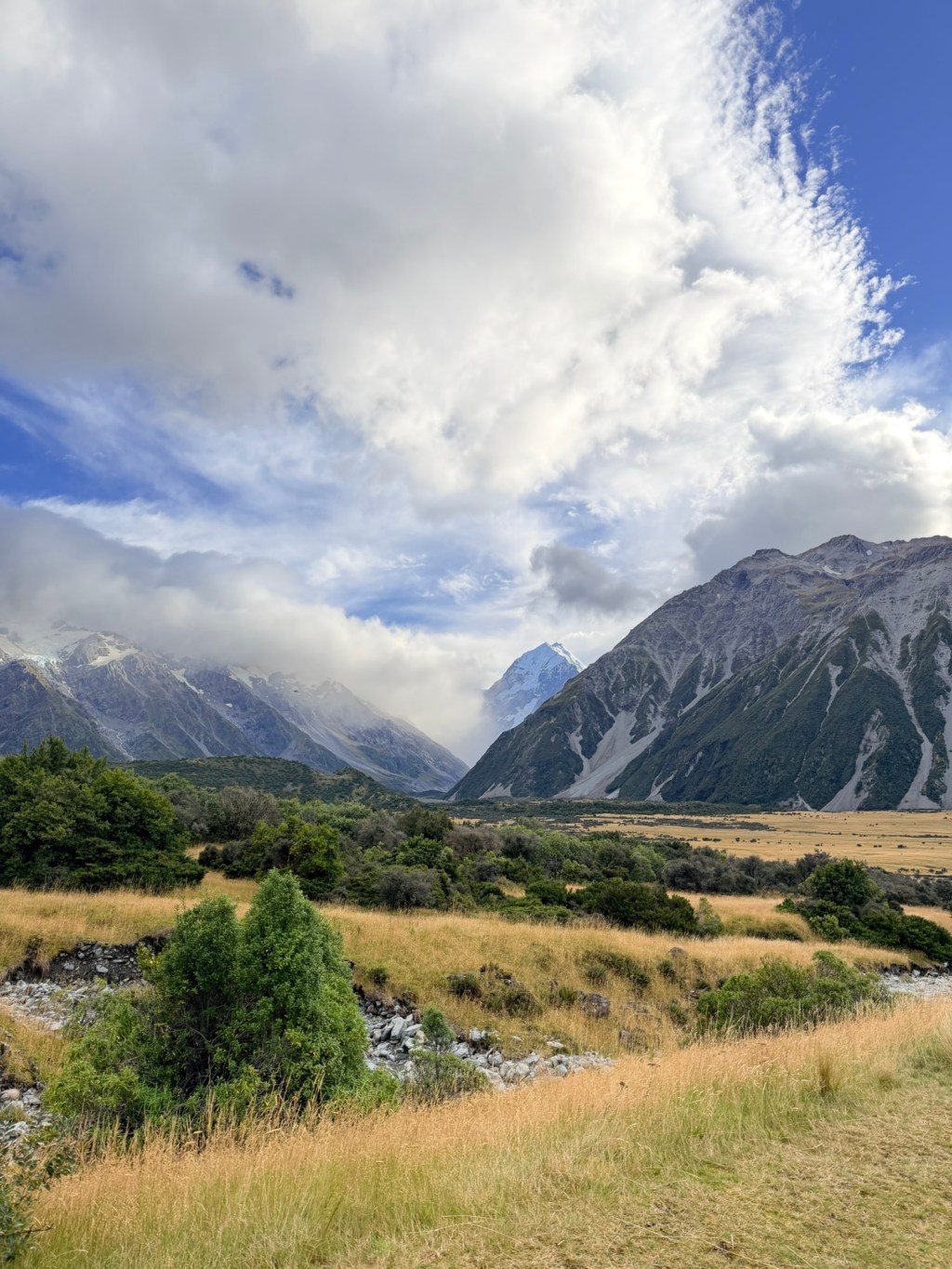
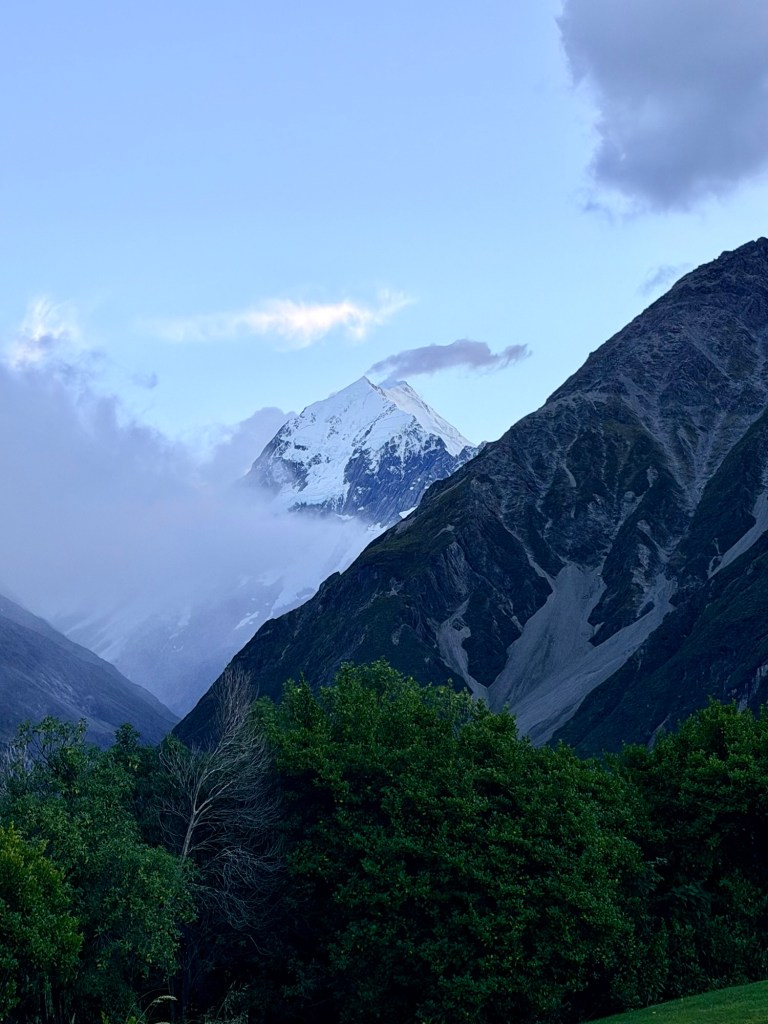
We woke up this morning at The Hermitage Hotel to something we hadn’t seen in two days—sun☀️! And just like that, there it was…Aoraki / Mount Cook, finally showing off after being completely hidden behind rain and clouds. Worth every bit of the wait.
Good morning, Aoraki / Mount Cook (view from The Hermitage Hotel).
We took our time leaving (hard not to), then hit the road to Christchurch. What should’ve been a shorter drive turned into 5½ hours with all the stops. And honestly, that’s the only way to do it.
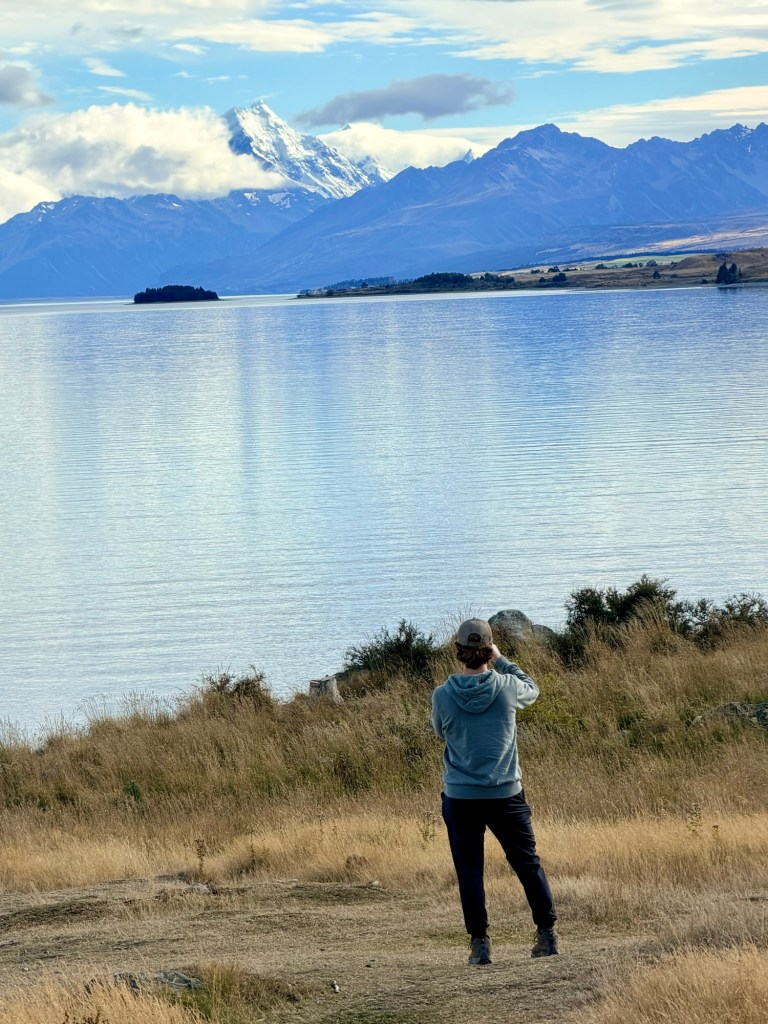
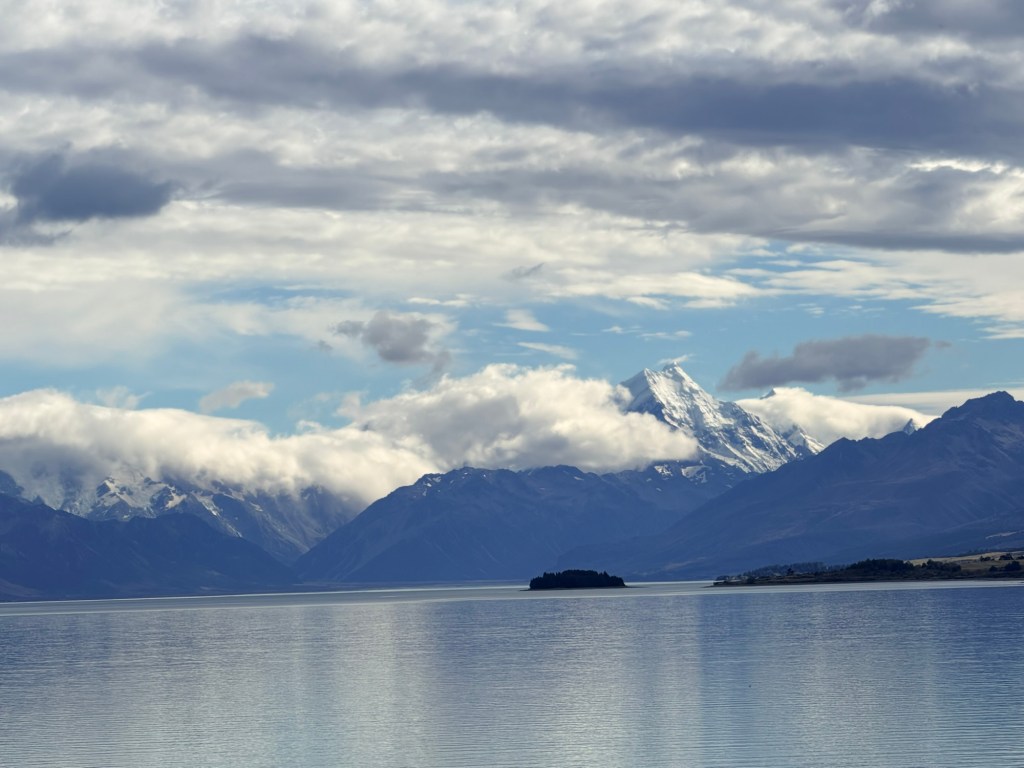
Back along Lake Pukaki, the water was still that signature glacial blue—but without full sun, it wasn’t as turquoise.
Taking a picture of Brendan, who is taking a picture of Lake Pukaki. Aoraki Mount Cook breaks through the clouds.
We continued on to Lake Tekapo, where the same thing held true—those unreal blues, just a touch softer under the clouds.
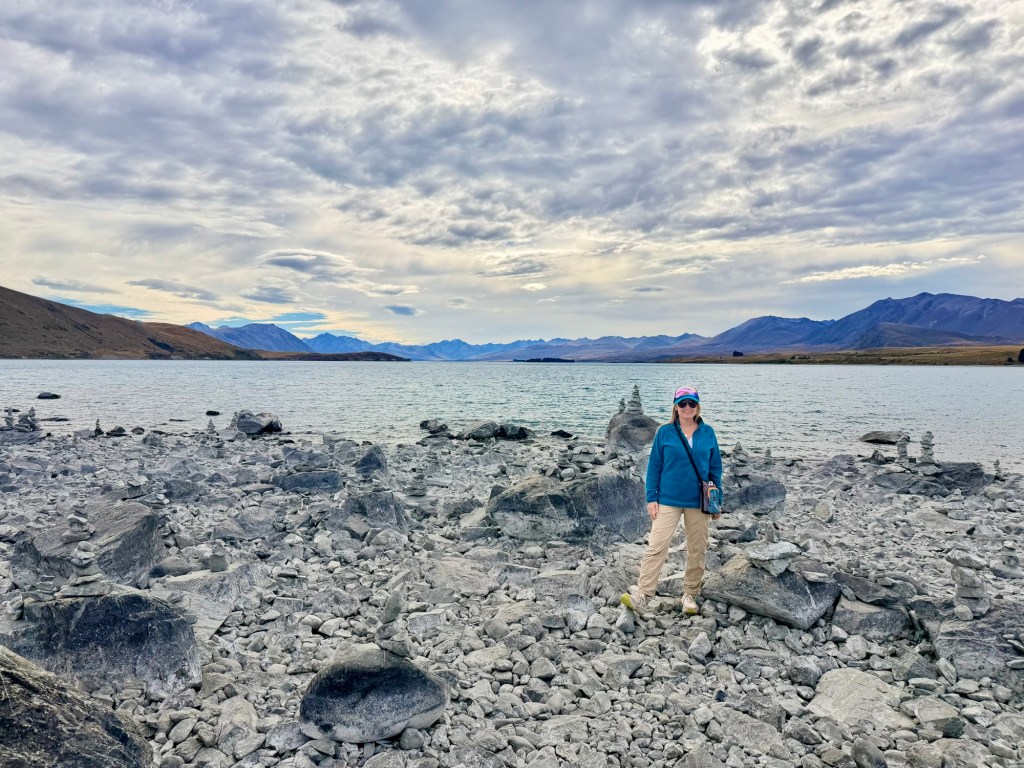
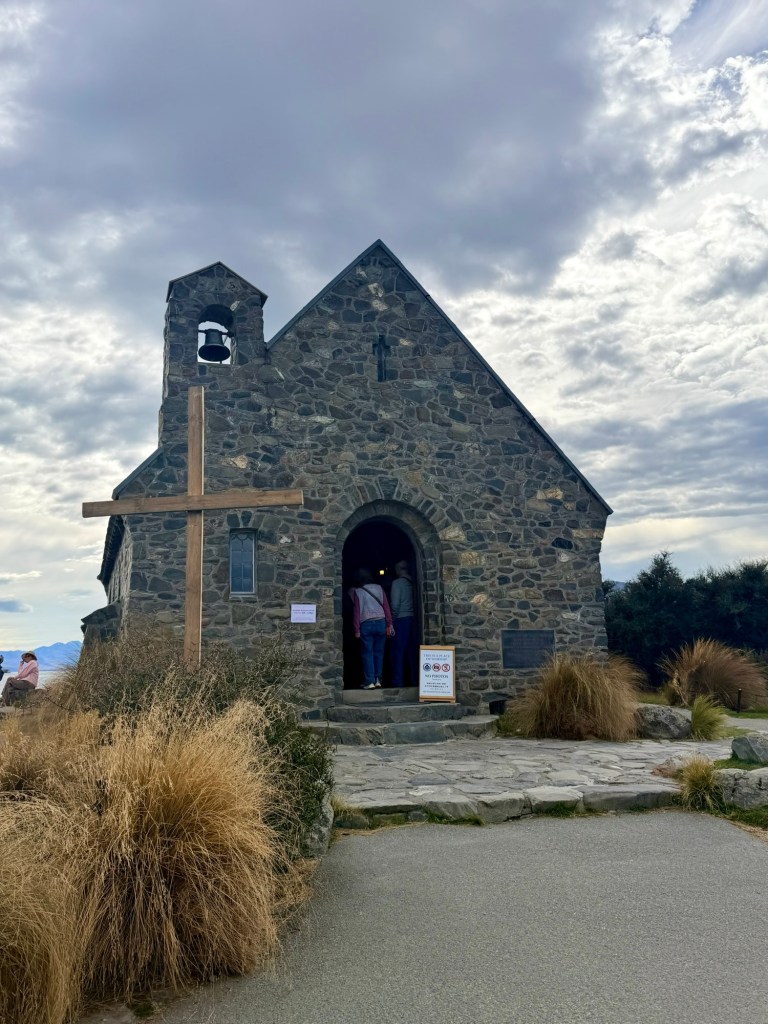
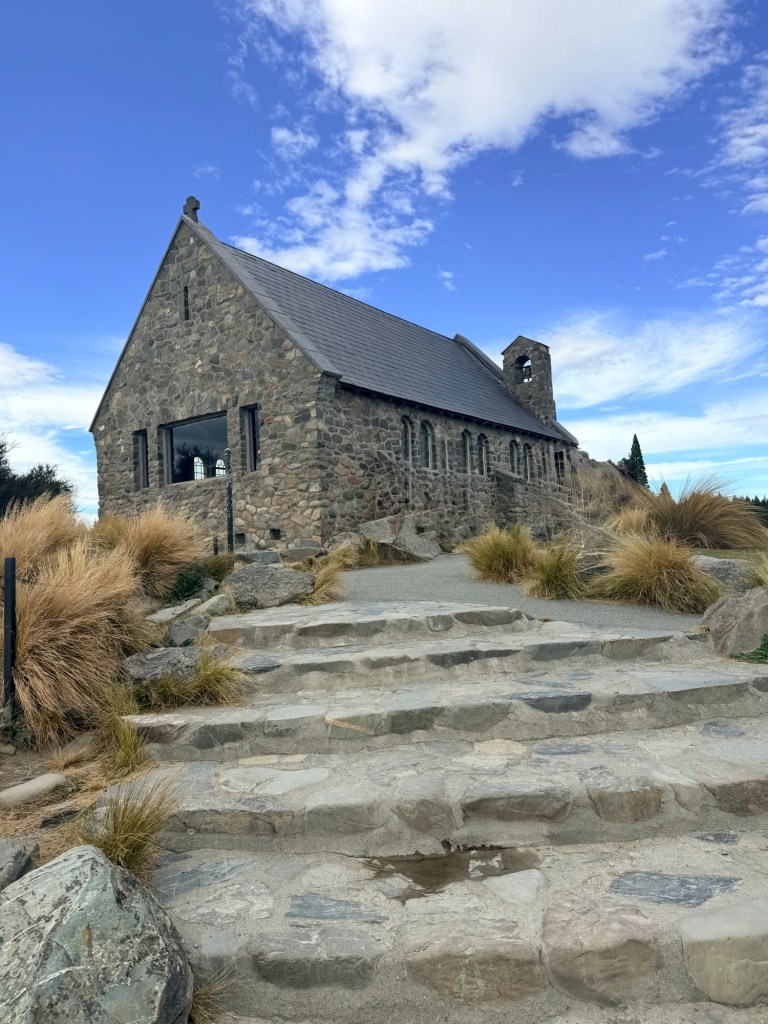
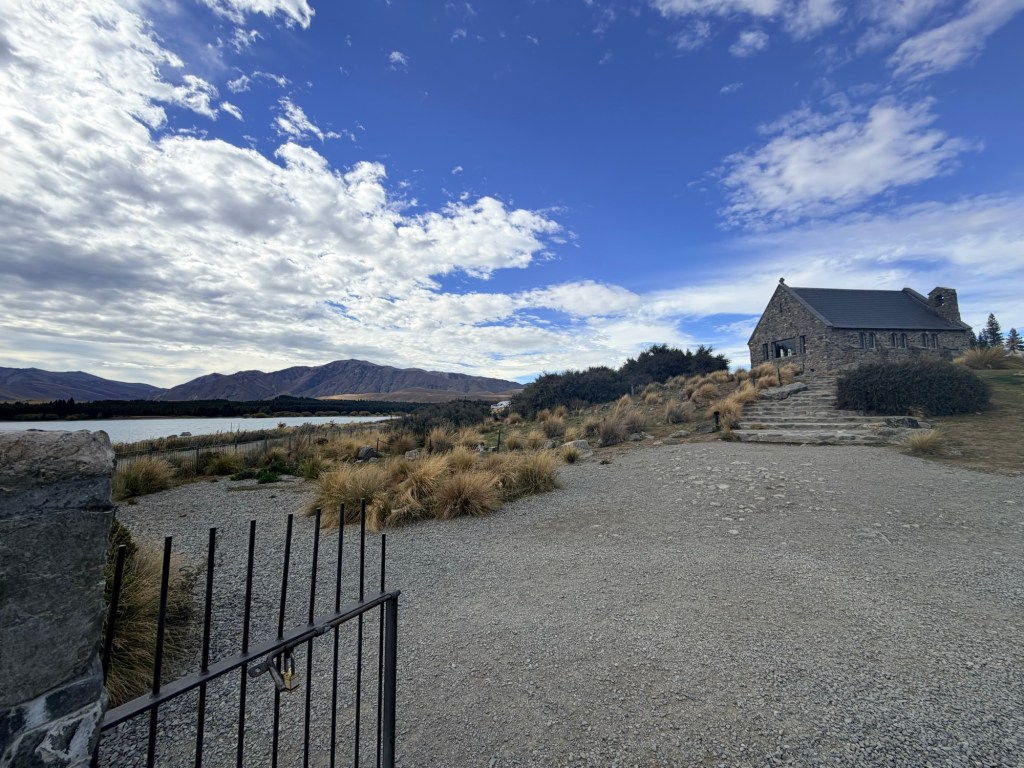
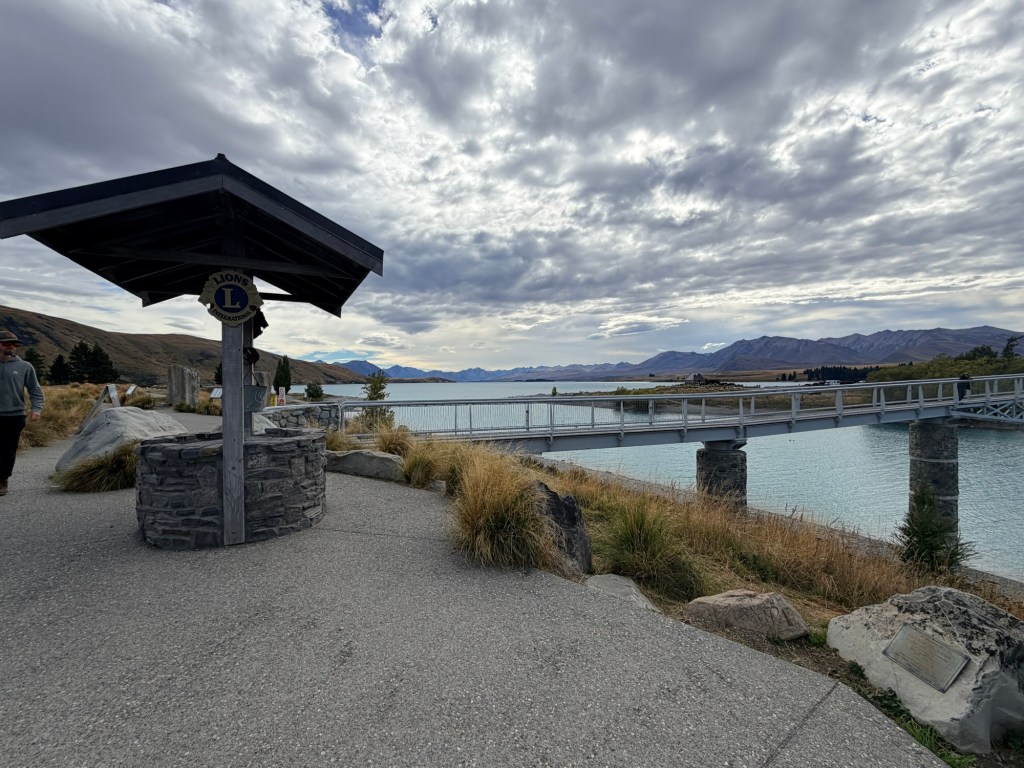
Lake Tekapo is another glacial lake on the South Island. This area is part of a Dark Sky Reserve. I wish we could have hung around for stargazing 🔭 as they say it’s one of the best spots in the world.The Church of the Good Shepherd was build in 1935 as a tribute to the early settlers of the Mackenzie Basin and named after the sheepdogs that helped these early farmers survive the harsh winters. It was designed to blend into the landscape as it sits on the edge of Lake Tekapo with the Southern Alps in the background. While no pictures are allowed inside, there is a large window that frames the lake and mountains instead of a traditional altar. The church is still in use today, with two weddings coming up (according to the tour guide). The one guide sang Amazing Grace for us and then she and her husband sang a Māori blessing song.The walking bridge with Lake Tepako. Behind where I am standing is one of the most interesting public restrooms I have ever been to. The door slides open and then locks by pressing a button. And, the toilet doesn’t flush until the water turns on to wash your hands.This is how blue the water is when the sun is out ☀️!
Continuing on our day trip, we made the essential stop at Fairlie Bakehouse—famous for their pies. I even had a gluten free one!
We made it to Christchurch around 4:30 pm (16:30), checked into our hotel, and then went out walking. We ended up on New Regent Street to start.
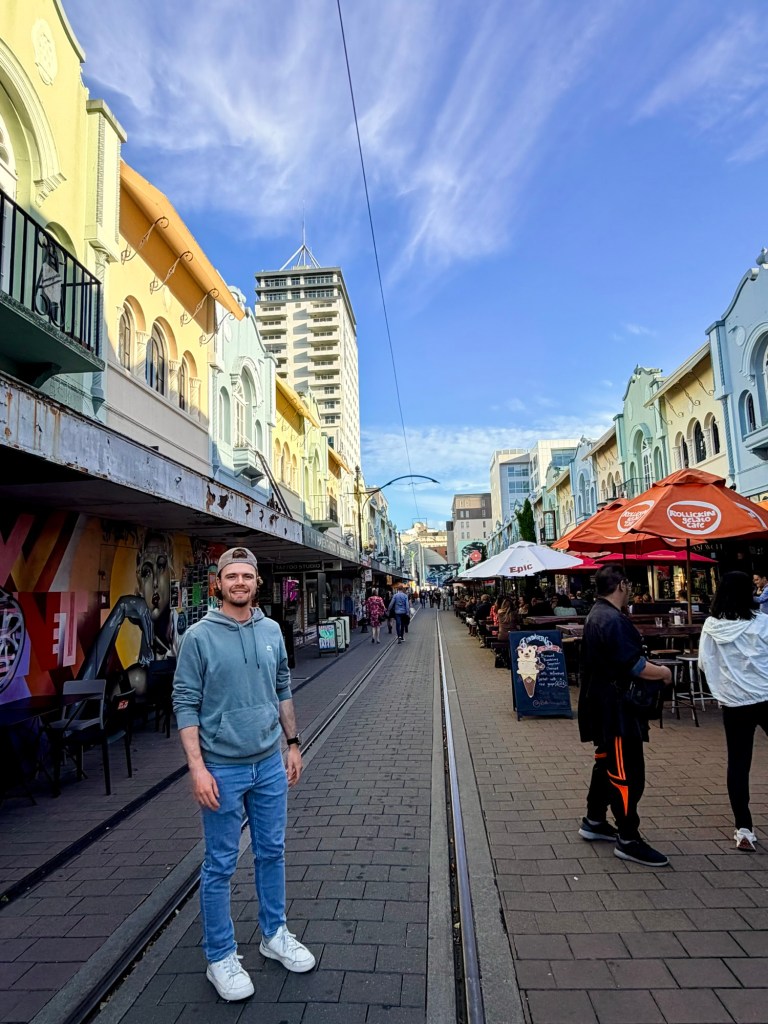
Brendan standing on New Regent Street Precinct, which was built in the 1930s with a Spanish Mission architecture. The pastel-colored street is lined with bars, restaurants and shops. A tram runs down the street. It’s said this is the most beautiful street in all of New Zealand 🩵💛💜💚
Dinner at Gin Gin was small plates of tapas. And we desserted at another gelato 🍧 shop called Rollickin’ Gelato, because apparently this is now a nightly ritual that needs to end soon or I may turn into Hokey Pokey ice cream!
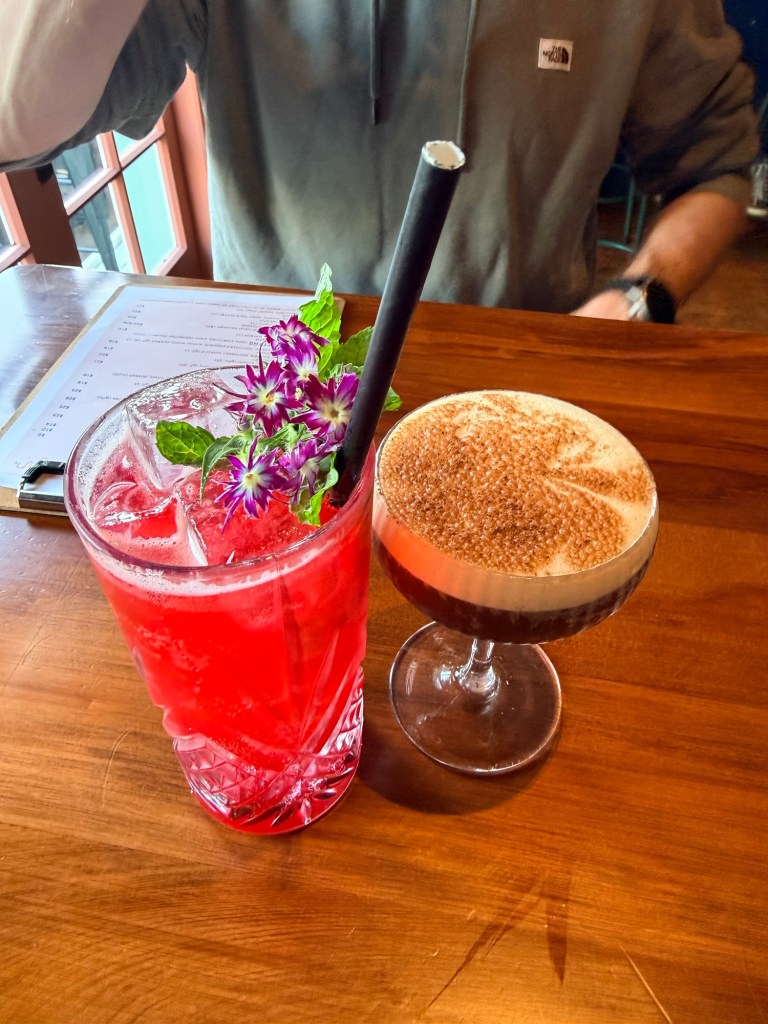
A raspberry mojito mocktail and a coffee martini at Gin Gin
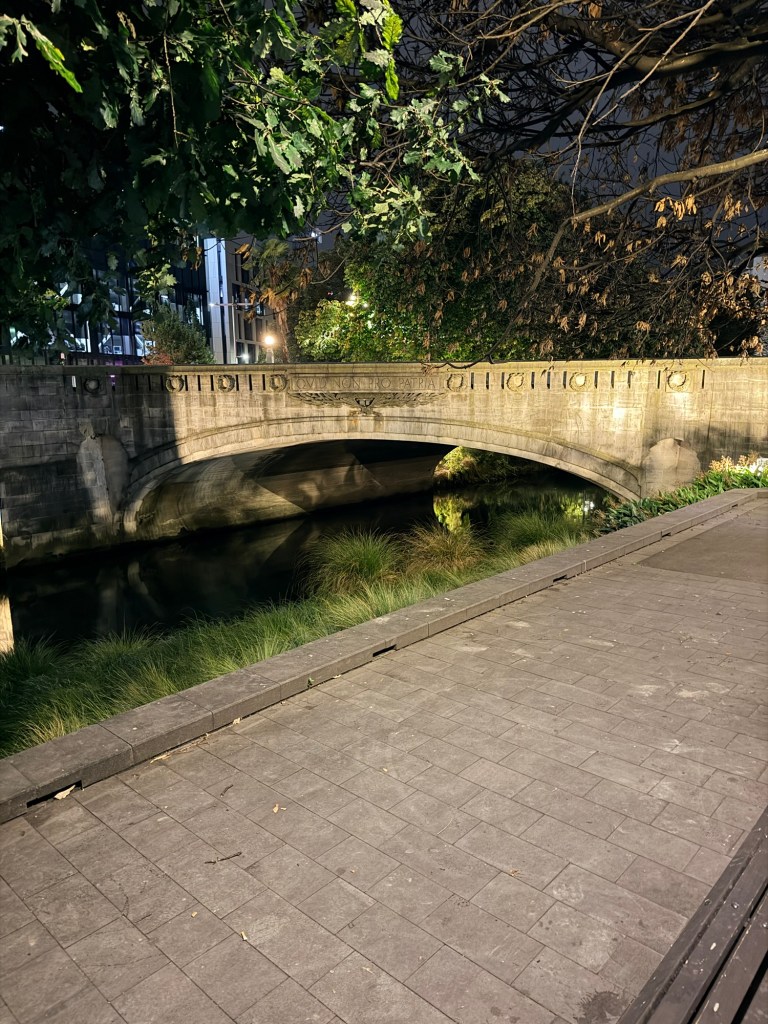
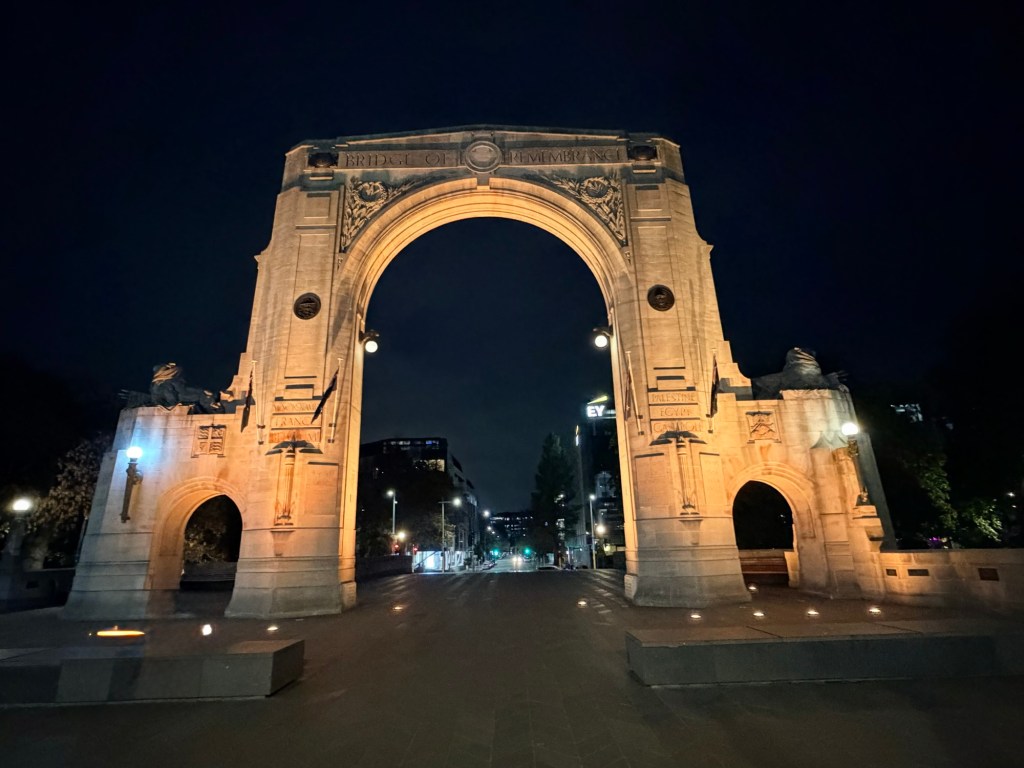
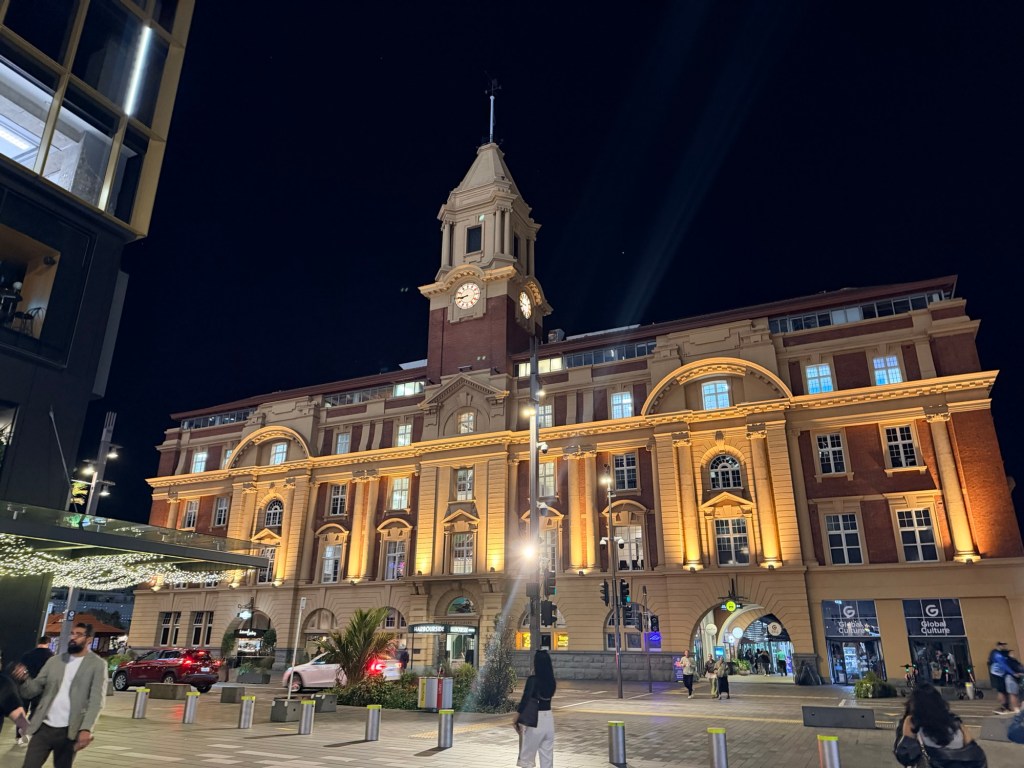
We tried to walk it off by taking in some of the city’s landmarks and sights—ChristChurch Cathedral, The Bridge of Remembrance, the Chalice Sculpture, Cathedral Square, Avon River, the City Tram, Canterbury Earthquake National Memorial, Riverside Market, etc. I will write more about the city itself after I spend more time here tomorrow.
The Cathedral (under re-construction after the 2011 earthquake)The Bridge of Remembrance – A War Memorial in 1923 to honor the sacrifice of the servicemen and women of two World Wars, plus conflicts in Korea, Malaya, Borneo, and Vietnam.By sculptor, Neil Dawson, the Chalice celebrated the new millennium as well as the 150th Anniversary of the founding of Christchurch and Canterbury. It was officially lit on September 10, 2001, has been lit ever since at night.Love this mural!💙🩵Chief Post Office
We had another amazing New Zealand day that started with finally seeing Aoraki and ended under the lights of Christchurch…with a lot of scenic stops (and sheep 🐑 ) in between.
It rained…and rained…and rained. A steady rain that gets you soaked after being outside for 5 minutes, which we know all too well because it took us 5 minutes to walk to the park’s Visitor Centre!
Rain rain go away!☔️
Despite the weather, we had plenty to do at the Hermitage.
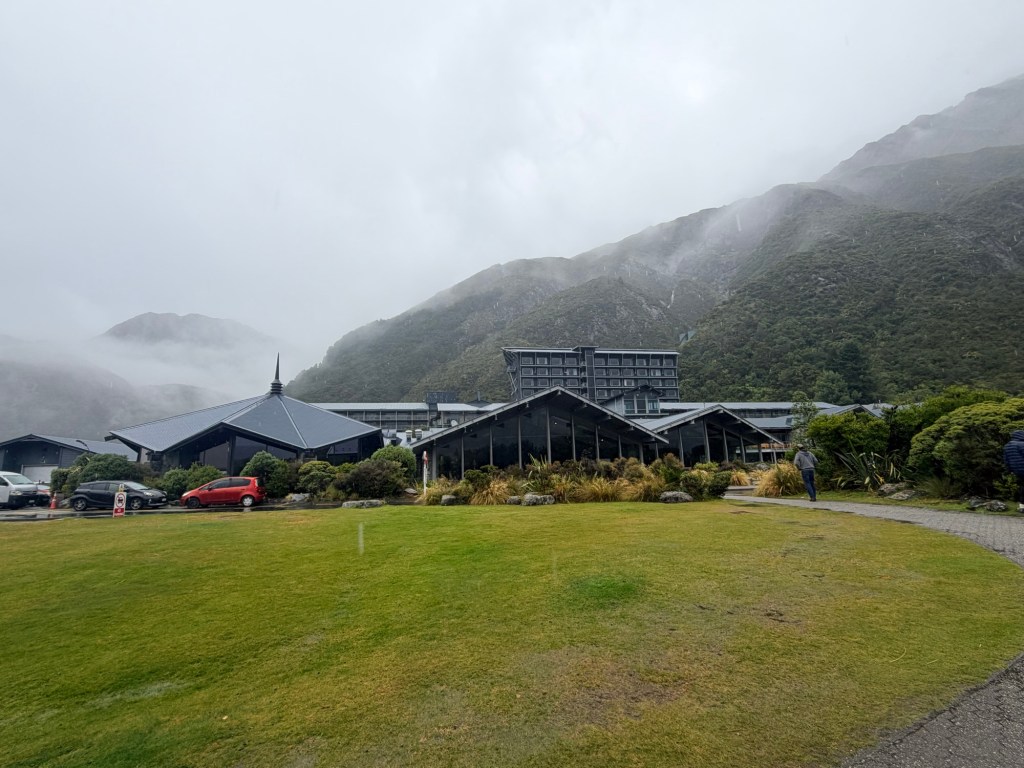
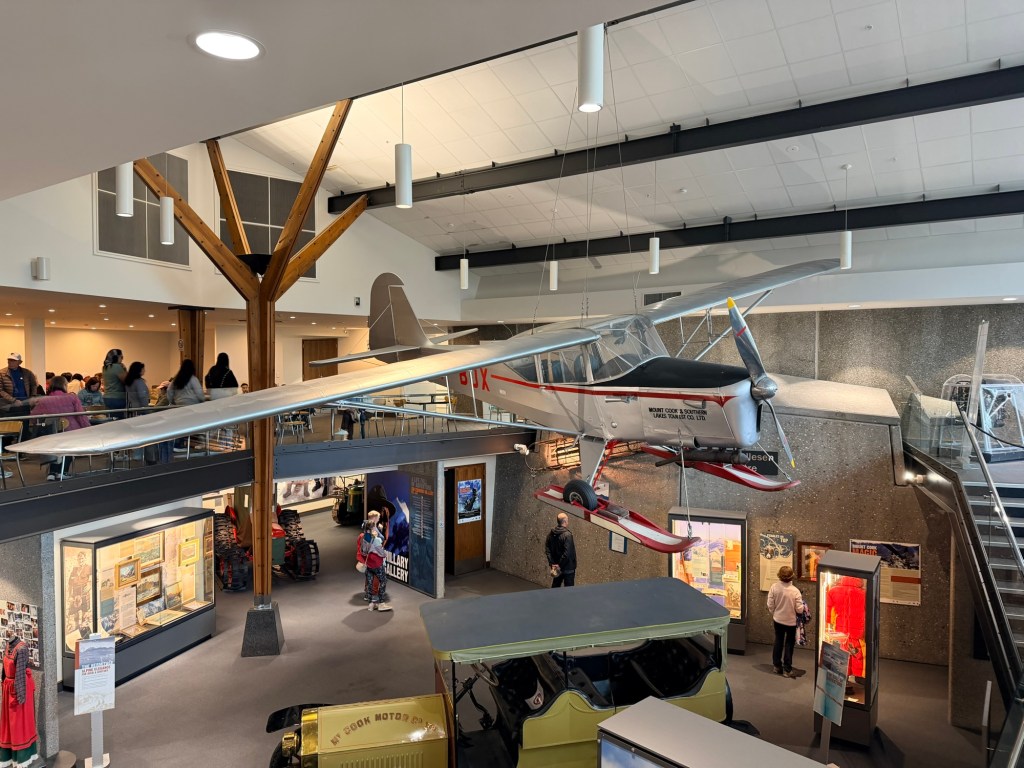
View of the Hermitage.The Sir Edmund Hillary Alpine Centre Theatre and Museum.
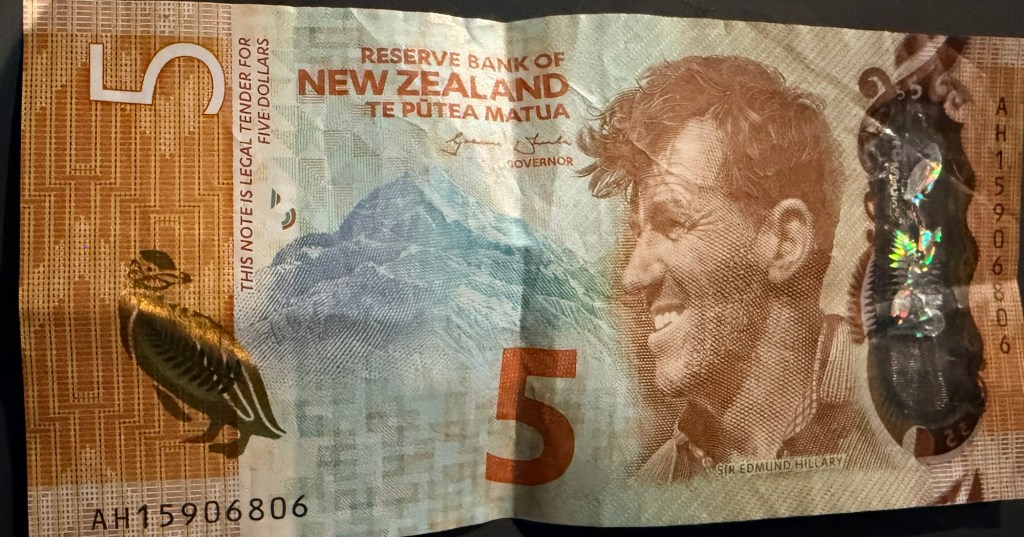
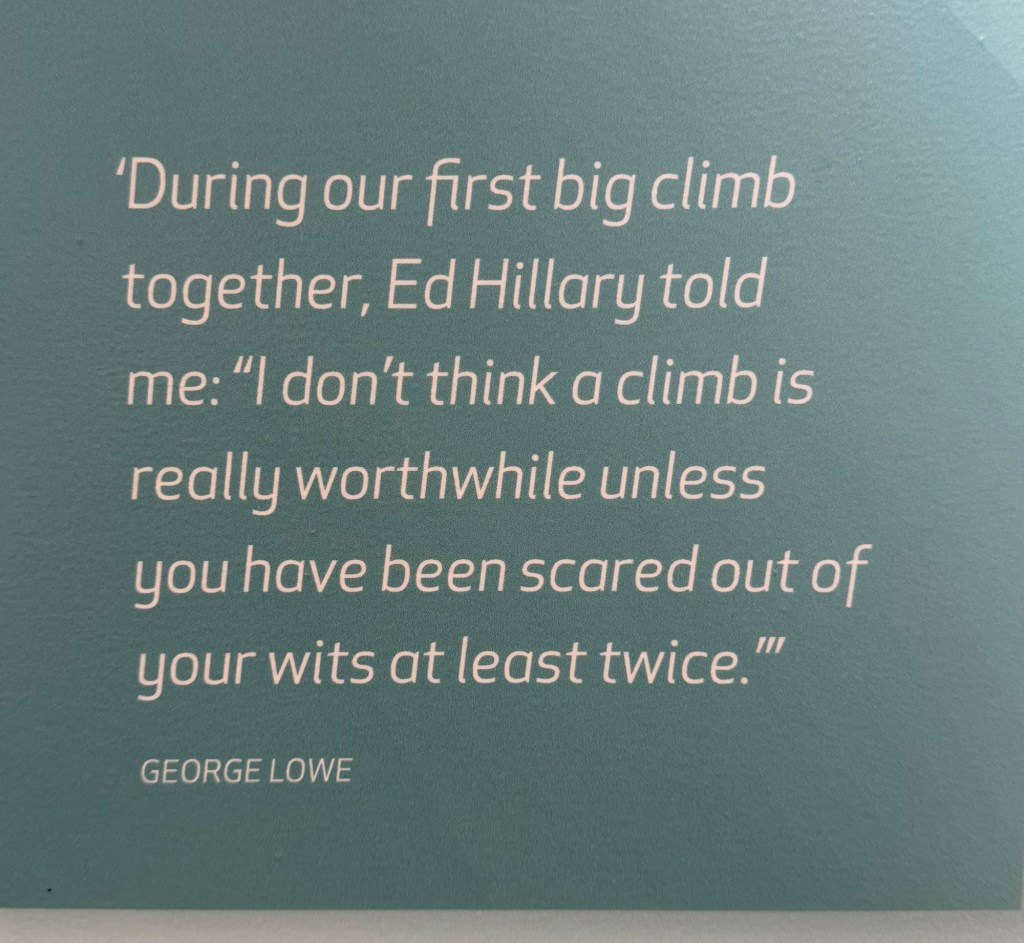
They have the Sir Edmund Hillary Alpine Centre Theatre and Museum. You could literally spend all day reading/viewing the pictures and exhibits about the history of the Hermitage, the climbers, guides, and of course, the legendary Sir Edmund Hillary. Sir Hillary, a New Zealander, is known for being one of the first two people to reach the summit of Mount Everest in 1953, alongside Sherpa, Tenzing Norgay. He also reached the South Pole in 1958, the first to get there overland since Amundsen/Scott. He spent a lot of time in this area and ascended the south ridge of Aoraki/Mount Cook in 1948. There’s even a bronze statue of Sir Hillary at the front entrance of the Hermitage Hotel.
Sir Hillary is on the $5 NZ note.
In addition, they have a theater and show movies about Aoraki, Sir Hillary, and the SAR (search and rescue team).
We braved the weather and spent time at the Visitor’s Centre where they have a great historical display as well.
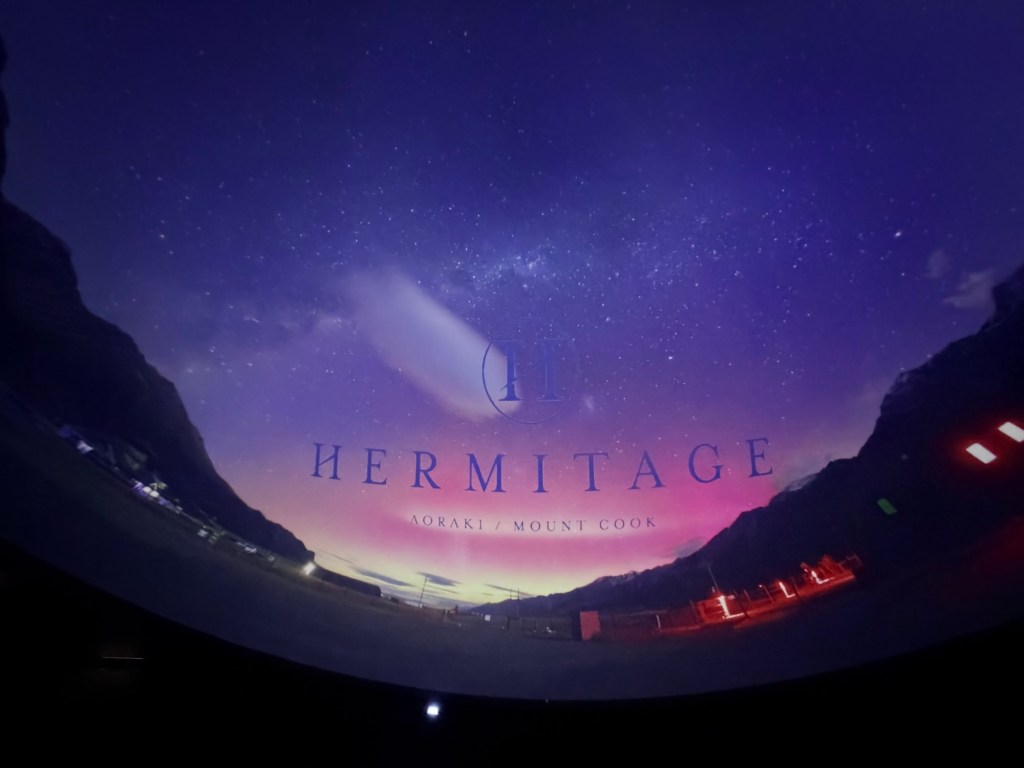
In the evening, the theater turns into a planetarium where we learned about the Southern sky since our outdoor stargazing experience was cancelled due to cloud skies.
🌍 🌖 The Planetarium 🪐☀️💫
Now a few things I have been meaning to write about…
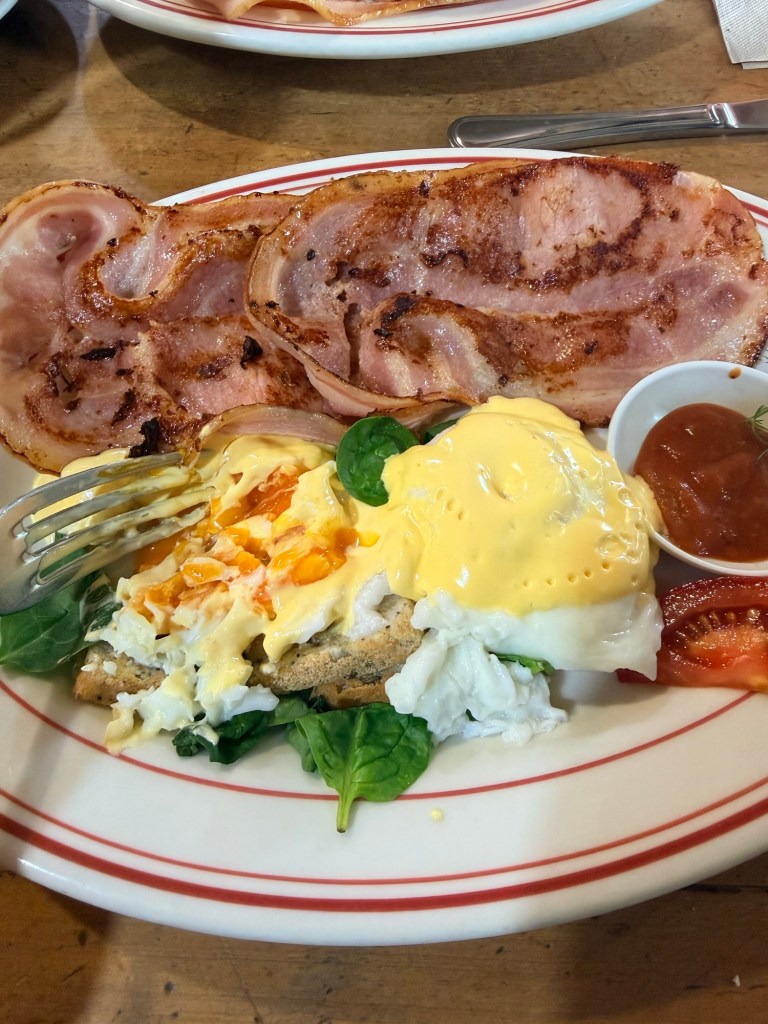
The eggs🥚🍳🥚! I call them the golden NZ eggs because the yolk is so yellow. And the eggs are so fresh. I looked it up to see if it’s just me. It’s not! It’s diet high in carotenoids (natural pigments) and a free range lifestyle. The hens eat a diet rich in yellow corn or lush greens. There are no synthetic dyes and the eggs are shipped to the grocery stores within days of laying. I had poached eggs multiple times and they eggs were all amazingly delicious. I will miss these eggs.
Freshest golden eggs I have ever eaten. This plate was eaten at The Wrinkly RamsFrom the cafe at the Hermitage Hotel.
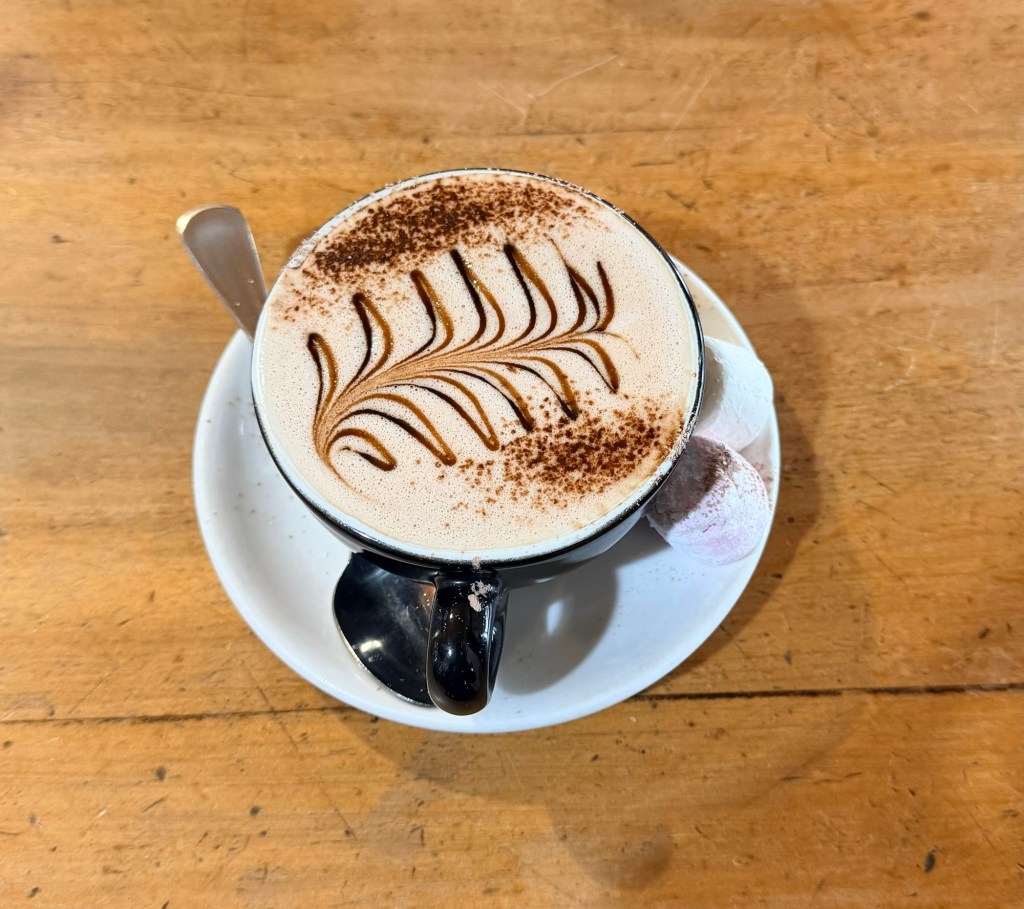
The hot drinks! Every place (from a gas station to a coffee shop) makes a great flat white and hot chocolate with milk or milk alternative. Sure beats those hot chocolate “machines”.
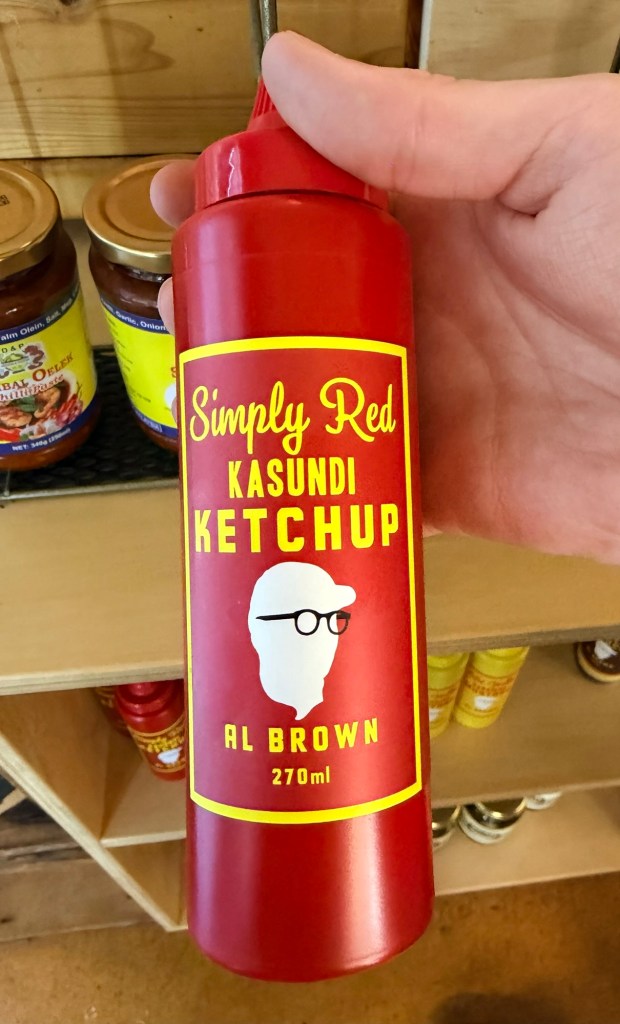
What is this?? It’s the best ketchup on the planet, that’s what! it’s ketchup spiced with Indian aromatics and I will never look at ketchup the same way again.
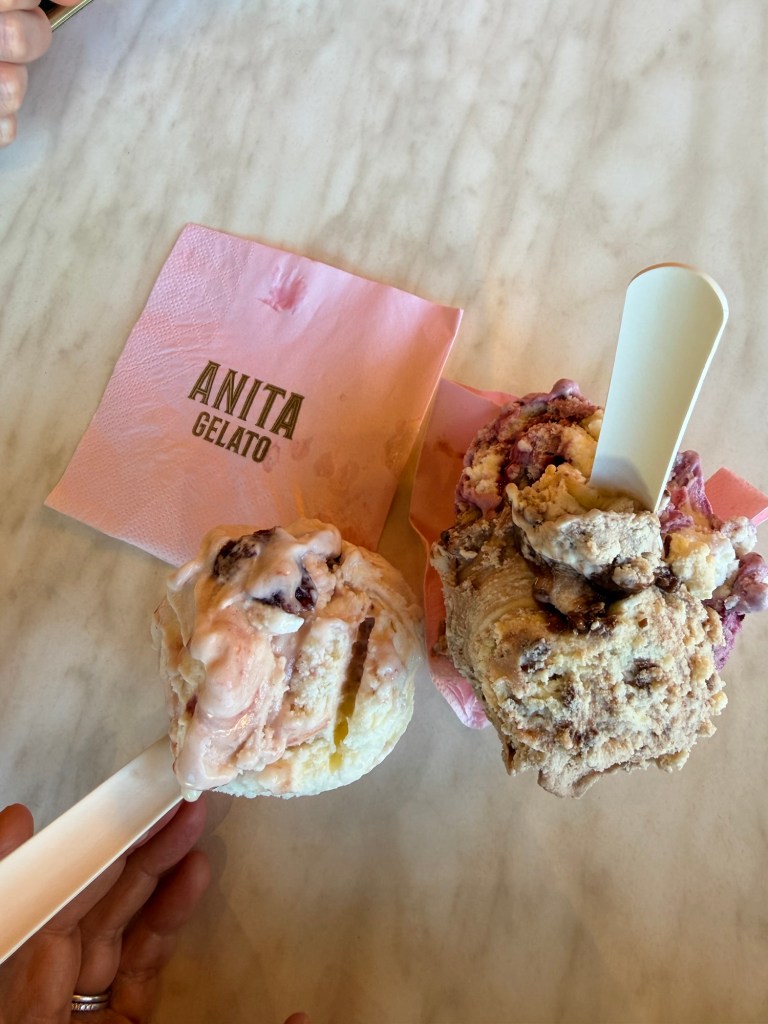
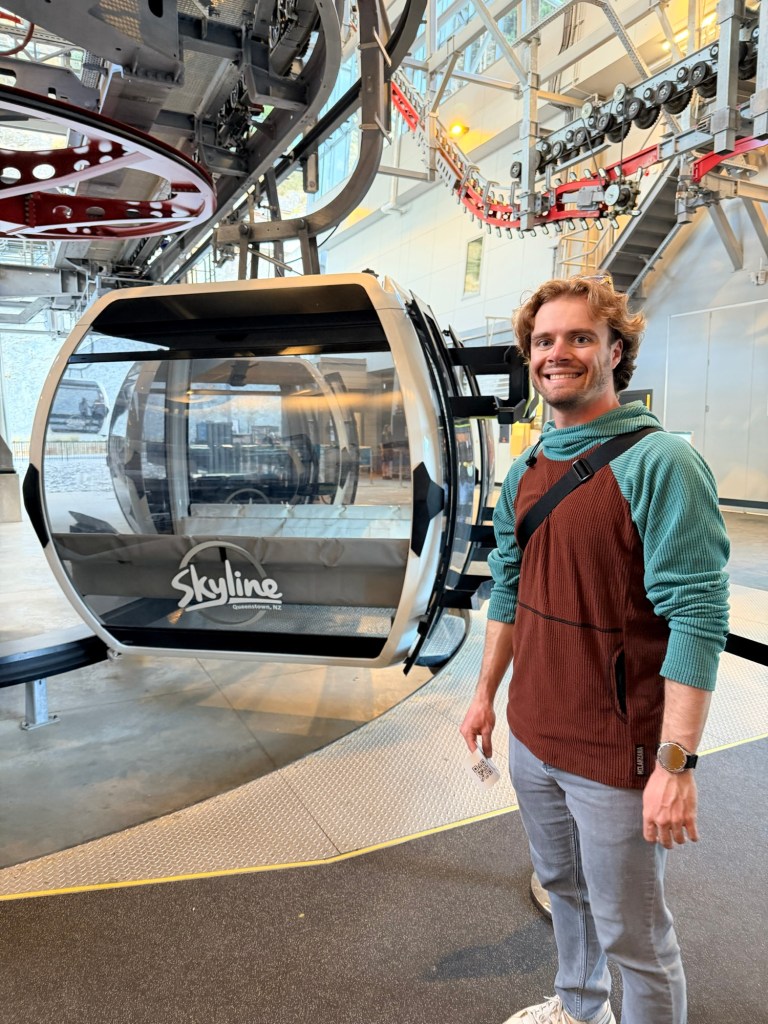
Brendan and I went to this gelato place twice while in Queenstown. You have to work for it as it’s up a hill as you head to the gondola. It’s delizioso! The flavors were some of the best I have had. I mentioned in a prior post that New Zealanders eat more ice cream per capita than any other country in the world. I don’t know what I’ll do when I get home and don’t have daily ice cream options! NZ is also the 3rd largest milk product producer in the world.🐄 They do dairy right. 🧀🥛🧈
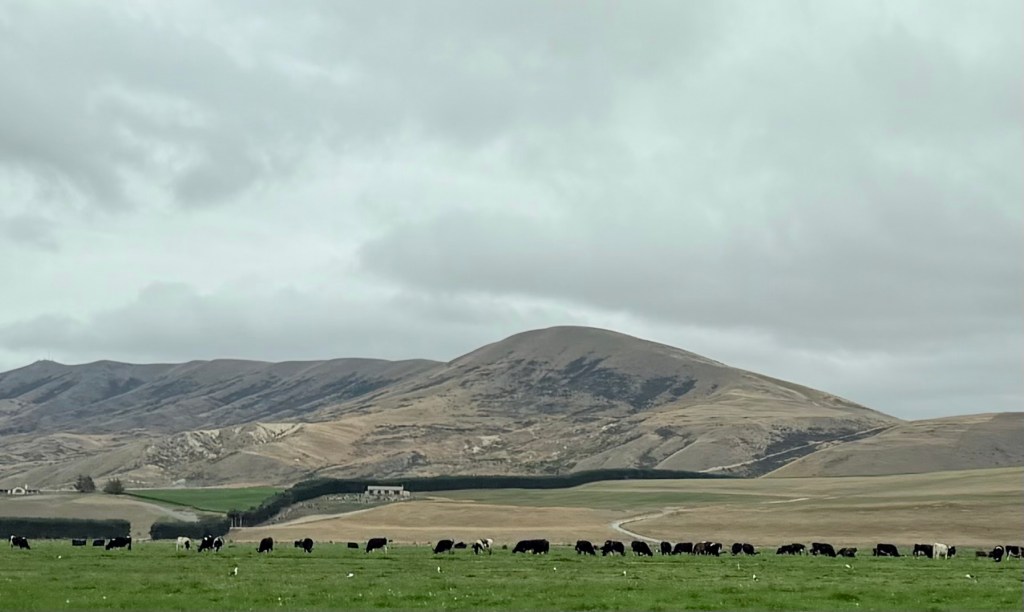
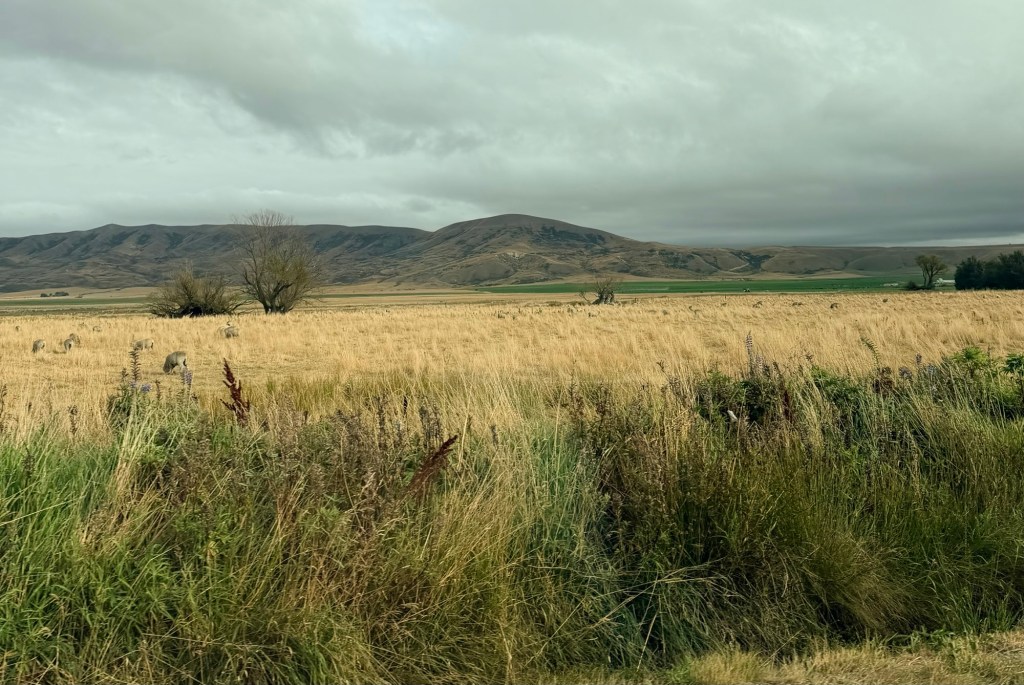
The cows🐮 and the sheep🐑! Cows more on the North Island because they don’t like the hills. Sheep everywhere but more on the South Island. They outnumber people 5:1.
Those are cows on our way to Aoraki.I spy with my little eye…sheep! Look closely, they blend into the scenery.Most of our “activities” have scared me! But they’ve been more than worthwhile. 💚
We started the day with an incredible sunrise in Wānaka before hitting the road for the 2.5-hour drive to Aoraki/Mount Cook.
Sunrise over Lake Wanaka.We stopped at The Wrinkly Rams for breakfast. New Zealand does hot chocolate right!
After a quick breakfast stop in Ōmarama, we continued toward the Southern Alps and Aoraki/Mount Cook National Park—home to 19 peaks over 3,000 meters.
About 40% of the park is covered by glaciers, including the massive Tasman Glacier, which stretches 17 miles long, 2.5 miles wide, and reaches depths of nearly 2,000 feet of ice. Other notable glaciers here include the Hooker and Mueller.
“Aoraki” means “cloud piercer” in Māori, and the story behind it is just as powerful as the landscape itself. In Ngāi Tahu tradition, Aoraki was a young boy traveling with his brothers when their canoe capsized. The canoe and boys turned to stone, forming the South Island and the highest peaks of the Southern Alps, with Aoraki the highest peak. Today, Aoraki/Mount Cook is the physical form of that ancestor, connecting the natural and supernatural worlds.
Standing at 3,724 meters (12,218 feet), Aoraki/Mount Cook is the tallest mountain in New Zealand and the crown jewel of the Southern Alps.
And…we couldn’t see it.
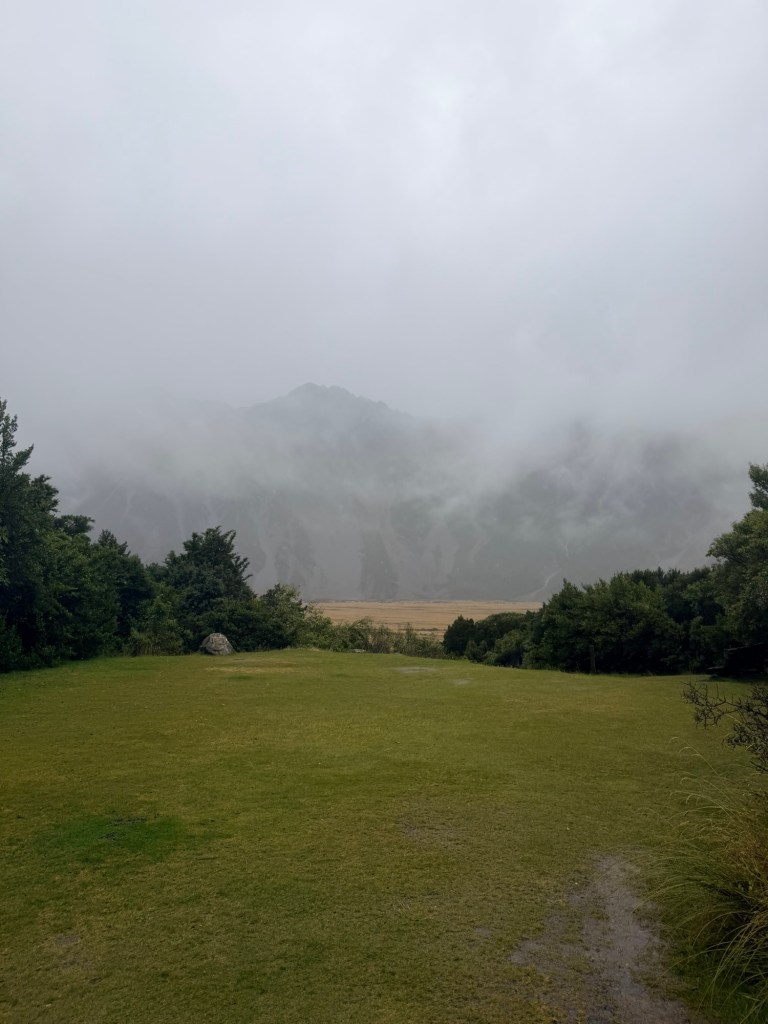
This was our first cloudy, rainy day of the trip. The normally spectacular scenic drive in? Completely hidden behind a wall of clouds. Not exactly what you picture when you come to see New Zealand’s most iconic peak.
We’re here for two days, and unfortunately our stargazing and the glacial boat tour were both cancelled due to the rain forecast. We did catch brief glimpses of the surrounding peaks before everything disappeared into cloud cover, but Mount Cook itself stayed completely hidden.
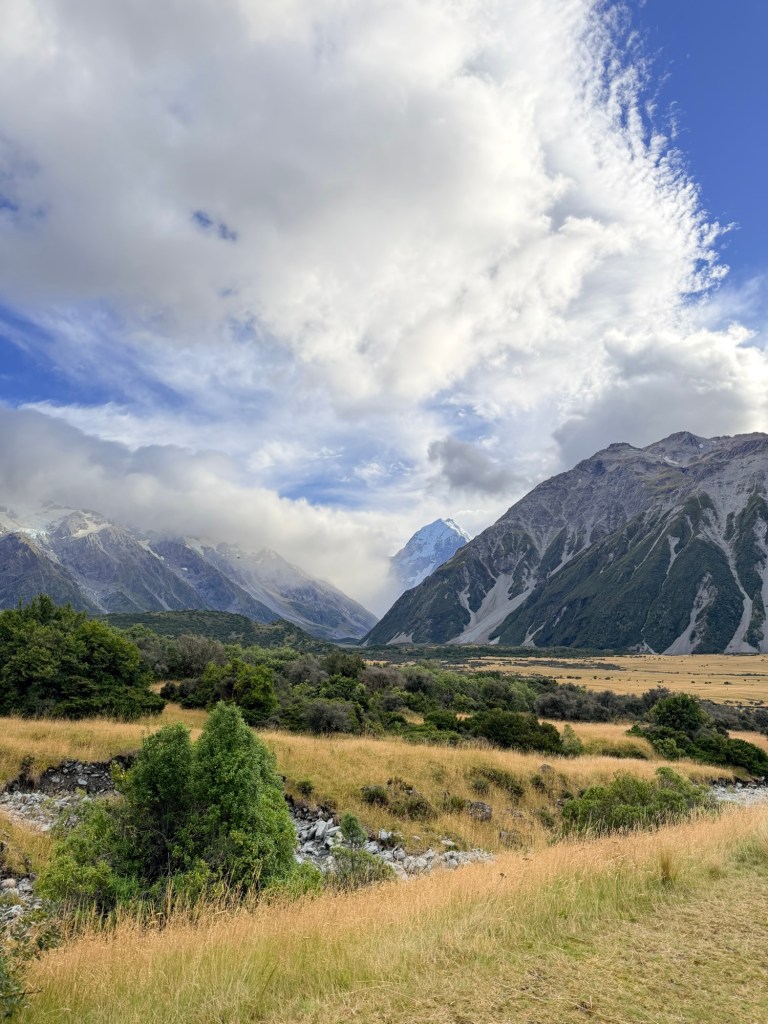
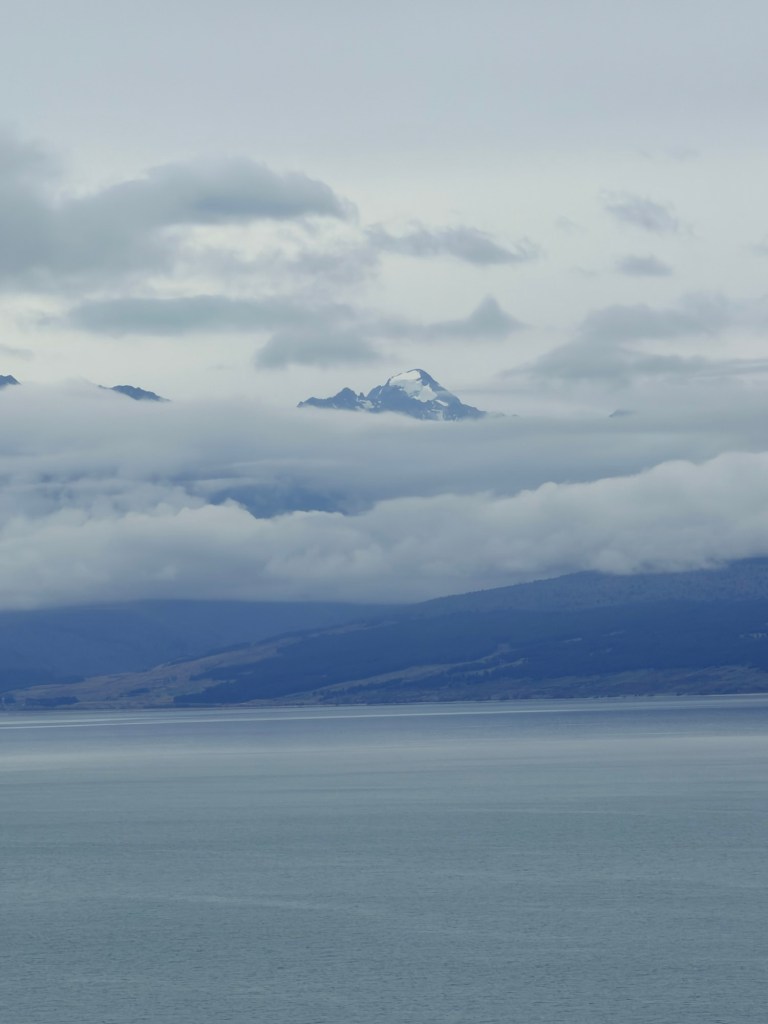
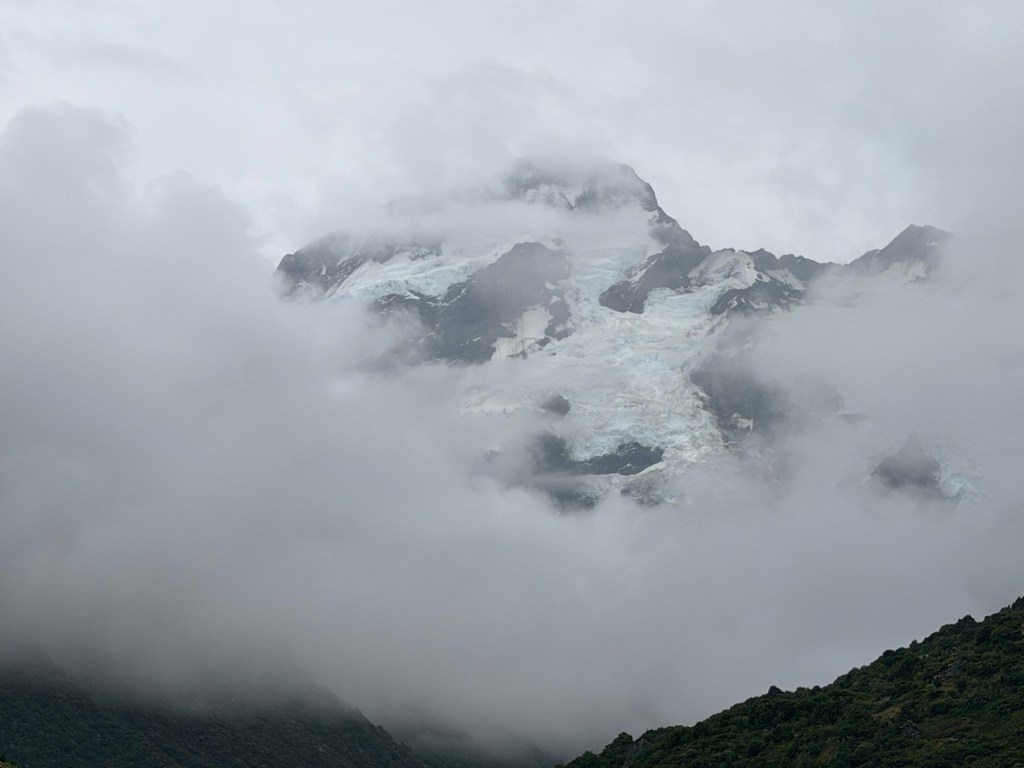
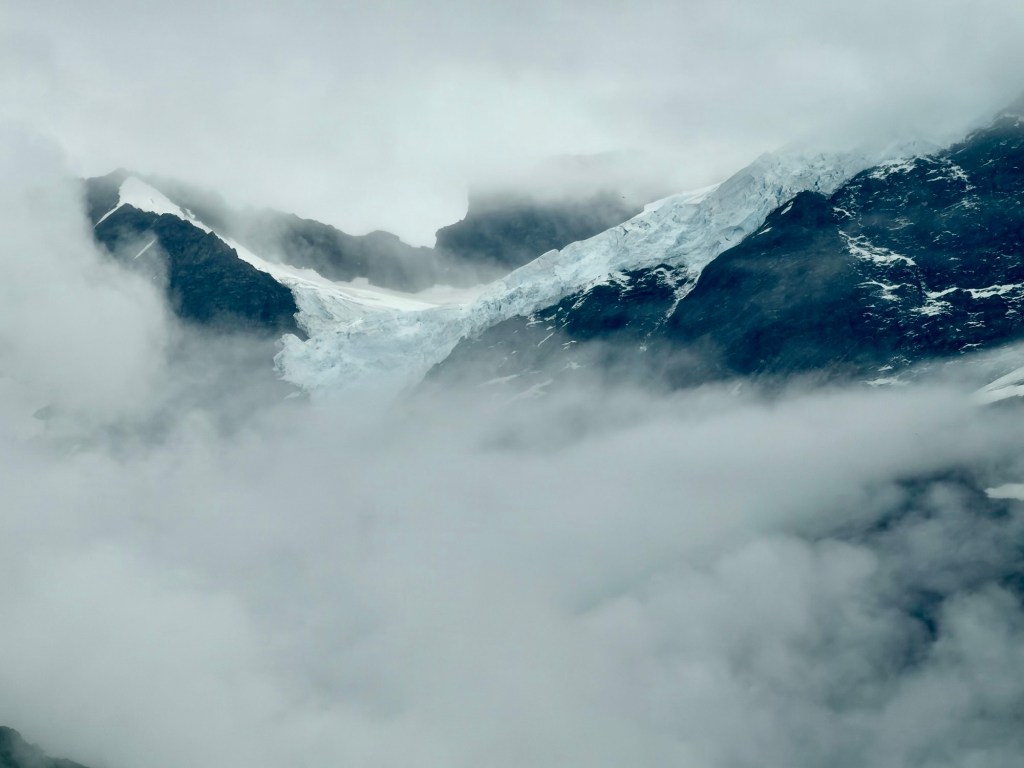
We stopped at Tapataia Mahaka Peter’s Lookout and could see the top of one of the mountains of the Southern Alps, fronted by Lake PukakiAs we started out on the Hooker Valley Track, the clouds parted just long enough for us to peak at another snow capped mountain!
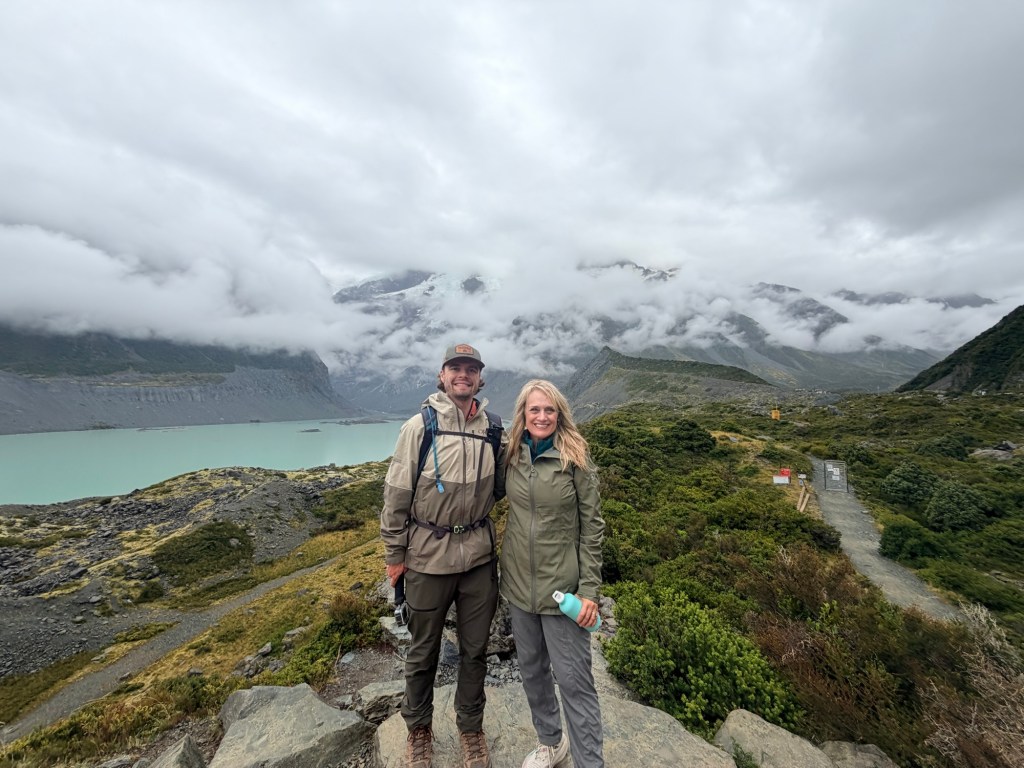
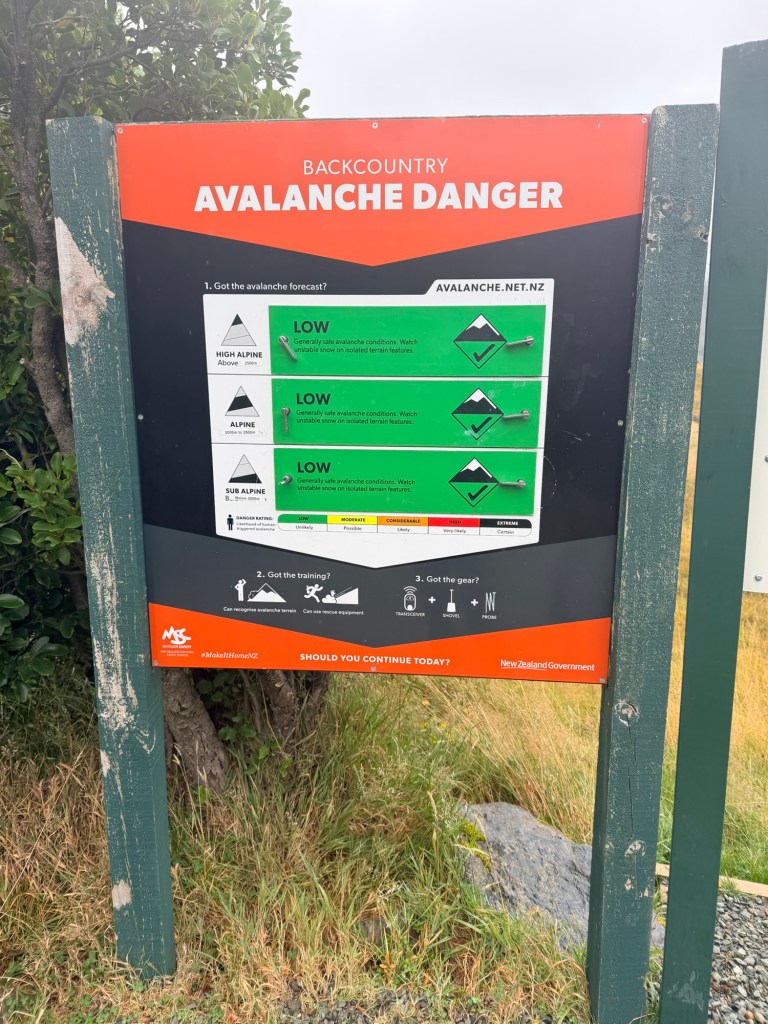
First rainy day hike = Hooker Valley Track
We didn’t let the rain stop us.
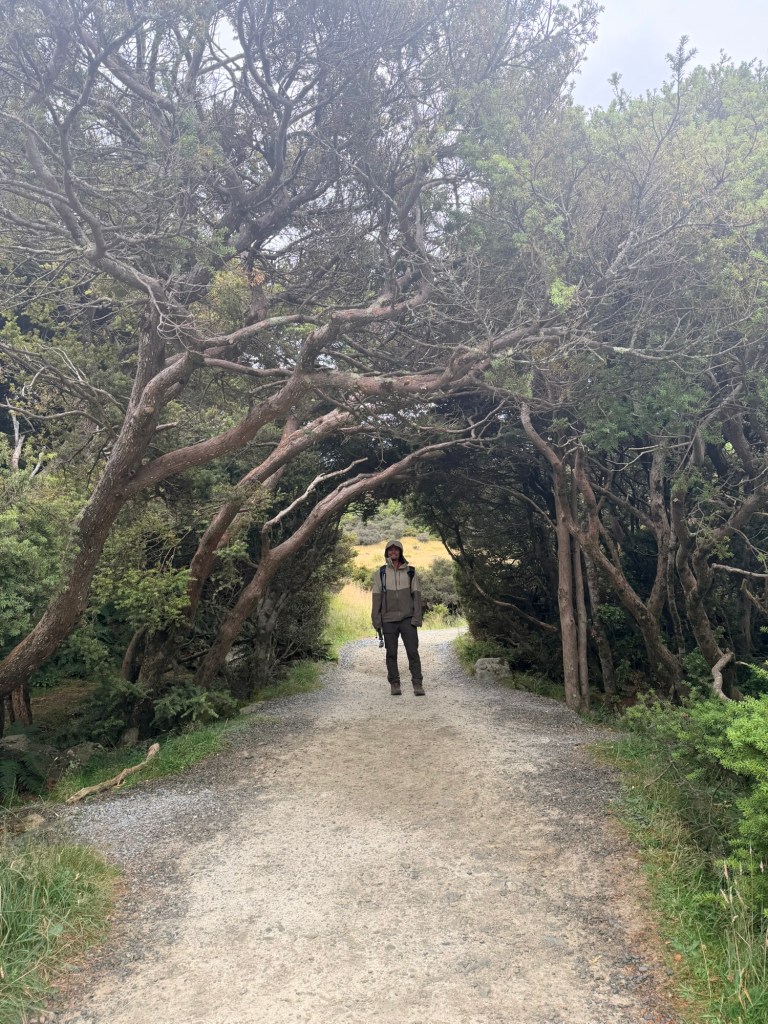
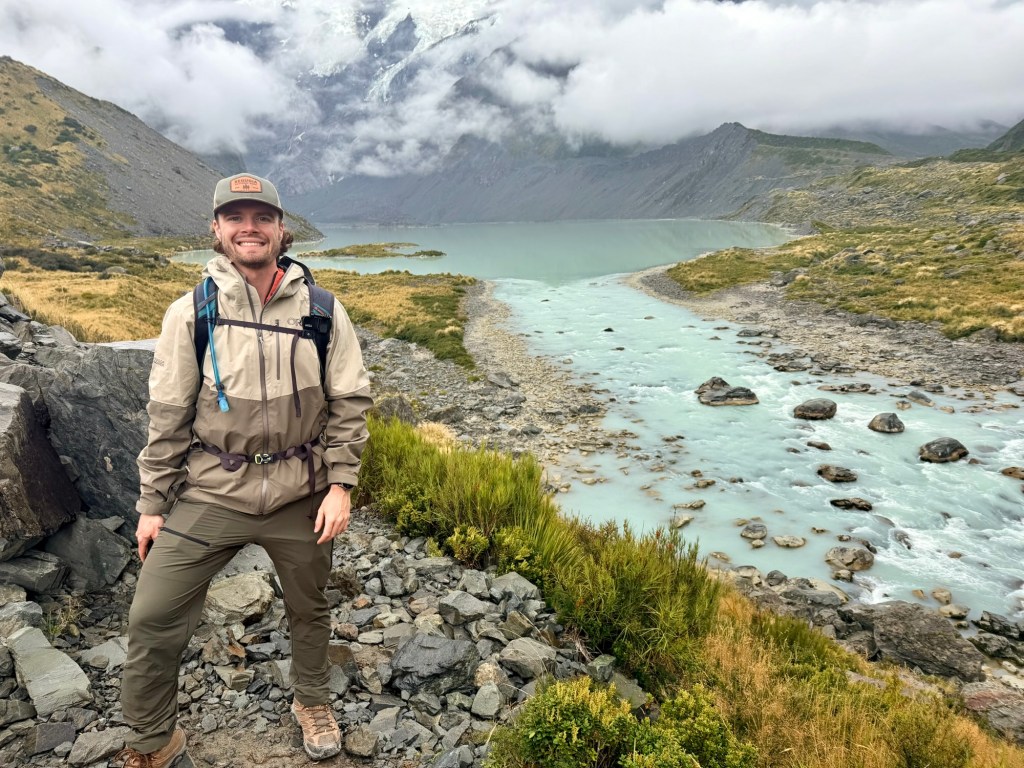
The Hooker Valley Track is one of the most popular hikes in the park for good reason. Even in the rain, it delivered. Think suspension bridges, rushing glacial rivers, and moody mountain backdrops that somehow feel even more dramatic with a little weather.
We couldn’t complete the full hike since they’re rebuilding the second bridge, so the modified version came in at about 2.8 miles. Honestly, it still felt like we saw plenty.
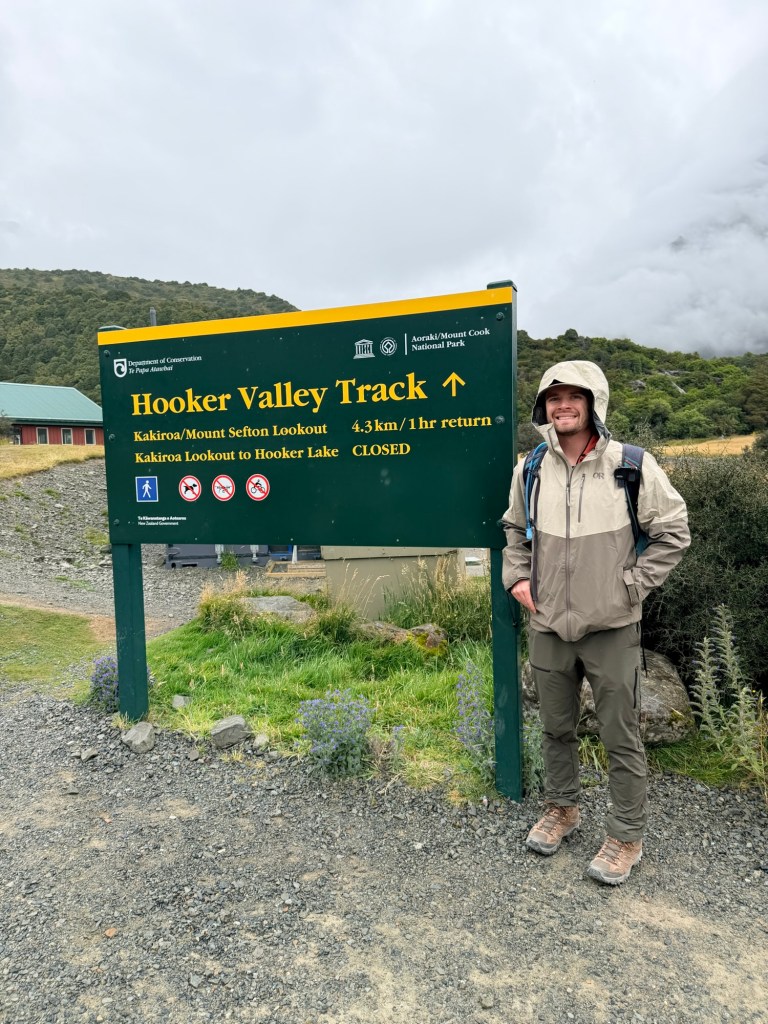
Getting ready to enjoy the Hooker Valley hike. 🌧️Very good to know!Snow capped peaks and glaciers. 🗻
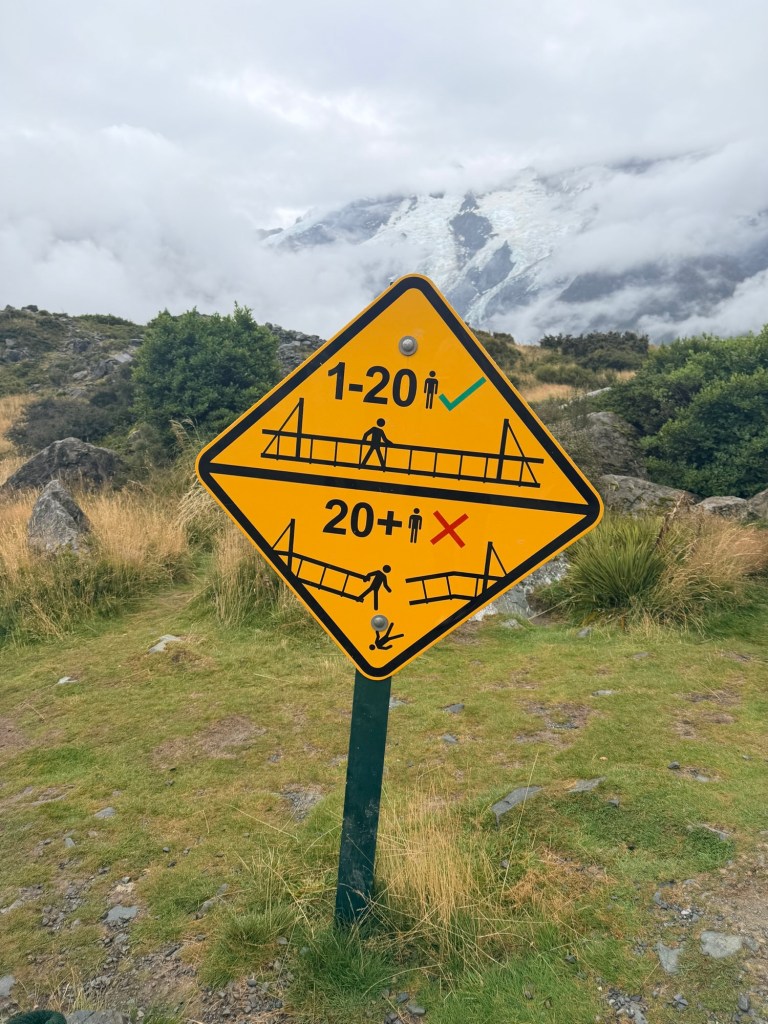
Sign by the suspension bridge on the Hooker Valley hike, which can only support 20 people. 😨
The first suspension bridge on the Hooker Valley Track. Below you’ll see the glacial fed Hooker River. Mueller Lake, which is fed primarily by the Mueller Glacier.Another view of Mueller Lake.
Second rainy hike = Tasman Glacier View
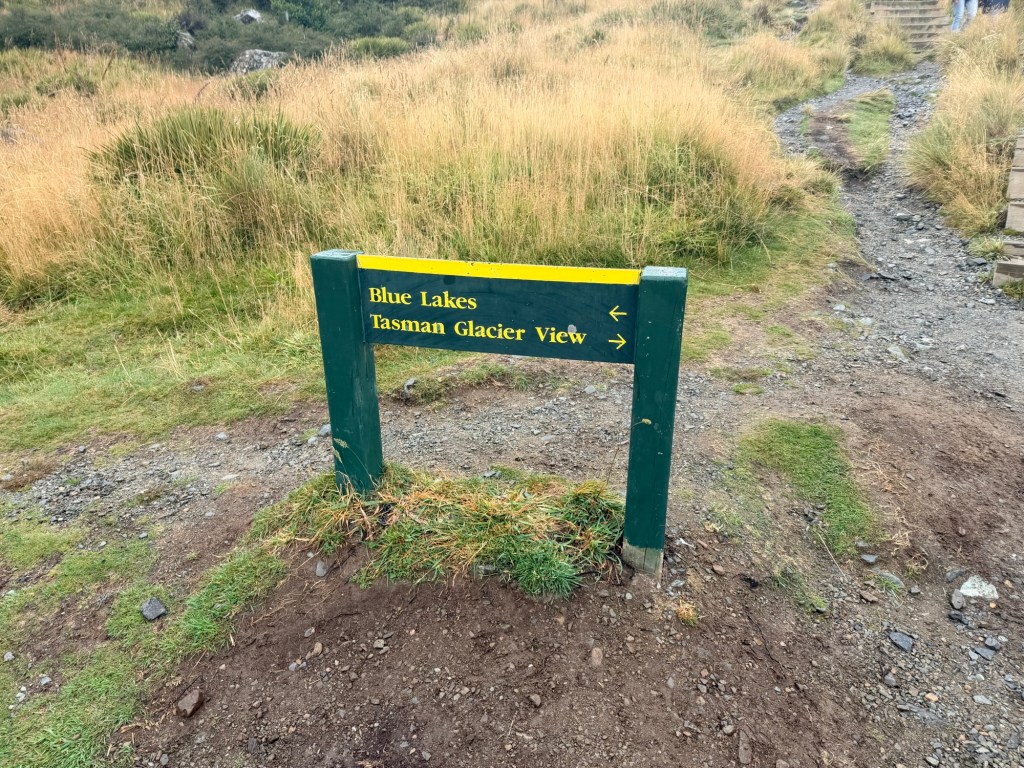
Next we did a short but steep hike to the Tasman Glacier viewpoint.
Not long, but uphill the entire way…and absolutely worth the view at the end.
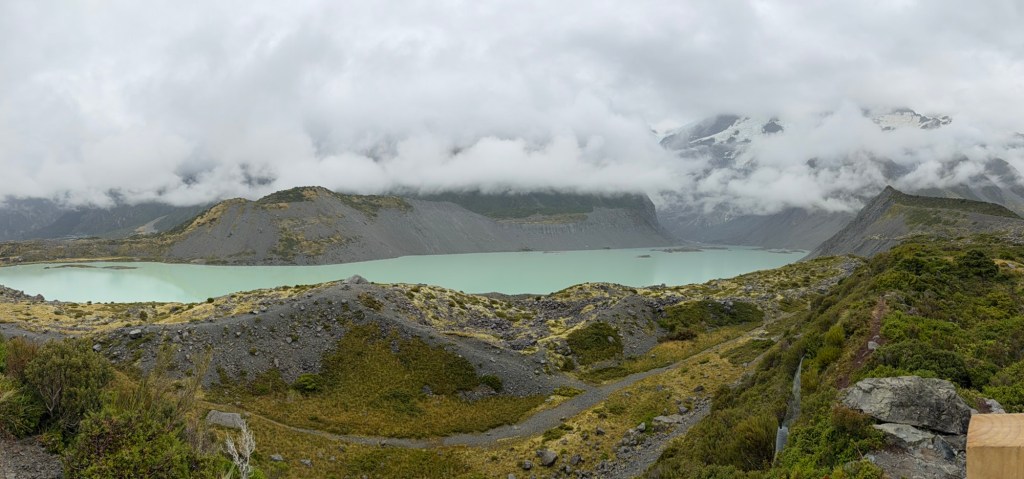
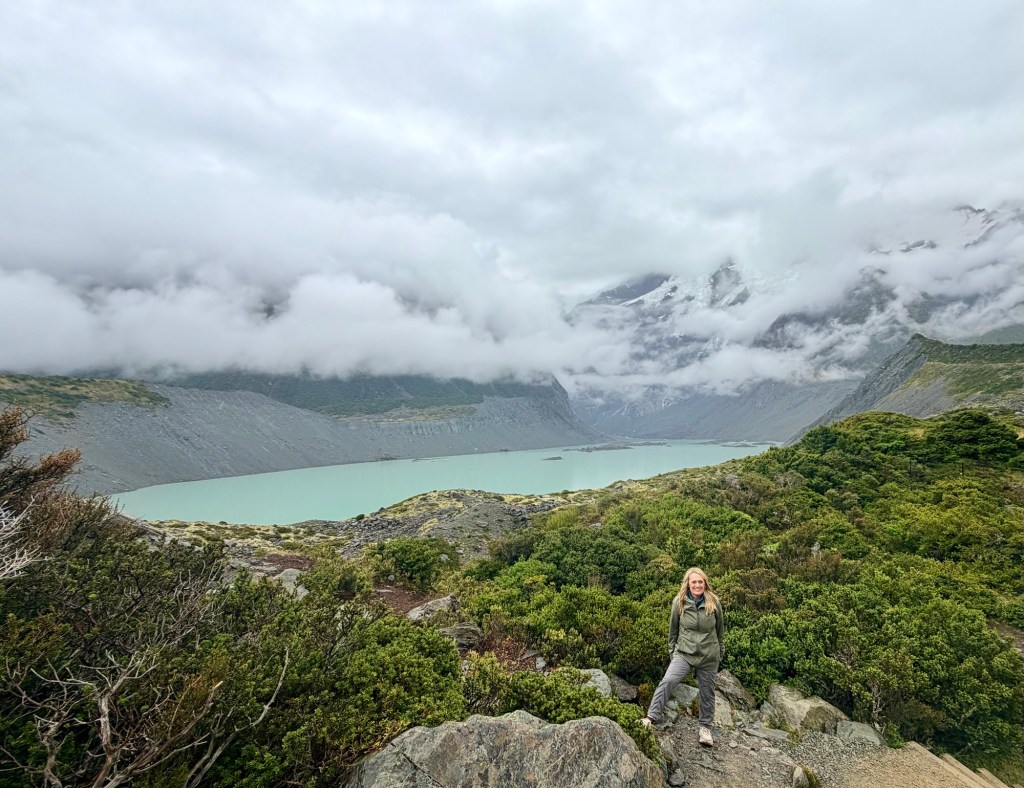
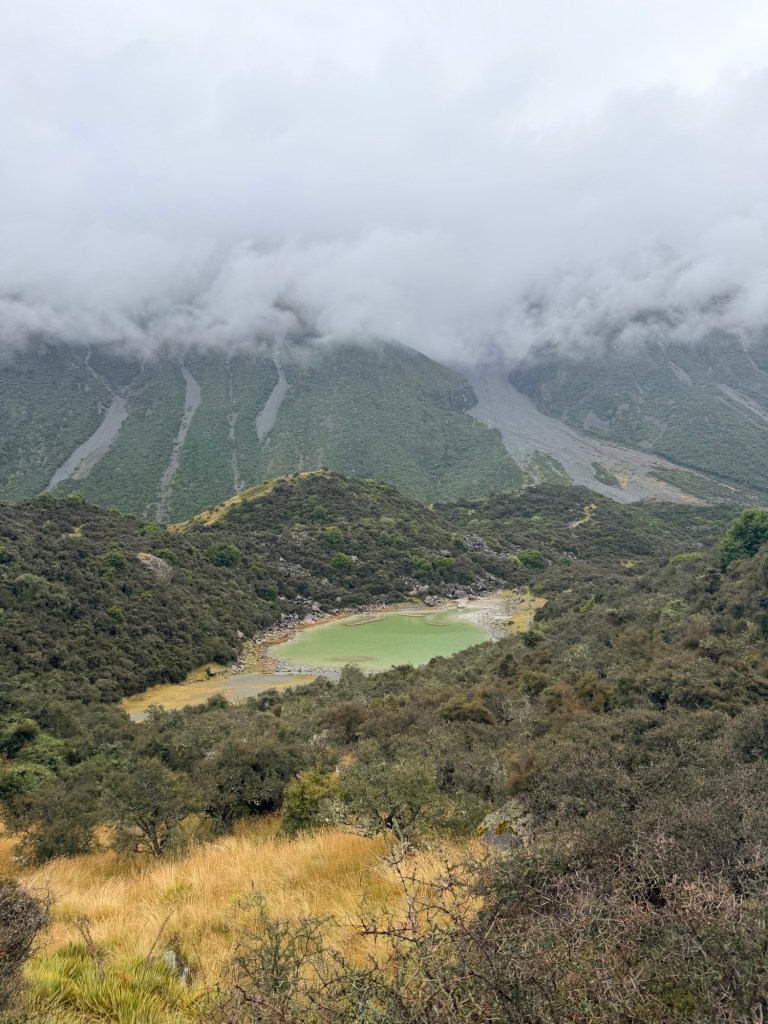
Blue Lakes🩵 These pools used to be blue when they were named in the mid-1800s as they were fed by the glacial meltwater from the Tasman Glacier. Since the Tasman Glacier has shrunk, it no longer flows into the lakes. The warmer rainwater now feeds the lakes and supports algae growth, turning it green.💚
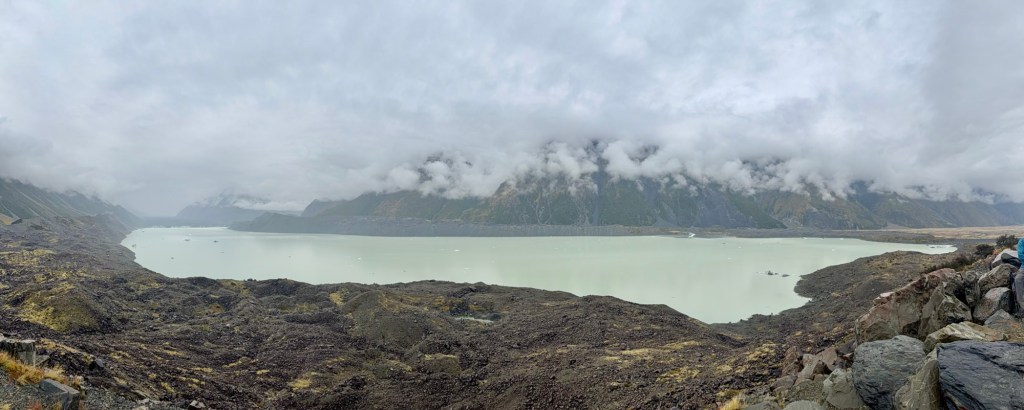
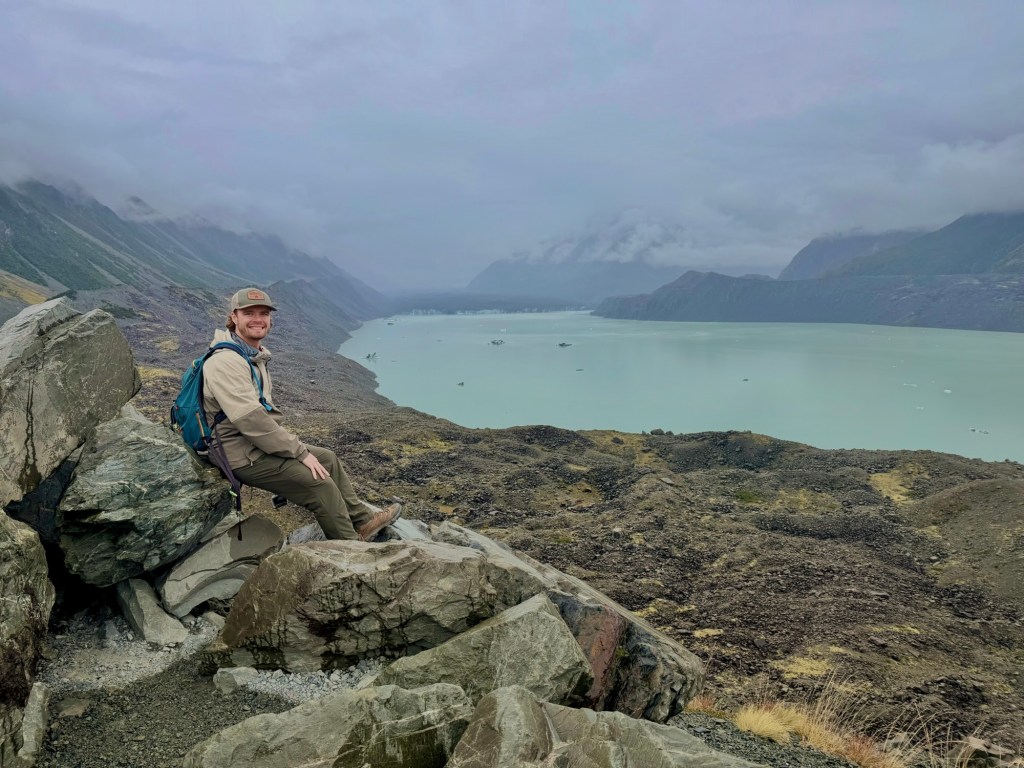
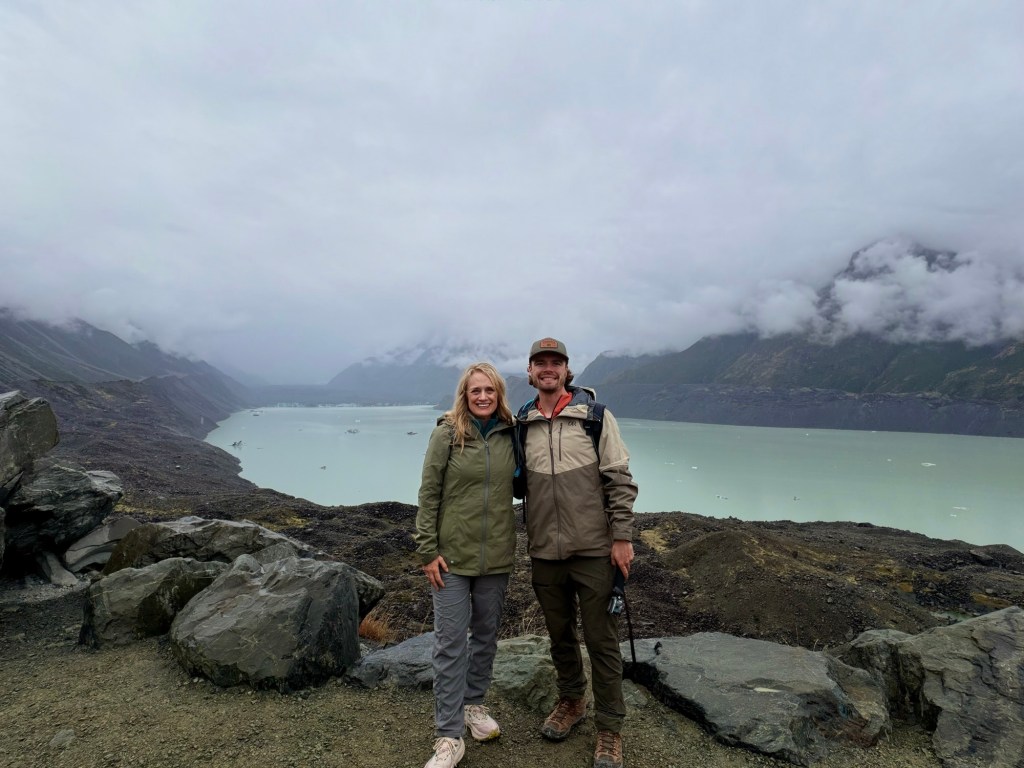
From the top, you get a look out over the glacier lake, dotted with floating icebergs. It’s one of those views where you take a deep breathe, exhale, and tell yourself to always remember this moment.
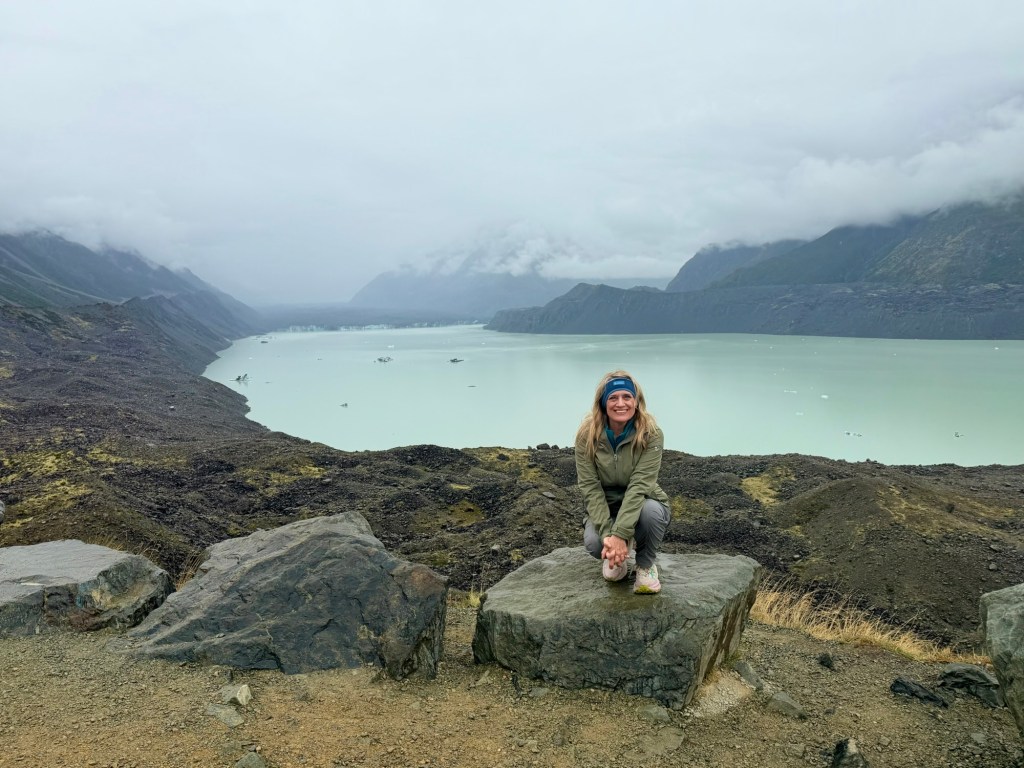
Tasman Lake is a milky-blue lake that sits at the end of the Tasman Glacier (to the left).
We wrapped the day at our hotel, The Hermitage, and it’s as iconic as the landscape surrounding it. Originally established in 1884 (with the current building dating to 1958), it’s more than just a place to stay…it’s part of the Mount Cook experience.
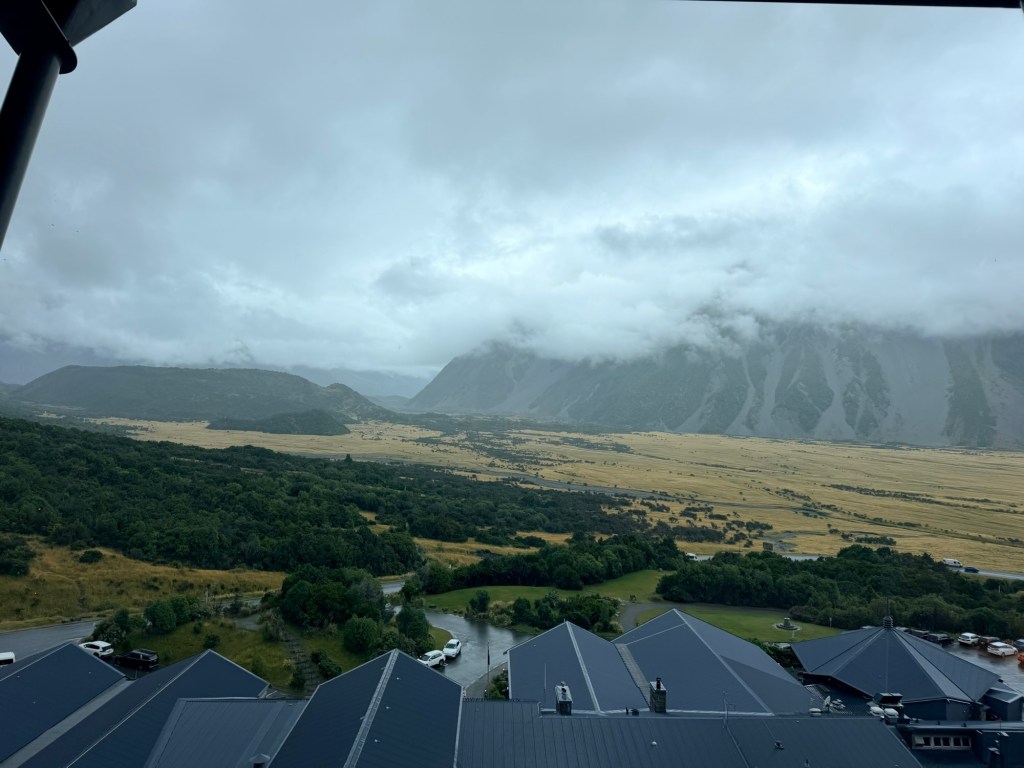
The cloudy and incredible view from our room.
Inside, there’s the Sir Edmund Hillary Alpine Centre and museum, a planetarium, and multiple dining options. We went with the buffet tonight. After a full day of hiking in the rain, it absolutely hit the spot.
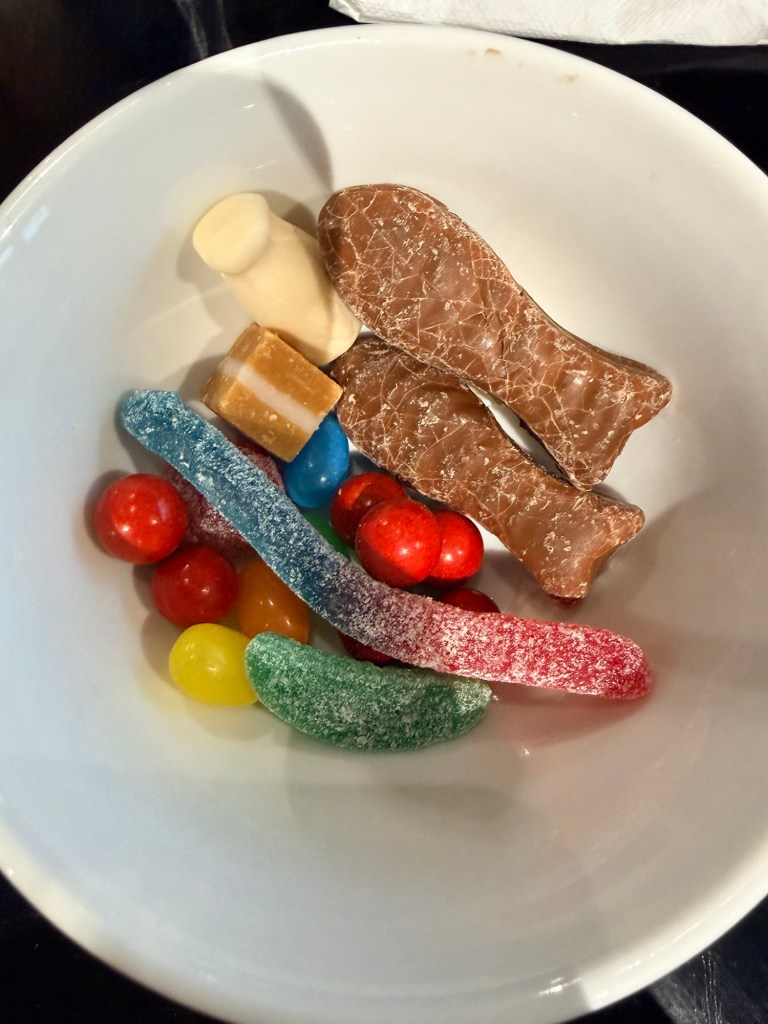
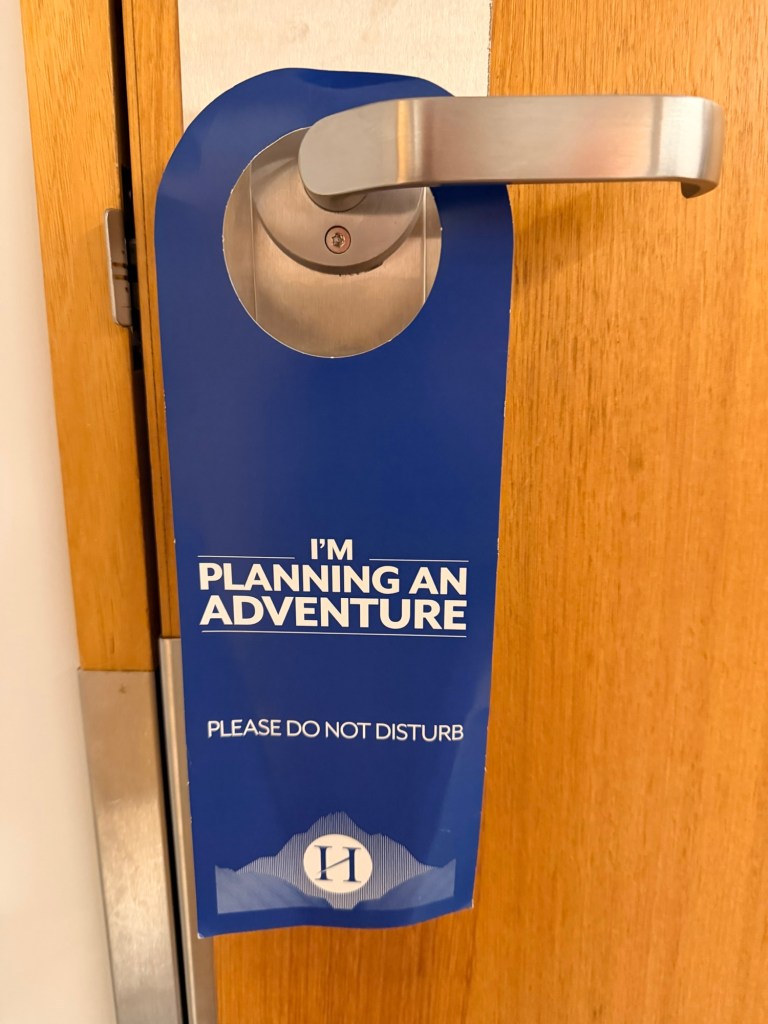
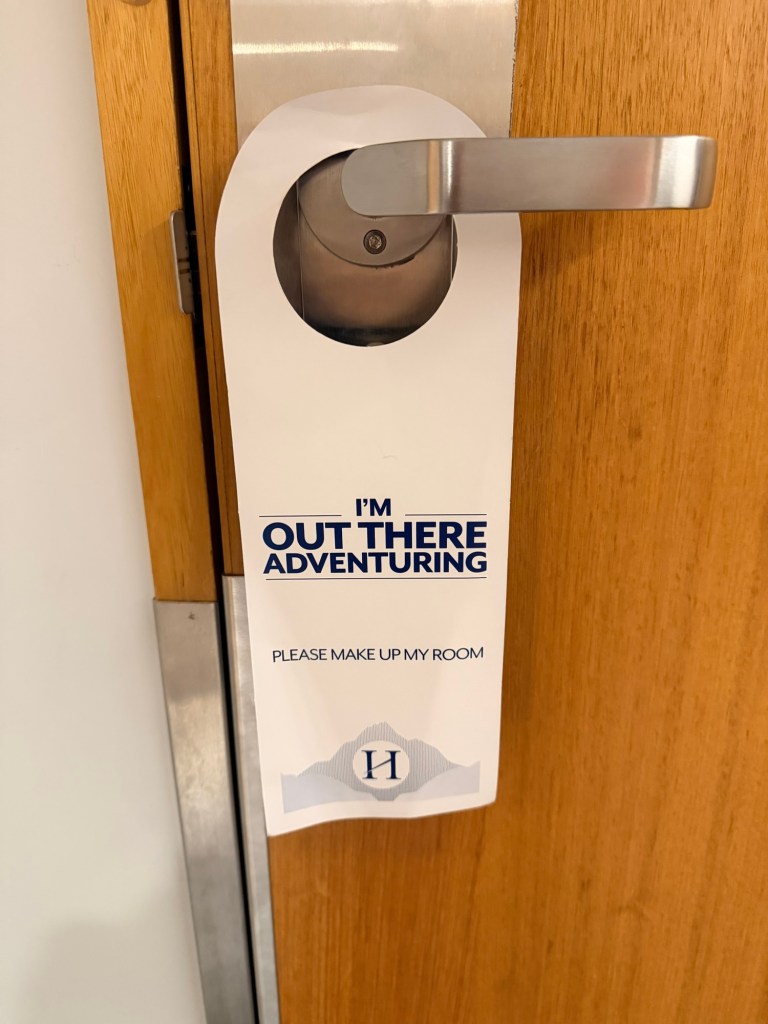
Some of the “lollies” on the dessert buffet, including chocolate fish (with a marshmallow center), Milk Bottles, and Jaffas (maybe?).Very creative “Do not disturb” for the door.And then the other side!
Not the bluebird 💙 day we imagined, but it doesn’t matter…we won’t soon forget the incredible hikes!
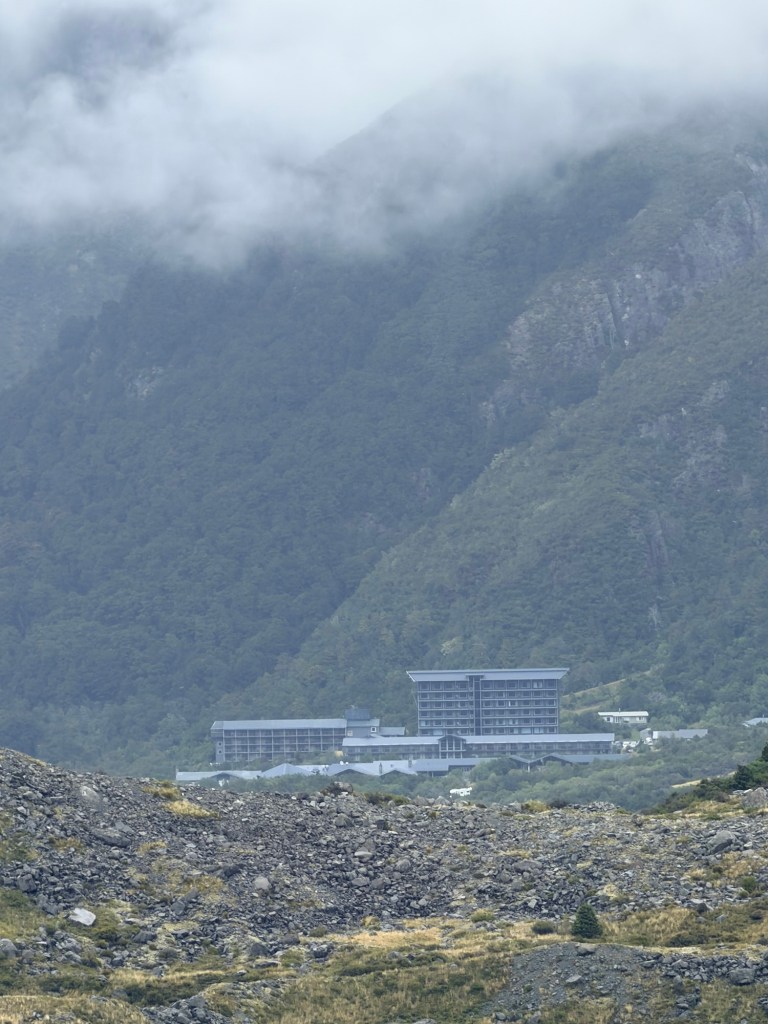
A view of the iconic Hermitage Hotel. What started as an alpine lodge for 12 guests in 1884, is today a luxurious hotel with an amazing history. There is a museum in the hotel that tells the tale of its past.
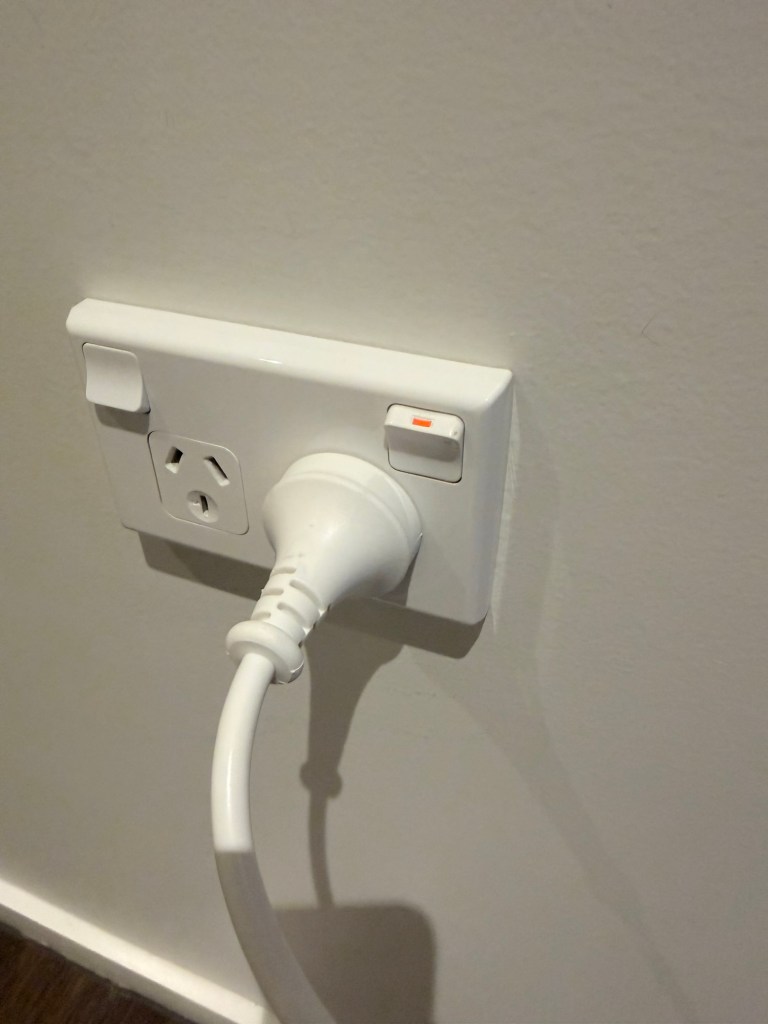
Note – Every outlet in NZ has a switch to turn on the power—flip the switch down to make sure the power is on!
NZ’s power outlets—flip the switch down to start the flow of electricity.⚡️
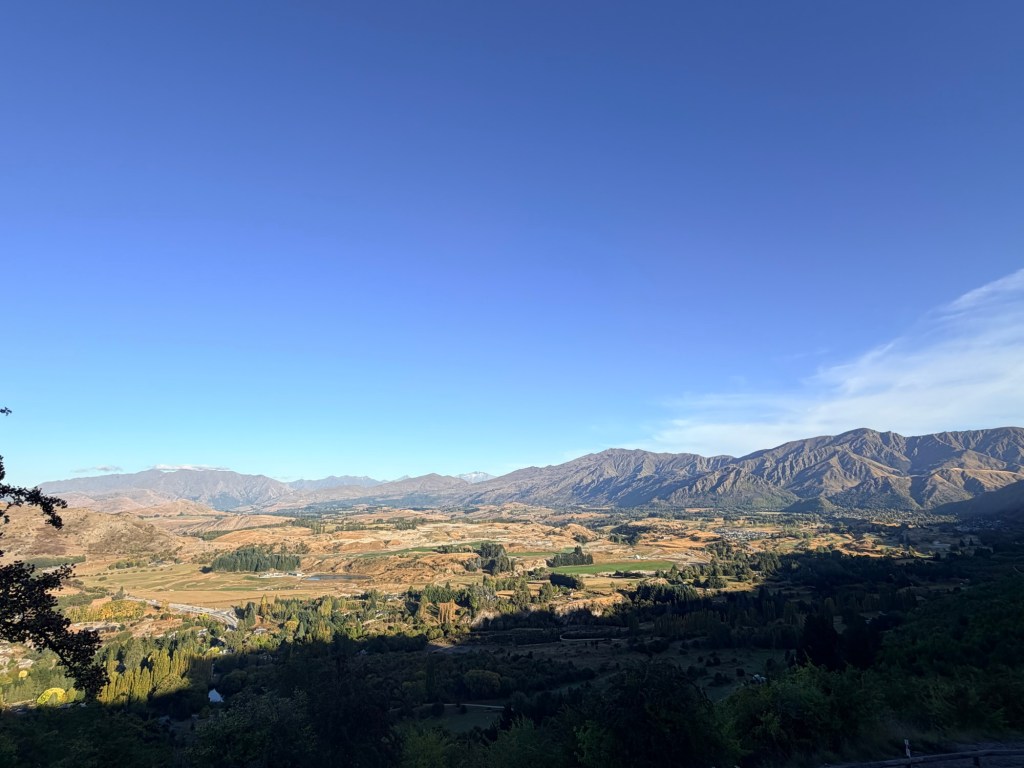
We said goodbye to Queenstown this morning and set our sights on Wānaka. The 90 minute drive wasn’t just “get from point A to point B”, rather a stunning stretch of road where every turn somehow topped the last.
Crown Range Road with sweeping views of the valley, rolling golden hills, rugged peaks, and that crisp New Zealand air that leaves your lungs wanting more!
A Quick Stop at Cardrona (and… Bras?)
One of our drive bys was the iconic Cardrona Hotel—New Zealand’s oldest hotel, dating back to 1863 during the gold rush era.
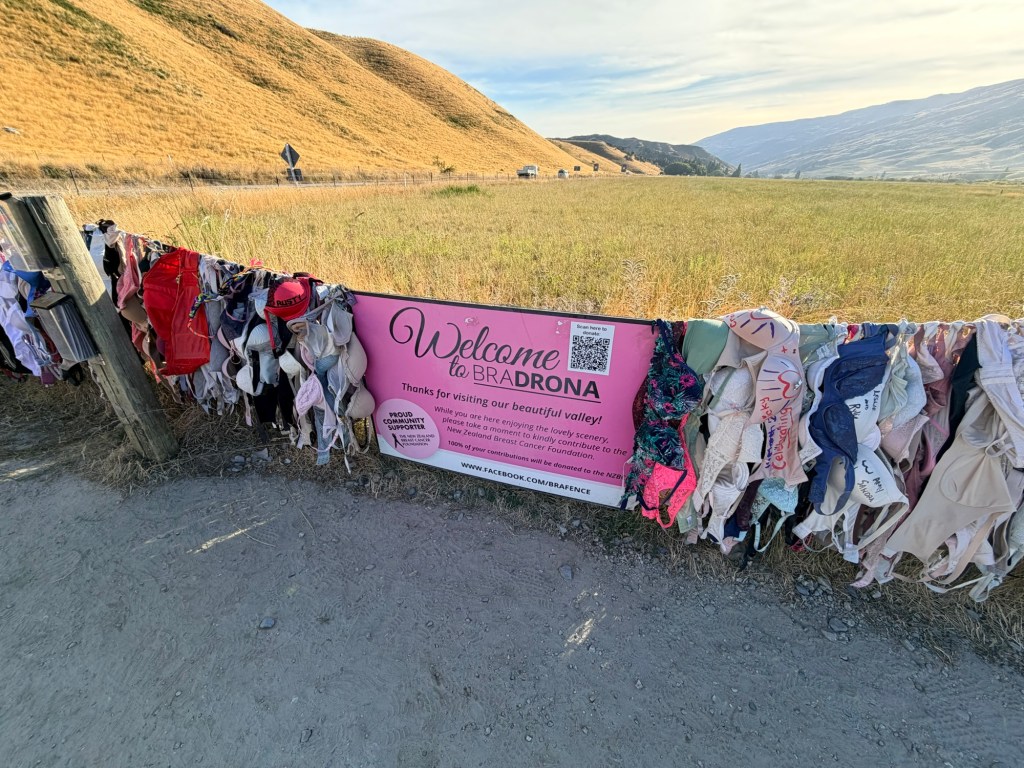
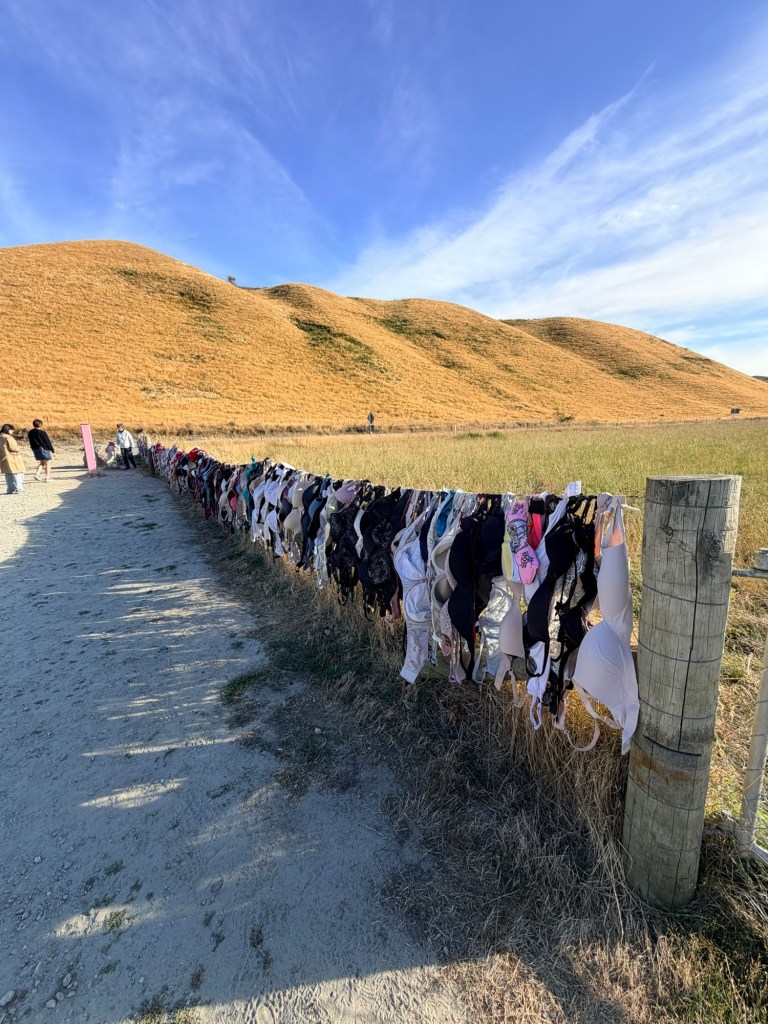
And then, right down the road we visited the infamous “Bradrona” fence—yes, a fence covered in bras. What started in the late 1990s as a few bras mysteriously appearing overnight has turned into a full-blown roadside attraction. While there appears to be some debate over its welcome, it’s become a quirky symbol of community, fundraising for breast cancer awareness, and just a little bit of Kiwi humor.
The famous “Bradrona” bra fence in Cardrona, New Zealand 🇳🇿 which now raises money myvlvl for breast cancer.
Wildwire: Lord of the Rungs
We rolled into Wānaka a few minutes early for our 11:00 am start time.
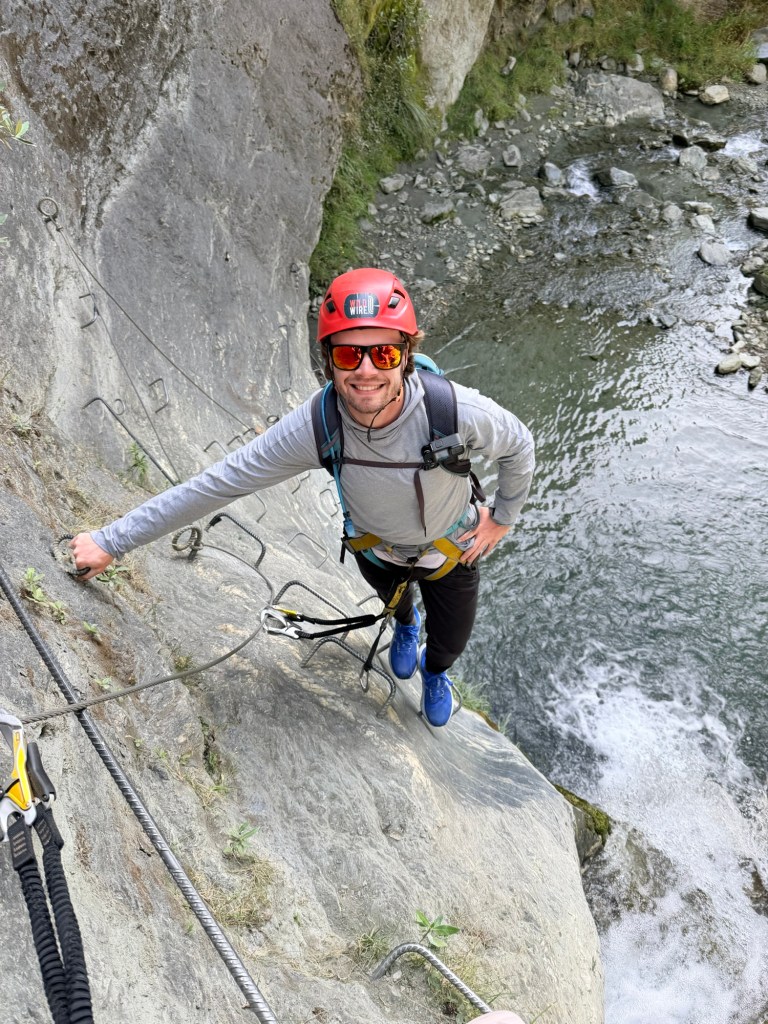
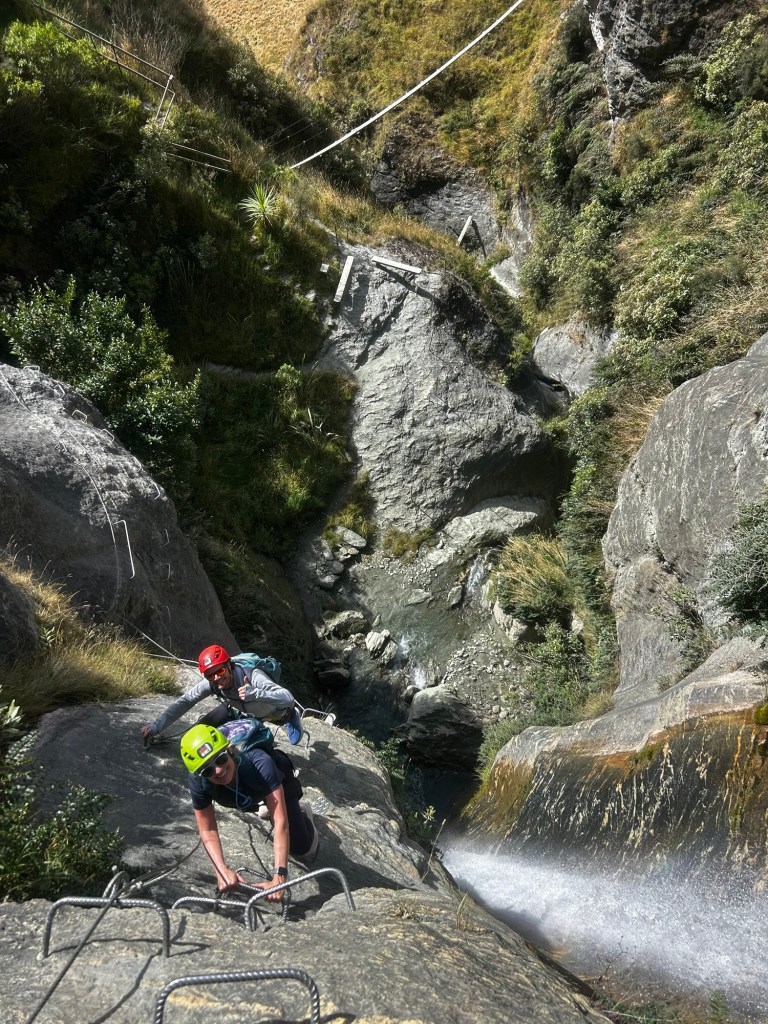
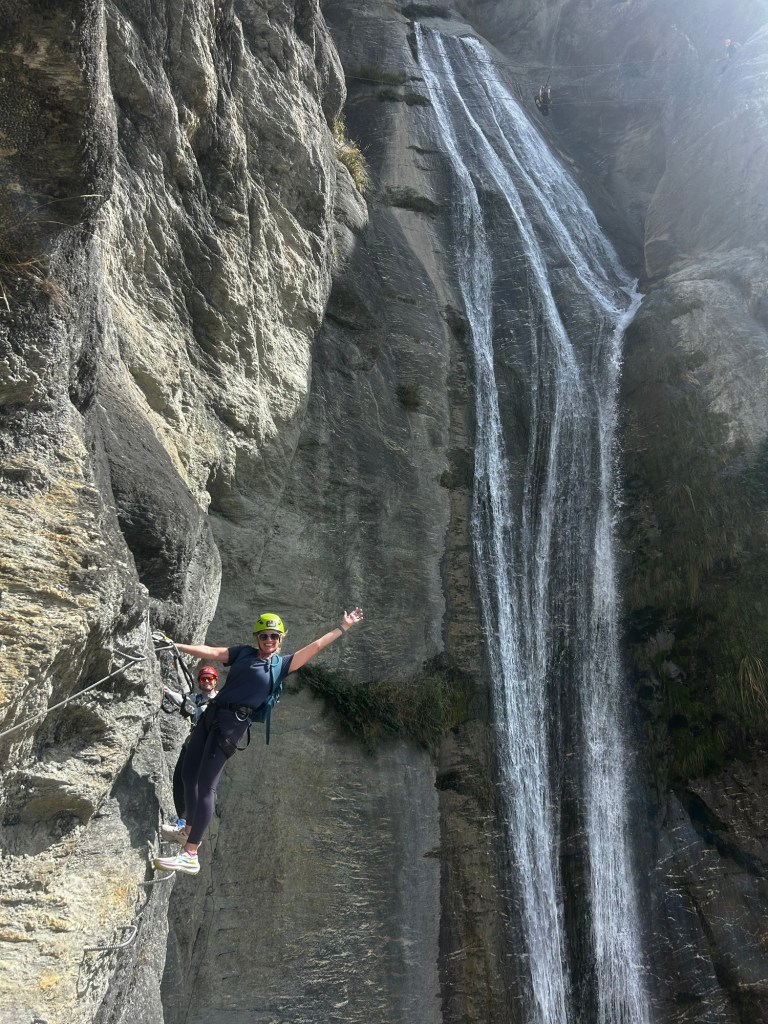
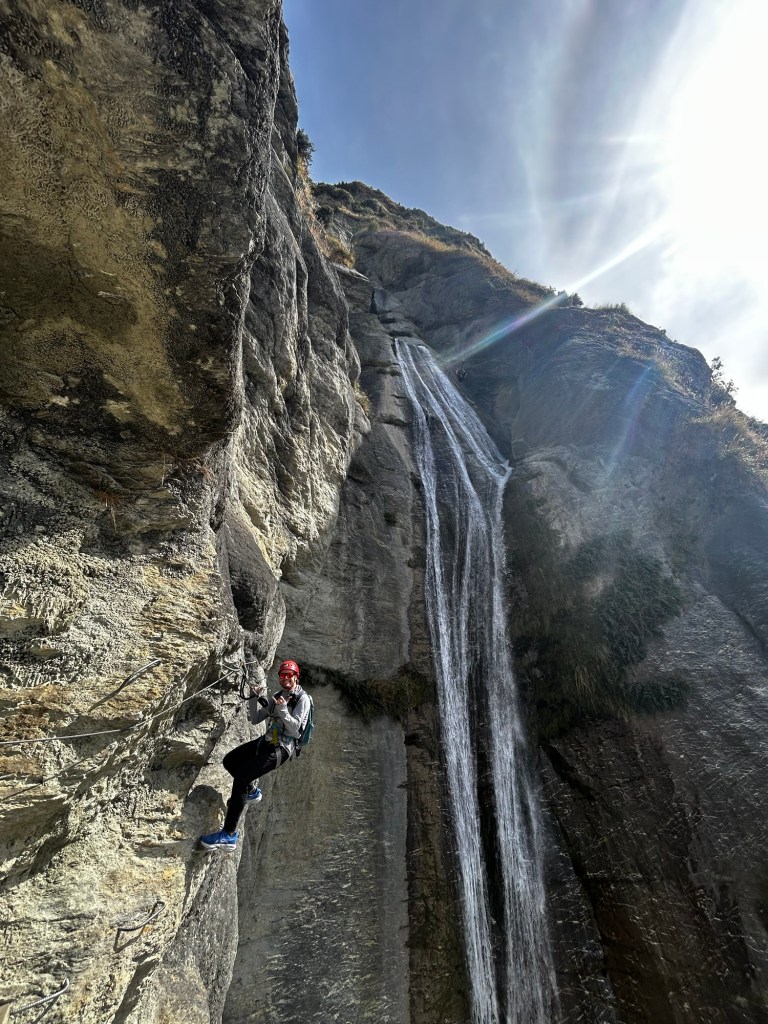
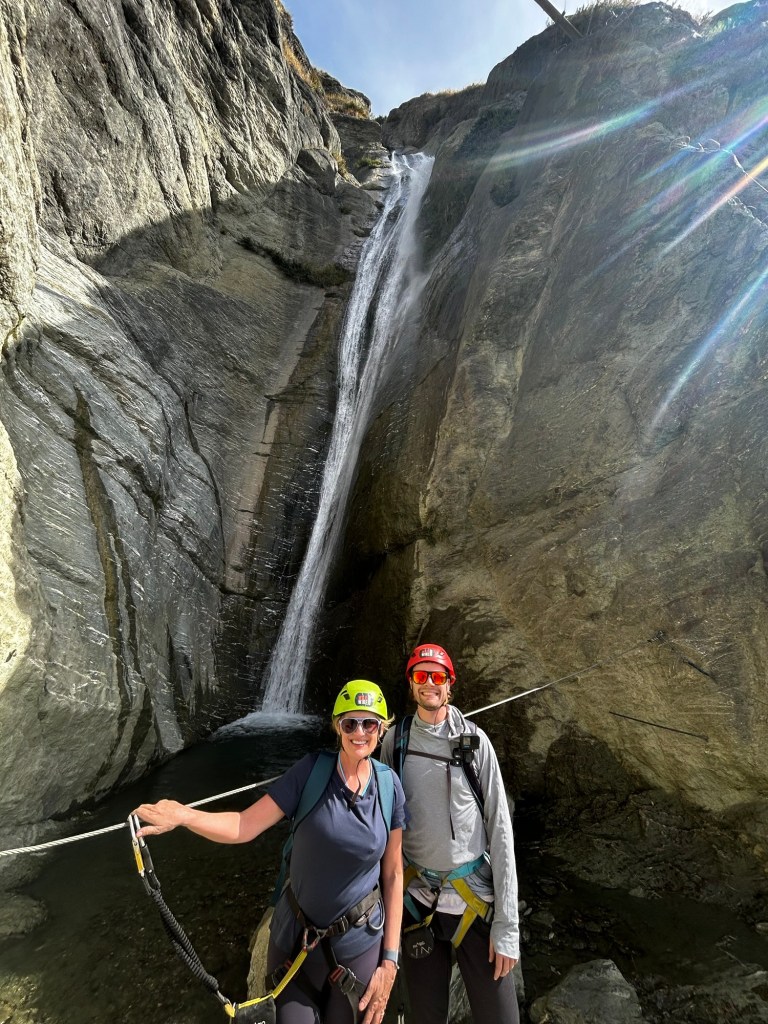
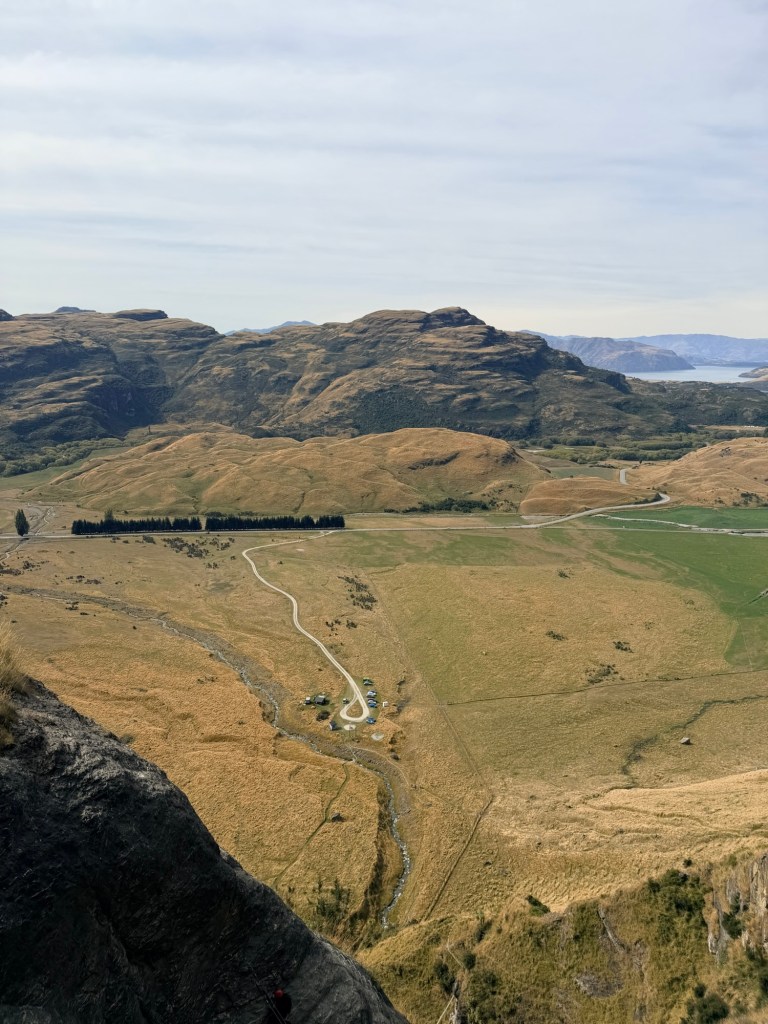
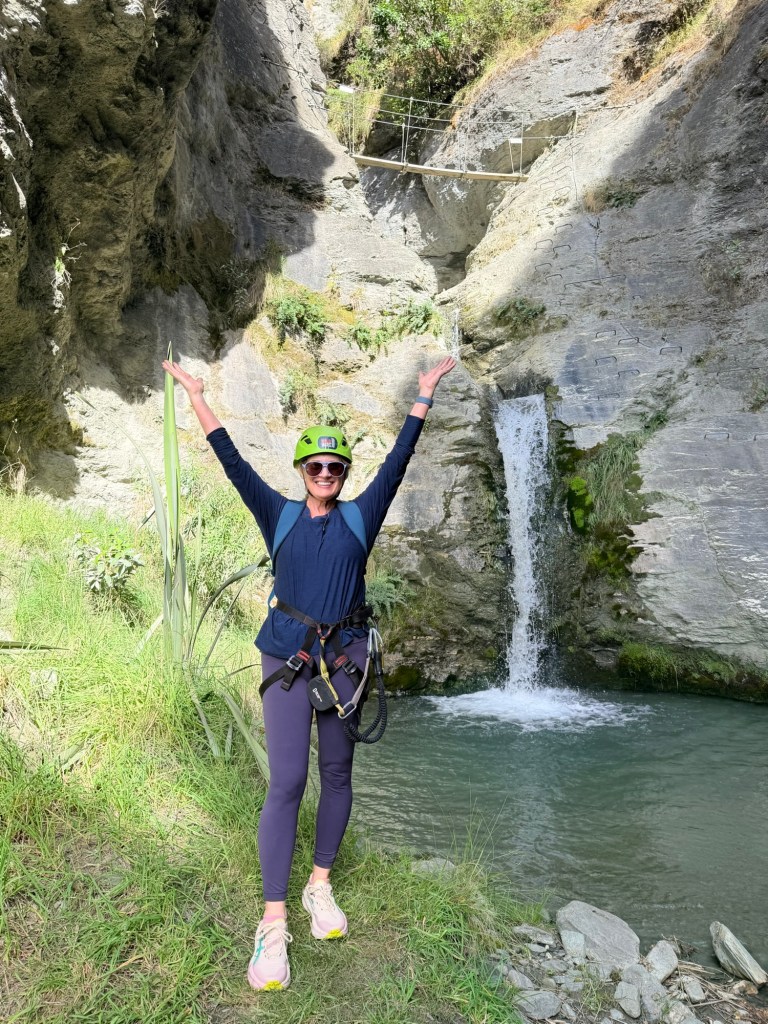
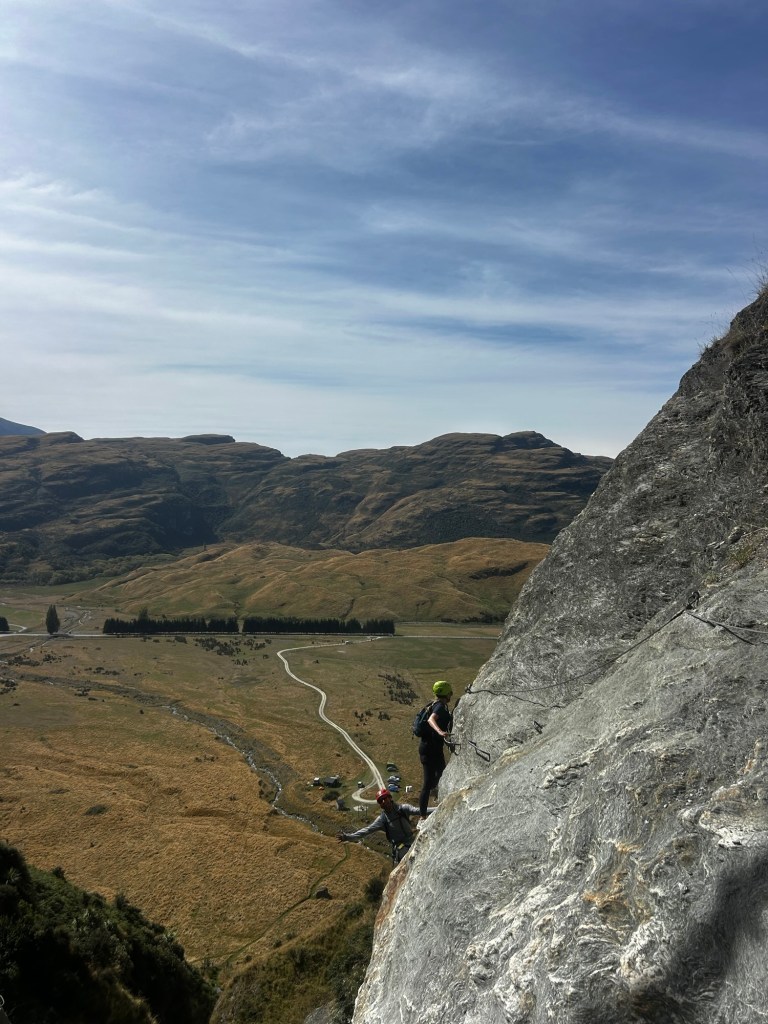
On the agenda was Wildwire’s “Lord of the Rungs” Level 2, which is a via ferrata climb.
If you’re like me and had to ask what that meant—here’s the simple version:
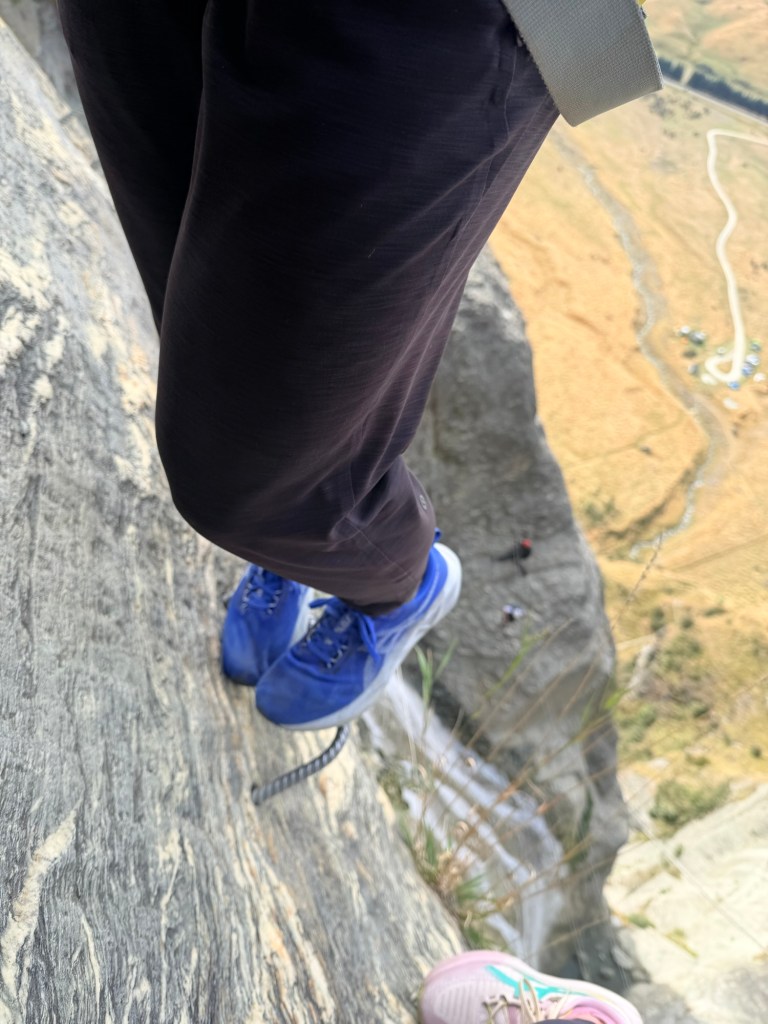
A via ferrata (Italian for “iron path”) is a protected climbing route that is built into rock. You’re clipped into a steel cable (at least two connection points via carabiners the entire time), and you climb using a series of ladders, rungs, pegs, and suspension bridges.
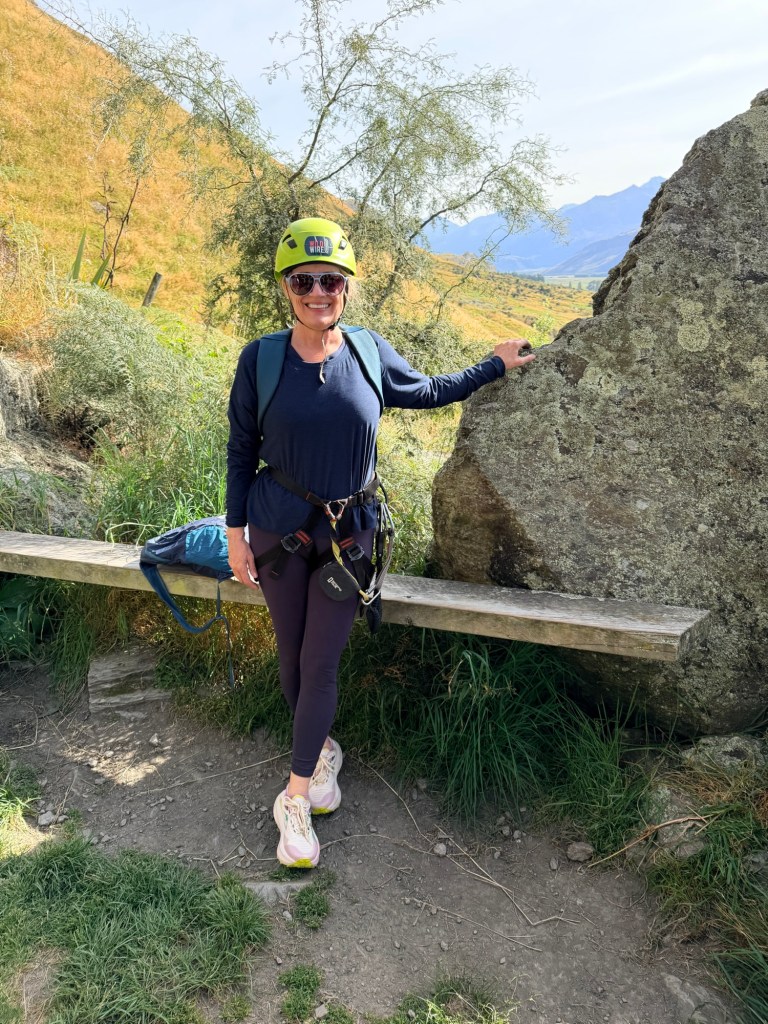
Geared up and ready to climb! Helmet, tool belt with Carabiners, and backpack with lunch.We have 3 carabiners—two are always connected. The 3rd one connects as you start to move one of the other two.
What we accomplished:
• 320 meters (1,050 feet) of vertical climb
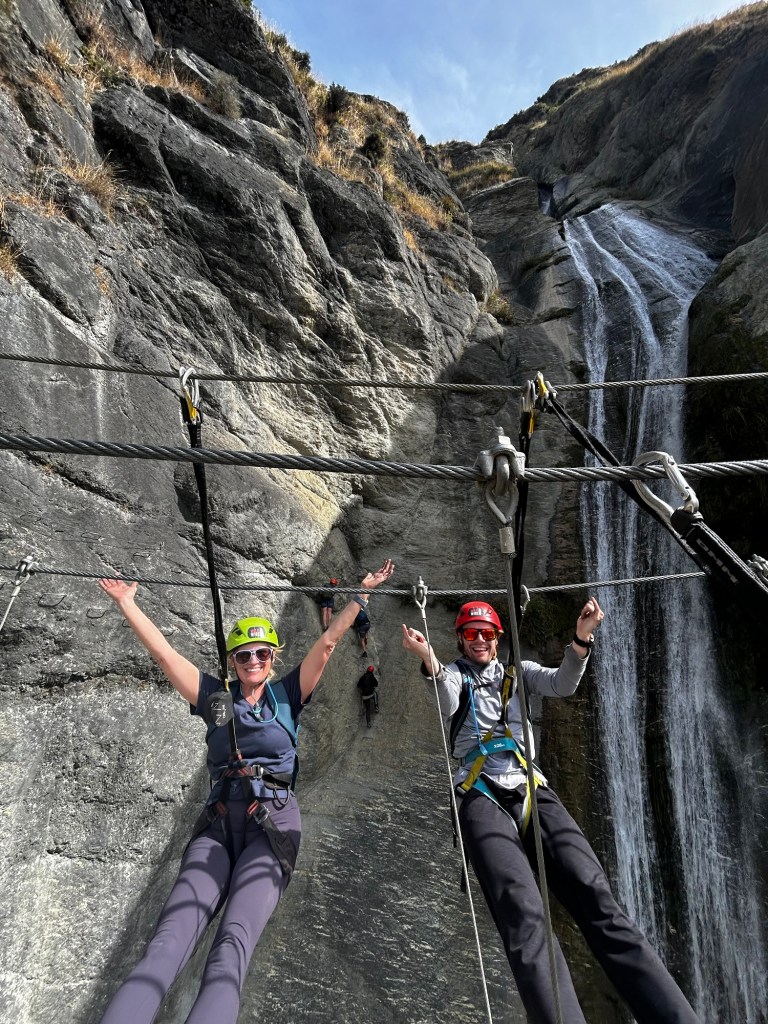
• 6 suspension bridges
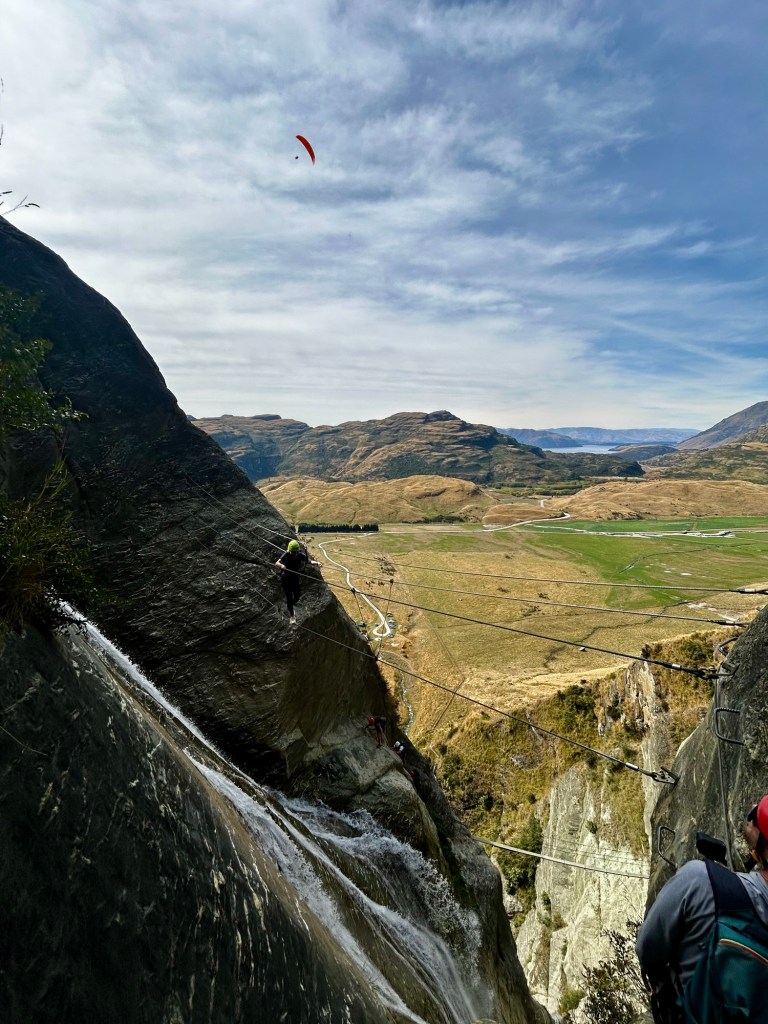
I was walking across a steel cable. See the paraglider in the background? At first I thought it was a piece of fuzz on my picture. 😂
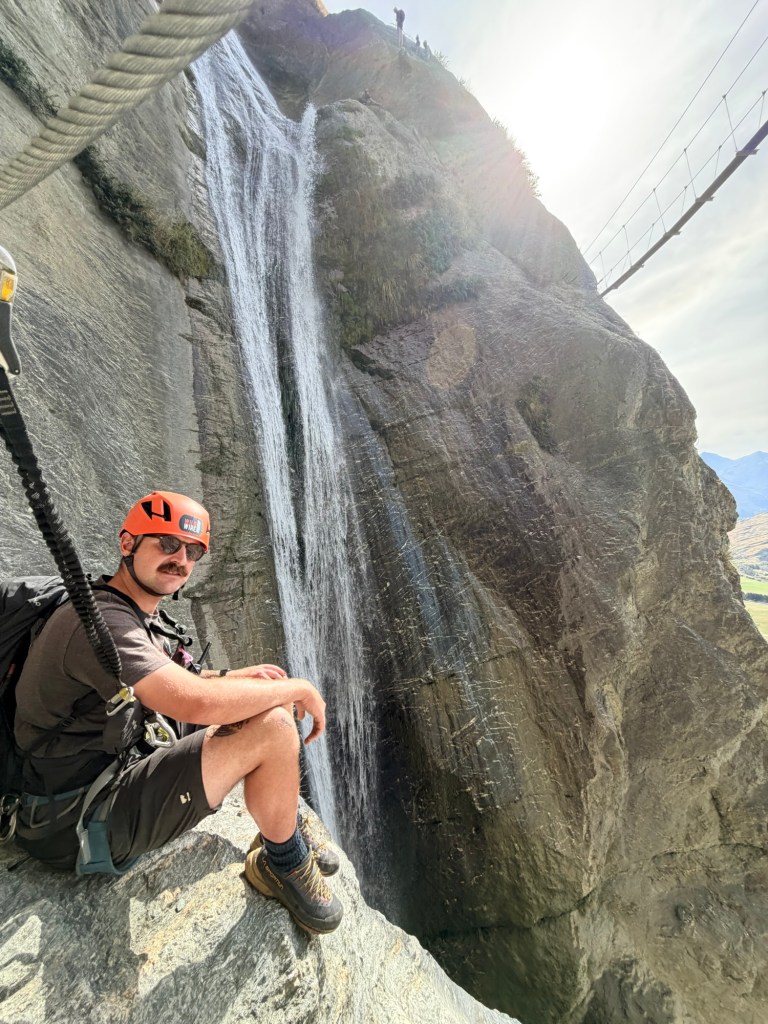
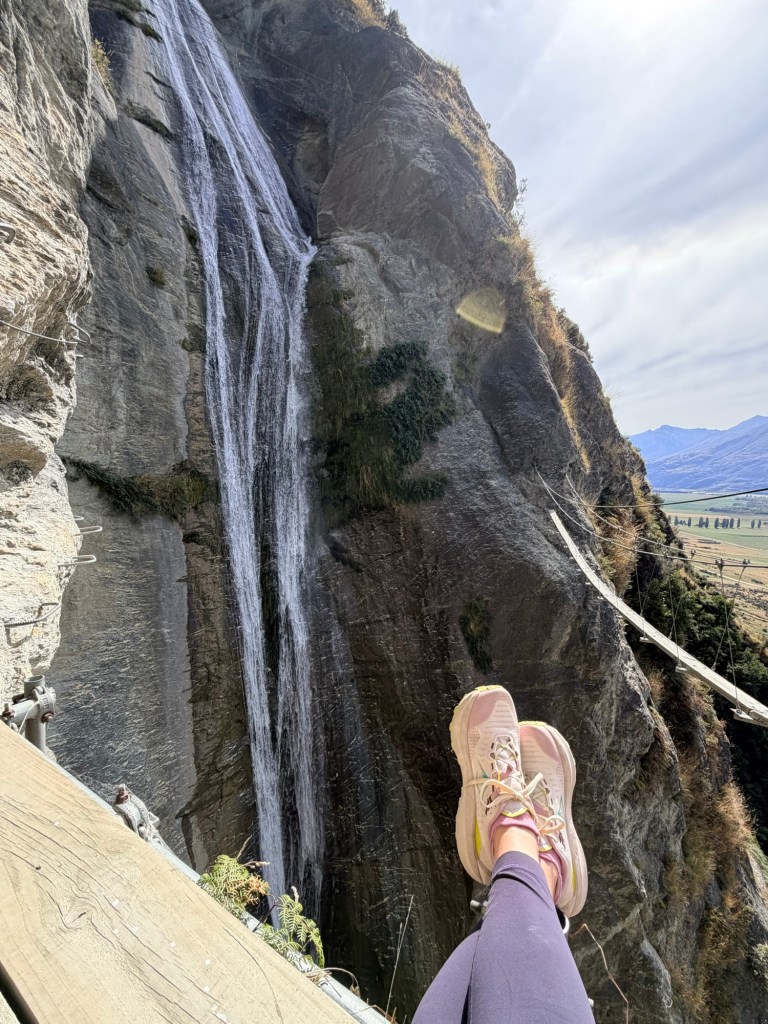
Brendan leading the way.Hanging off one of the suspension bridges. The bridge was simply a piece of wood on the bottom!
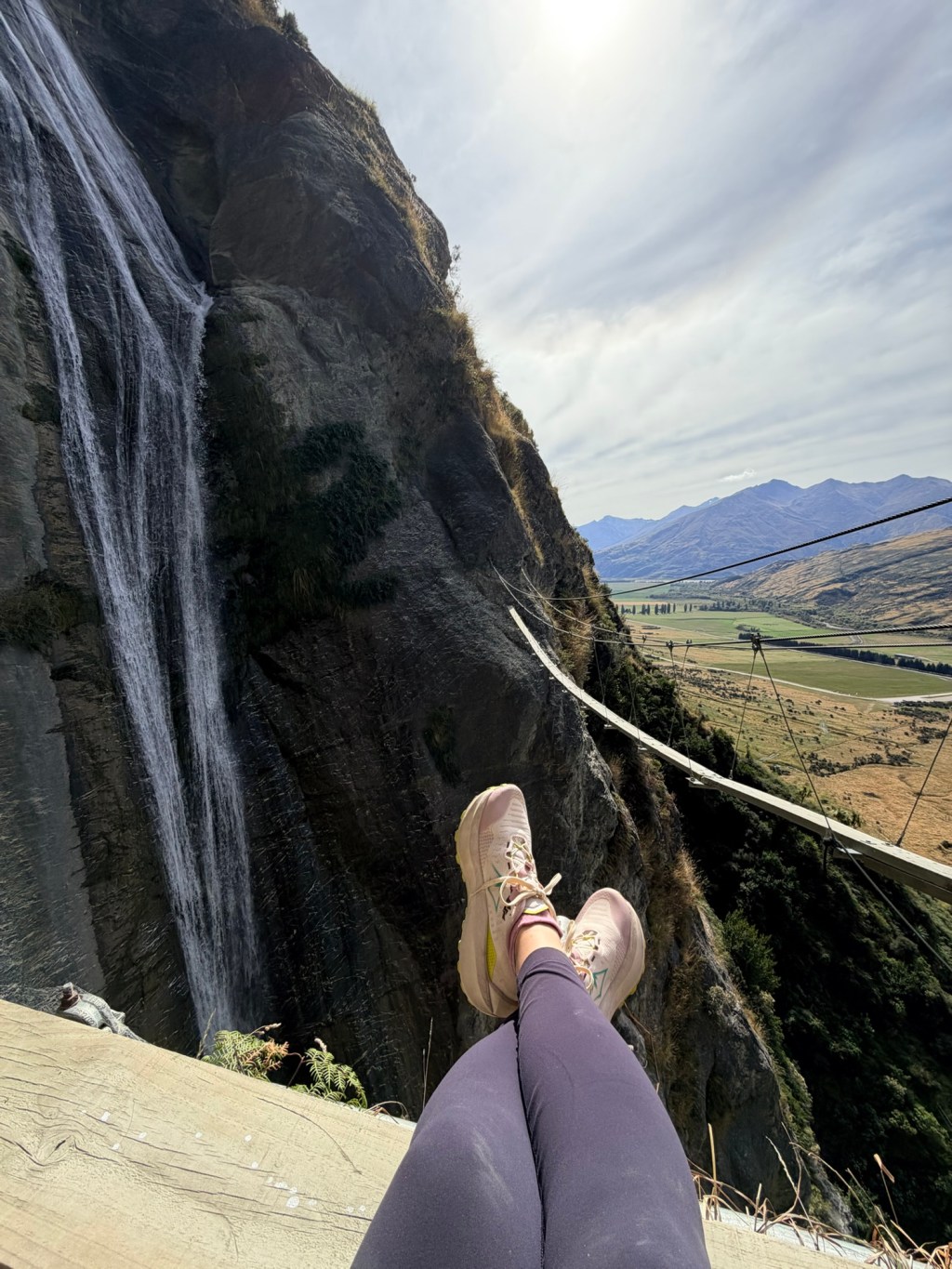
• Waterfalls rushing right next to you (and sometimes you get a cooling spray coming off the fall)
I carried my phone in under my T-shirt and when safe, I could take pictures. Brendan wore his GoPro. Our guide also took pictures for us.Climbing!🧗
• Unreal views of Lake Wānaka and the surrounding mountains
It was equal parts thrilling, challenging, and simply fun. Definitely more physical than expected—but in the best way.
Another smaller waterfall and brief break on our climb.
We were guided by Ben from the UK, who made us feel completely safe while also encouraging us to push just a little further than we thought we could. They also packed sandwiches for us, which somehow tasted like the best meal of my life at the top of the waterfall.
Side note – love my Goodr sunglasses. They are no slip and didn’t have to worry about them falling off!
Our guide, Ben.
The Lone Tree That Stole the Show
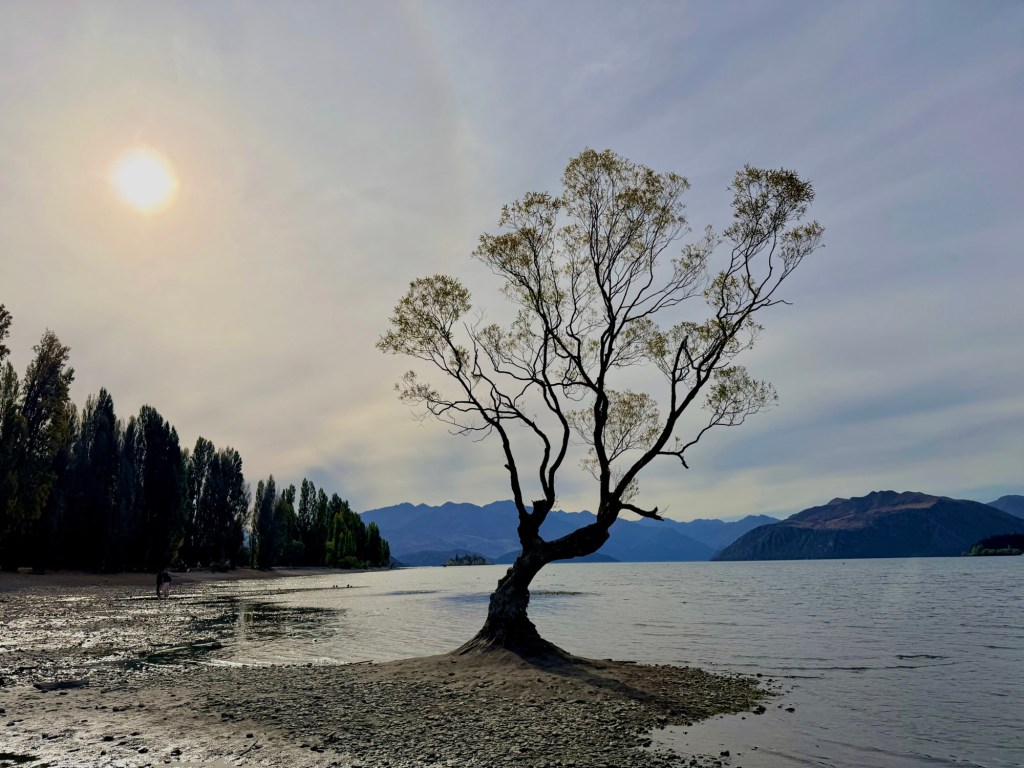
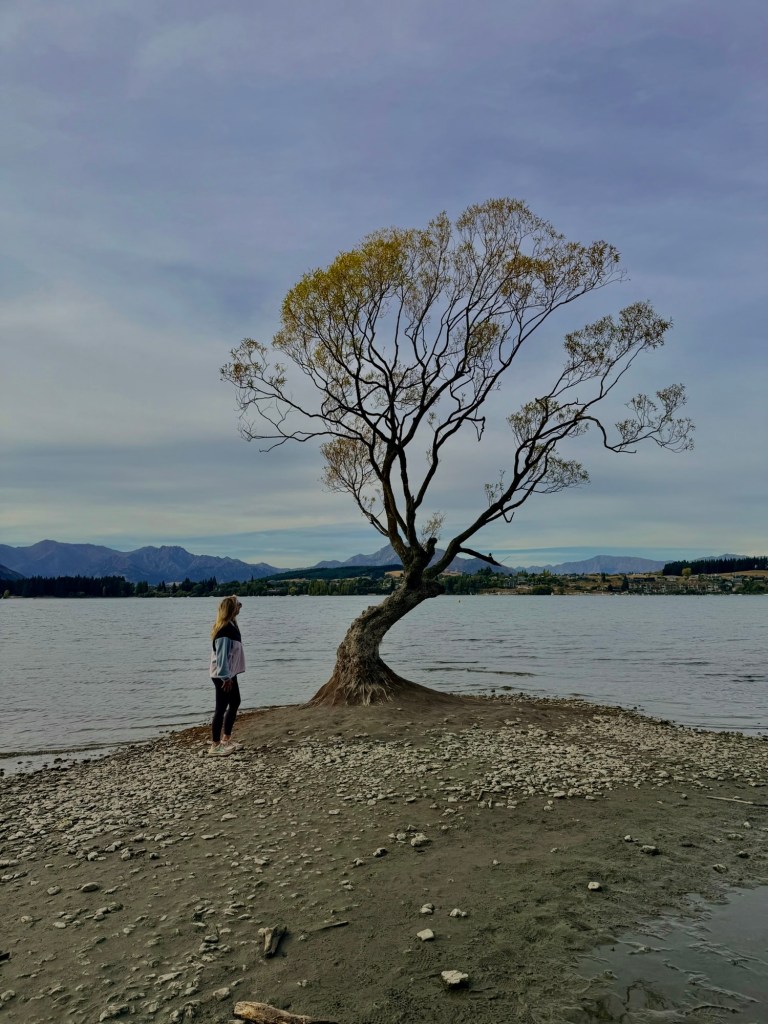
After coming down (and feeling very accomplished), we made our way to one of Wānaka’s most photographed spots: That Wānaka Tree.
This little willow tree has been growing in Lake Wānaka for decades, likely from a fence post that took root back in the 1930s. Over time, it’s become an accidental icon.
Then we walked along the lake, took it all in, and just slowed down for a bit after the adrenaline of the afternoon.
Wānaka After Dark (Early Night for Us)
We wrapped up the day with dinner at Big Fig and a stroll through downtown Wānaka, which might just be one of the cutest little towns I’ve ever seen. Cozy, relaxed, and surrounded by insane natural beauty in every direction.
Final Thoughts
Today we had a little bit of everything—scenic drives, quirky roadside stops, adventure, and a peaceful lakeside ending.
But if I had to pick?
The climbing straight up a waterfall on the side of a mountain might be hard to beat.❤️⛰️🧗♂️
Coming around the corner!Taking a break on our climb 💚
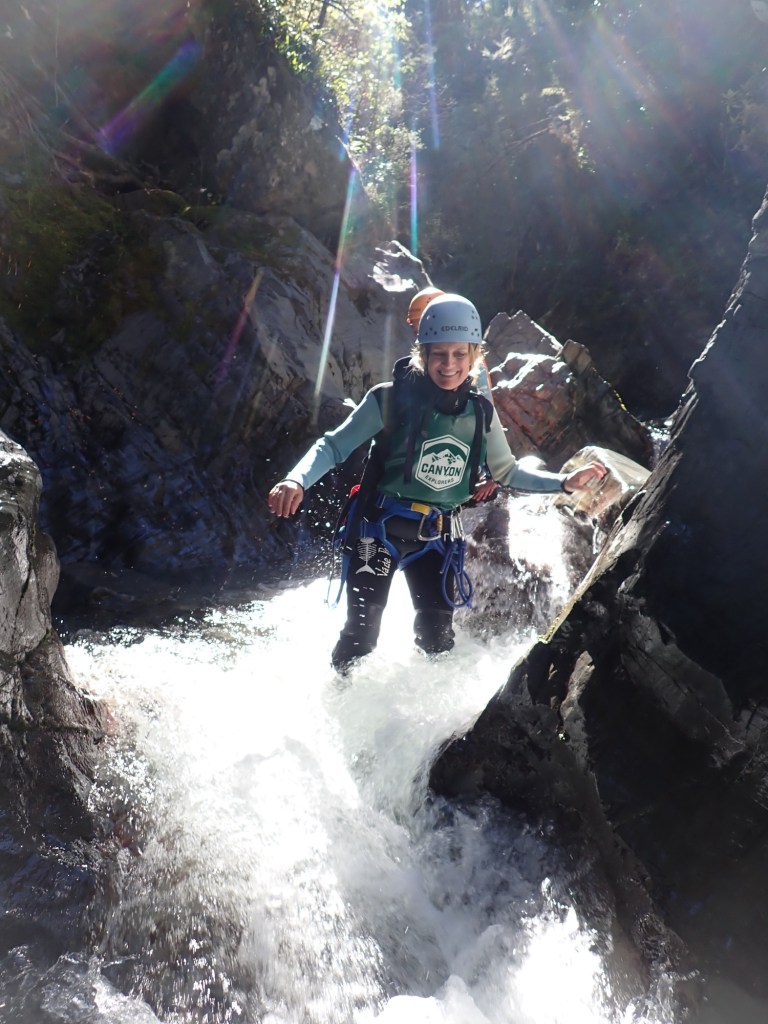
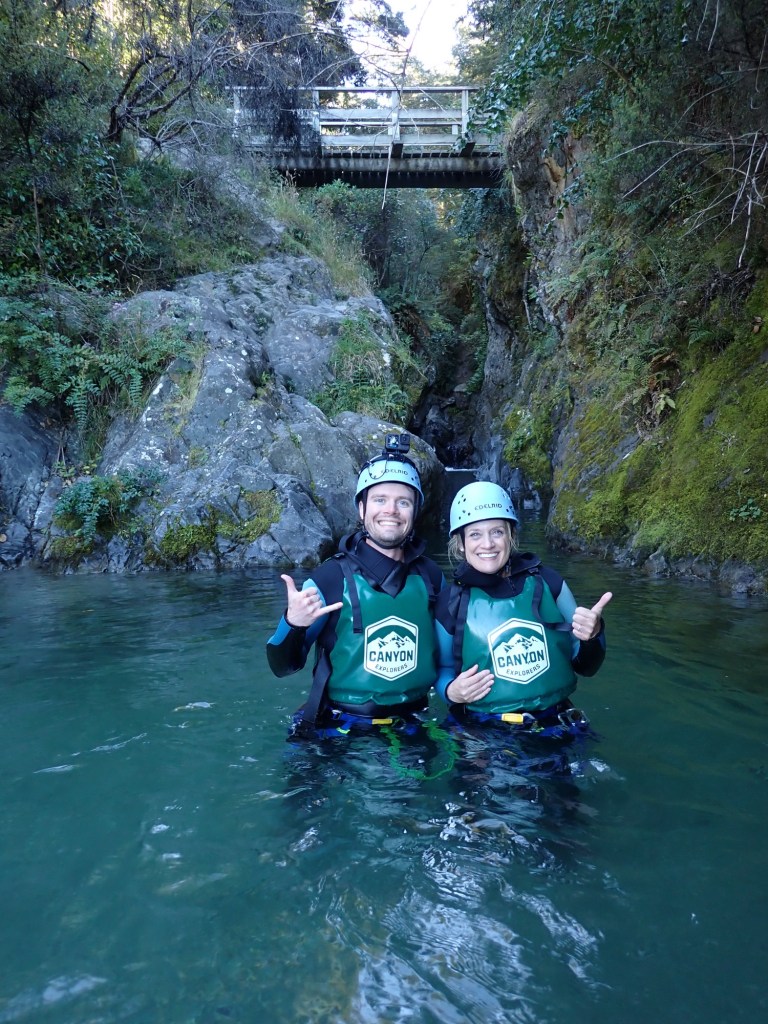
We slept in a bit, enjoyed a leisurely breakfast at our hotel, and then took the water taxi into town. We grabbed a quick lunch, did a little shopping, and then headed out for our half-day adventure with Canyon Explorers.
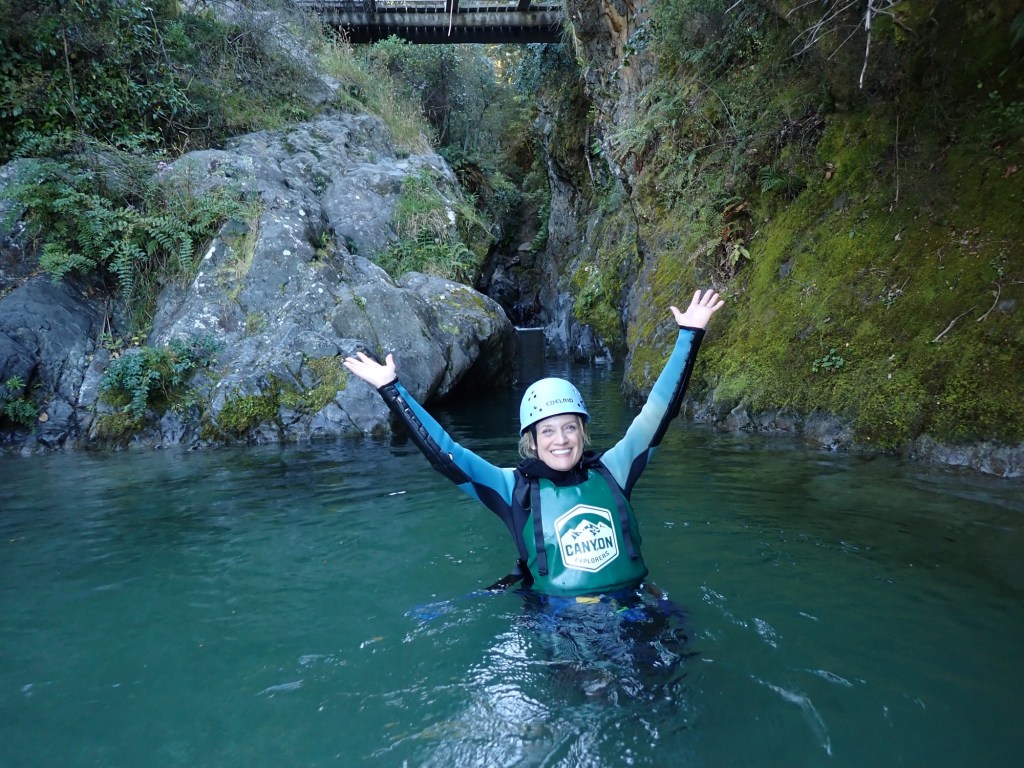
Definitely a more physical adventure as we navigated a canyon. You heard me right…a canyon. It turned out to be one of the most unique things we’ve done so far.
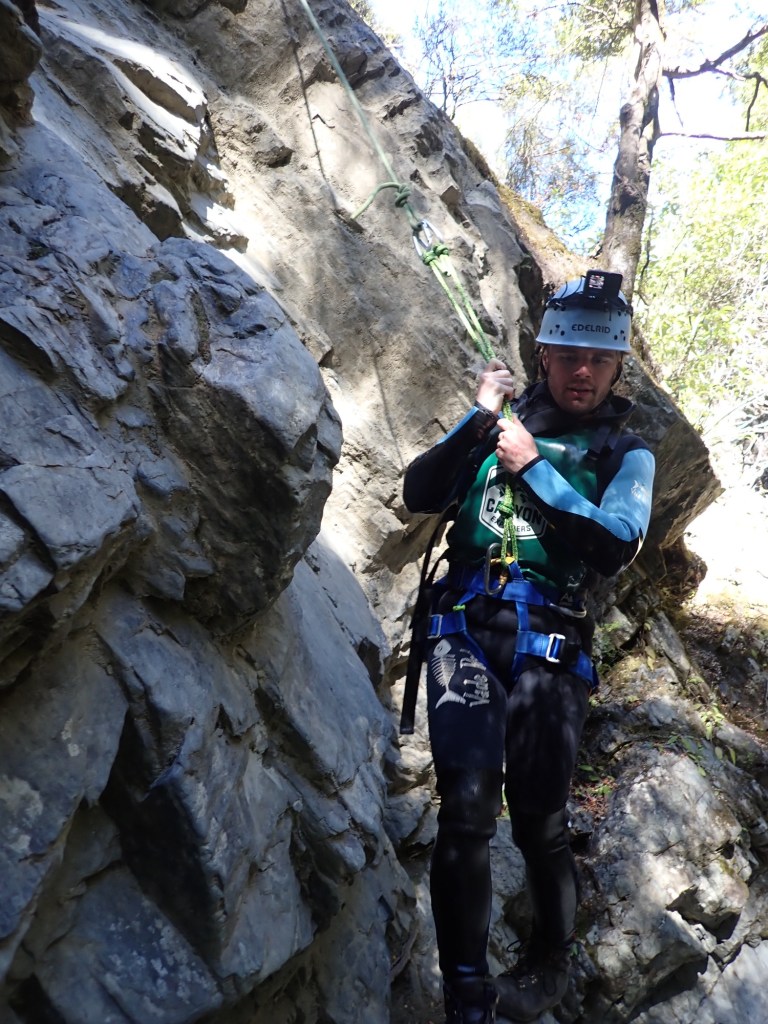
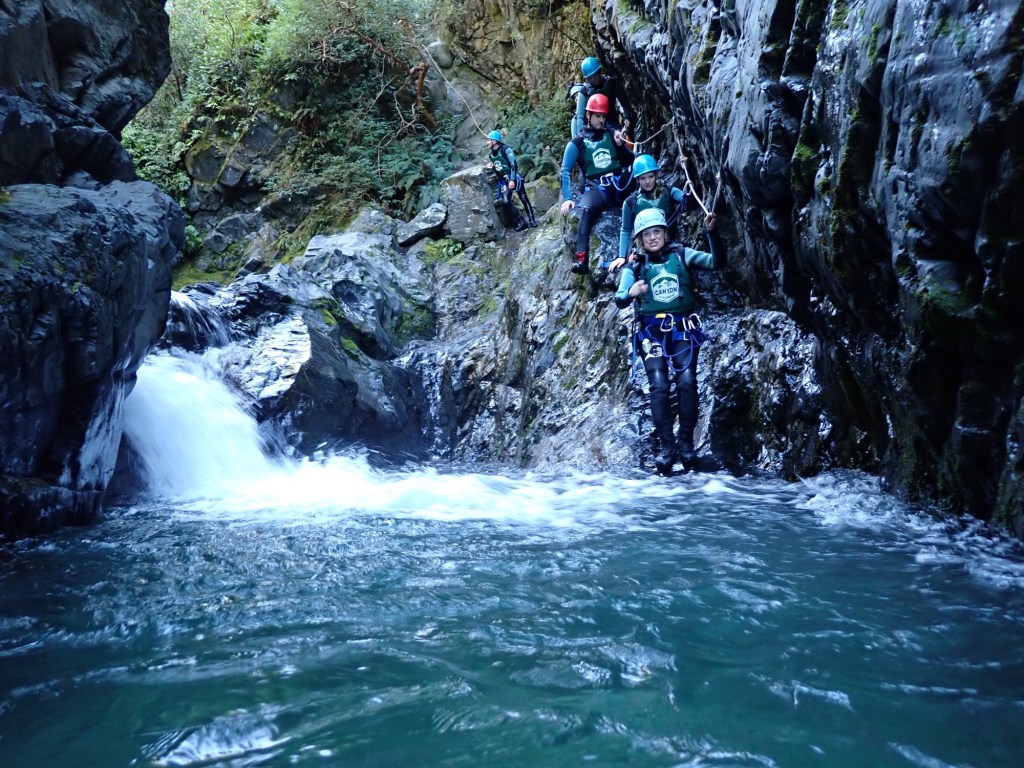
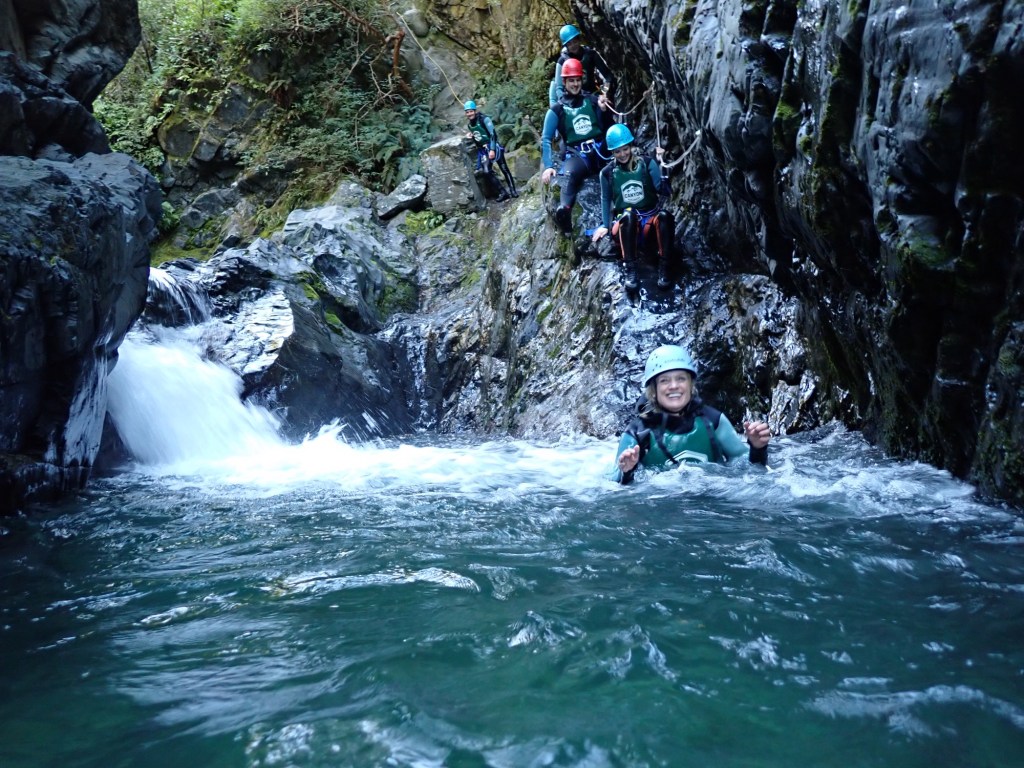
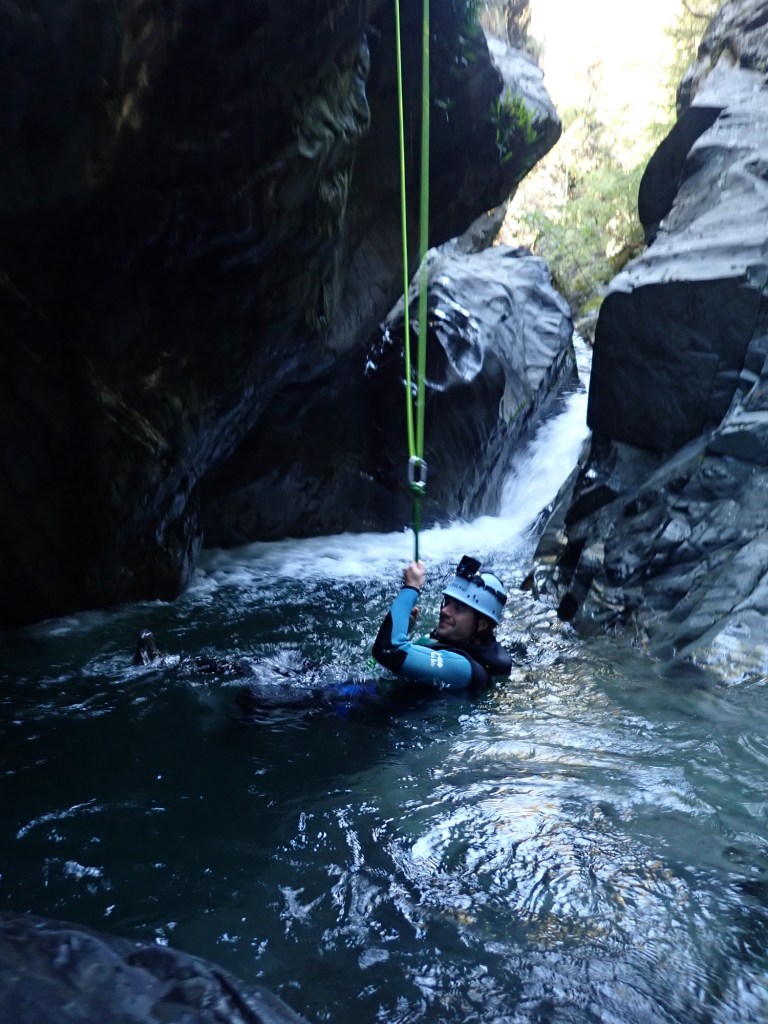
Canyoning is basically nature’s version of a water park—but more rugged. You make your way down through a canyon using whatever the terrain gives you and you use your body, your equipment (ropes, carabiners), plus experienced guides. Then you hike, climb, rappel, zipline, slide, and occasionally jump into pools along the way.
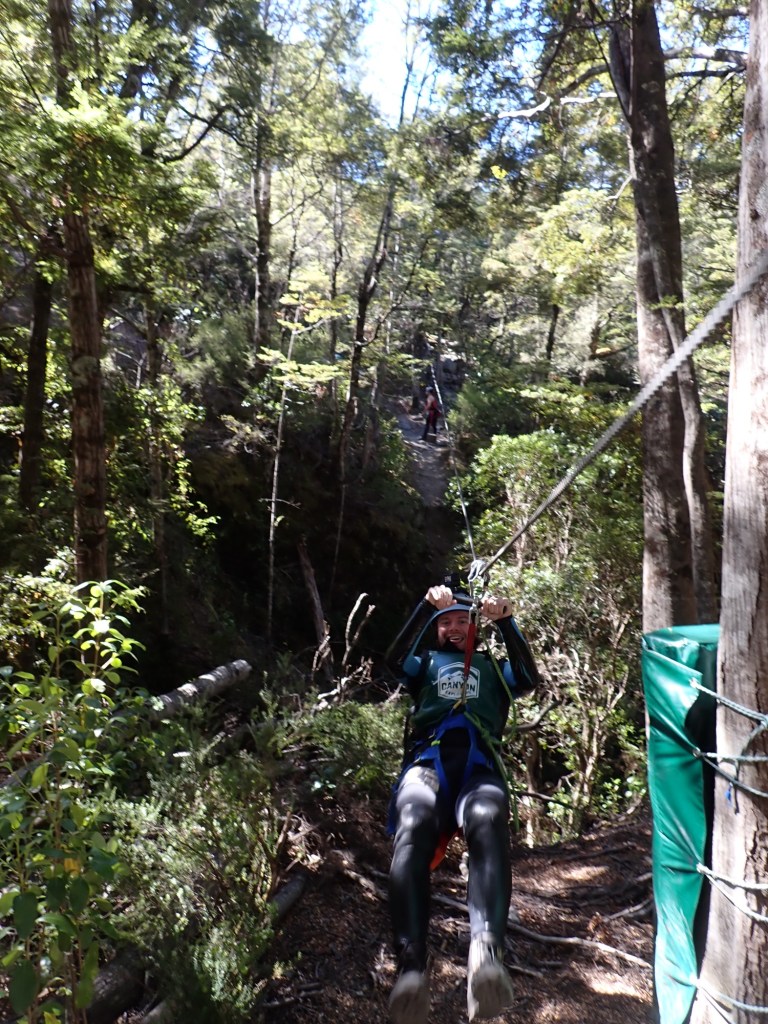
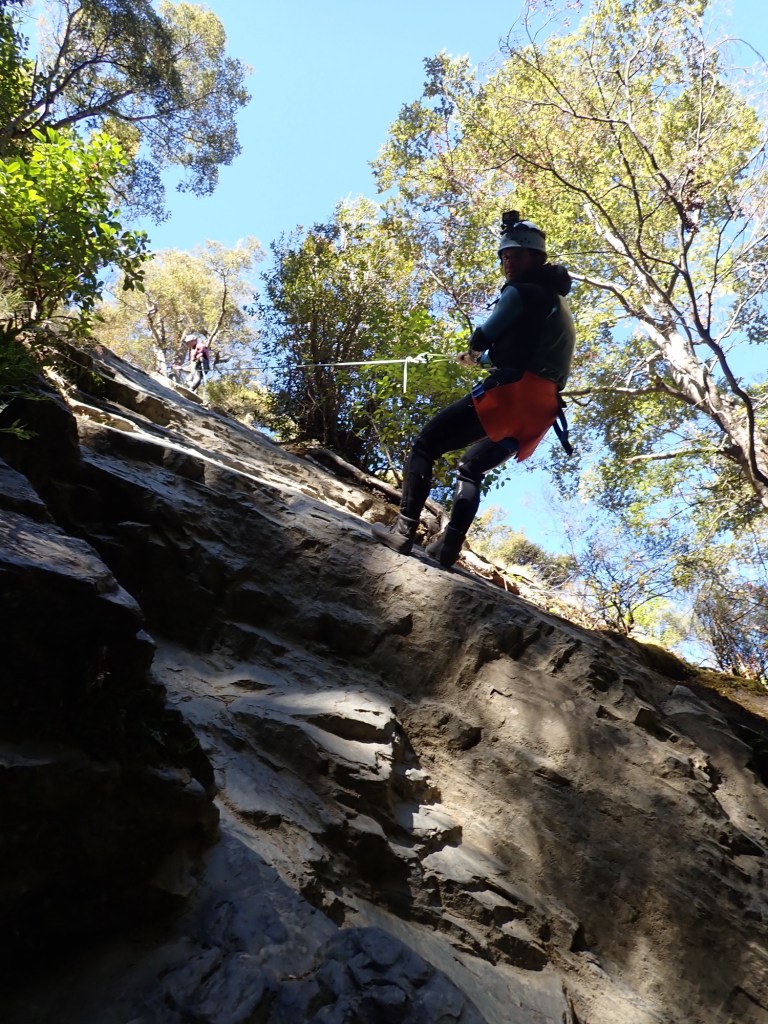
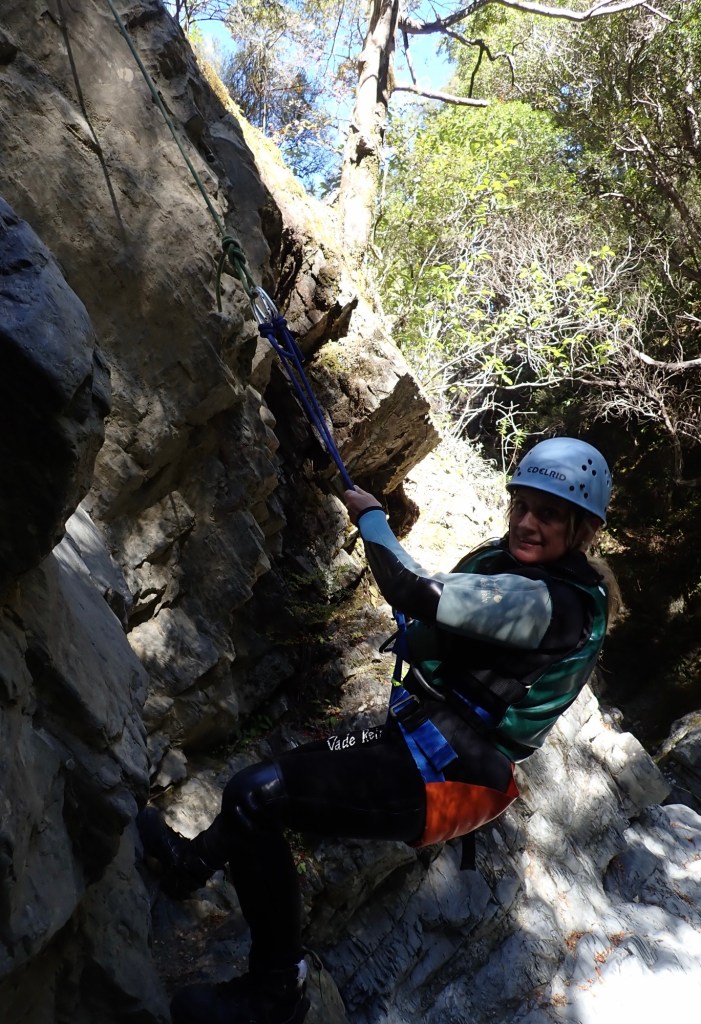
We were a group of 9 plus our two guides, Tim and Oscar. After a safety briefing, we took a short hike through a beautiful forest that suddenly opened up to this hidden, high-walled canyon. From there, it was nonstop. We ziplined twice across the canyon, repelled next to a waterfall, squeezed through narrow rock passageways, floated through pools, and navigated natural slides carved into the rock over time.
Ziplining over the canyon to get to the spot where we will enter.Brendan rappelling down the side of the canyon.Next it’s my turn!Action shot coming through the canyon.
It was part adrenaline, part problem-solving, and part just staying on my feet! We wore wet suits because that water was cold. 🥶
Done!✅
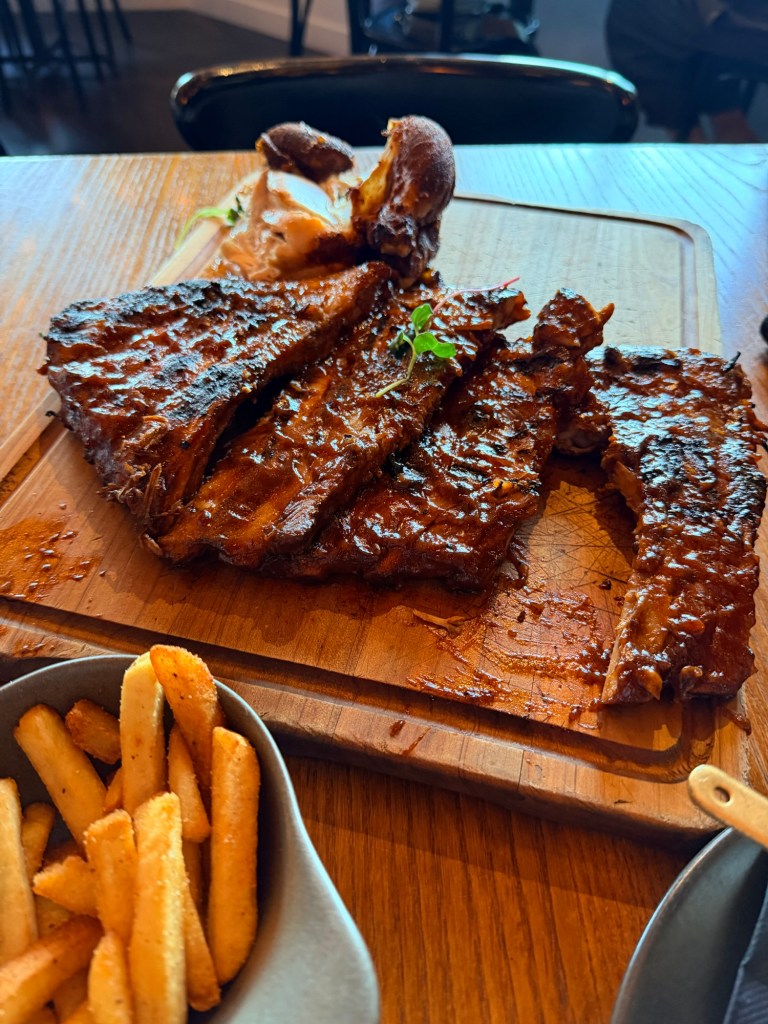
By the time we finished, dinner was calling loudly so we indulged at an AMAZING restaurant with incredible views called Flame. We definitely got our share of protein with the mixed grill for two: ribs, chicken, fillet, and African boerewors sausage. Add fries, amazing sauces, and cole slaw salad that was out-of-this-world good!
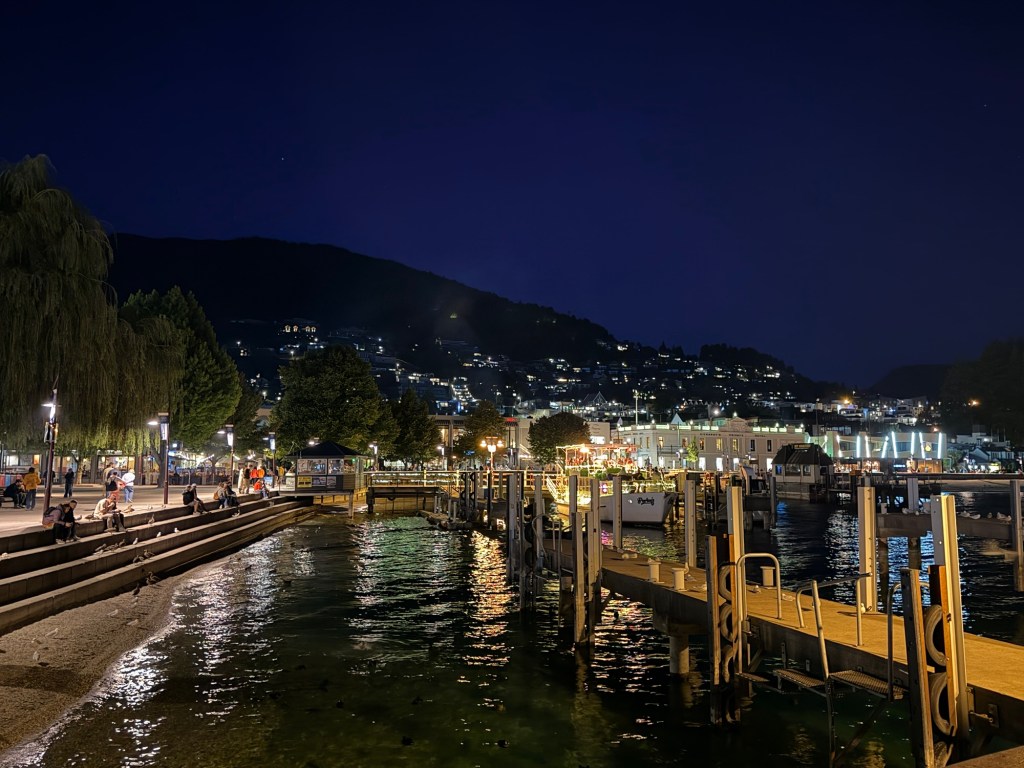
We walked around town after dinner, then took the water taxi back to pack. We’re hitting the road again tomorrow for more South Island exploring!
Queenstown, I will miss your postcard views and your adrenaline-filled energy around every corner. You have a way of getting my heart 💗 racing one minute, and completely stealing it the next. Until we meet again (I have a few more things to do on the next visit).
They don’t call Queenstown the Adventure Capital of the World for nothing. This is where commercial bungy jumping, jet boating, and tandem paragliding were all born—because apparently someone looked at these mountains and thought, “How can we make this more intense?”
Milford Sound: Worth Every Bit of the Hype
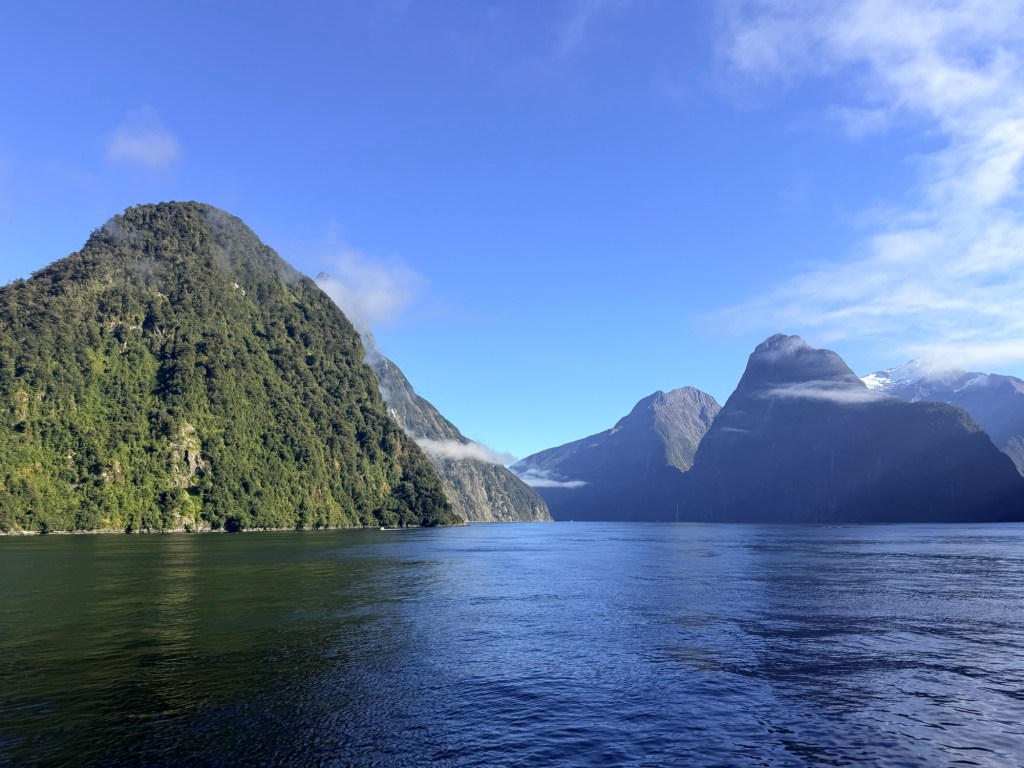
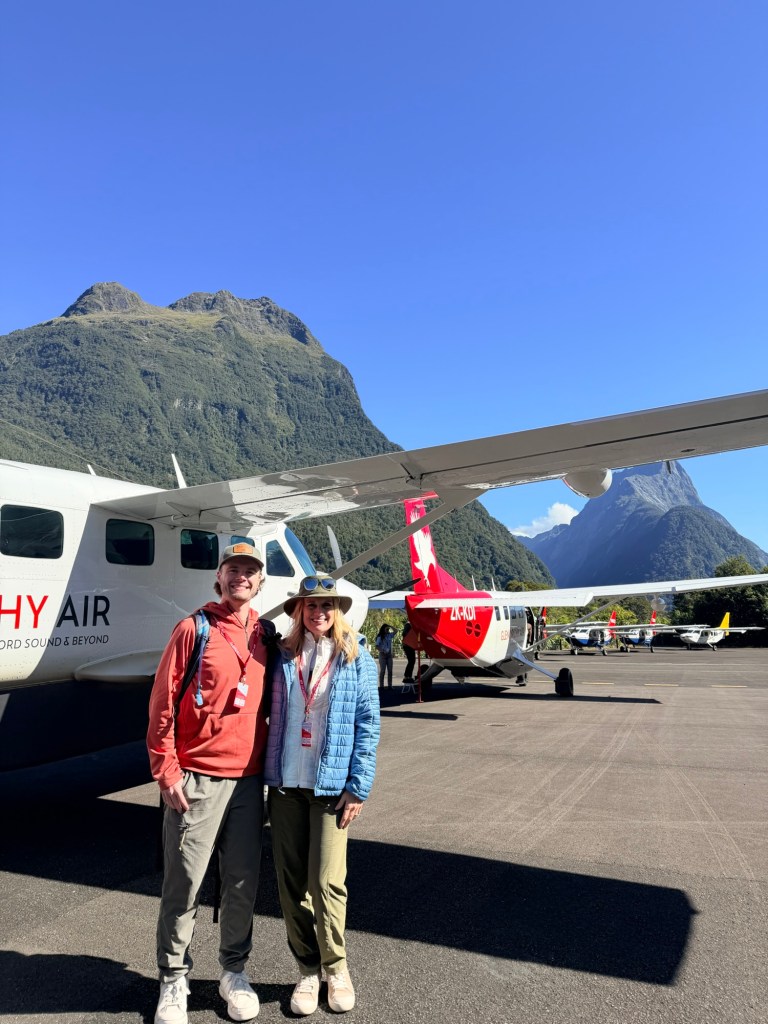
We kicked off the day with a scenic flight with Glenorchy Air to Milford Sound—often called the “8th wonder of the world” (Piopiotahi in Māori) and part of a UNESCO World Heritage Site.
Take one didn’t exactly go as planned. We took off and then had to turn right back around because the cowling (covers the engine) flew open mid-flight. Nothing like a little pre-adventure adrenaline spike. Our pilot, Annabelle, handled it extremely professionally.
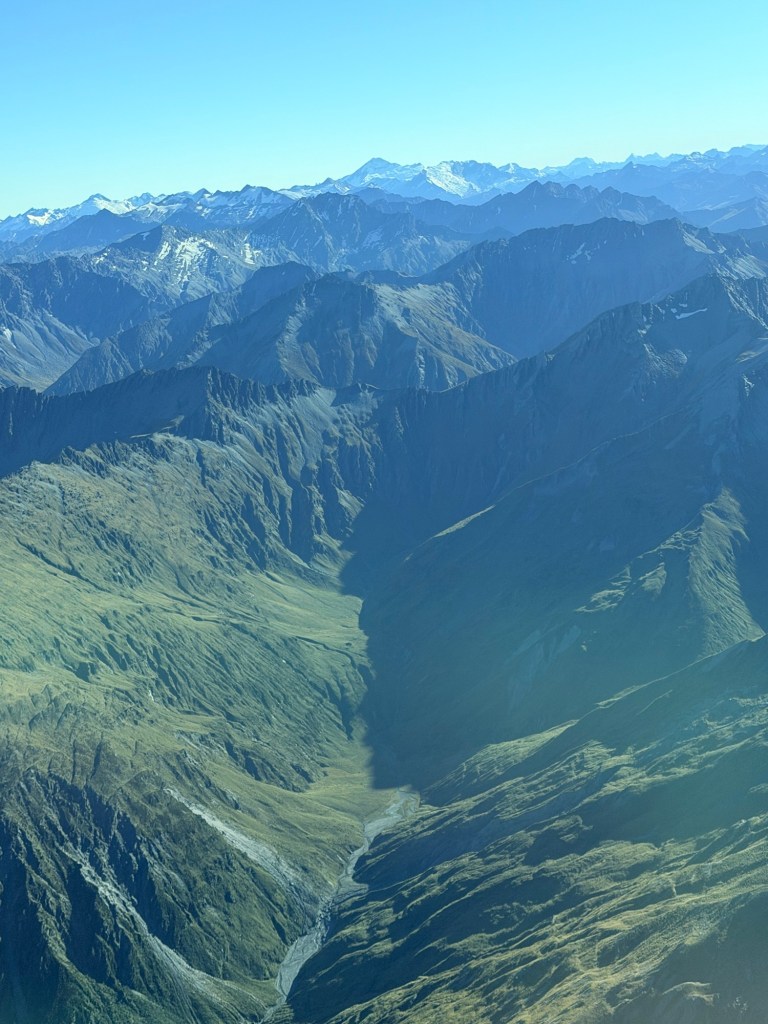
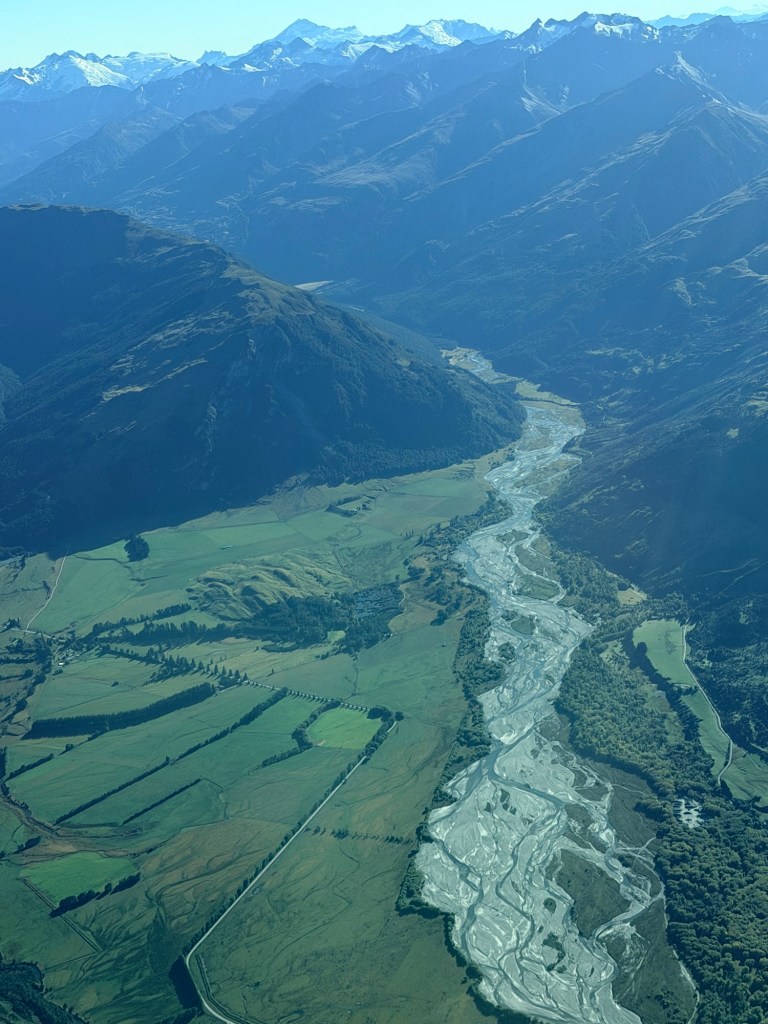
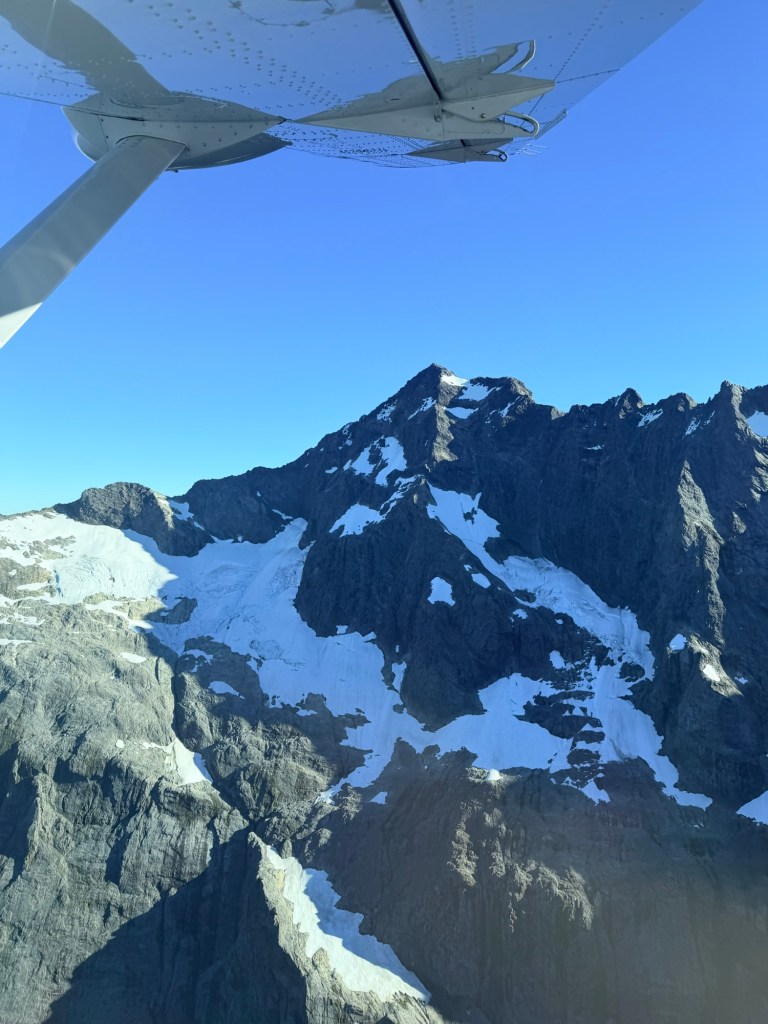
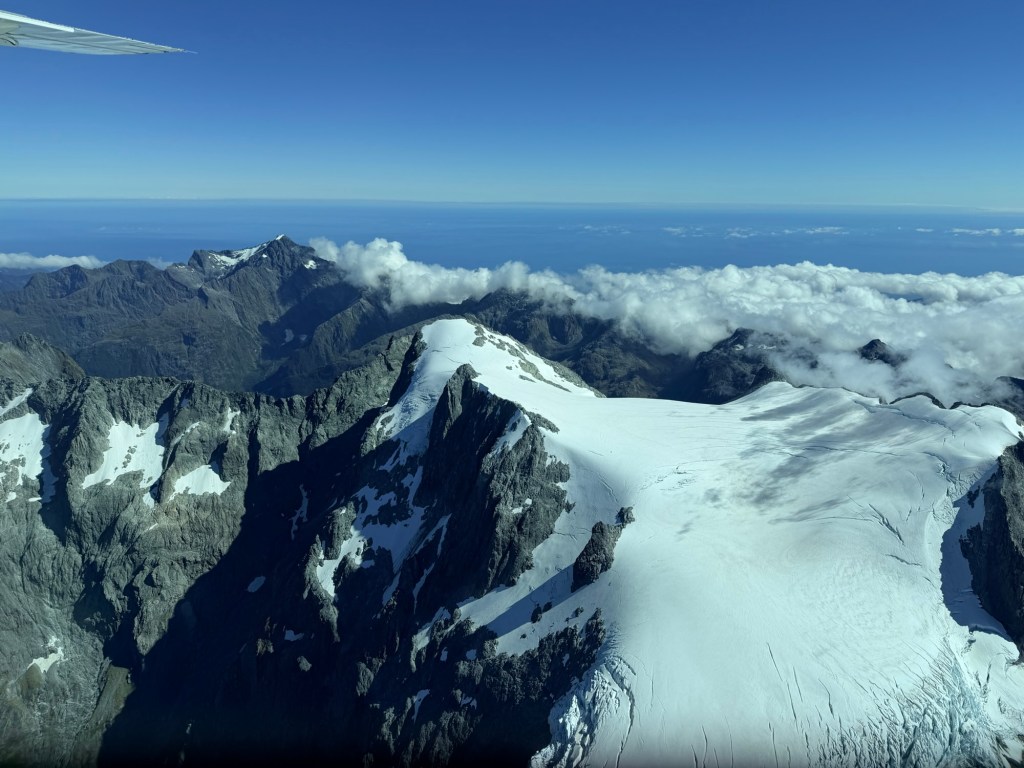
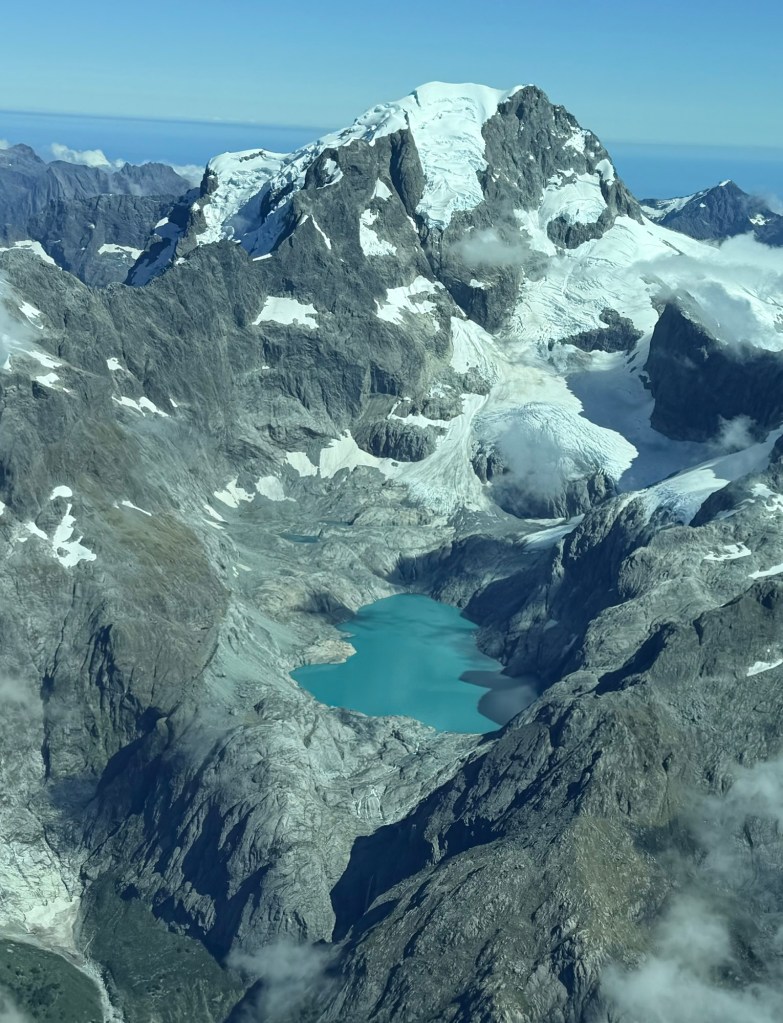
Round two was much more successful—and absolutely stunning. A few snow-capped peaks, glacial lakes up high in the mountains, deep valleys, and scenery that doesn’t even look real from above.
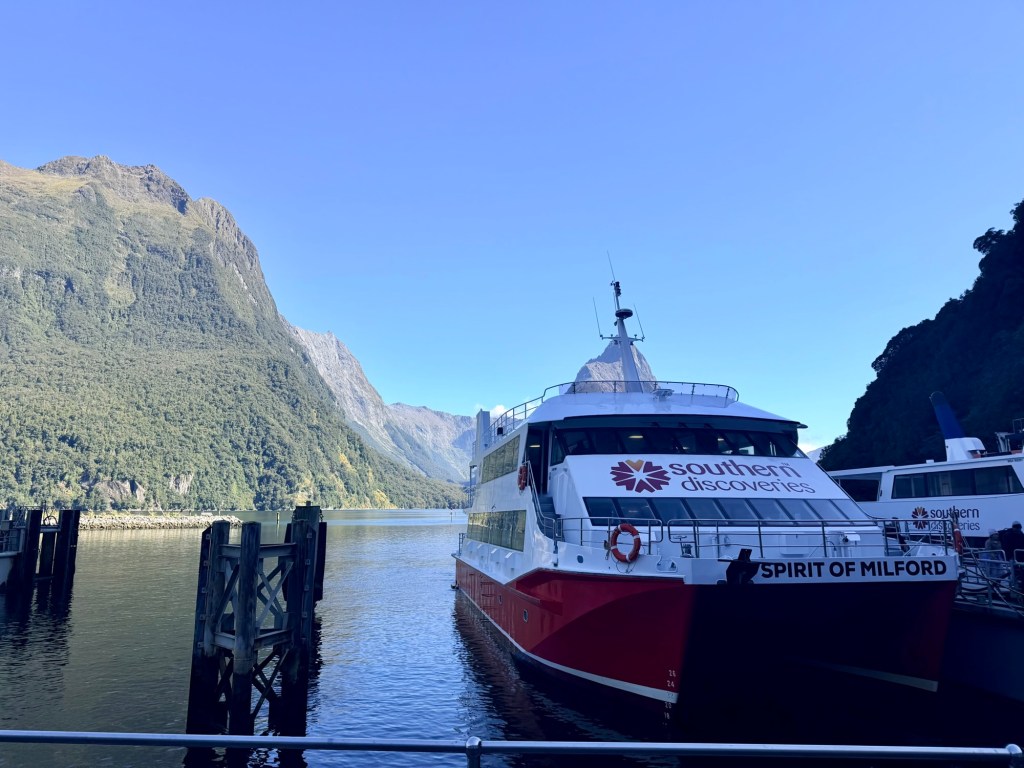
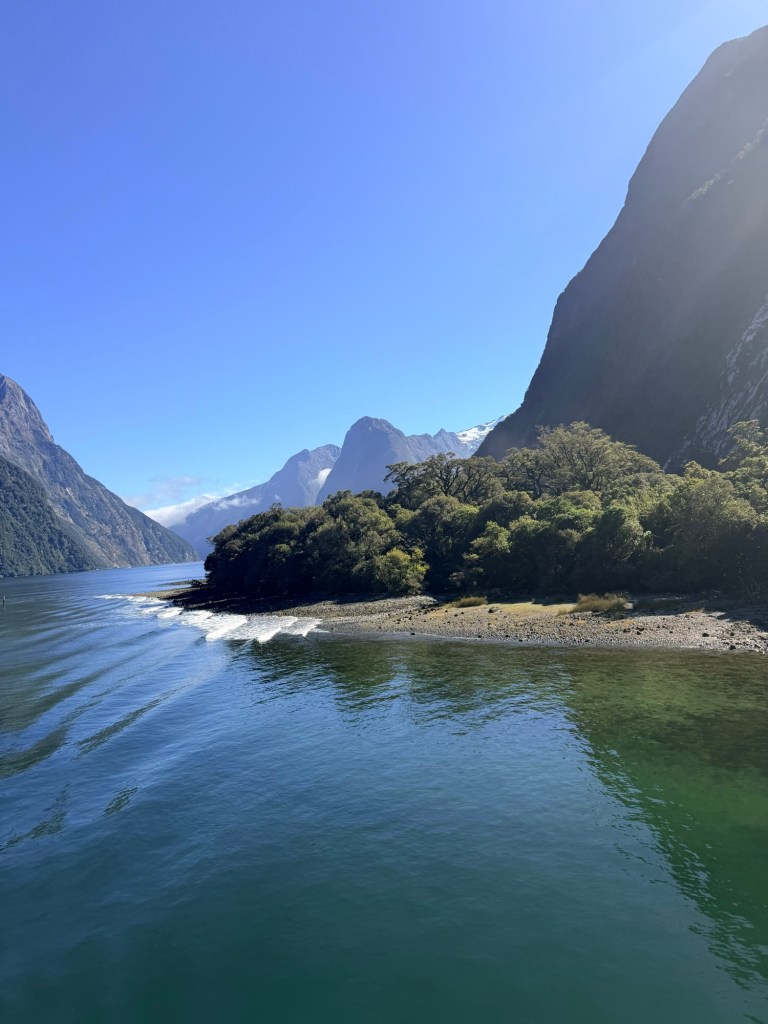
Once we landed, we boarded a boat to explore deeper into the fjord (and yes—it’s actually a fjord, not a sound, carved by glaciers).
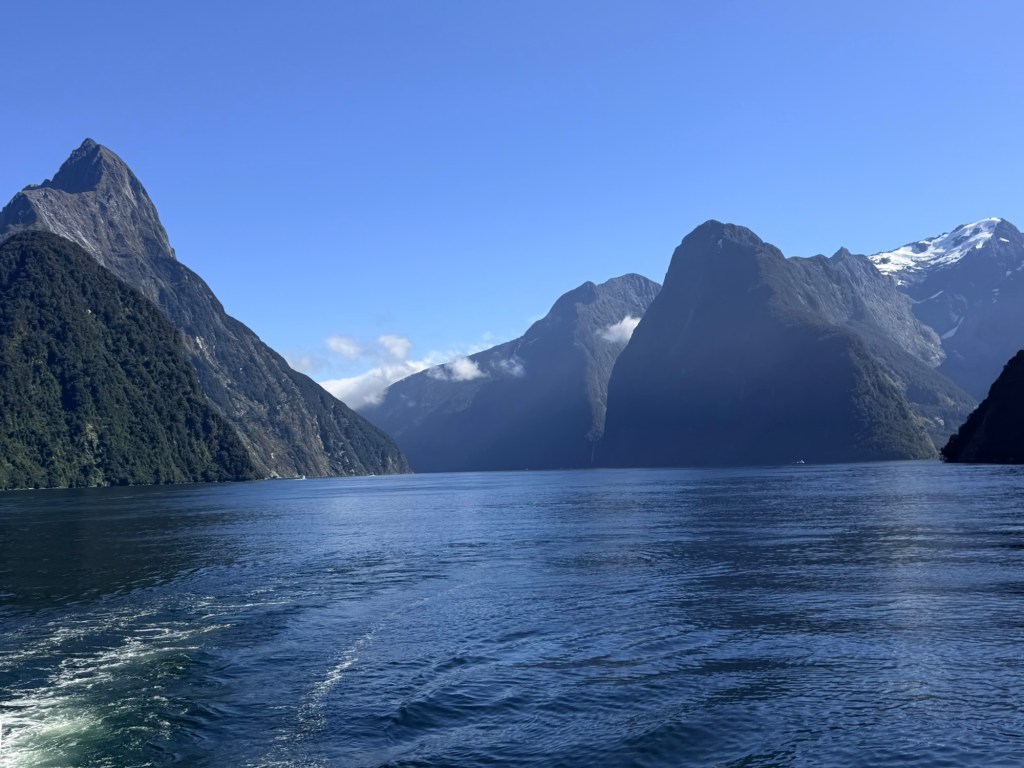
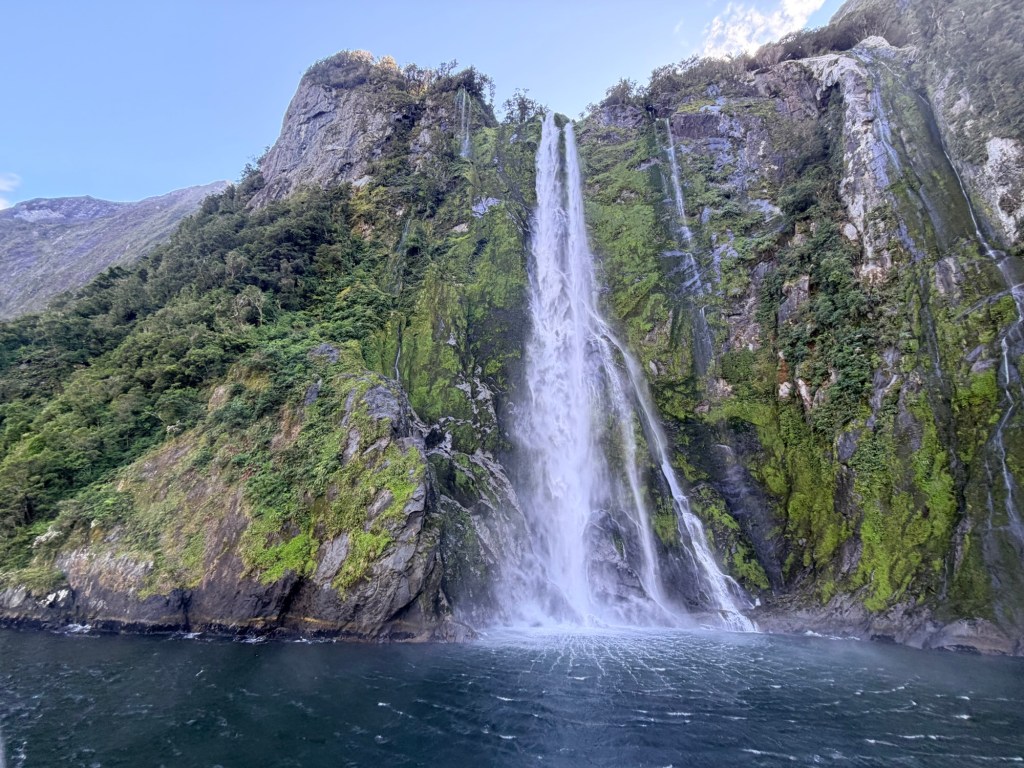
Towering granite cliffs clinging to impossible angles, and waterfalls everywhere—some permanent like Stirling Falls and Lady Bowen Falls, and others that appear out of nowhere, especially when it rains (we had a blue sky day).
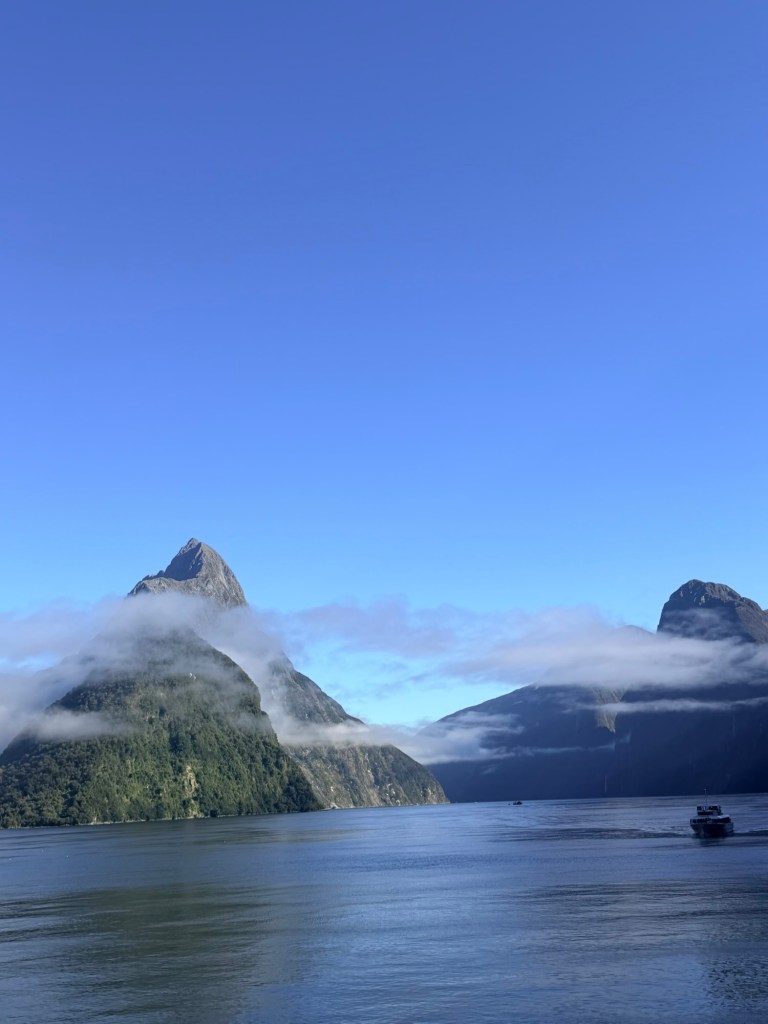
And then there’s Mitre Peak—rising straight up 5,551 feet like it’s showing off.
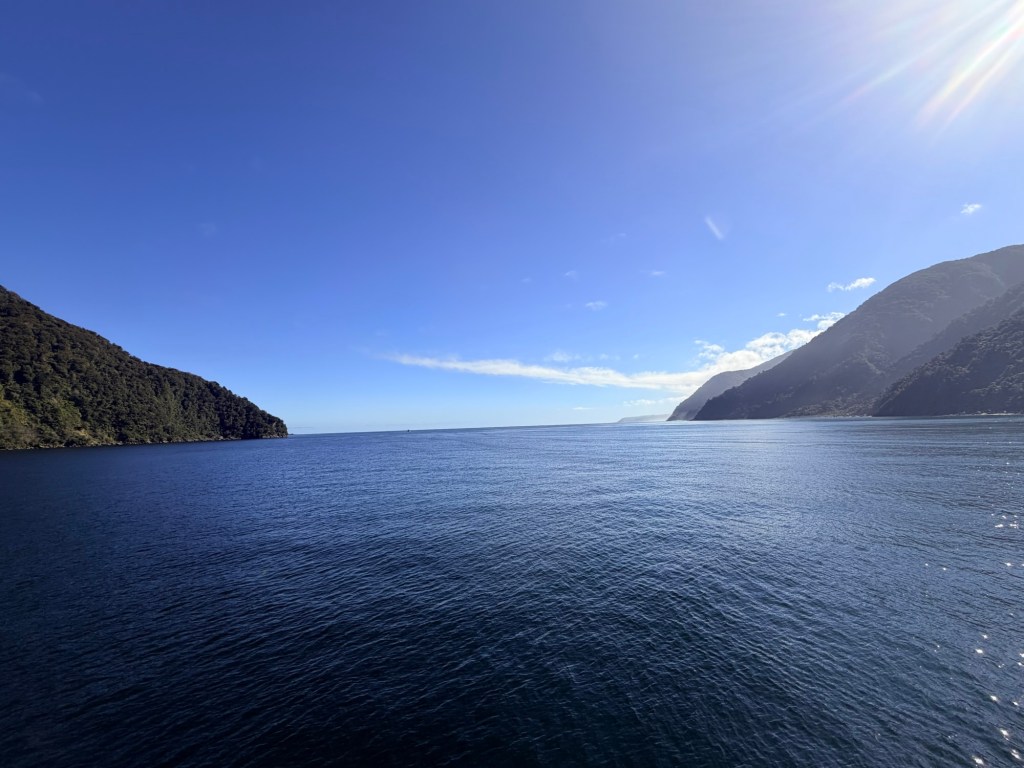
At the entrance to Milford Sound, opening up to the Tasman Sea.
Stirling Waterfall – one of two permanent waterfalls. Most of the waterfalls are temporary and happen when it rains.
Just when it felt like it couldn’t get any better, we spotted a New Zealand fur seal having a little snack in the water, completely unbothered by our presence. Watching it in that setting, with waterfalls crashing around it, felt like we had somehow wandered straight into a nature documentary.
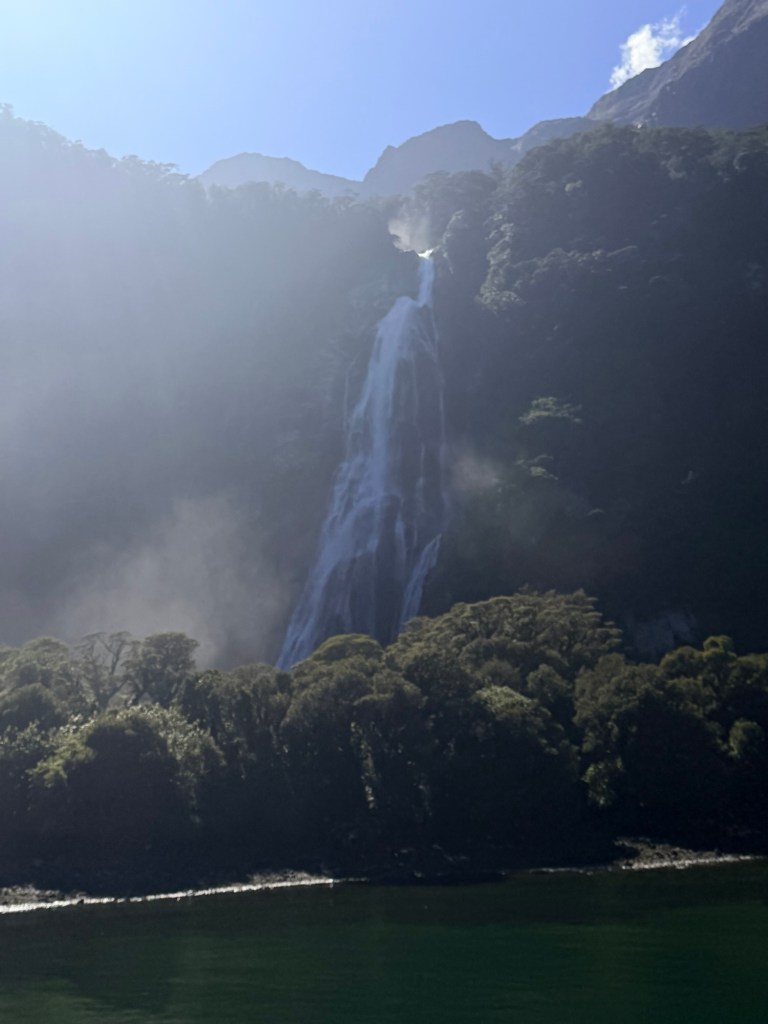
Lady Bowen Waterfall – the other permanent waterfall. It provides water and electricity to the local town.Flight back to Queenstown.A glacial lake high up in the mountains.
A Quick Kiwi Encounter
Back in Queenstown, we stopped at a kiwi (bird) sanctuary—because you can’t come to New Zealand and not see one.
Since they’re nocturnal, the sanctuary flips their schedule so you can actually spot the birds foraging “at night” (in the dark). What surprised me most? Their long, skinny beaks with nostrils at the tip, which they use to sniff out food.
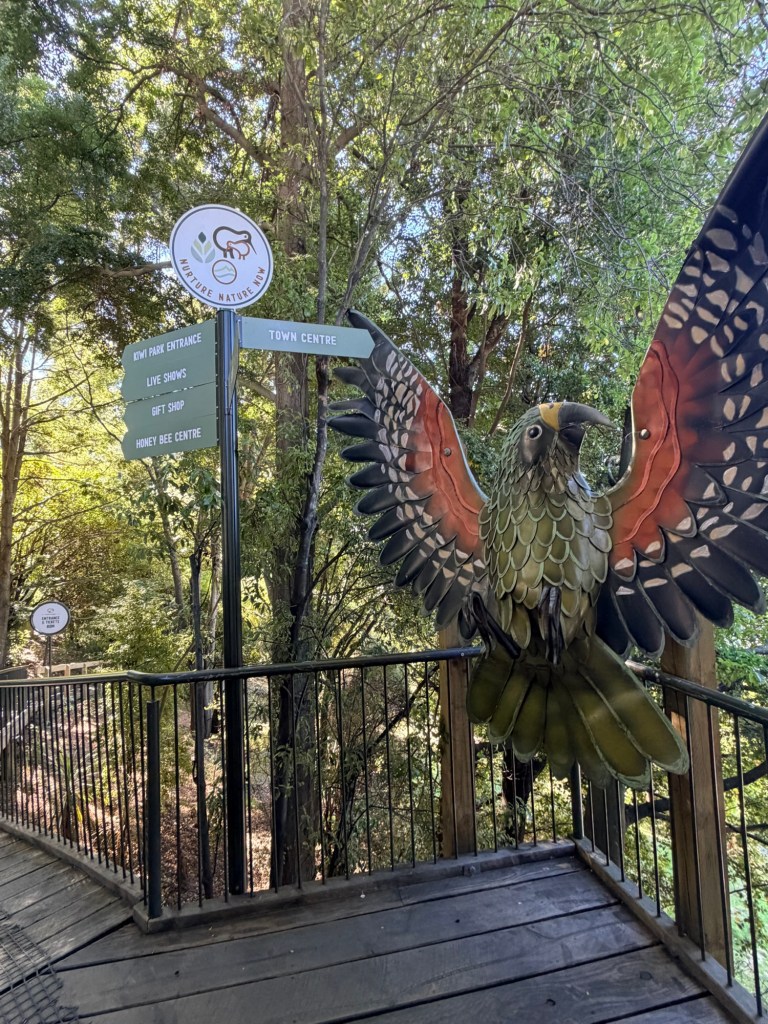
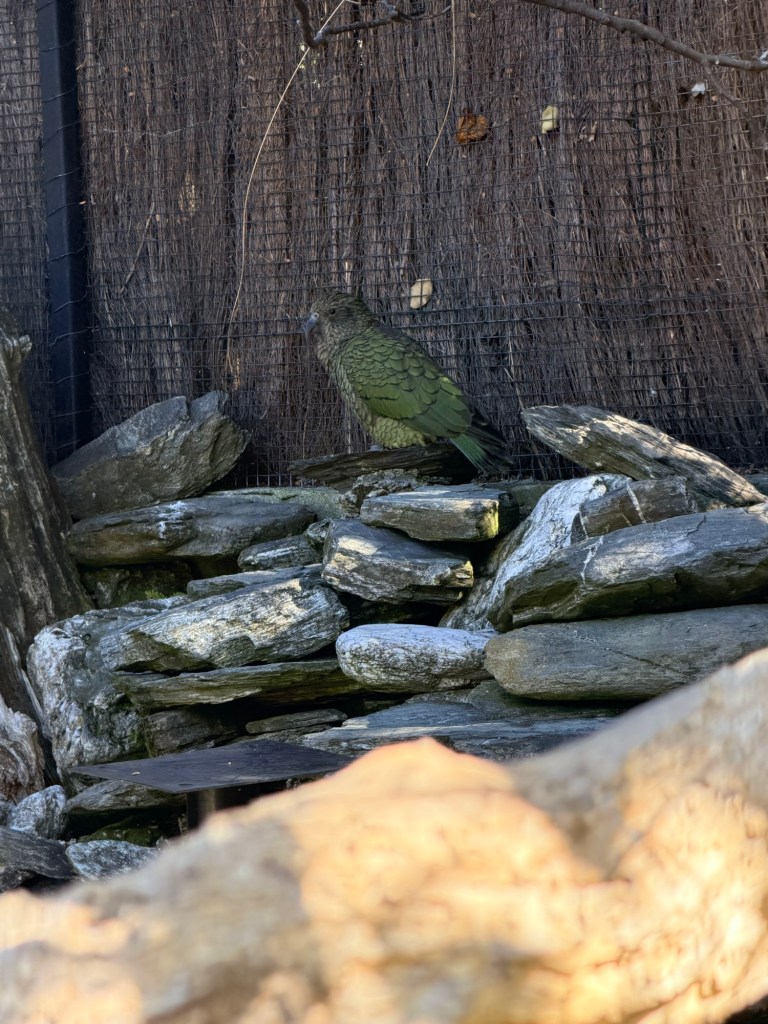
This is the famous Kea bird. It’s a world‘s only Alpine parrot, native to the South Island, New Zealand. The Kea is very curious and mischievous, pick pocketing small car parts and things off a backpack. It makes a very distinctive kee-aa sound in flight. It took me a back the first time I heard it as I thought it was a kid laughing. 
And Then… We Floated.
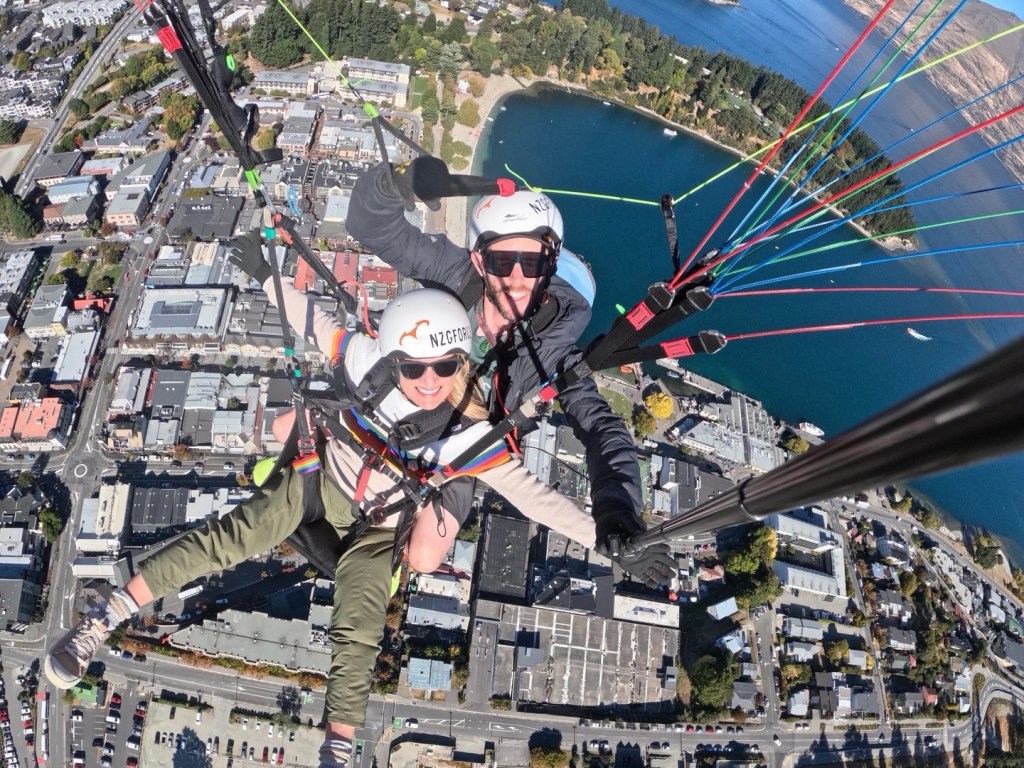
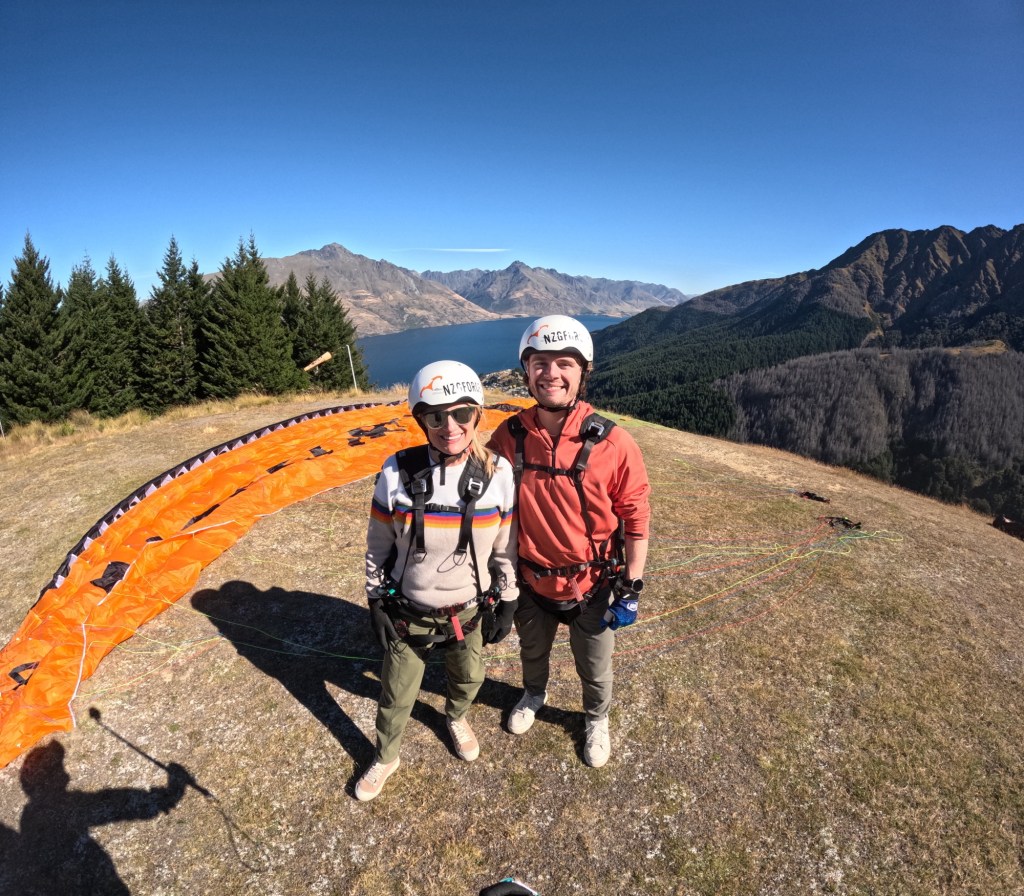
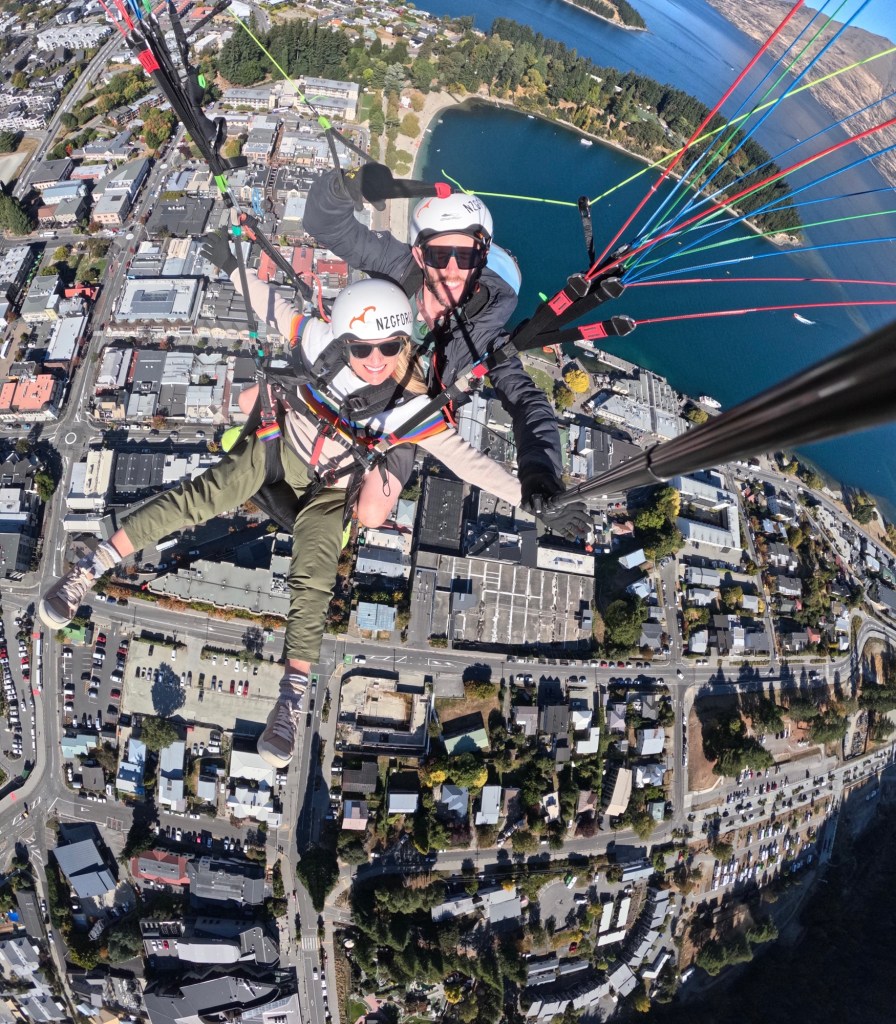
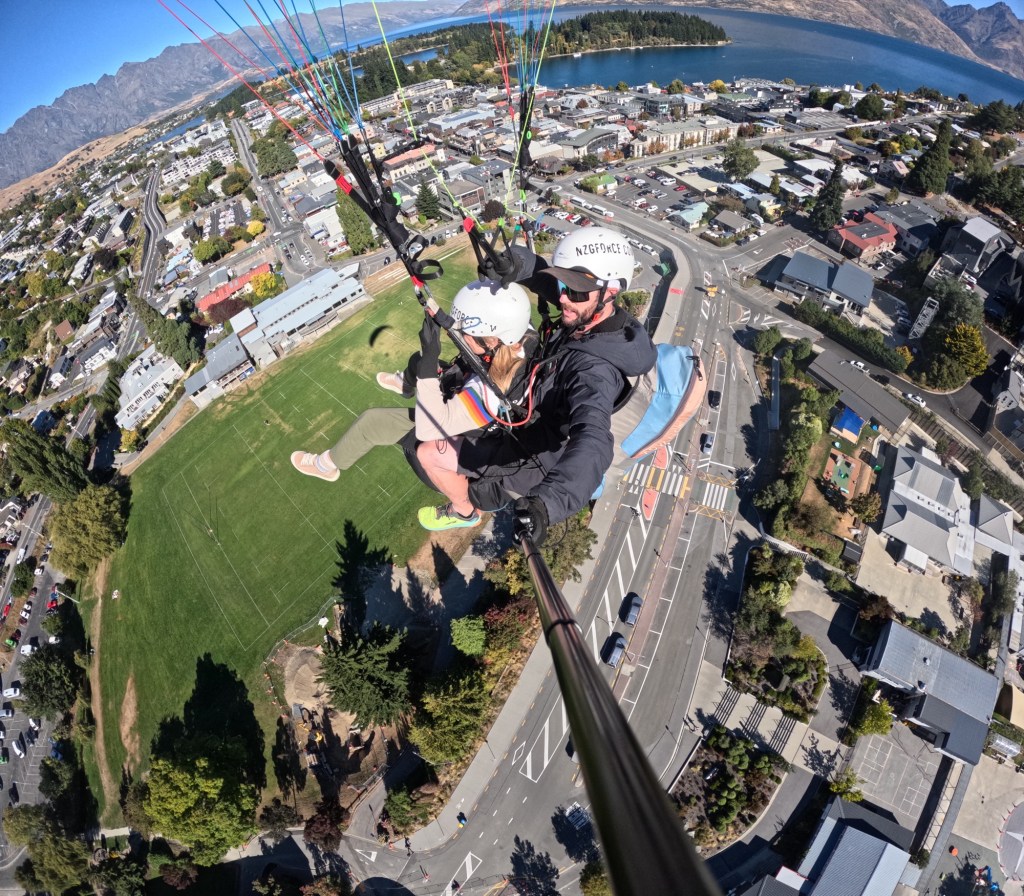
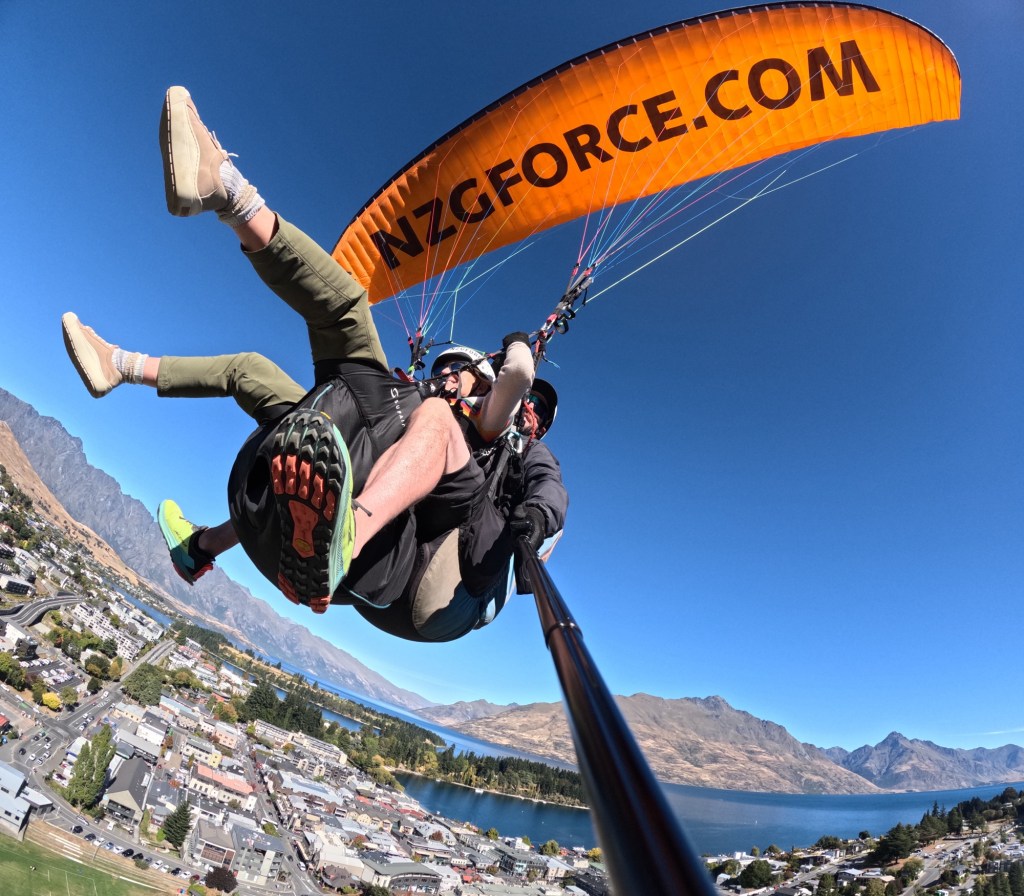
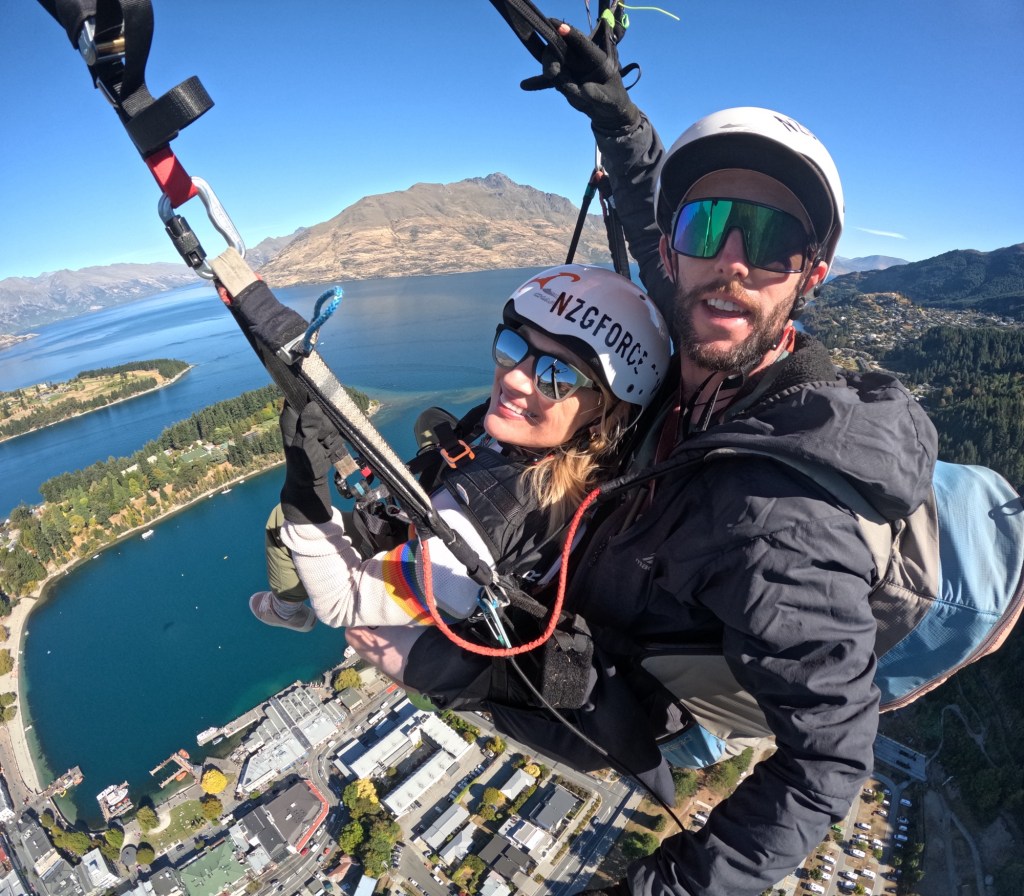
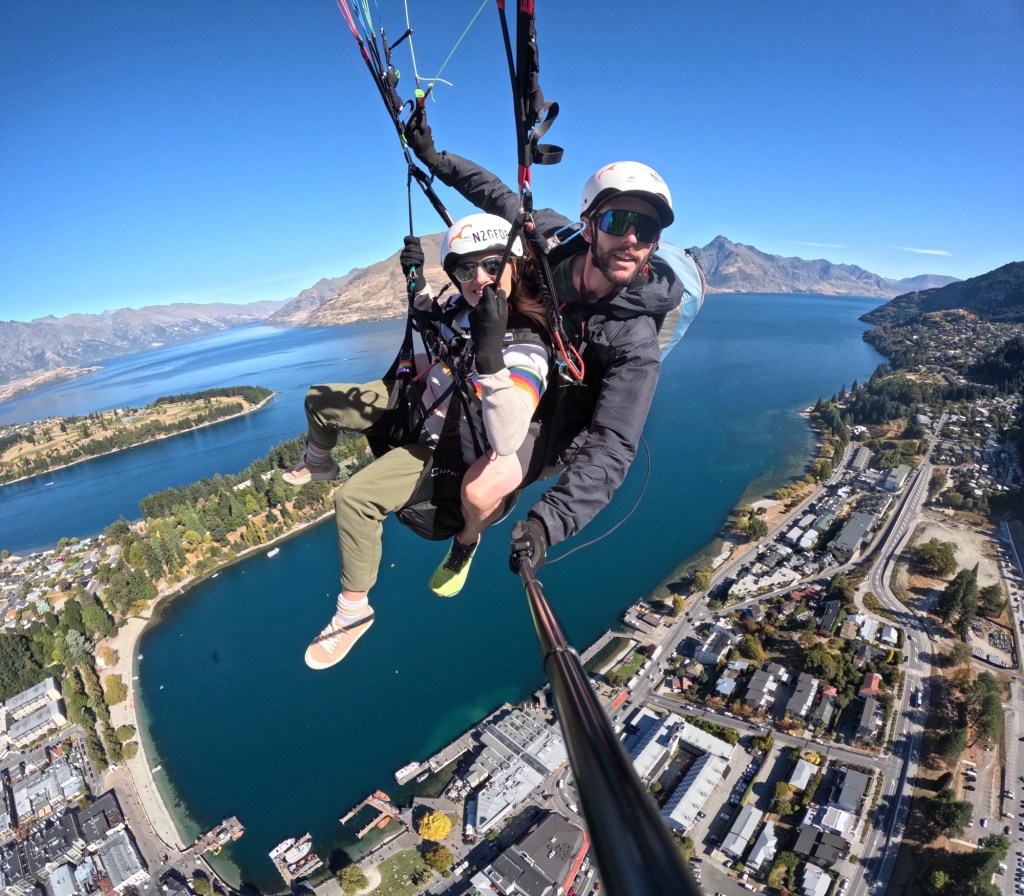
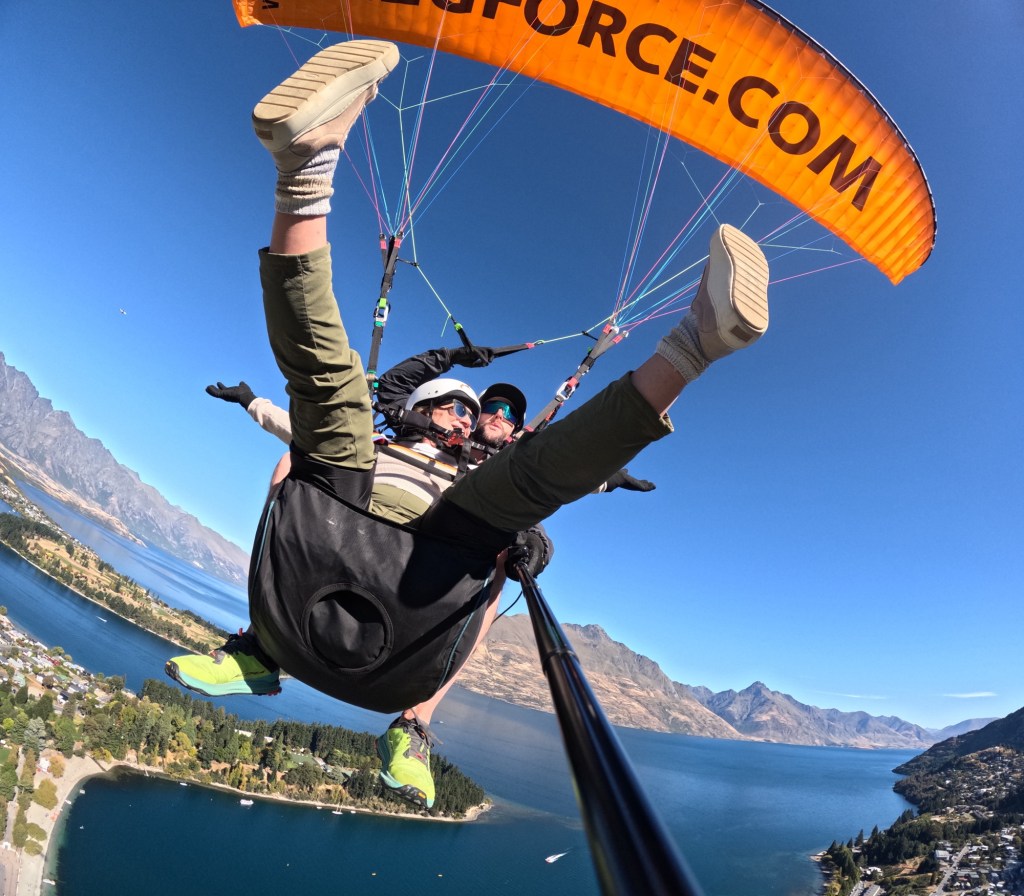
To round out the day, we tried one of Queenstown’s signature inventions: tandem paragliding with Gforce Paragliding. I had to be talked into this by Brendan but very glad I did it! After all, it was invented here in Queenstown.
You run a few steps off a mountain (which your brain strongly objects to), and then suddenly… you’re not falling, you’re floating. Quiet, peaceful, and completely mesmerizing as you glide over Lake Wakatipu with views that don’t feel real.
And then you do a few twists and turns and before long, you’ve landed on your rear end.
Queenstown doesn’t do passive sightseeing. Good thing we are not passive people!
Interesting to note: Tipping is not common in New Zealand. Traditionally, you don’t tip, but you can leave something if you think the service was really good.
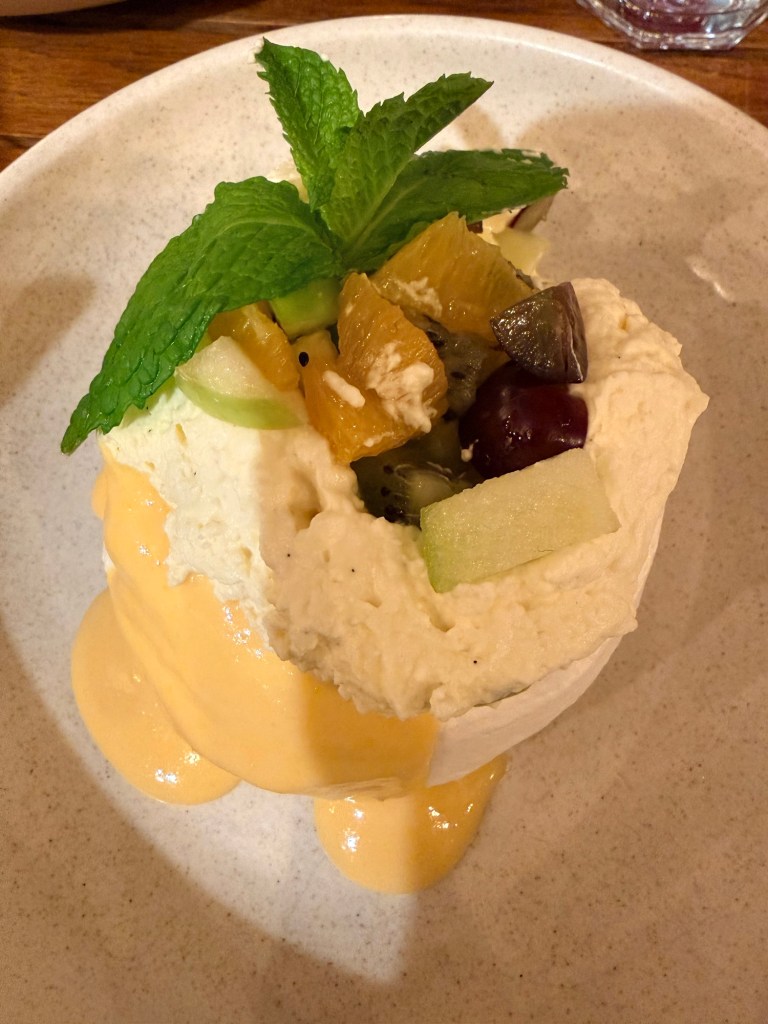
Dessert: The dessert of NZ is pavlova. There’s an going dispute between New Zealand and Australia who invented it. The Kiwis are holding firm to historical facts that point to it being invented in 1926 to honor the Russian ballerina, Anna Pavlova, who visited the country. It’s meringue with a creamy marshmallow-like center, topped with fruit. Yum!!
After finishing the hike yesterday, we drove about four hours to Wellington—and wow, what a drive. Twisty, turny roads, winding through rolling green hills dotted with sheep. Lots and lots of sheep grazing on those hills.
We arrived around 9 pm, checked into our hotel downtown, and called it. After a day like that, sleep was earned and we didn’t surface until after 8 am.
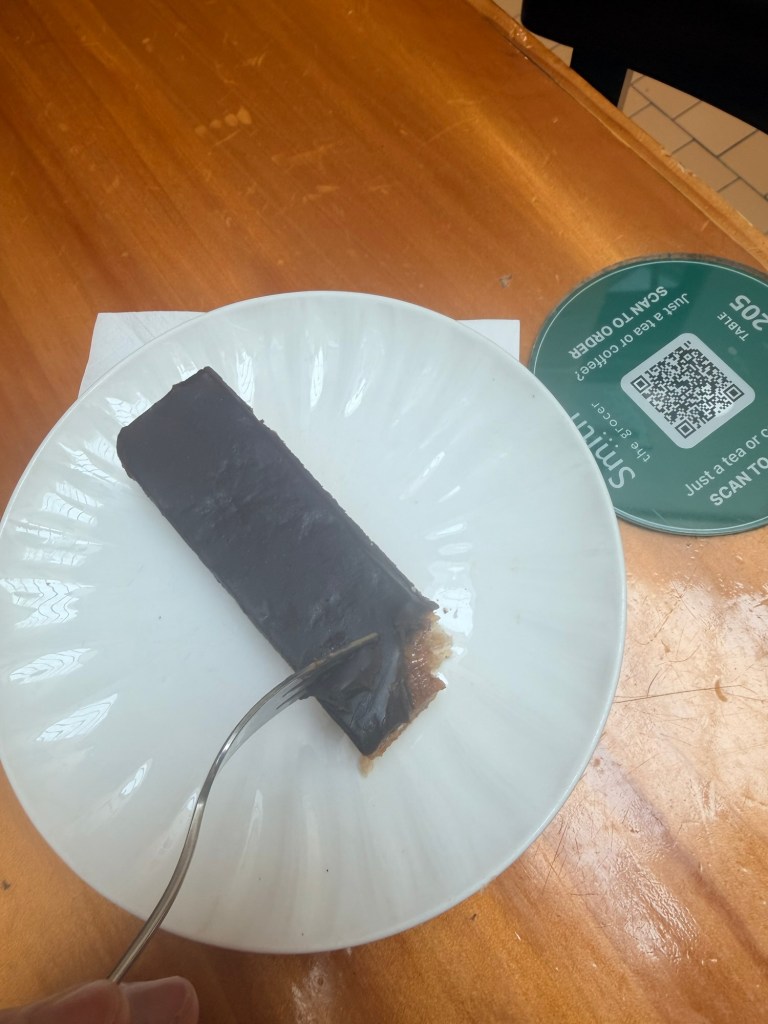
Breakfast was at Smith The Grocer Cafe, and it was outstanding. I went straight for another gluten free slice (clearly a theme here), this time chocolate caramel. Outstanding! I’ve already looked up a recipe to recreate it at home.
A “slice” – caramel and chocolate with a shortbread base. Scrumptious!
Side note: New Zealand absolutely nails gluten-free. It’s not an afterthought—it’s intentional, creative, and just as good.
Then it was time to return the rental and head to the airport for our Air New Zealand flight down to the South Island.
I ended up sitting next to Gregory and Helen, a couple from Wānaka, and Gregory gave me a full list of must-do’s for the next few days. Also—Air New Zealand, I see you! Snack choices (including gluten-free!), lollies (aka candy) being handed out, and even trivia on the drop-down screens.
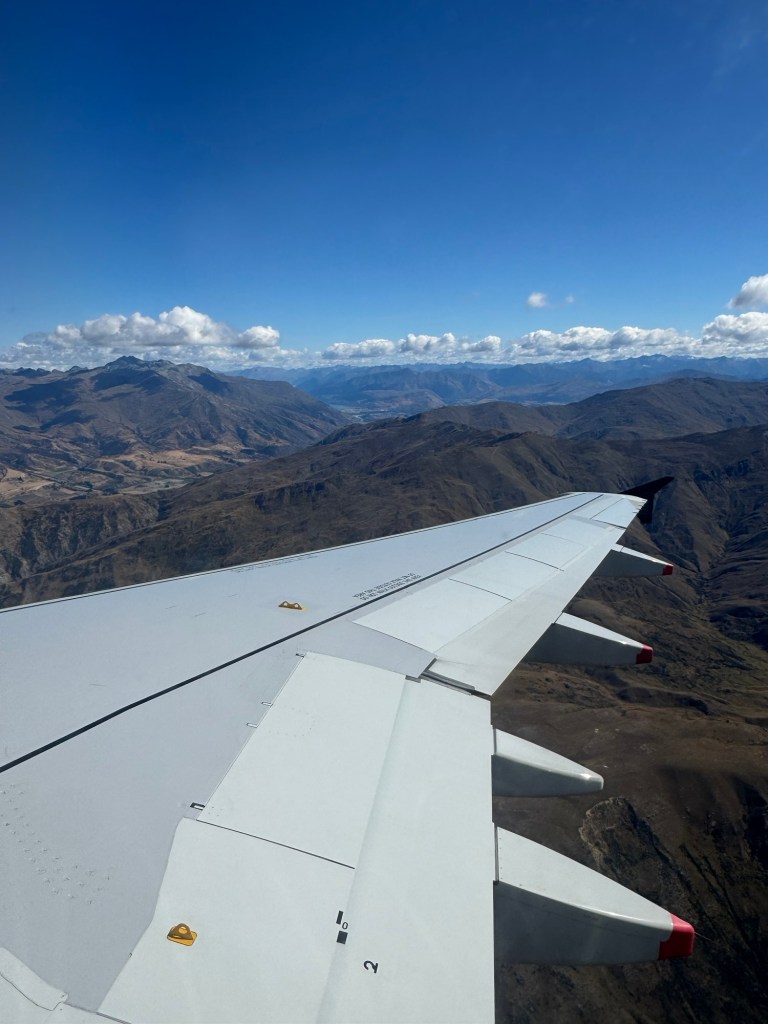
Flying into Queenstown is next level. The plane weaves between mountains and yes, pilots actually need special training for this approach.
We’re going to turn left and fly right between those mountains to land.
Queenstown: Welcome to The Adventure Capital of the World! You can bungy jump, jet boat, and skydive. In the winter there’s snow skiing. There’s also this surreal beauty to it. It’s the kind of place where you stop mid-sentence just to stare.
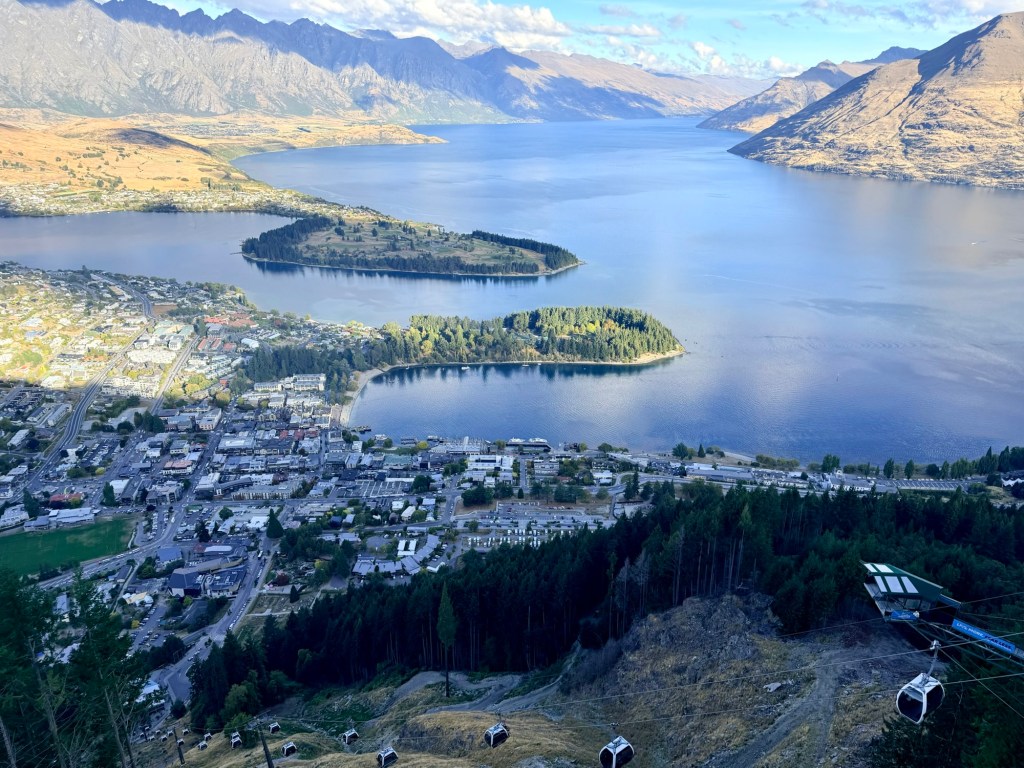
Video from the top of the gondola where we enjoyed a remarkable view of the Remarkables!
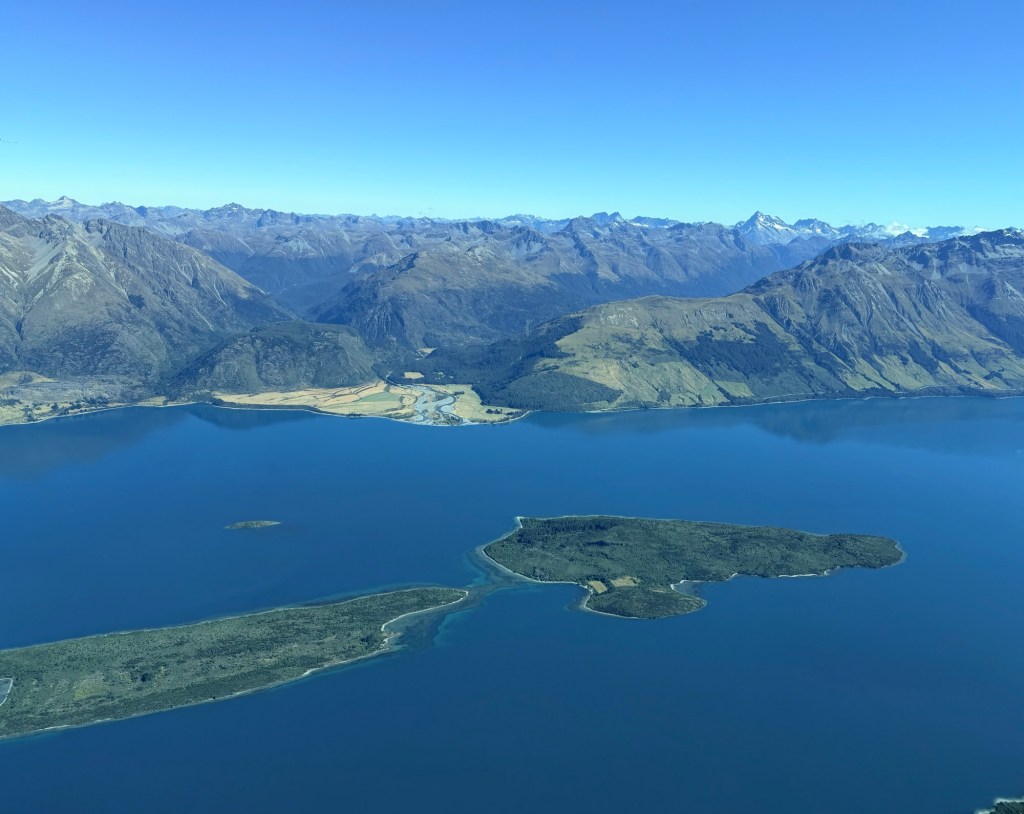
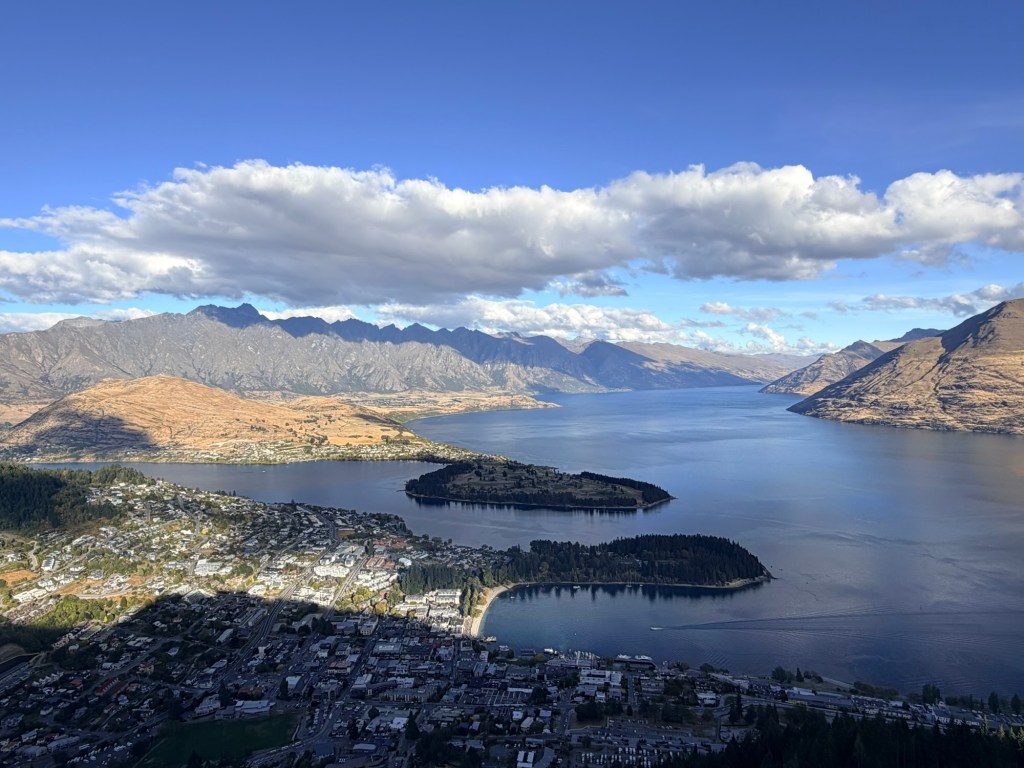
Queenstown sits on the edge of Lake Wakatipu, an 80 km long glacial lake. It’s surrounded by jagged peaks like The Remarkables that look like they were designed for a movie set.
Let the adventure continue!
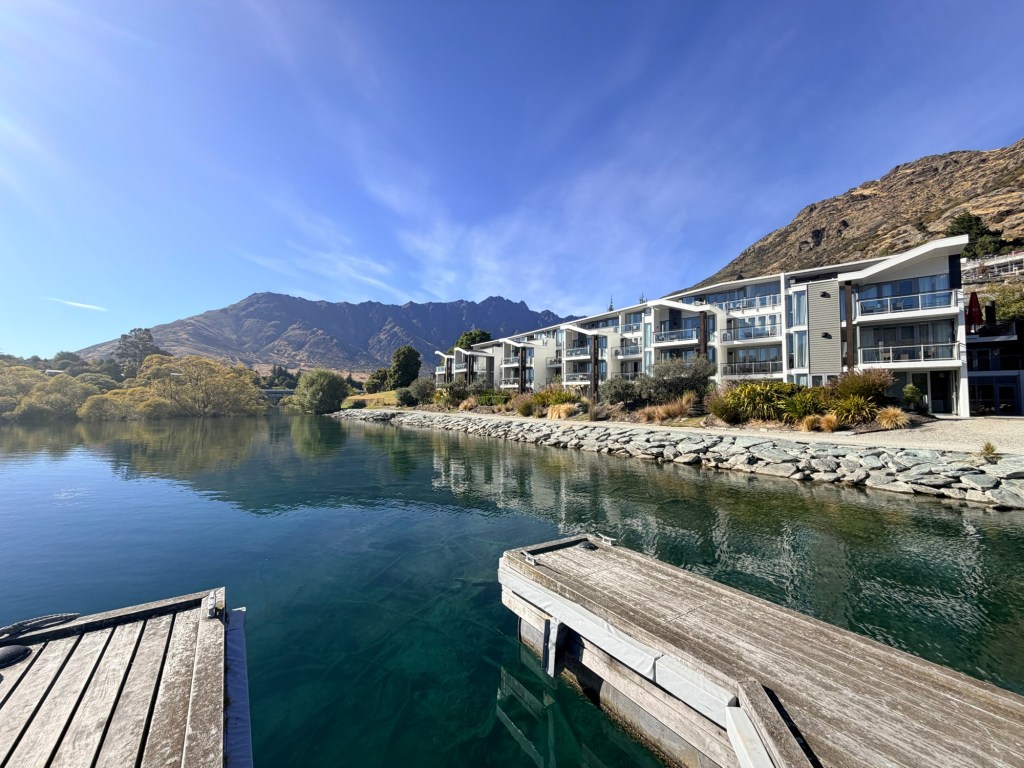
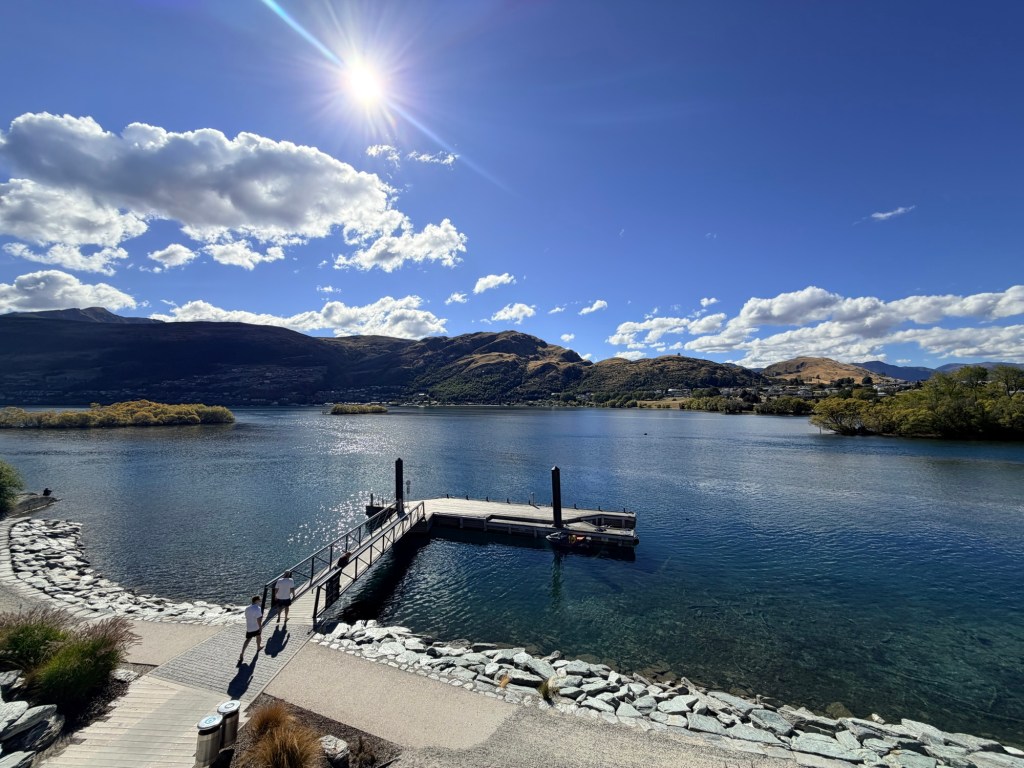
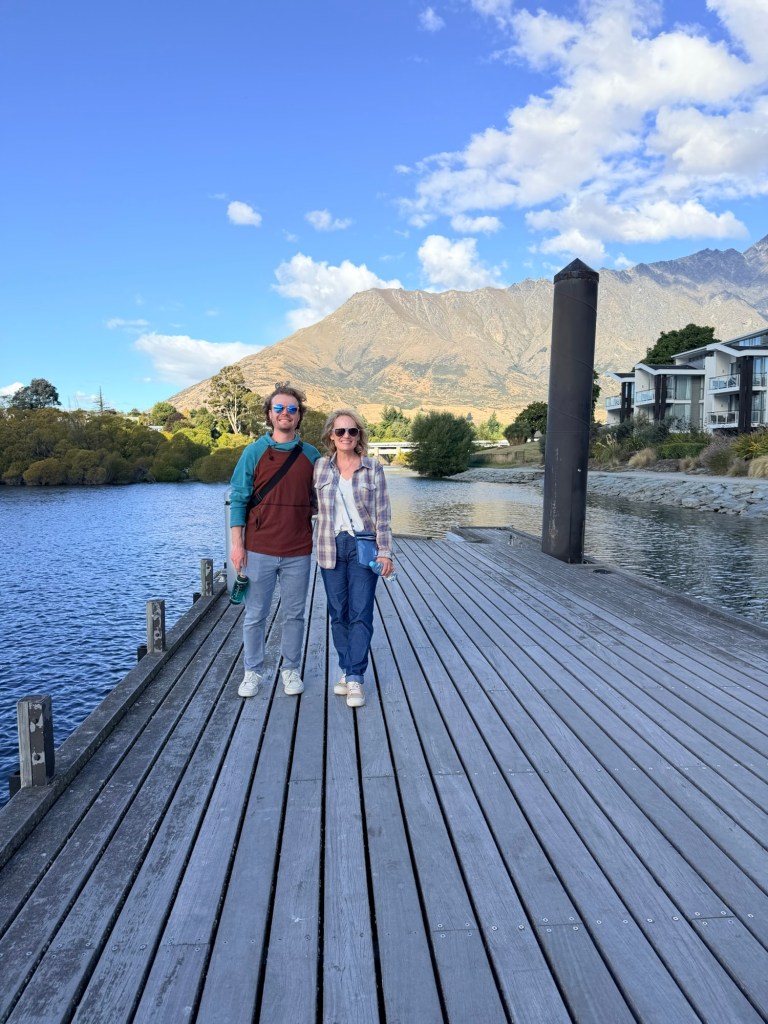
On the dock by our hotel, awaiting the water taxi ($14 NZD per trip or $10 NZD with a Bee card)
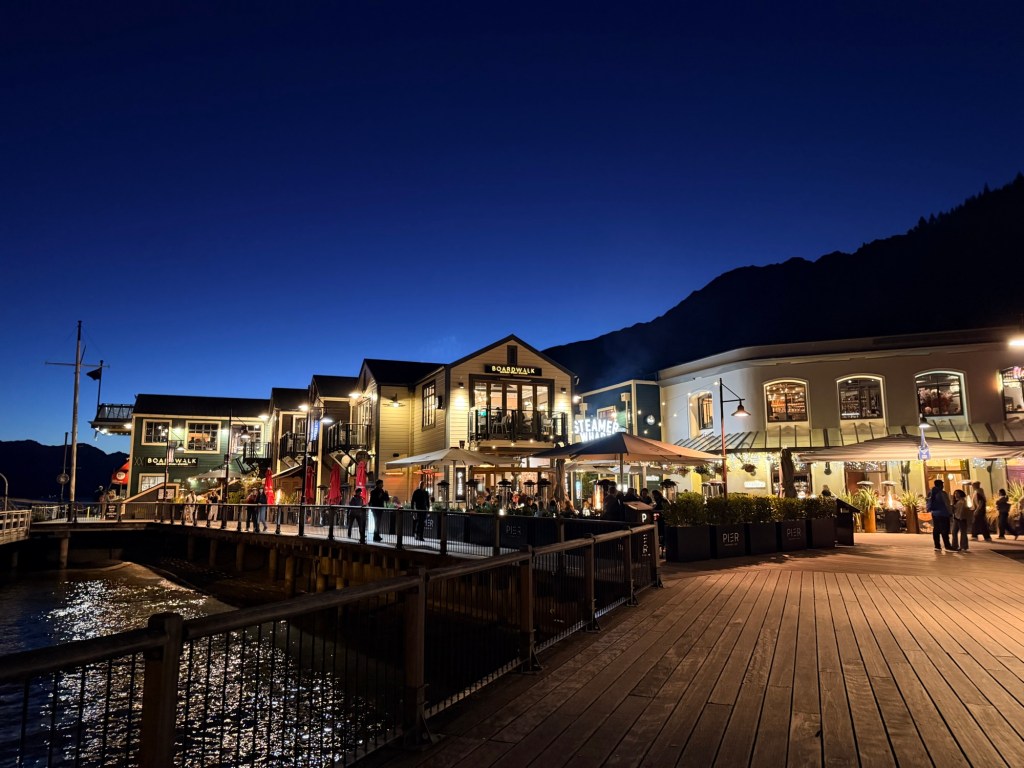
We took a water taxi from our hotel across Lake Wakatipu into town—and honestly, this might be the best “commute” in the world.
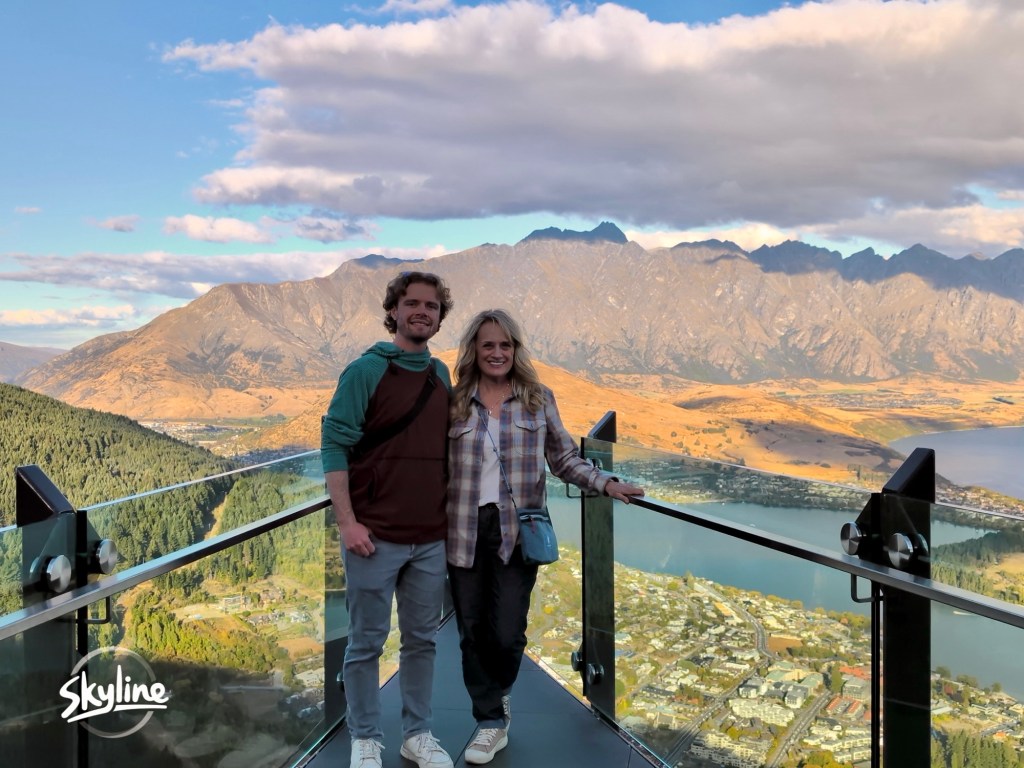
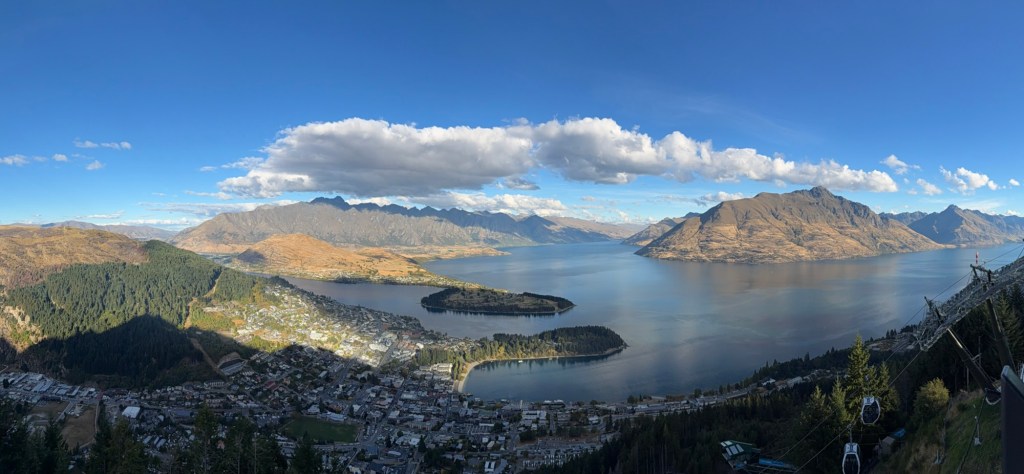
The ride up is steep—but the payoff at the top is unreal. You get this panoramic view of the entire town wrapped around the lake, with the mountains stretching out in every direction. It’s one of those “ok this is unbelievable ” kind of views. But it’s believable because you’re staring right at it.
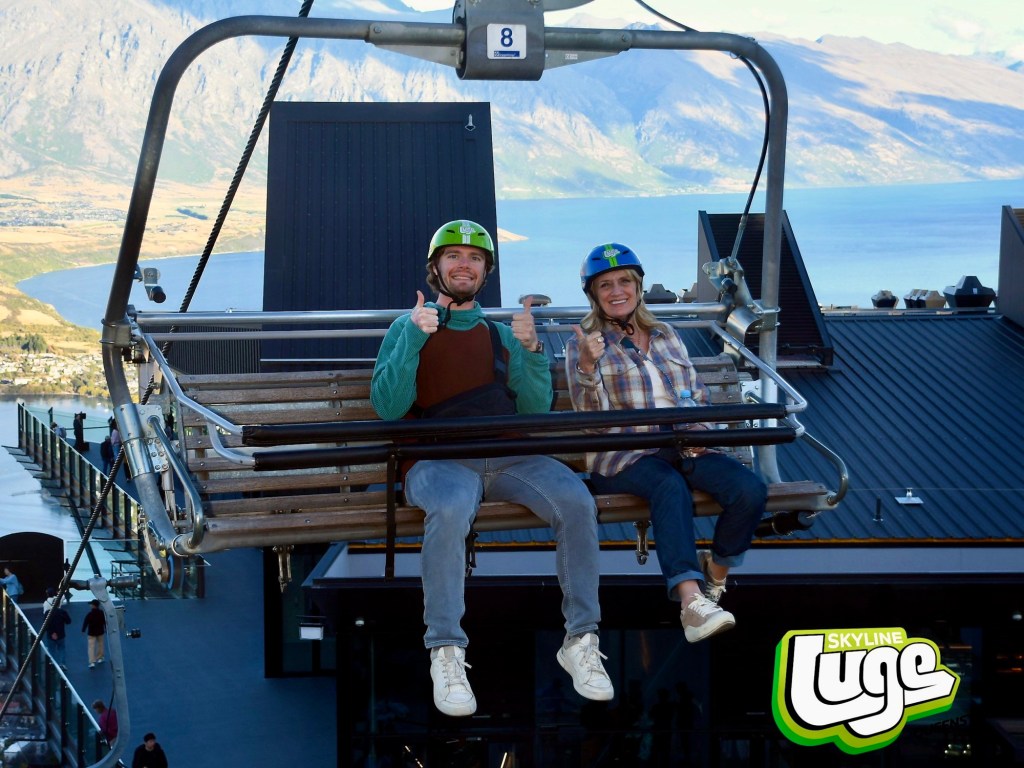
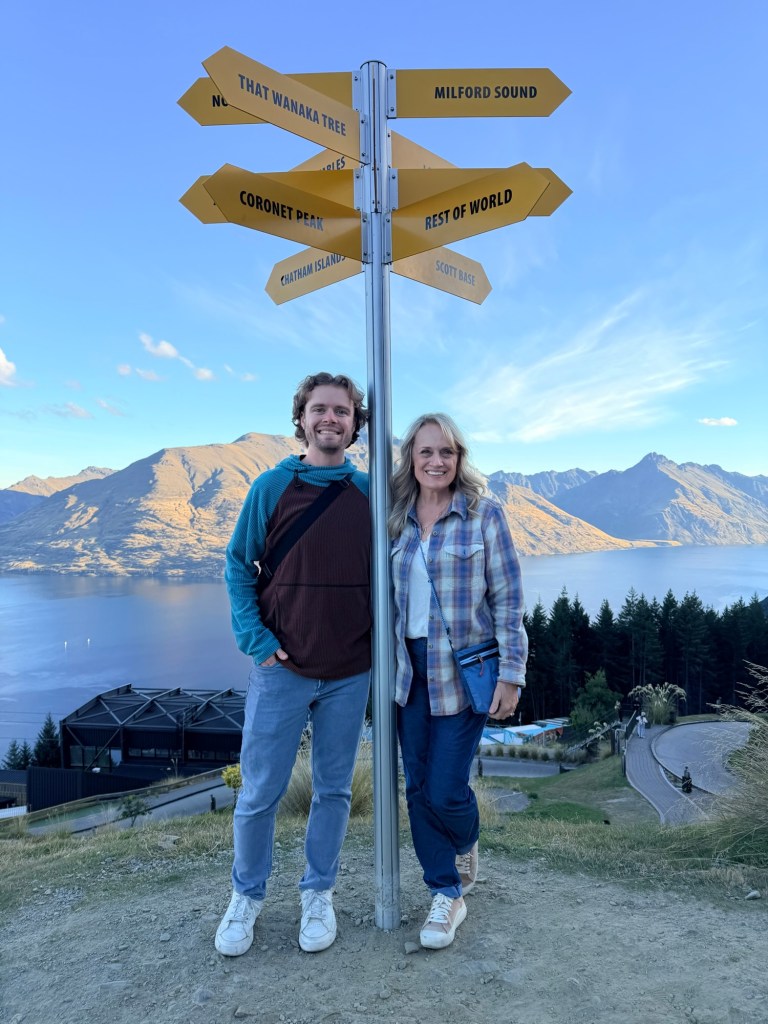
Free photos taken by Skyline. The View!!
And then…we luged. If you’ve never done it, imagine a gravity-powered go-kart where you control your speed and race your way down a winding track. Equal parts fun and competitive. But, I will not be participating in the 2030 Winter Olympics. 😂
Heading back up to luge again. Our pass allowed us to luge down the mountain 3 times. They have two different tracks.
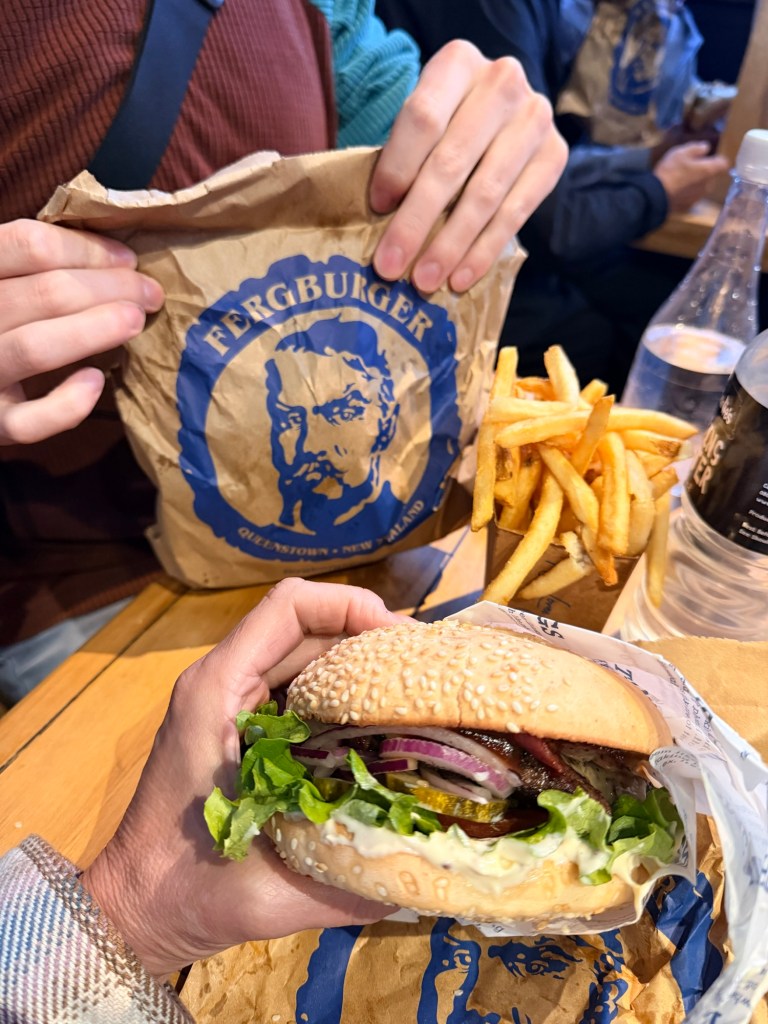
And because no day in Queenstown is complete without it, we ended at Fergburger. Massive, messy, ridiculously good burgers that somehow taste even better after a full day of adventure. They have a gelato place right next door and no vacation day is complete without a scoop!
Unreal burger 🍔. The line for this place was out the door but moved fast. Don’t miss the Fergburger!
Two days left in Queenstown…this story’s just beginning!
According to Māori legend, Lake Wakatipu formed when a giant named Matau was burned in his sleep. This formed a deep trough in the ground. When the lake water rises and falls, it is said to be the heartbeat of the sleeping monster. In science terms, the lake has a 20 cm (7.87 inches) tide-like surge every 27 minutes. This is caused by a seiche (I learned a new word). A seiche is a wave in an enclosed body of water, like how water sloshes back and forth in a tub.
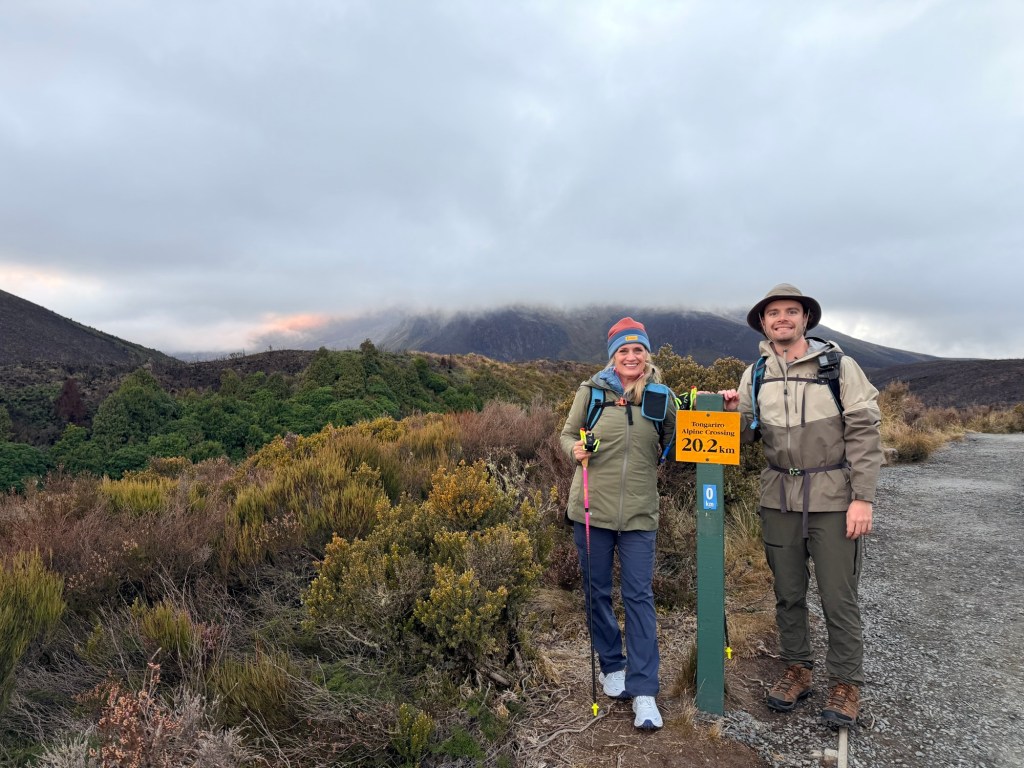
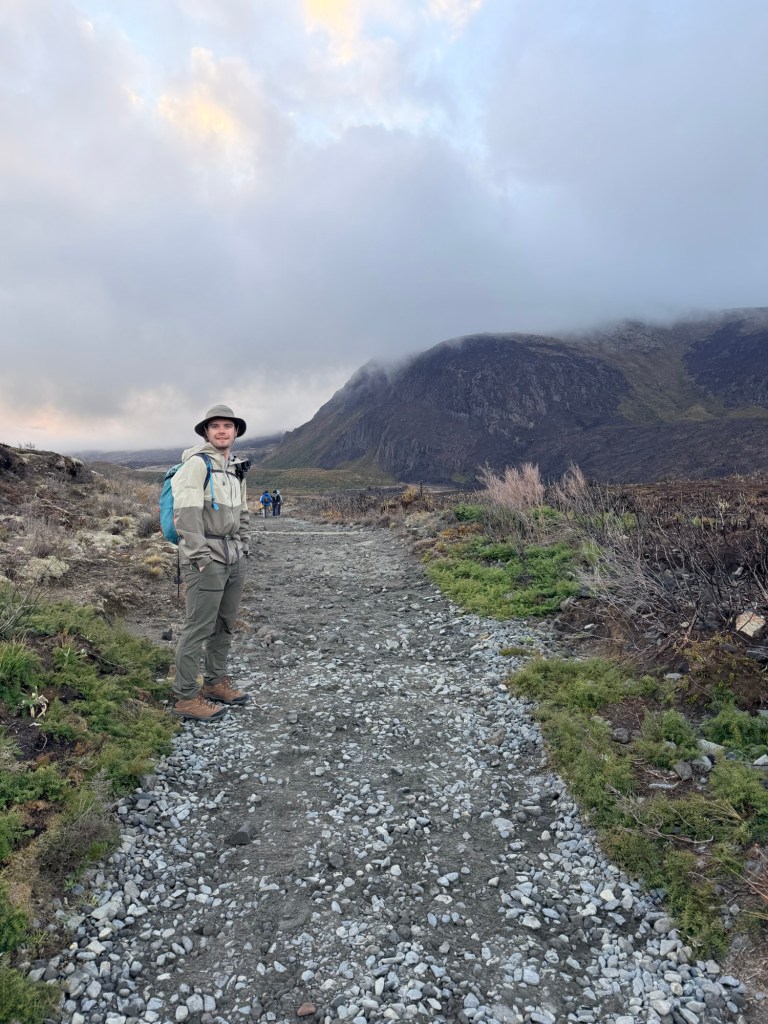
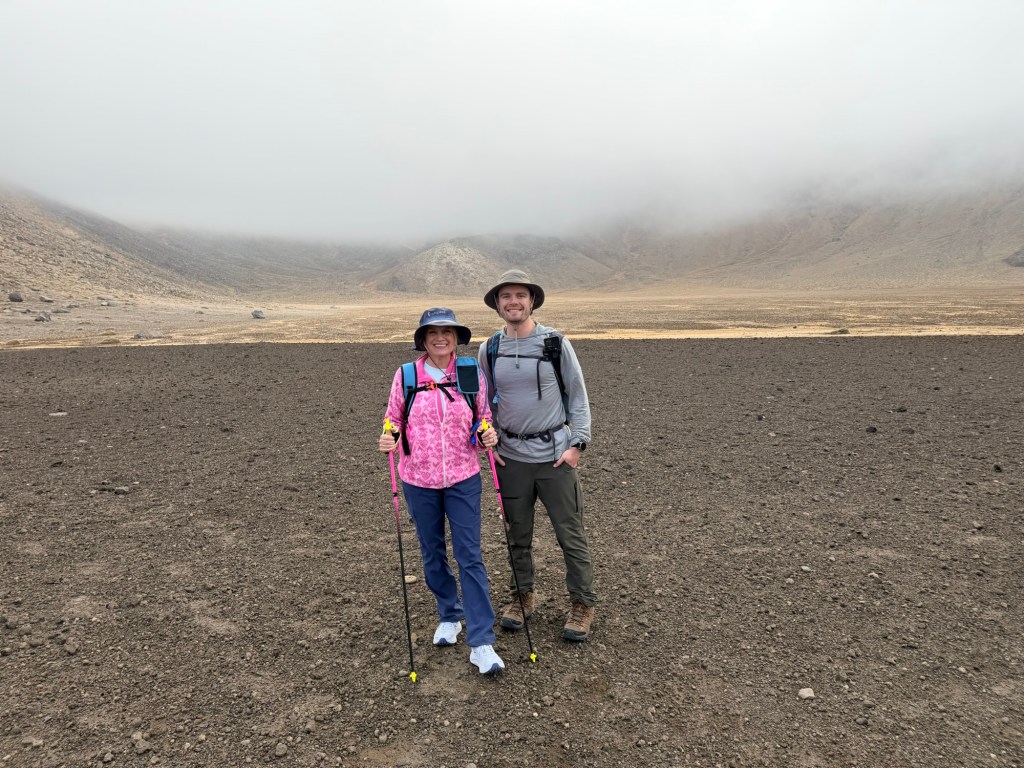
We set off at 7:30 am for the 20.2 km (~12.6 mile) hike on the Tongariro Alpine Crossing. Before we even took our first step on the trail, there was a quiet moment that felt different from every other hike we’ve done.
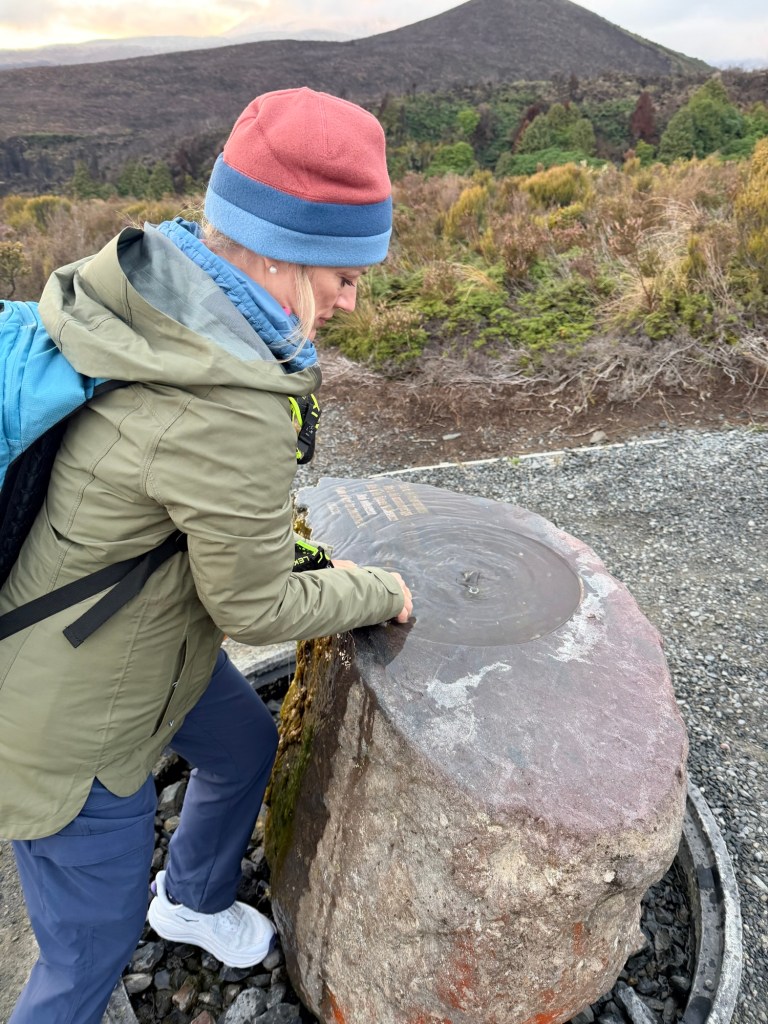
At the start, there was a small ceremonial bowl of water. Brendan and I paused and washed our hands—simple, quick, but meaningful. In Māori culture, this connects to the idea of moving from tapu (sacred) to noa (balanced, safe to proceed). It’s a way of acknowledging that this land isn’t just beautiful—it’s spiritually significant.
And standing there, about to hike (aka tramp) across an active volcanic landscape considered sacred, it felt like more than just a gesture. It felt like a reminder to tread with respect.
Then we tightened our packs and set off on one of the most challenging and stunning hikes we’ve ever done.
Ready to go!🚦
🌿 The Gentle Lie: Mangatepopo Valley (The Beginning)
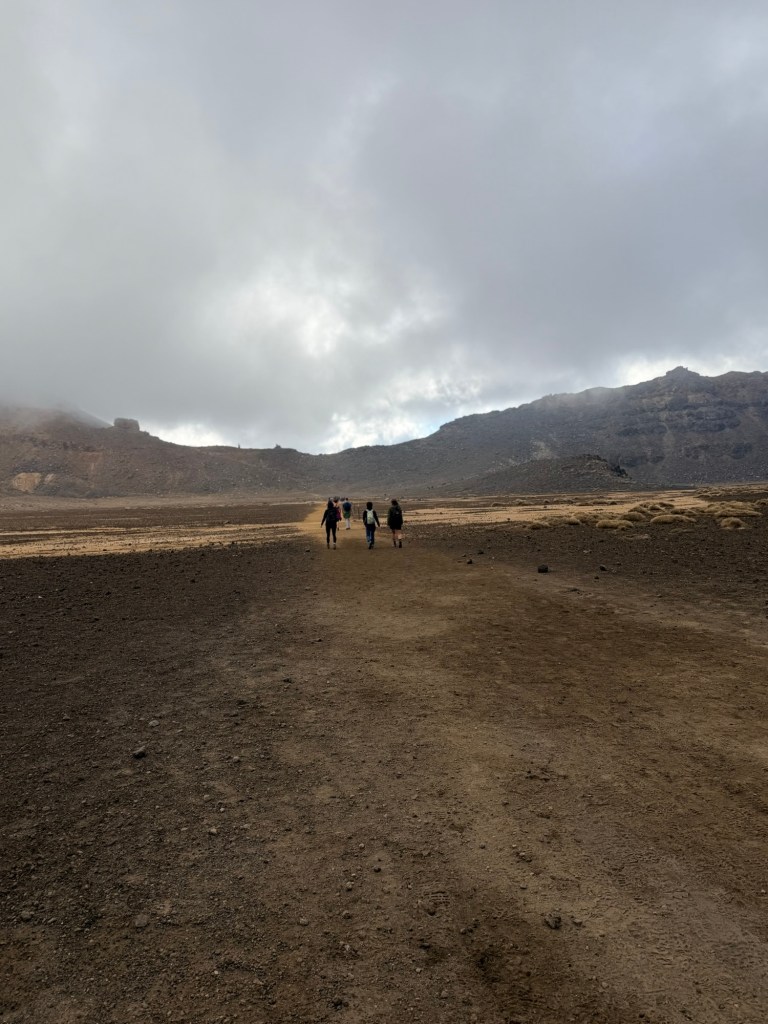
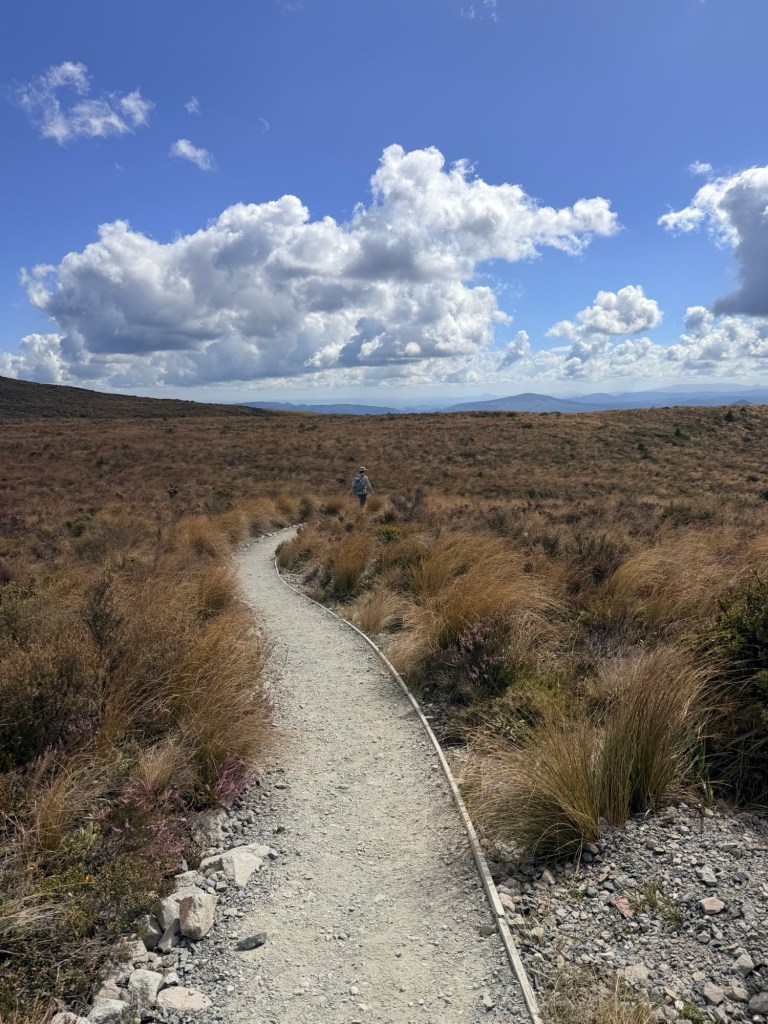
We started optimistic, energized and slightly overconfident. The trail eased us in with a relatively flat, boardwalk-style path through the Mangatepopo Valley. It’s scenic, open, and led us to believe this was going to be manageable.
We chatted. We admired the views. We said things like,
“Wow, this isn’t bad at all!”
Lol. The innocence.
🪨 The Reality Check: Soda Springs to Devil’s Staircase
Enter: The incline.
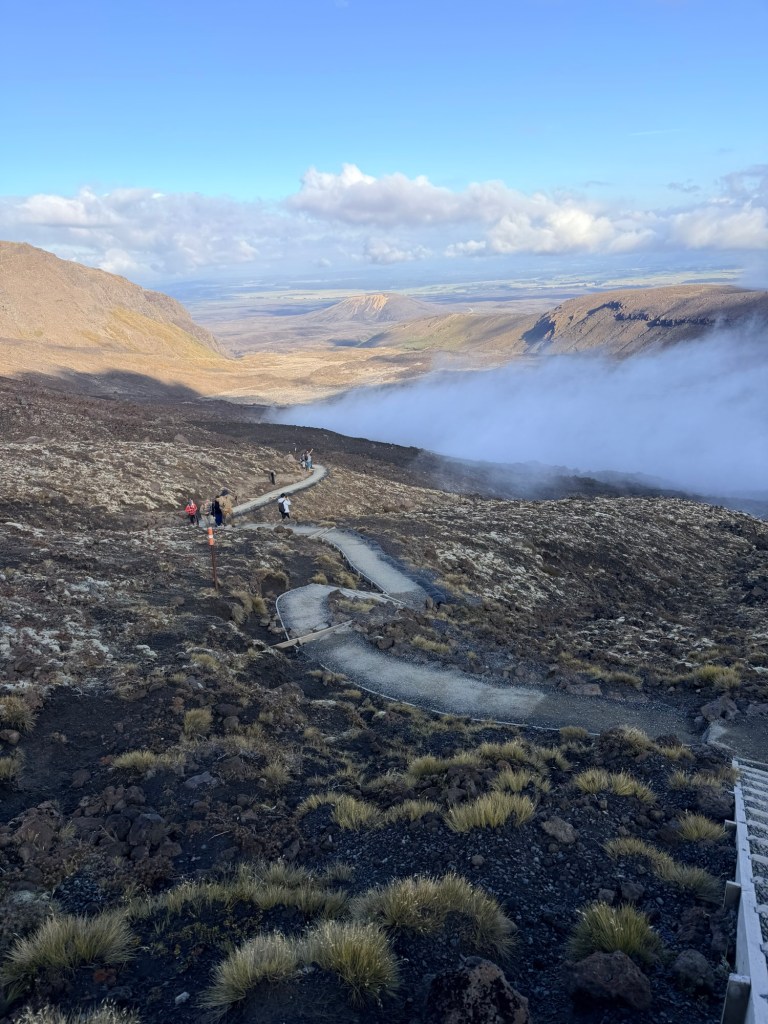
The climb up to Soda Springs woke up our legs, but it’s the Devil’s Staircase that officially humbled us (well, maybe me more than Brendan). A relentless series of steep steps that felt like you’ve truly arrived in Hell.
At this point our conversation decreased, our breathing increased, and layers started coming off (turns out five layers was ambitious).
Lots of stairs. Lots and lots of stairs. And more stairs.
And yet, you look up and the landscape is already becoming otherworldly.
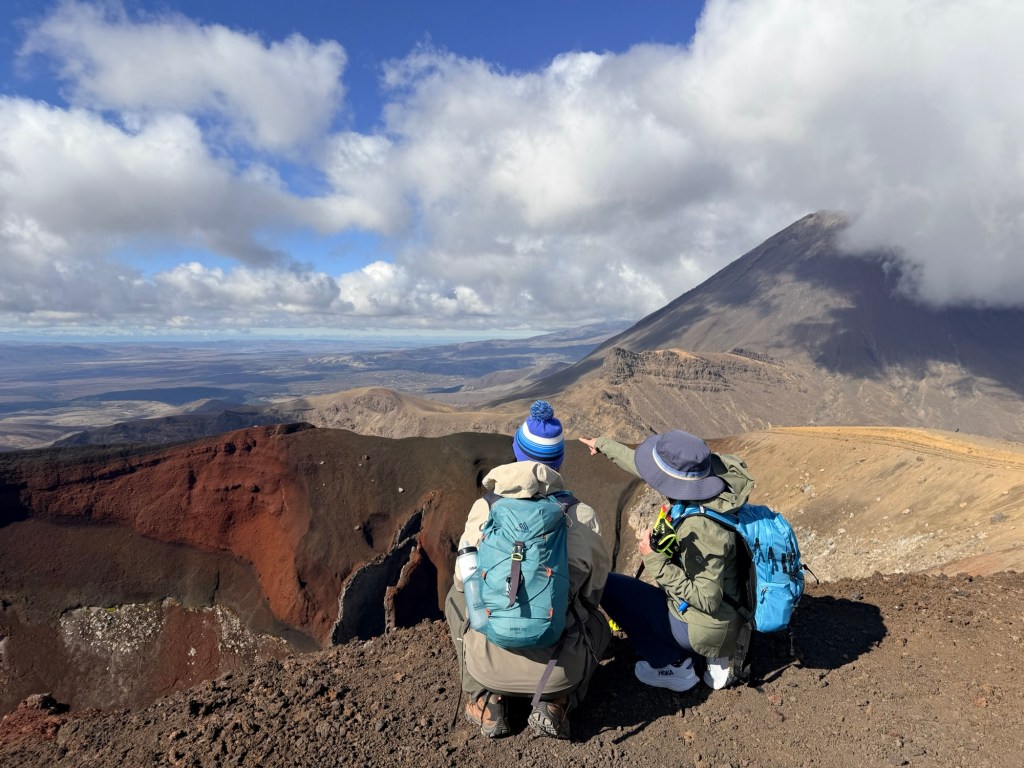
🌋 The “Why Are We Doing This?” Section: South Crater & Red Crater Climb
We got a brief reprieve crossing the South Crater—a wide, flat expanse that feels like walking on another planet.
Eventually we walked in that same cloud behind us once we ascended.
Then we saw it.
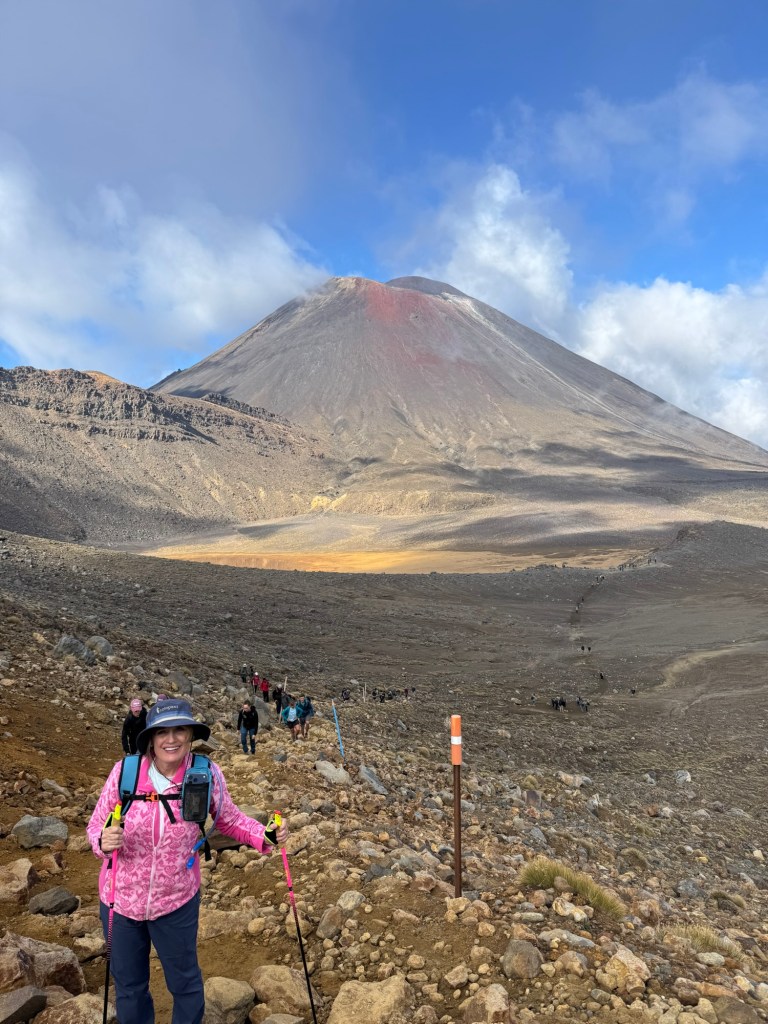
The climb up Red Crater.
Holy moly. THAT WAS HARD. In fact, there’s even a sign after the Devil’s Staircase that says it’s about to get even harder, so if you want, turn back now.
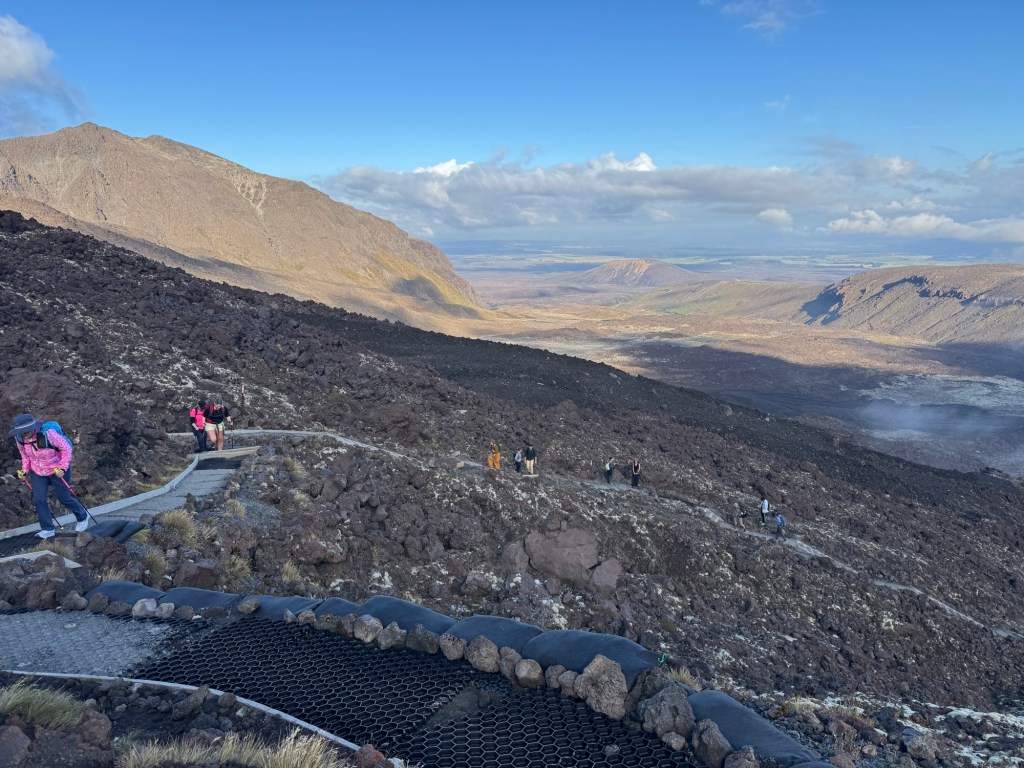
It is definitely the hardest cardio part of the hike. It’s steep, loose, and requires equal parts determination and stubbornness. I didn’t think it was going to end.
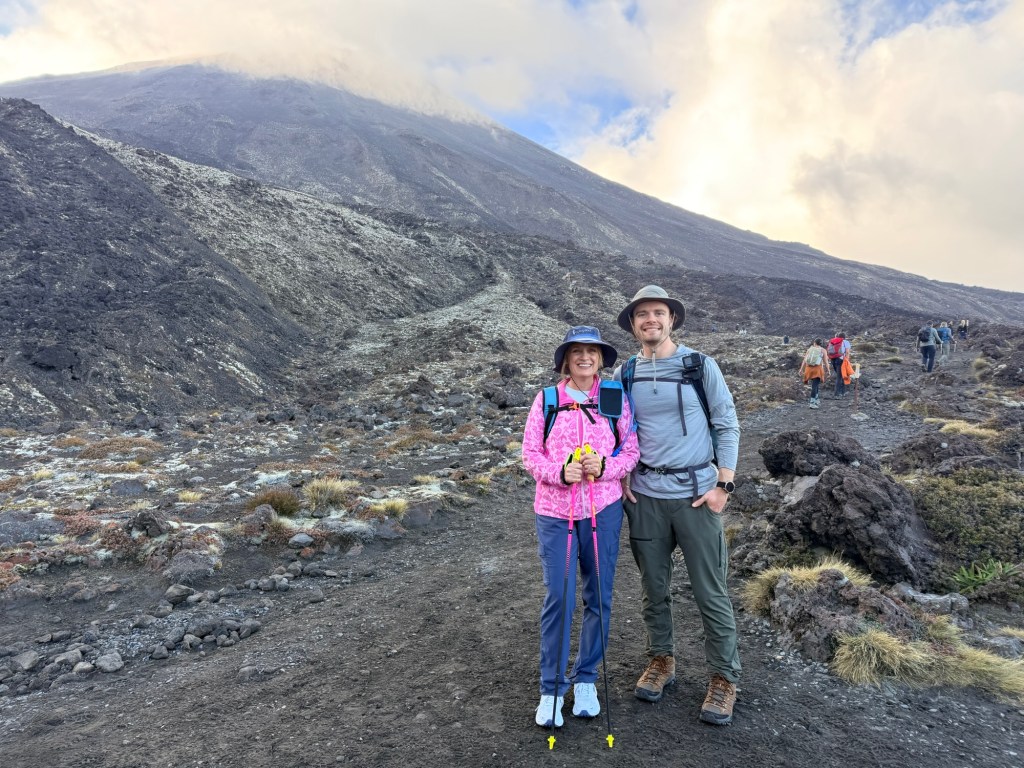
There was pain on that face disguised with a smile 😊
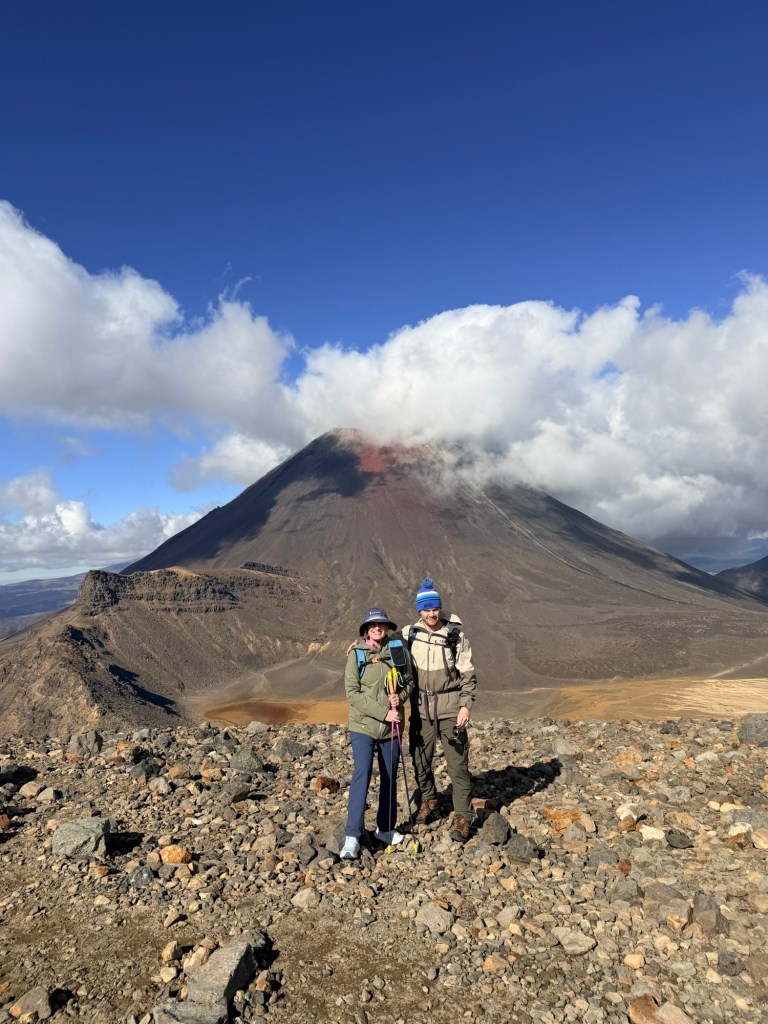
But when we finally reached the top and stood at the highest point of the crossing, we were surrounded by raw volcanic beauty that made us forget (temporarily) how hard that really was.
💨 The Descent That Tests Your Balance: Red Crater to Emerald Lakes
Going down sounds easy. It is not.
The descent is steep, covered in loose volcanic gravel, and feels like walking on marbles. It’s less “hiking” and more “controlled sliding while trying to look graceful.”
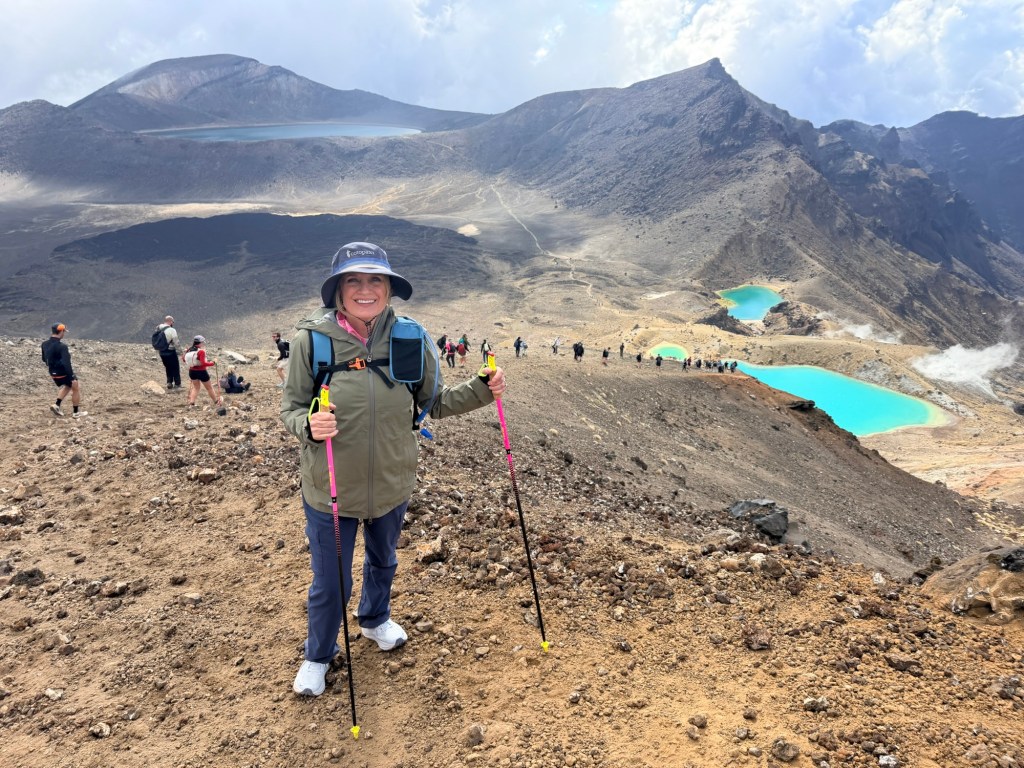
This is also where my hiking poles officially became MVPs. Absolute lifesavers on the downhill—10/10 recommend if you enjoy having functional knees. Thank goodness for them otherwise I may have gone right off the edge. So many people were sliding and falling down, Brendan and me included.
But then—just as we’re questioning everything—we see them…
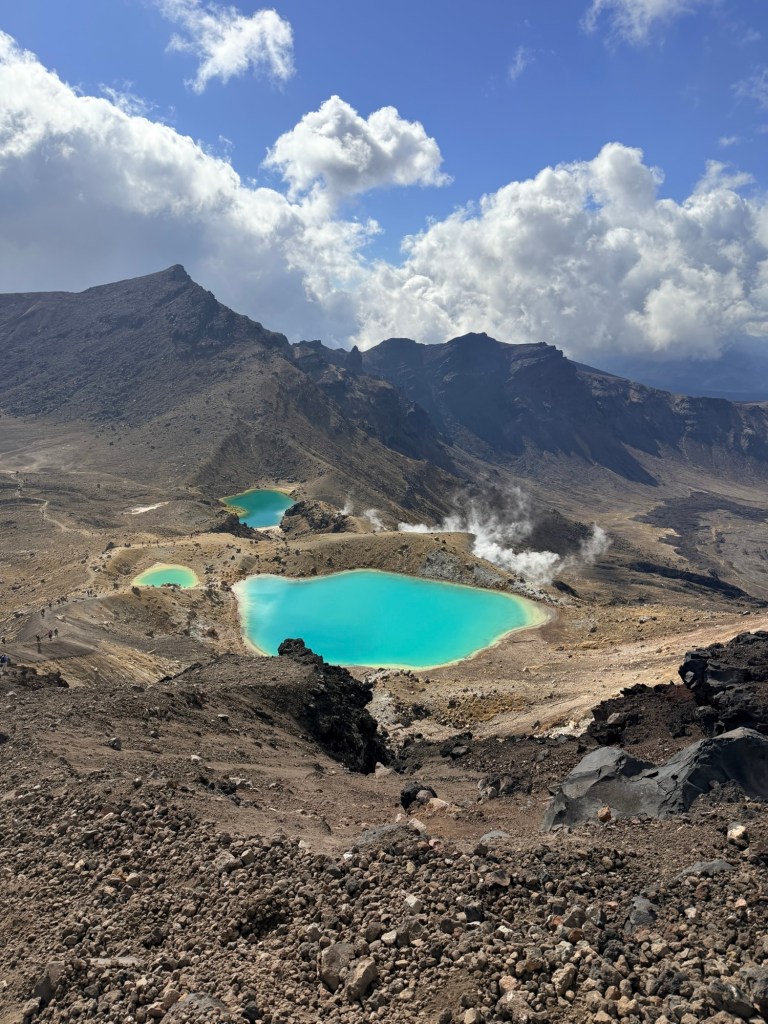
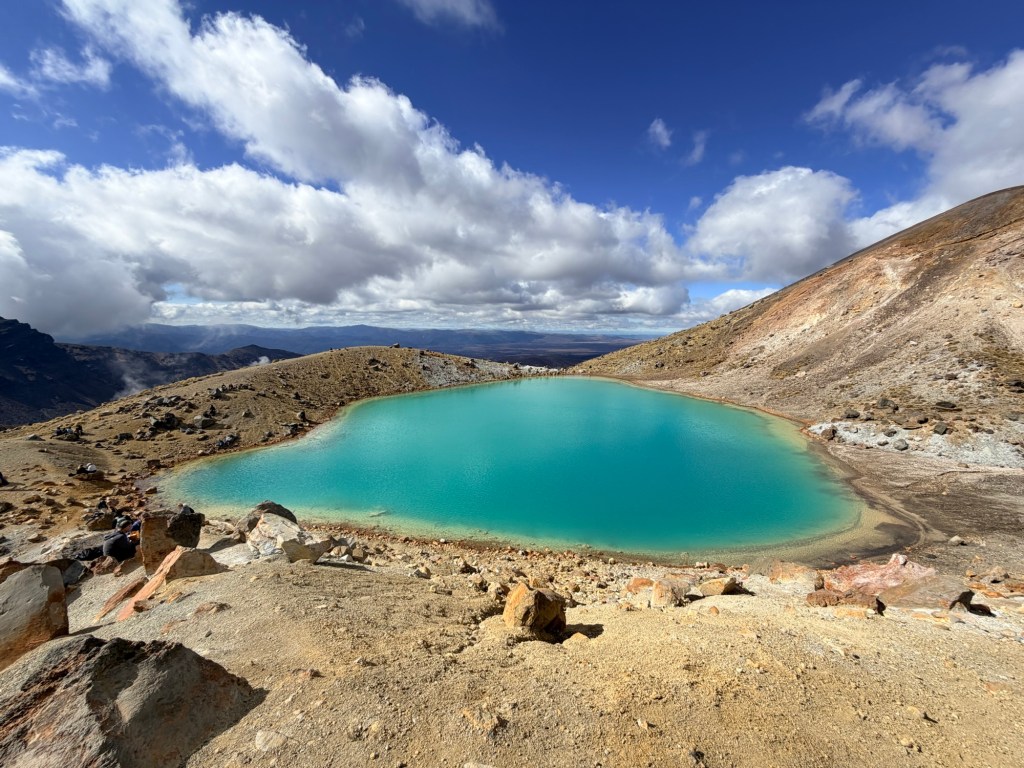
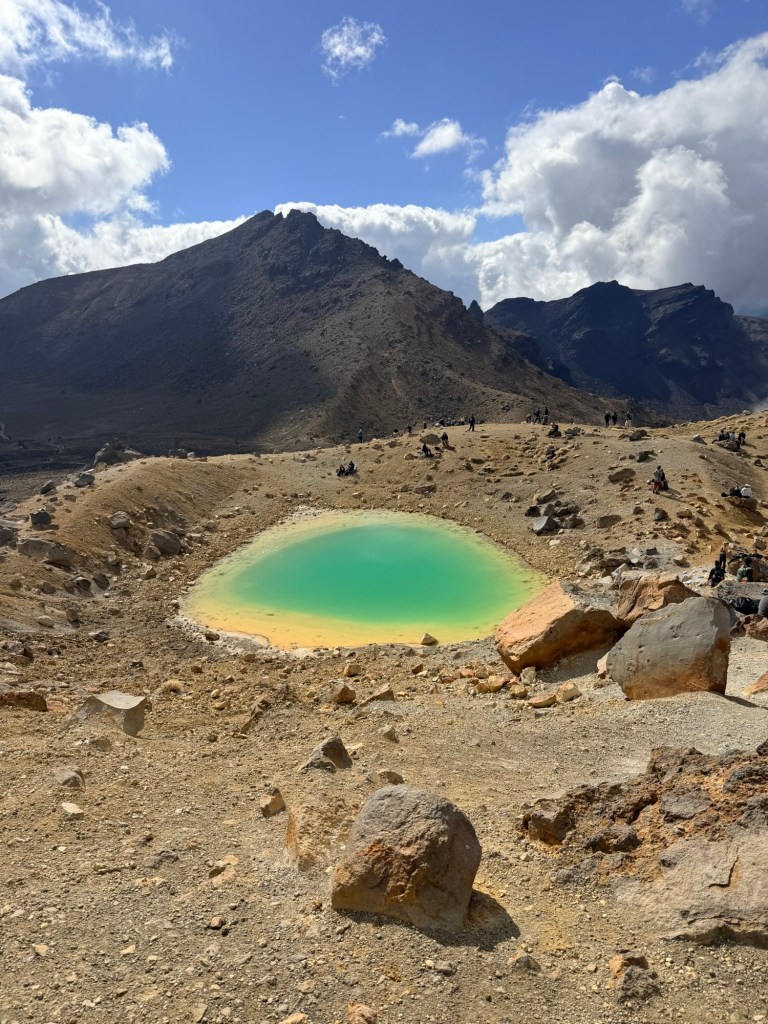
💚 The Showstopper: Emerald Lakes
Bright, surreal, almost impossibly green.
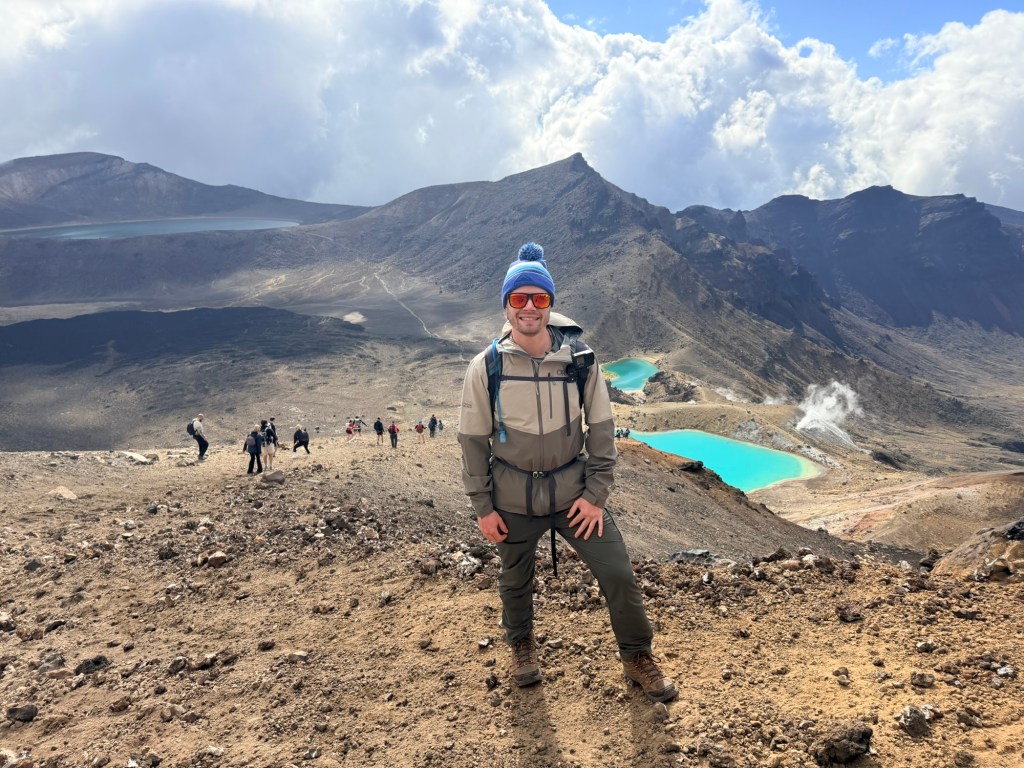
The Emerald Lakes look like they were photoshopped into real life. The contrast against the dark volcanic terrain is unreal! Suddenly everyone forgot their exhaustion and turned into a photographer.
First glimpse of the 3 Emerald Lakes! Take a look at that downhill slide…everyone was stumbling and falling.That is steam coming up from the ground, which is created by groundwater that is heated by magma. It is also called a fumerole emission.
This is where we paused. Took it in. Smelled the sulfur. Wonder how something this harsh can also be this beautiful.
The stunning green color comes from dissolved minerals, including sulfur and calcium carbonate leaching from the thermal area.
Take a closer look at the lakes (and the path to get to them😳)
🩵 The Long Way Home: Blue Lake to Ketetahi Descent
From here, the hike shifted yet again.
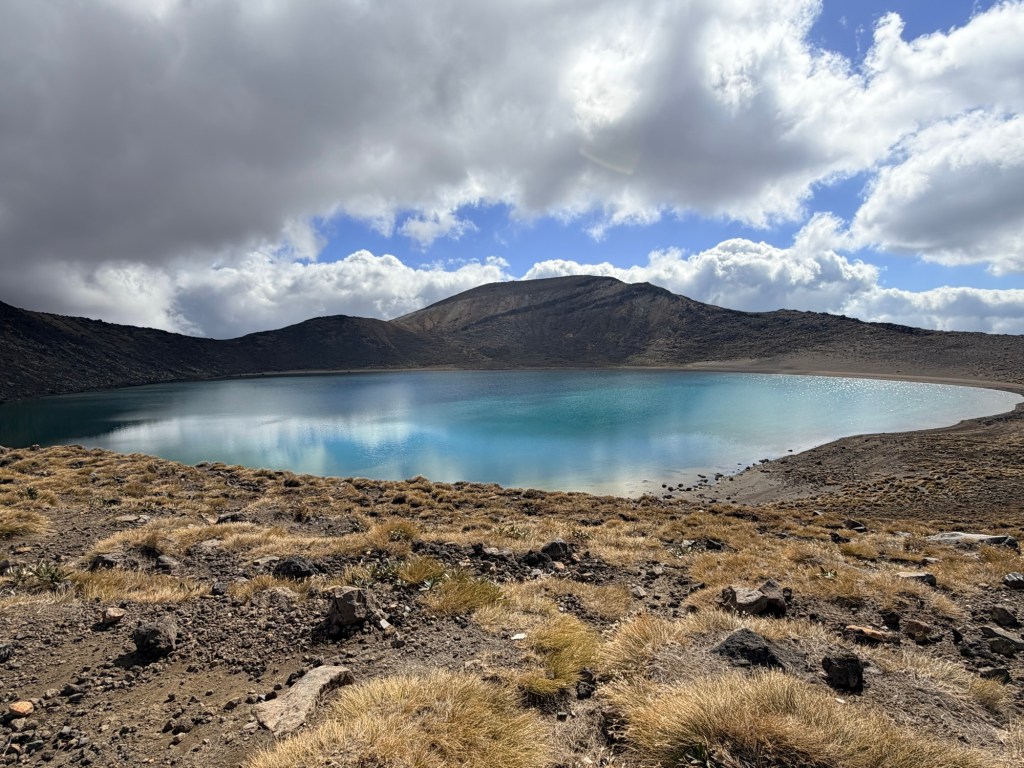
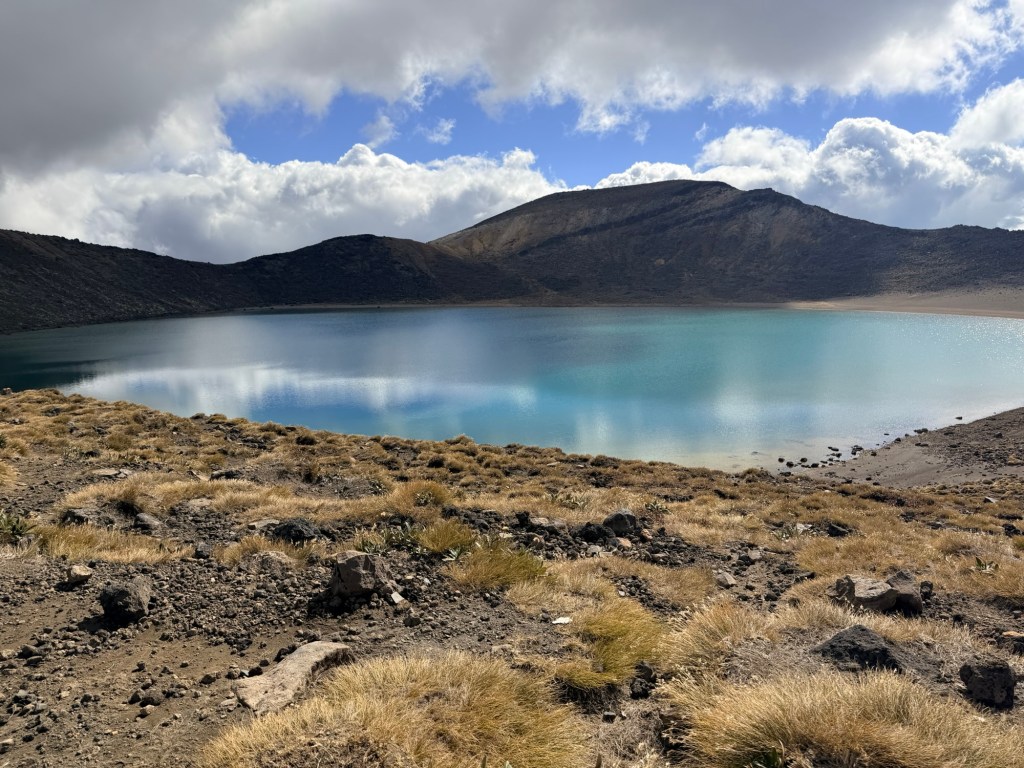
We came to Blue Lake where we ate lunch, admired the calm, and watched the water change colors and sparkle.
Look at the clouds reflected in the Blue Lake!🩵
Then we began the long descent down the other side. And when I say long, I mean long.
This section tests your endurance in a completely different way. It’s less intense, but it just keeps going. And going. And going.
My knees started negotiating. Our feet filed complaints. Brendan and I definitely hit the “are we there yet?” phase, more than once.
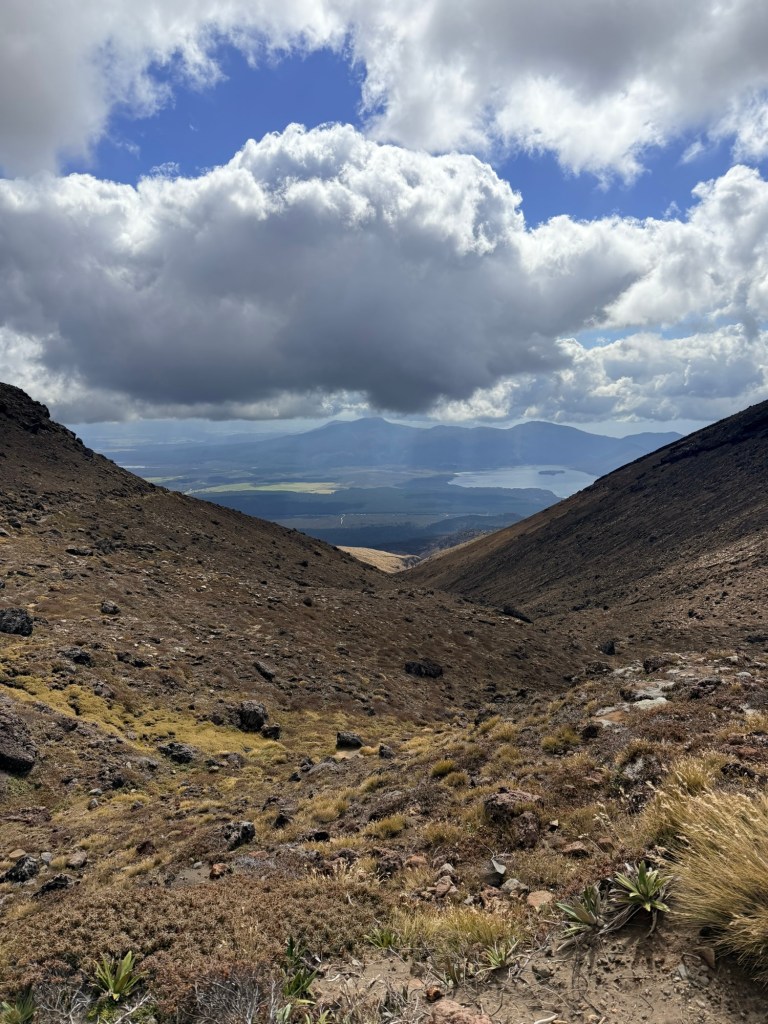
But the views opened up again, stretching out toward Lake Taupō in the distance, reminding us why we’re doing this hike.💙
🌄 The Finish Line
When you finally reach the end, there’s no dramatic finish line—just a quiet, deeply satisfying sense that you did something hard and worth every step. However, had there been “finisher medals” handed out, I would’ve kept that medal for the rest of my life and proudly displayed it in a prominent place! 🏅
We finished in just under 7 ½ hours, tired, dusty, and fully in awe of what we had just experienced.
Done!
🥪 What We Brought (and were very glad we did)
This is not a hike where you want to under-pack… but also not one where you want to wildly overdo it either (speaking from experience).
Water:
I carried 2 liters of water in my hydration backpack + a Powerade. I drank every last drop. Brendan carried 3 liters of water, a Gatorade, and two extra bottles of water. He only had those two extra bottles left at the end.
Equipment:
I used my new Leki hiking poles, which were absolute lifesavers on the downhill. They’re also easy to pack as they fold up very small and have a carrying bag. Brendan did not use poles but he’s also 30 years younger than me lol.
Even if you don’t have knee problems, it’s very common to have knee issues on the way down because your quads are so taxed and there are a million steps. OK, maybe not a million but it sure felt like it.
Food:
Our amazing hotel, Tongariro Crossing Lodge, packed us a perfect lunch—Ham and cheese sandwiches, chocolate, apple and granola bar. Plus we had some other snacks from a local gas station.
Clothing:
As mentioned above, I wore five layers, which, in hindsight, was aggressively unnecessary.😂 Better safe than sorry as some days may be colder.
Weather:
We couldn’t have asked for a better day. Other than the time we were actually in a cloud, it was mainly sunny. Keep in mind that you constantly need to be checking the weather up to the point when you hike, and then you may even have to turn around if the weather is too severe. Keep in mind that this hike is pretty wide open so sunscreen and hats are a must.
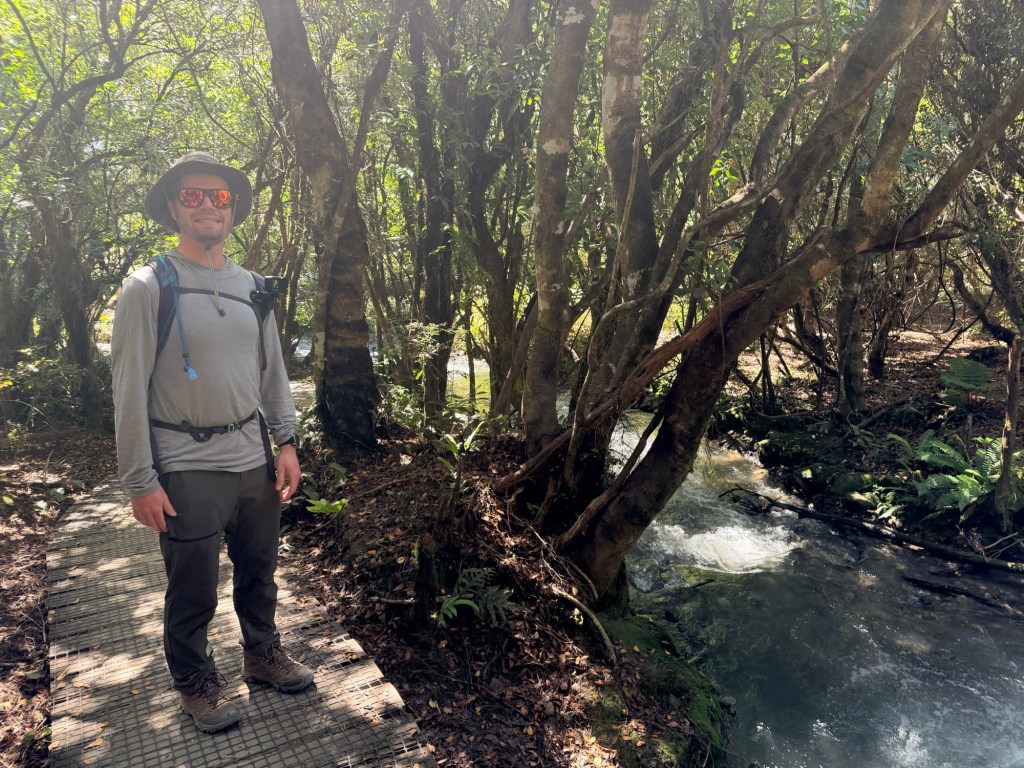
Also, we went through so many different biomes—volcanic, rolling hills, prairie, forest, jungle. I’ve never been on a hike, so diverse before.
Transportation:
Where are you start the hike and where you end it are two different places. Therefore, you don’t want to drive and leave your car at one end because you won’t have it when you finish.
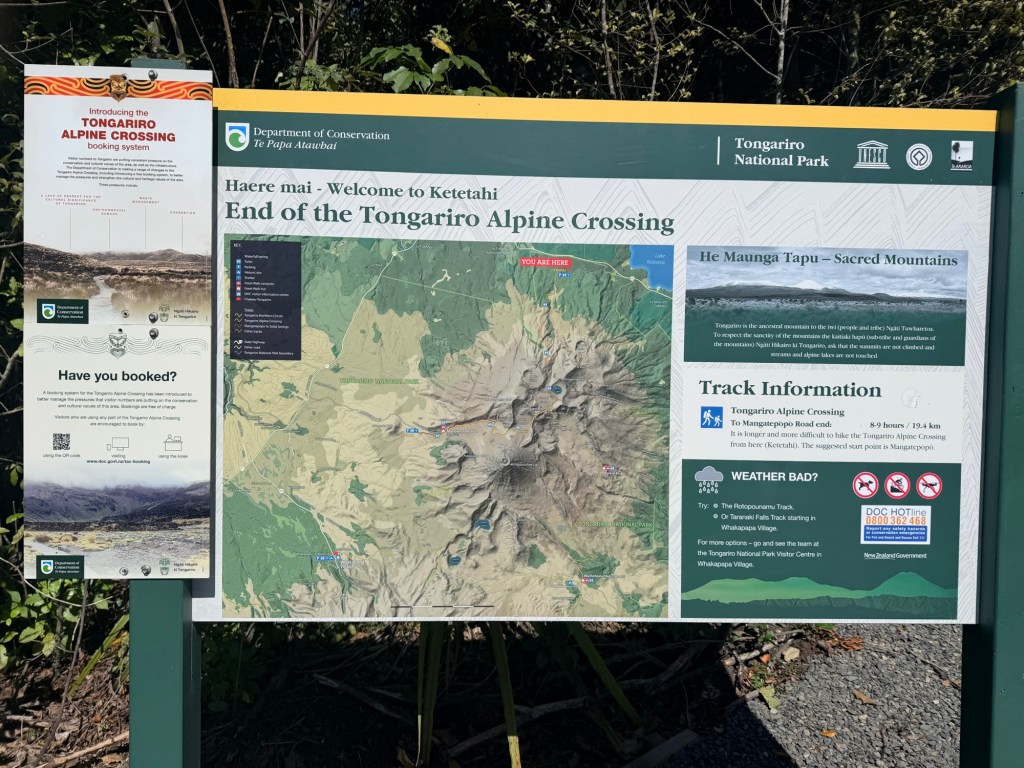
Therefore, our hotel booked us a ride both ways with Dempsey Buses. Worked perfectly. They picked us up at 6:45 am and then brought us back to the hotel when we finished. Pick up time is either 3:00 or 4:30 (or you call them and they’ll pick you up after). We made the 3:00 pm. And it was a good thing we did because we had a 4-hour drive to Wellington after we finished the hike.
Altitude:
Throughout the hike, we ascended 3,002 feet, we descended 4,170 feet, max elevation was 6,194 feet, and the minimum was 2,513 feet (thanks to Brendan’s Garmin watch).
Attitude:
Better bring a good one or that 6-8 hour hike will be miserable. Keep that positive mindset, think safety first, and enjoy the surprise around every corner.
🤔 Reflection
The Tongariro Alpine Crossing is physically demanding, mentally challenging, spiritually grounding, and visually surreal.
We came for the hike. We left with sore legs, incredible views, and a much deeper respect for the land we crossed. It was worth every ache and pain that, hopefully, Advil is going to cure.
Today was one of those days where New Zealand just keeps showing off and it’s just fine with us!
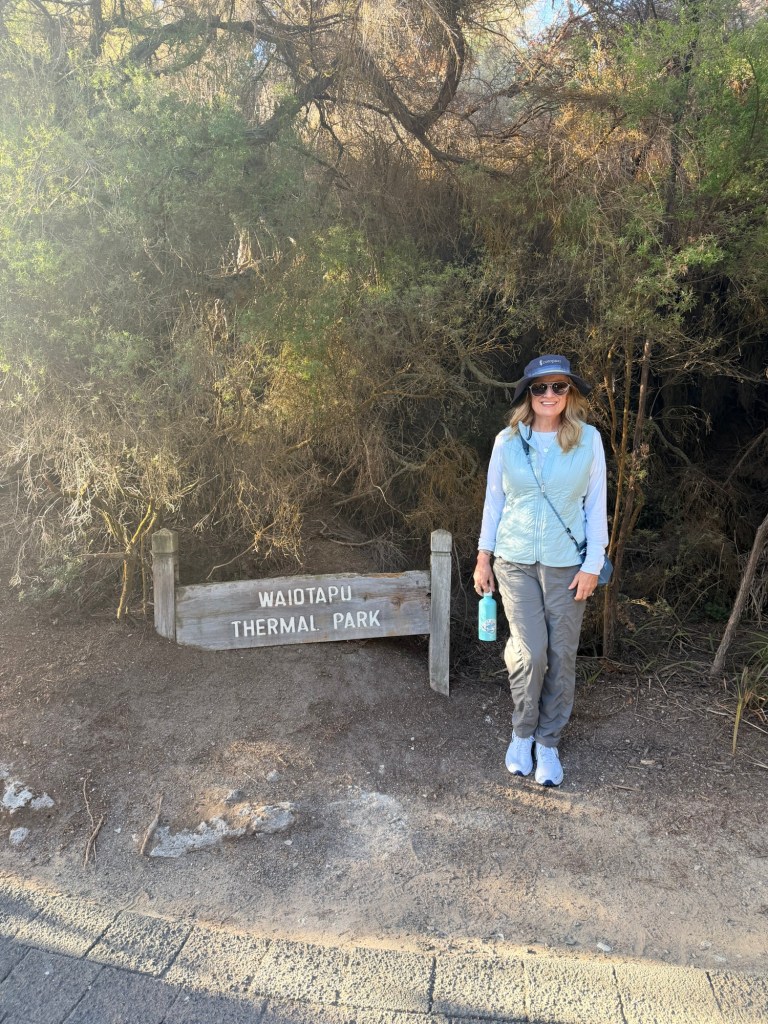
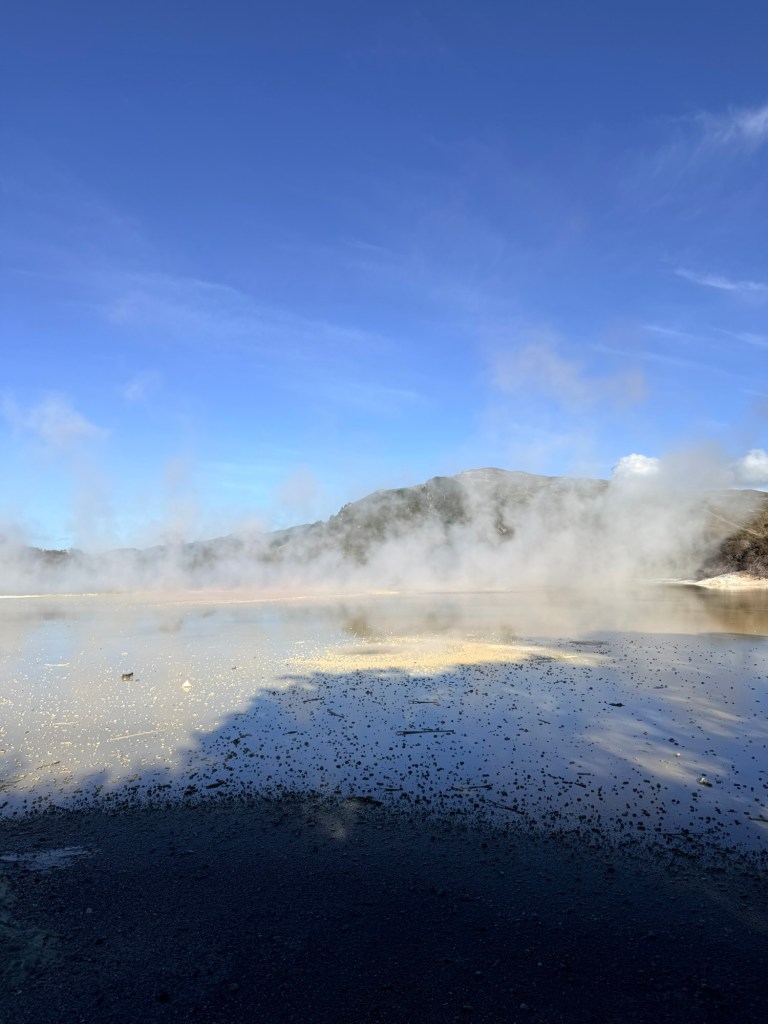
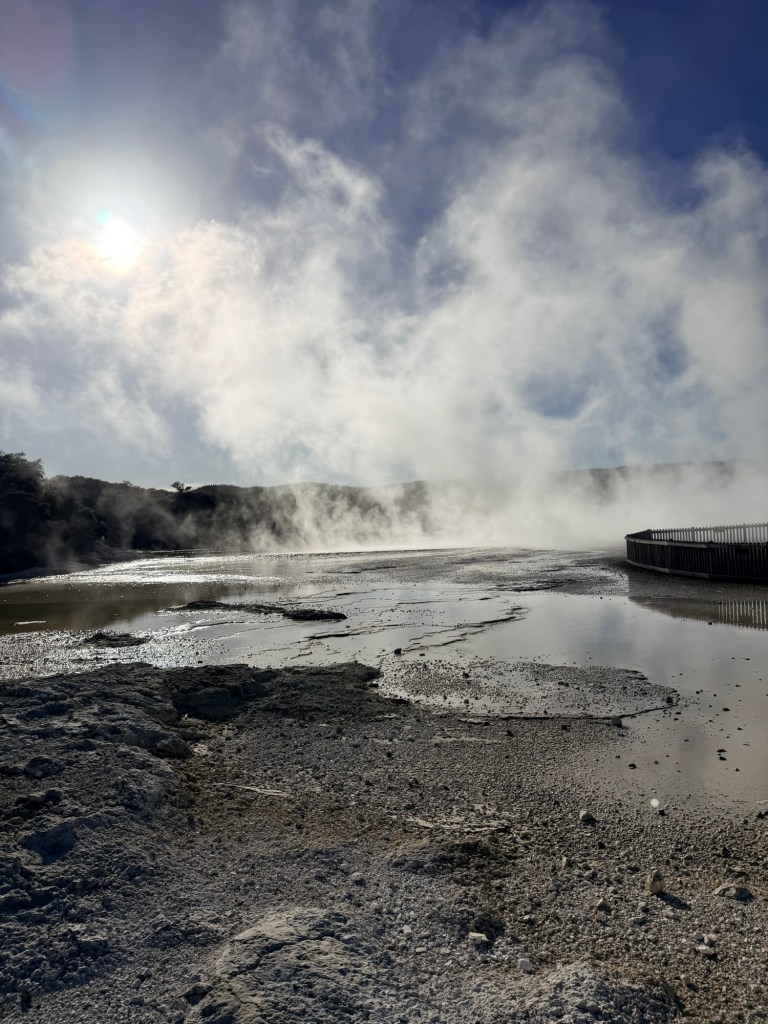
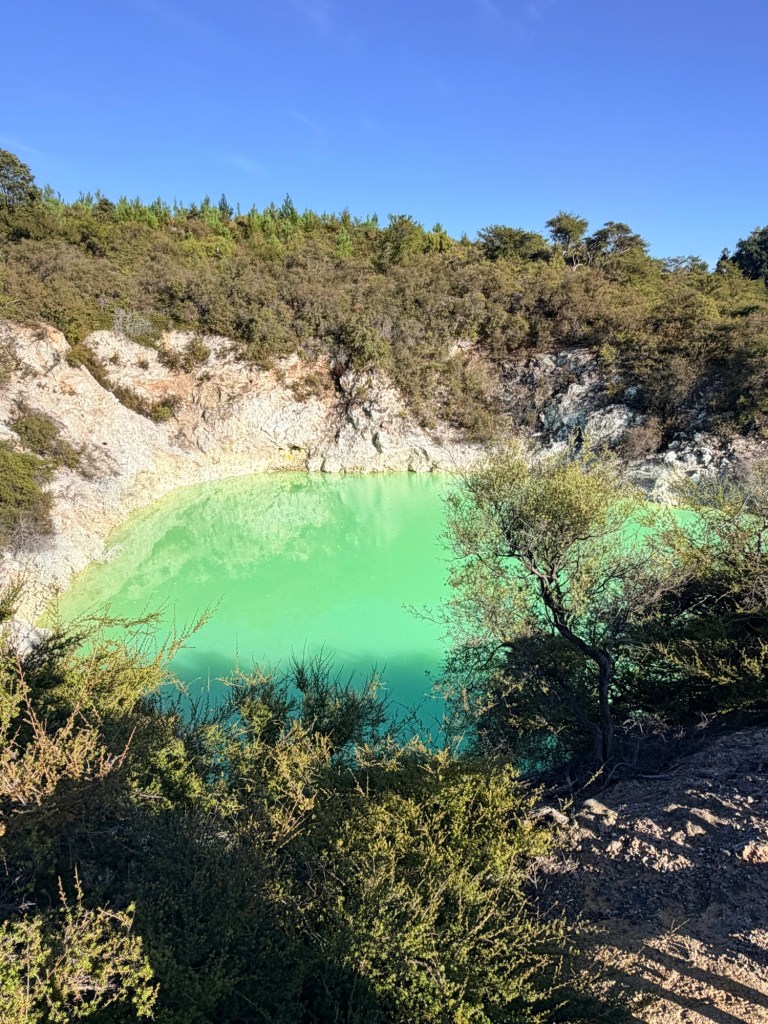
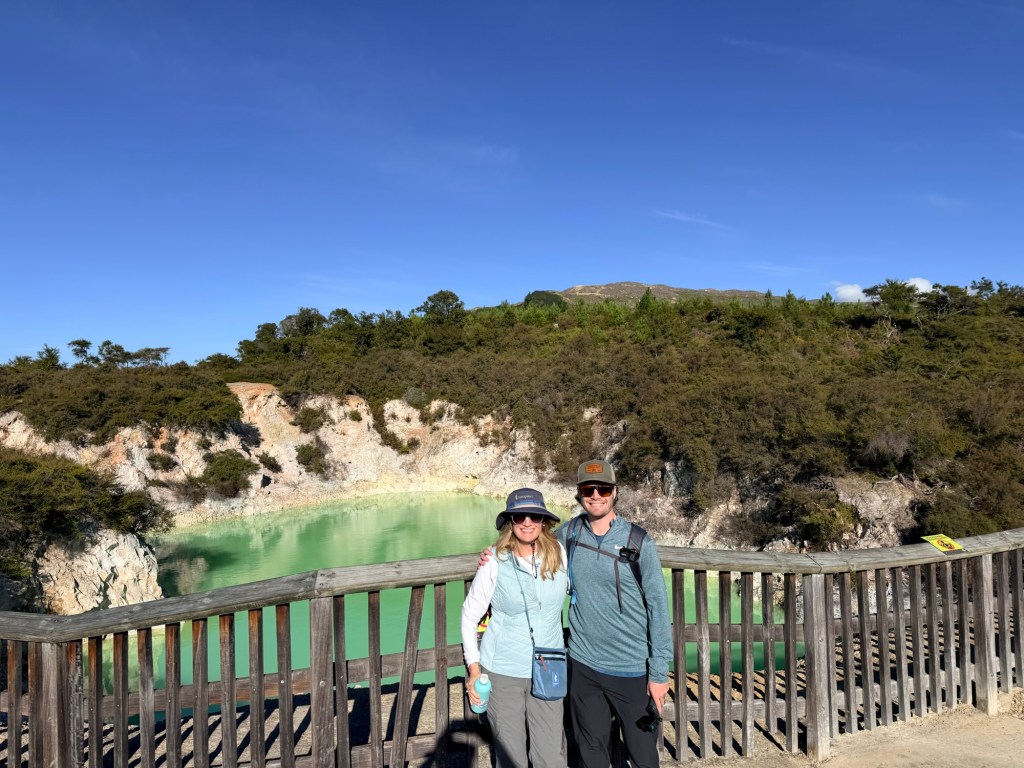
After a gorgeous sunrise over Rotoua Lake that we could see from our hotel window, we made our way to Wai-O-Tapu Wonderland, which is on the ancestral land of the Ngāti Tahu – Ngāti Whaoa iwi (tribe). Neon pools, bubbling mud, steam rising out of nowhere…it’s wild, colorful, and smells exactly like you’d expect (hello, sulfur).
The Artist’s PaletteChampagne Pool The largest hot spring in NZ. This isn’t one you want to bathe in as it’s 165 degrees Fahrenheit! It’s made up of minerals like gold, silver, mercury, sulfur, arsenic, thallium, and antimony. How’s that for a geothermal cocktail?
The bubbles are caused by carbon dioxide and produce a champagne-like effect. That’s a 700 year old vintage!Roto Karikitea – a much cooler 57 degrees Fahrenheit. It’s formed by the run off water from temhe Champagne Pool. It gets its color from the deposit of minerals suspended in the water and refracting the sunlight. It’s very acidic with a Ph of 2!
Rua Pumahu
Then we made sure to time it just right for the Lady Knox Geyser show, which erupts every day at 10:15 am. And yes, it’s triggered by eco-friendly soap (you heard that right), but that doesn’t make it any less impressive. A guide shared the history with the gathered crowd, and sang a beautiful Māori song as the geyser shot skyward right on cue, about 65 feet.
The story goes that this geyser was discovered by prisoners in 1901 when they went to wash their clothes. They added soap to the water and all of a sudden, it triggered an eruption! They uncovered that adding soap reduced water surface tension.
Lady Knox is named after the daughter of the 15th governor of New Zealand. Made in New Zealand 🍫
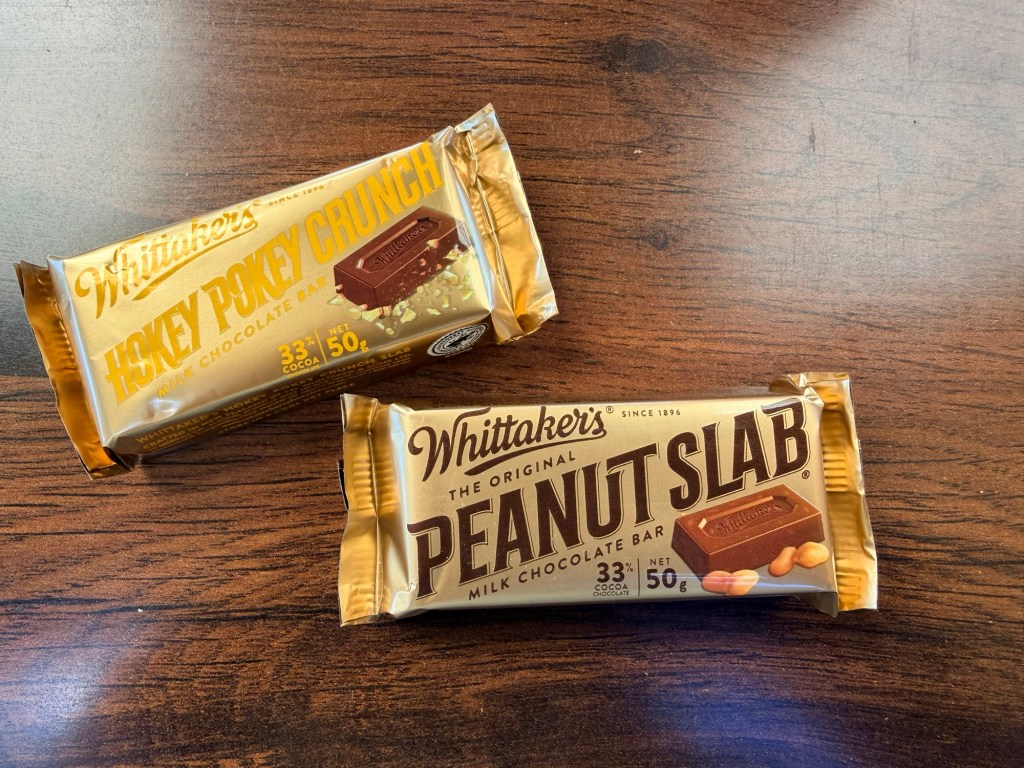
‼️ Food alerts – I had the best gluten free chicken bagel sandwich I have ever had at the Visitor Center Cafe. In addition, we finally tried Whittaker’s famous Peanut Slab bar. For all you chocolate fans—so good!
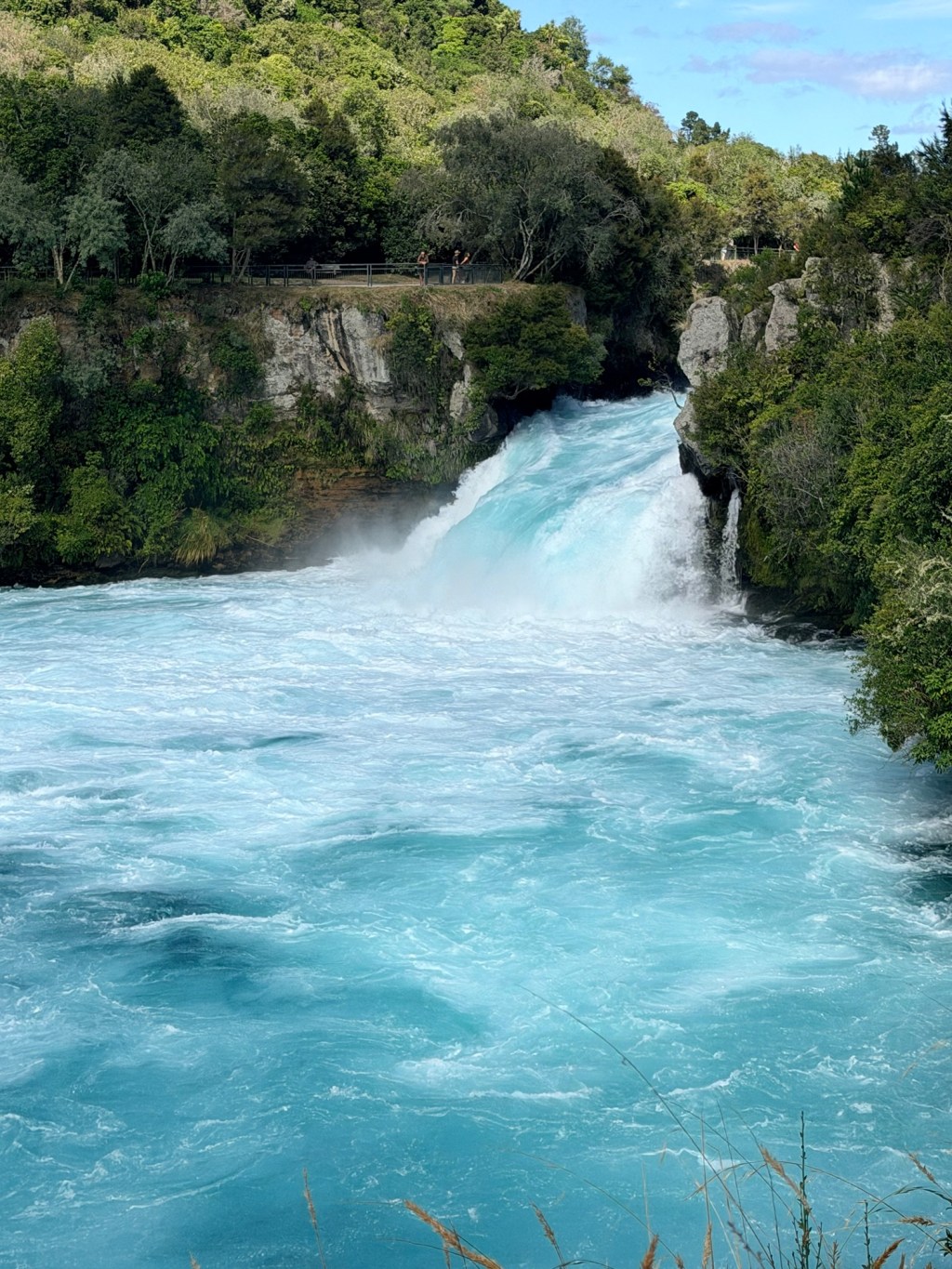
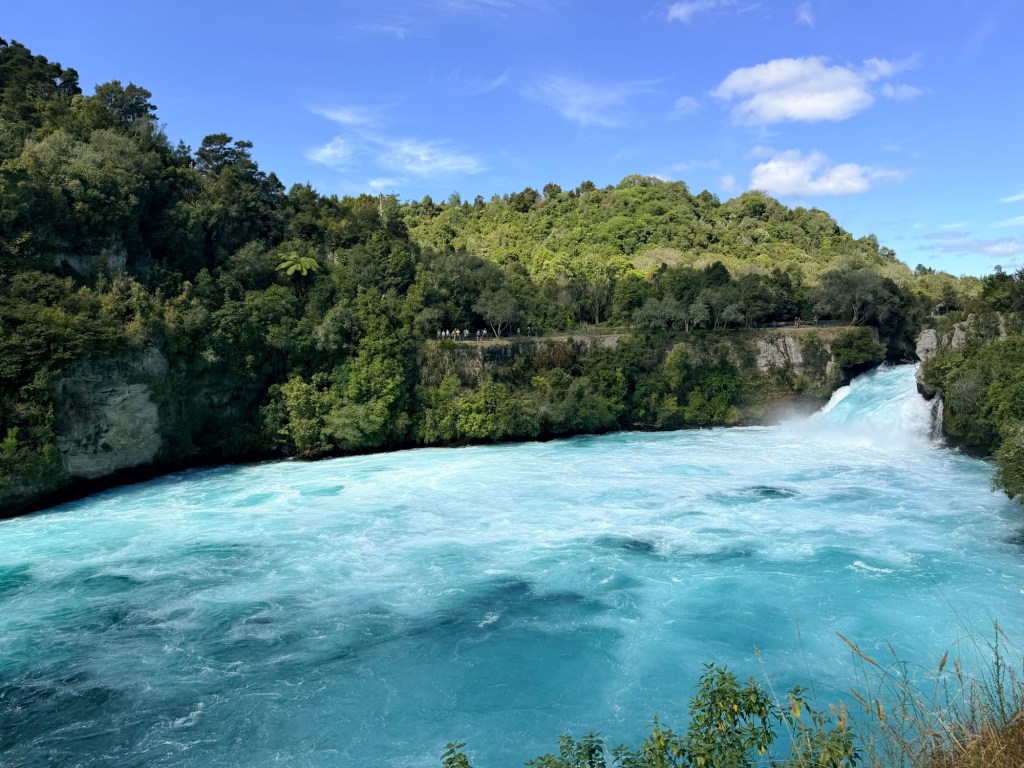
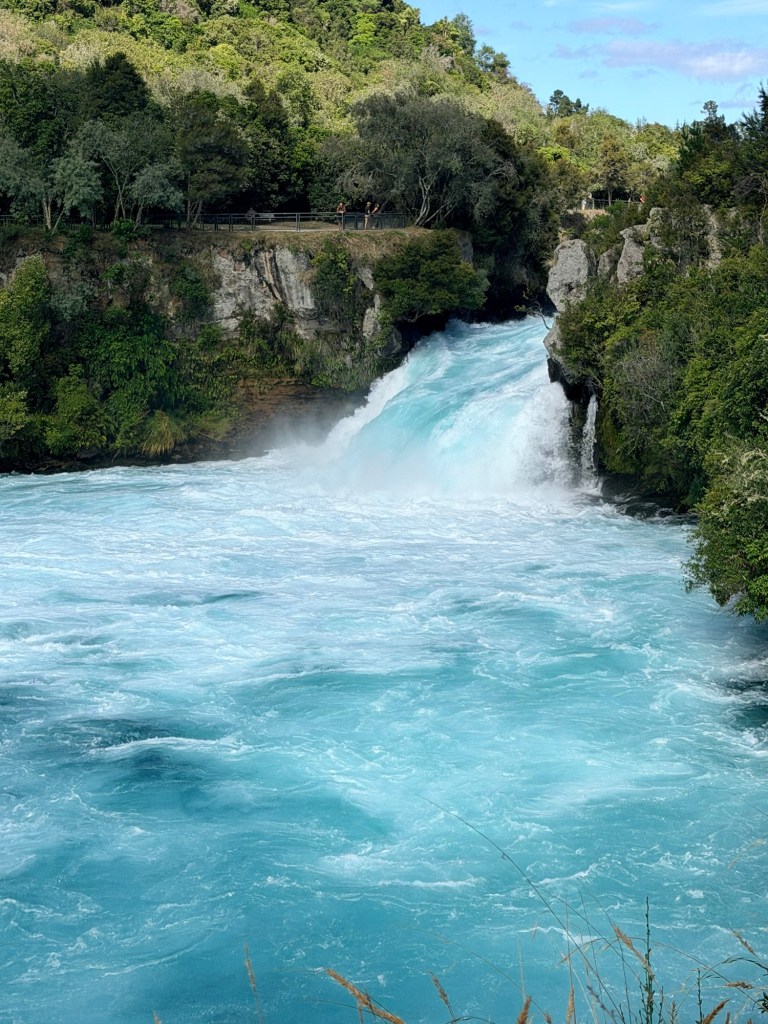
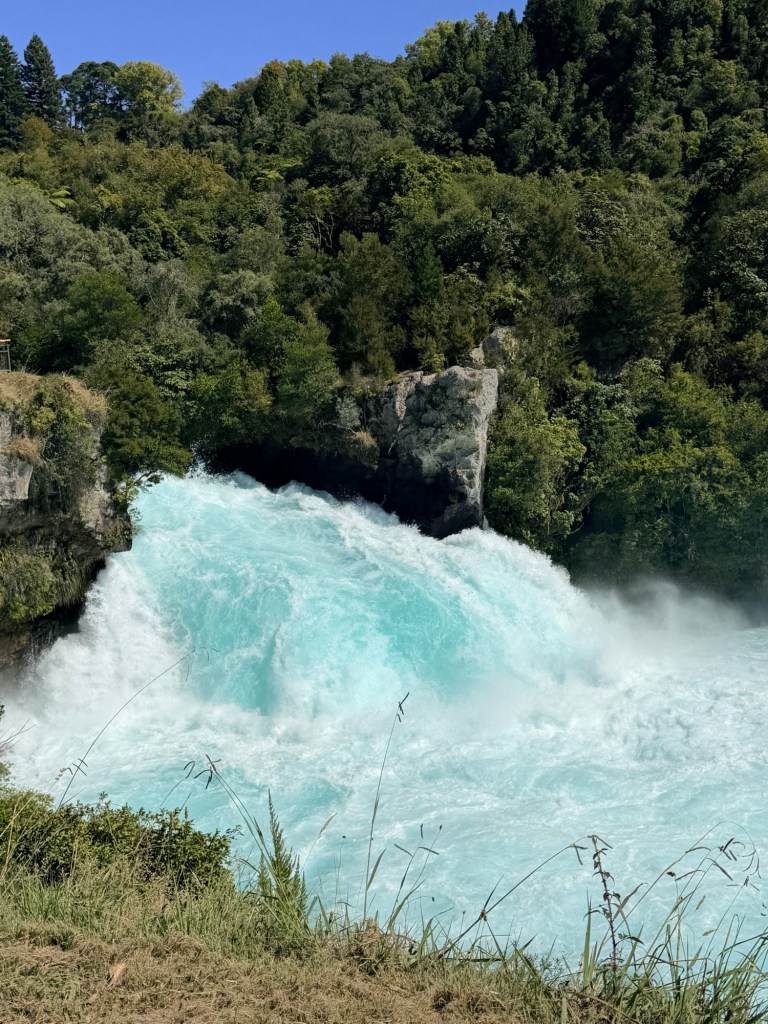
We continued our drive and traded geothermal energy for raw power at Huka Falls. And no, we did NOT raft over these falls! We hiked for a short 15 minutes and heard them before we saw them. The electric blue color is unreal! It comes from really clear water packed with tiny air bubbles created as the Waikato River is forced through a narrow gorge. The bubbles scatter the light in a way that gives the water that signature aqua color before it explodes out into a rush of whitewater. It’s loud, intense, and you can feel the force of it.
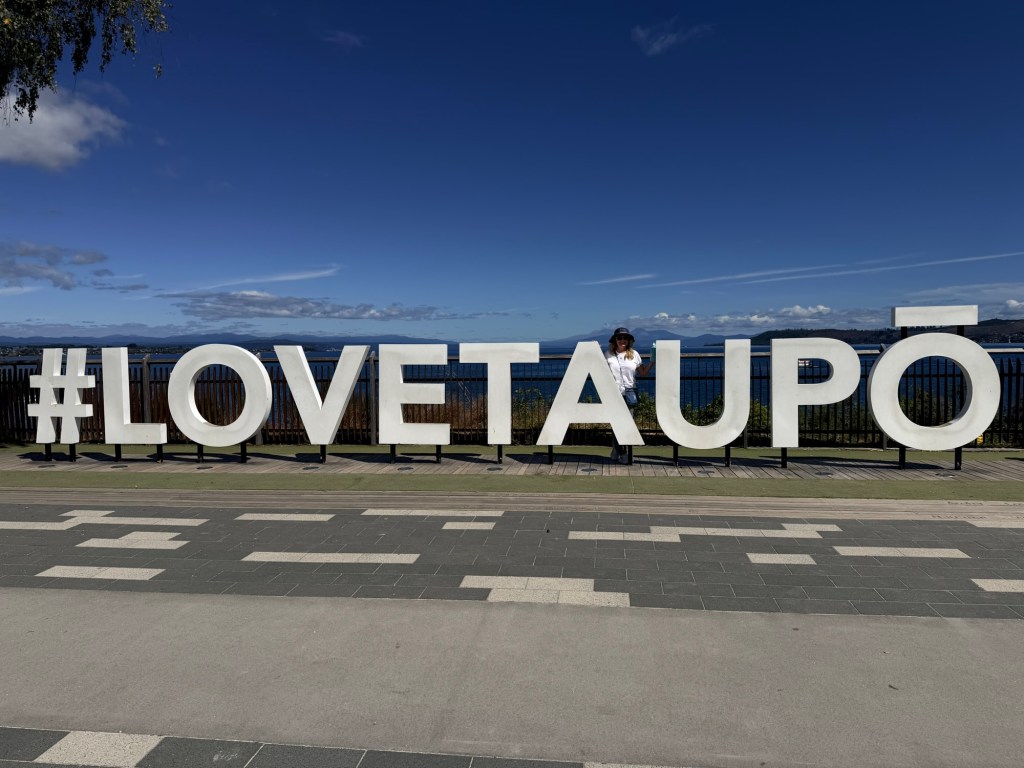
Next stop: Taupō.
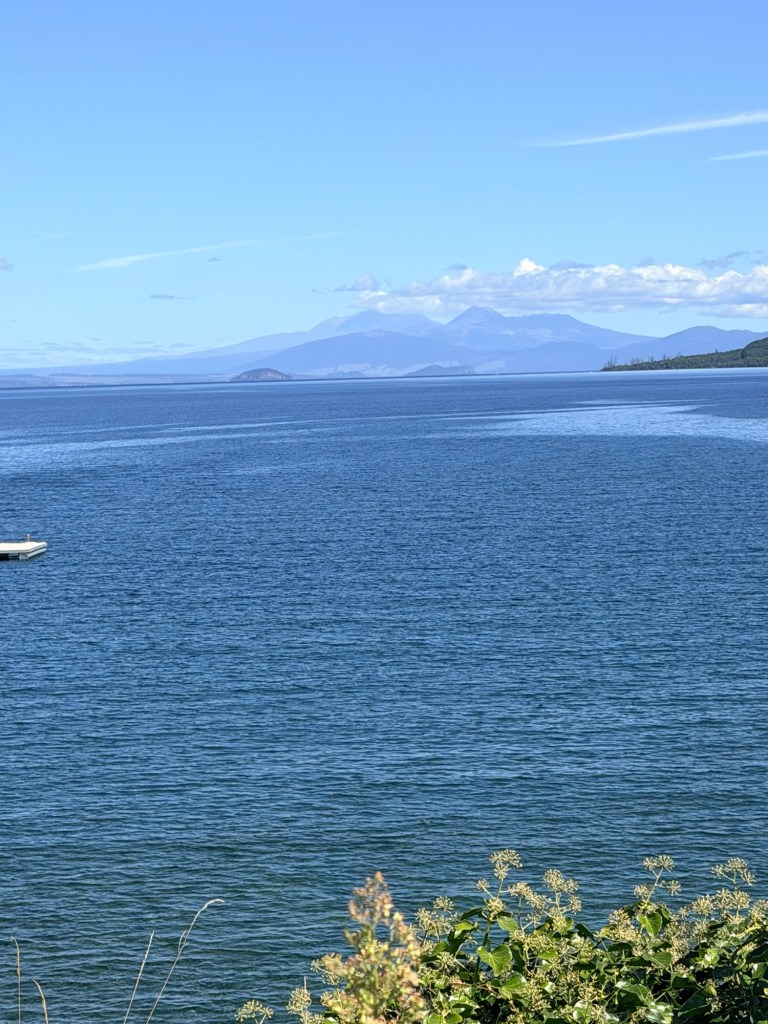
Lake Taupo
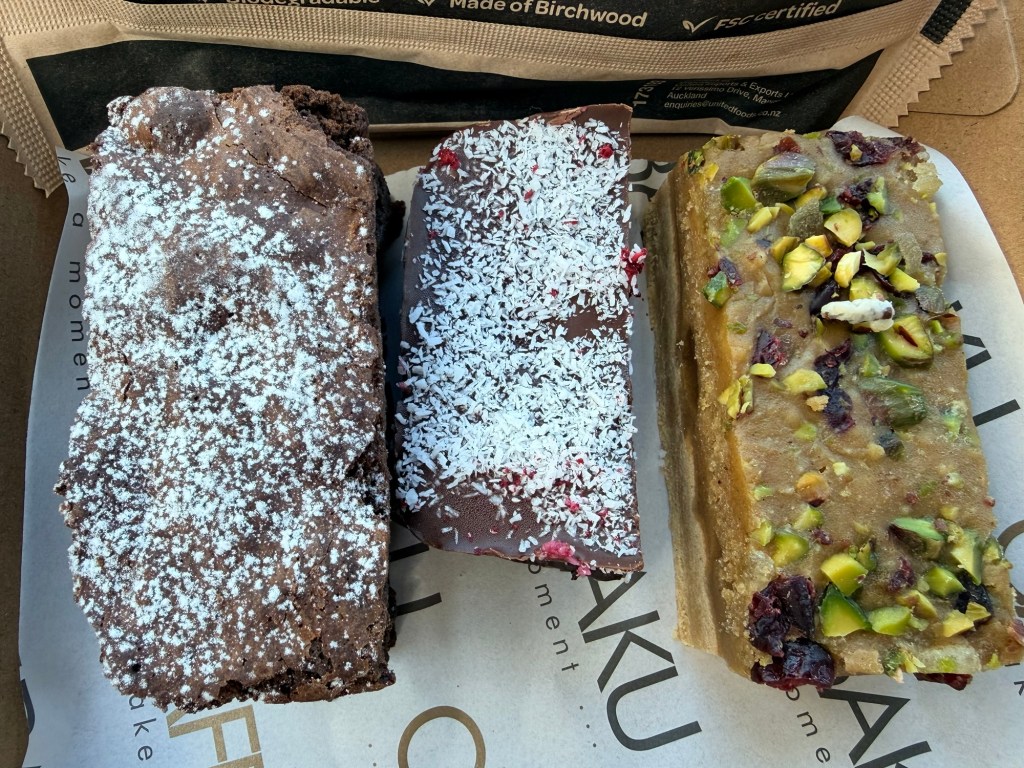
And Lake Taupō is massive—like, “are we sure this is a lake?” massive because it felt more like an ocean! It’s the largest lake in New Zealand, over 238 square miles, which is 25% larger than Lake Tahoe in the U.S. We walked along the water, and grabbed a slice—the dessert, not the New York kind.
Traditionally eaten during an afternoon break, New Zealand slices are café-style treats. They typically have a buttery shortcake base with an assortment of toppings like chocolate, caramel, pistachios, etc. the 3 above are all Gluten Free❤️
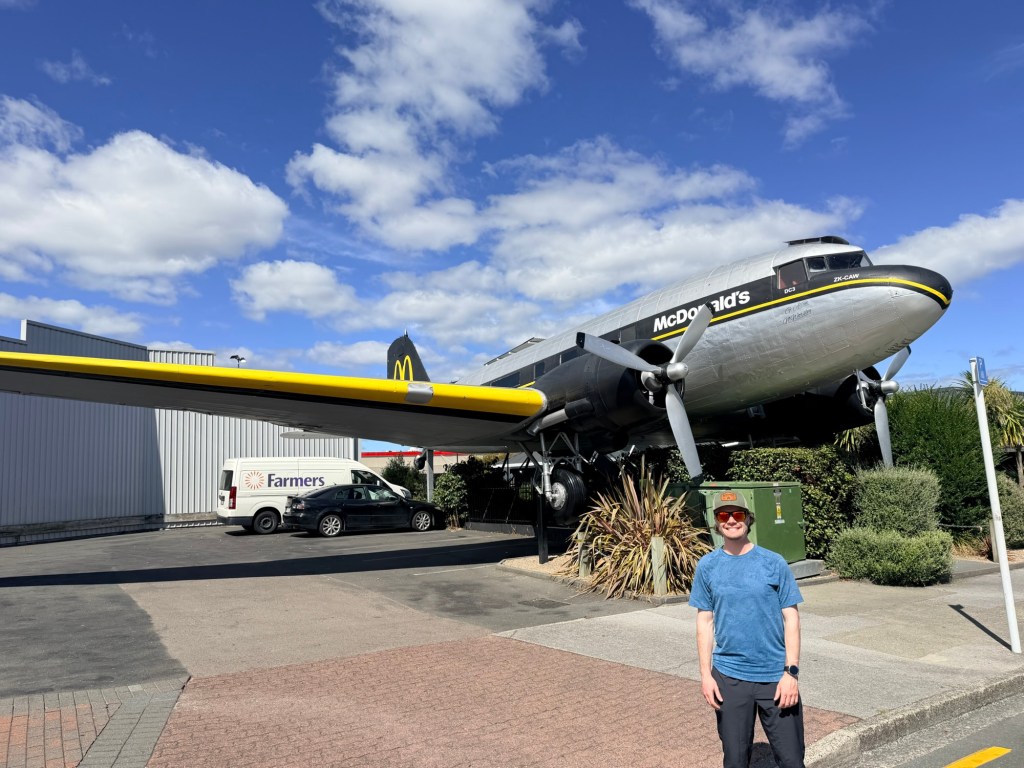
Oh, and check out this airplane that is attached to the Taupō McDonald’s! Don’t know why but there’s a sign that they were voted the coolest McDonald’s in the world! 🌎
Then it was back on the road toward Tongariro. The drive itself felt like part of the experience—lots and lots of rolling hills, wide open landscapes, and views that never end. Every view is a photo opp!
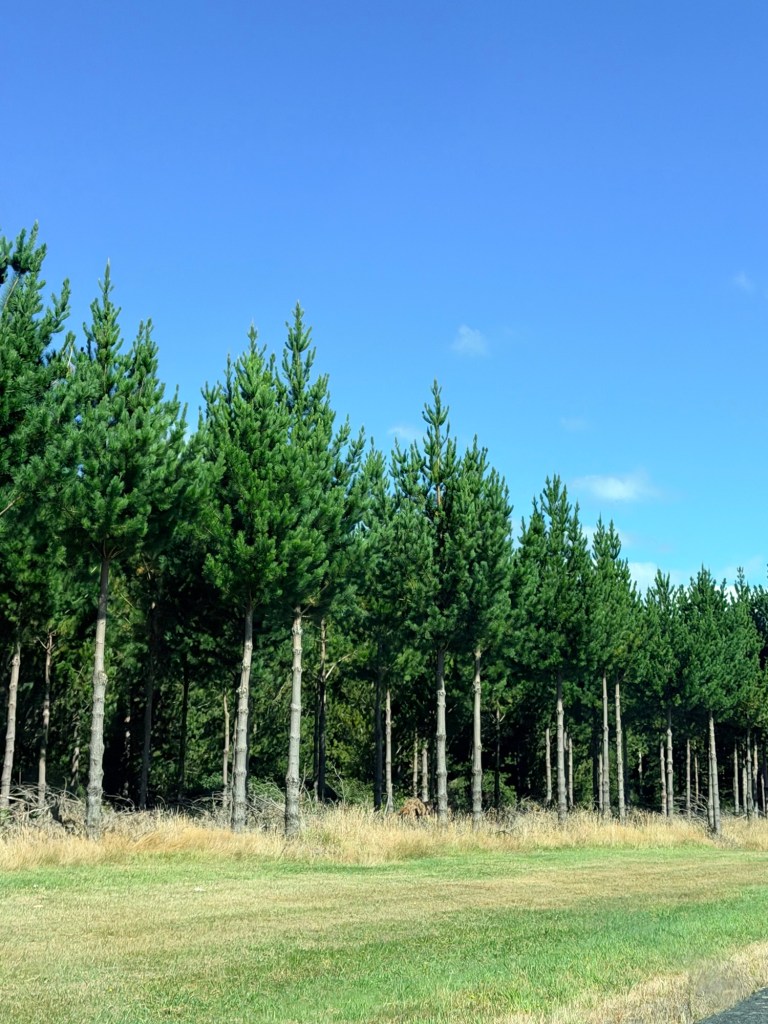
Radiates Pine Trees, they’re missing their pants!
We pulled into Tongariro around 4:00, and it was exactly what we needed. Cozy, simple, and quietly charming.
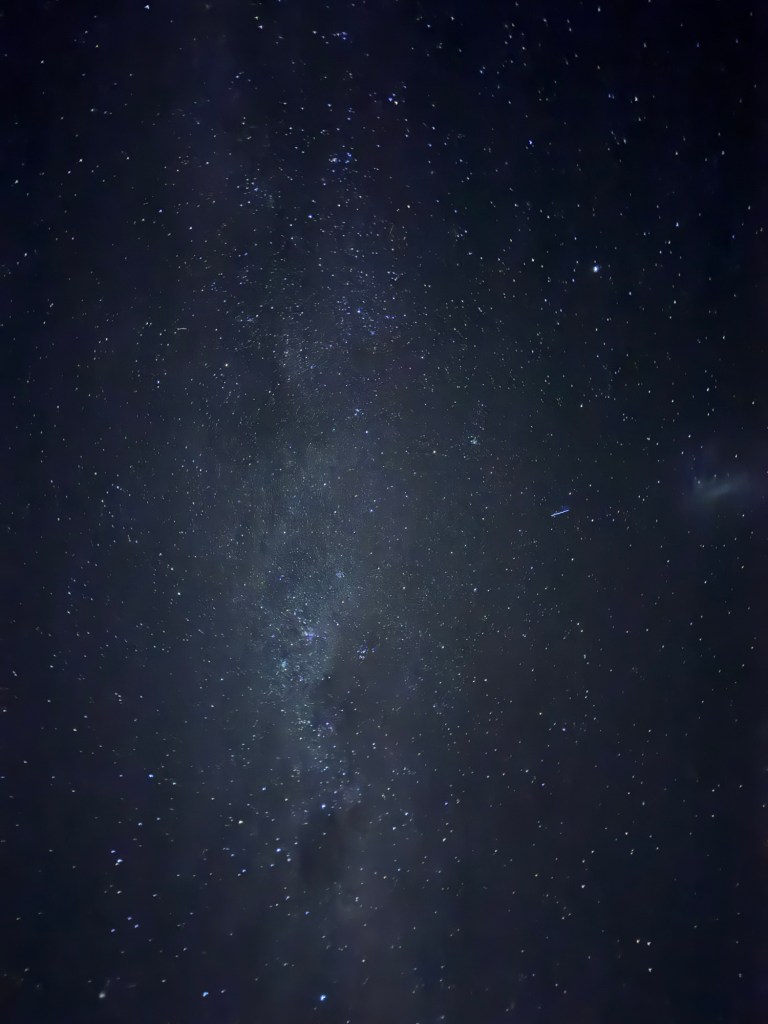
The star of the show was…well, the stars! 🌟 I could see the Milky Way with my visible eye. Minimal light pollution and the right season (March-September) helped. I count my lucky stars!
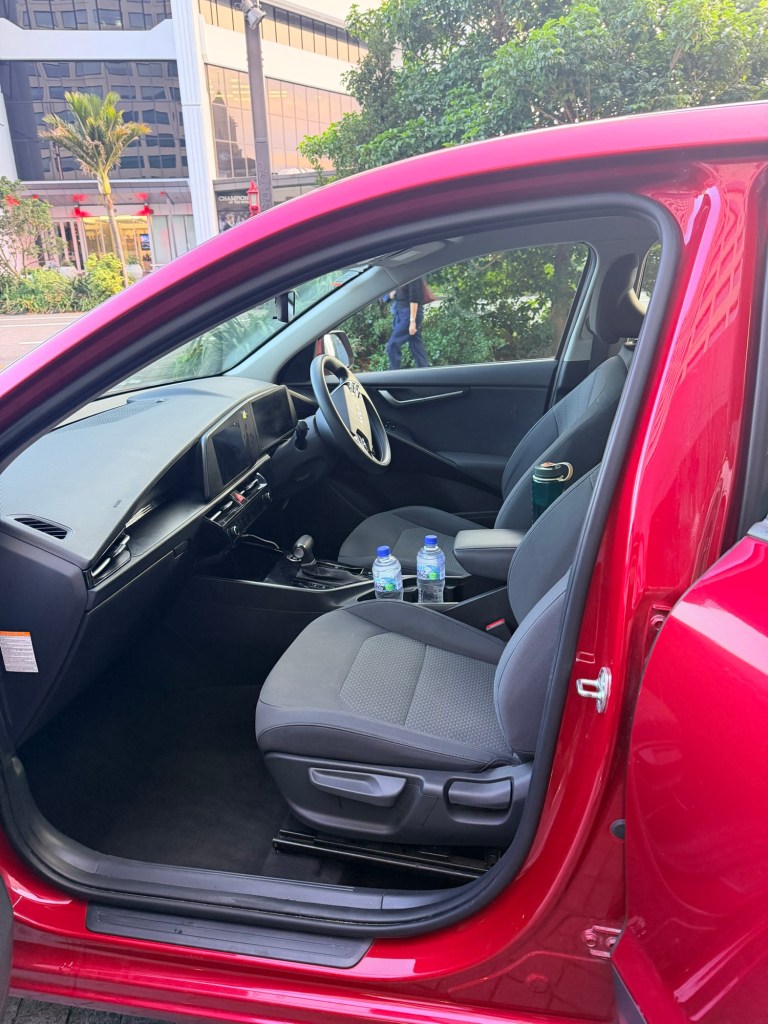
We left Auckland this morning in our rental…this will take some getting used to! We will be driving on the left side (just like we did with the e-bikes), and the driver sits on the right. Everything is reversed so instead of the turn signal, Brendan turned on the windshield wipers many times!
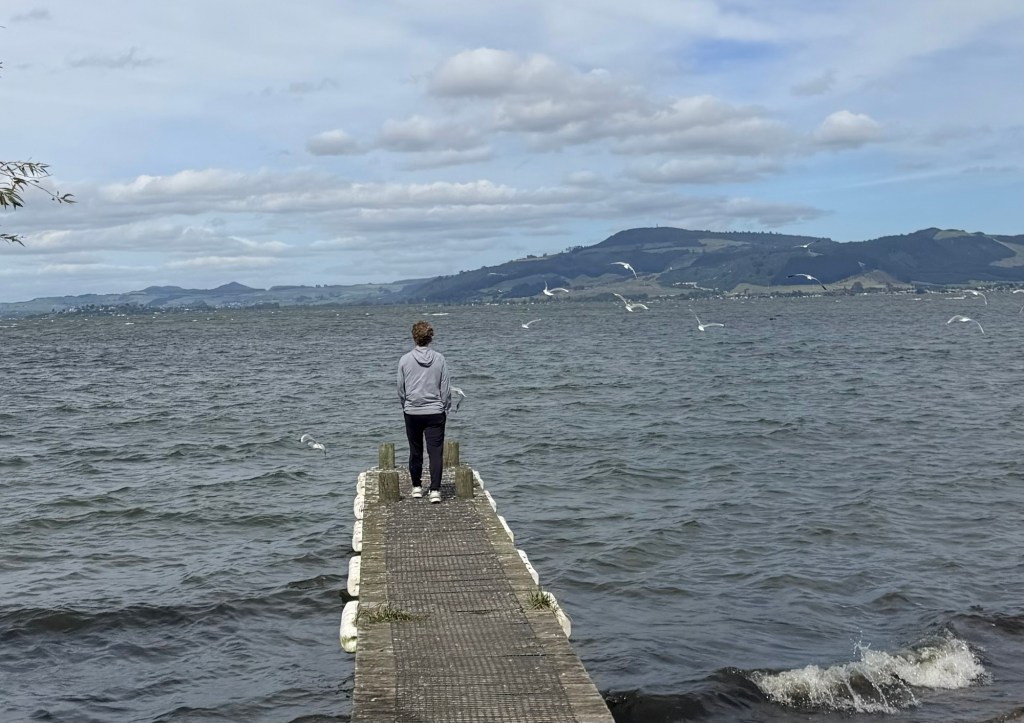
We arrived in Rotorua around noon and stopped at Lake Rotorua—the volcanic crater lake in New Zealand’s Bay of Plenty region.
Lake Rotorua – a caldera lake that was formed by a massive volcanic eruption over 200,000 years ago. It has a slightly green-yellow color which is caused by high sulfur and mineral content from the surrounding geothermal springs. We could smell the sulfur throughout Rotorua at various times but it wasn’t unpleasant.
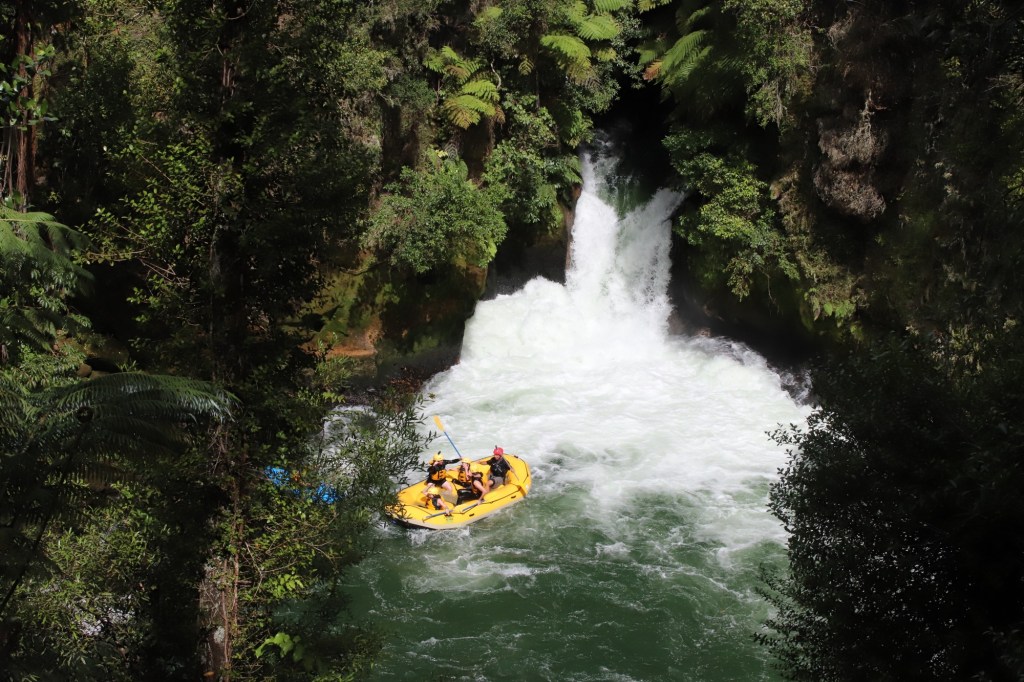
🌊 We Went Over the Highest Rafted Waterfall in the World
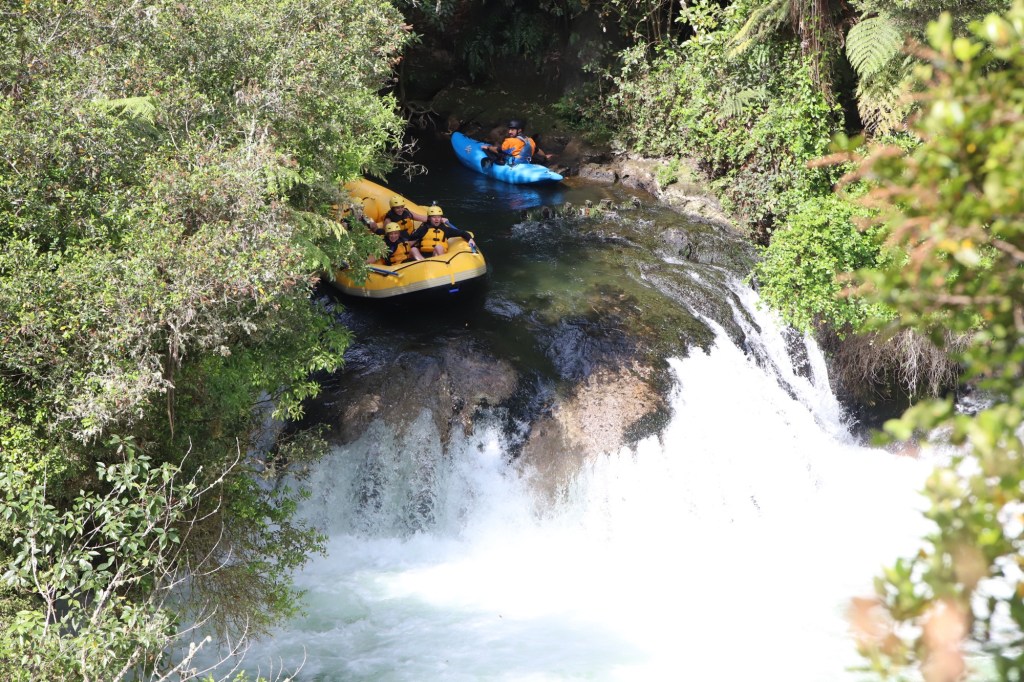
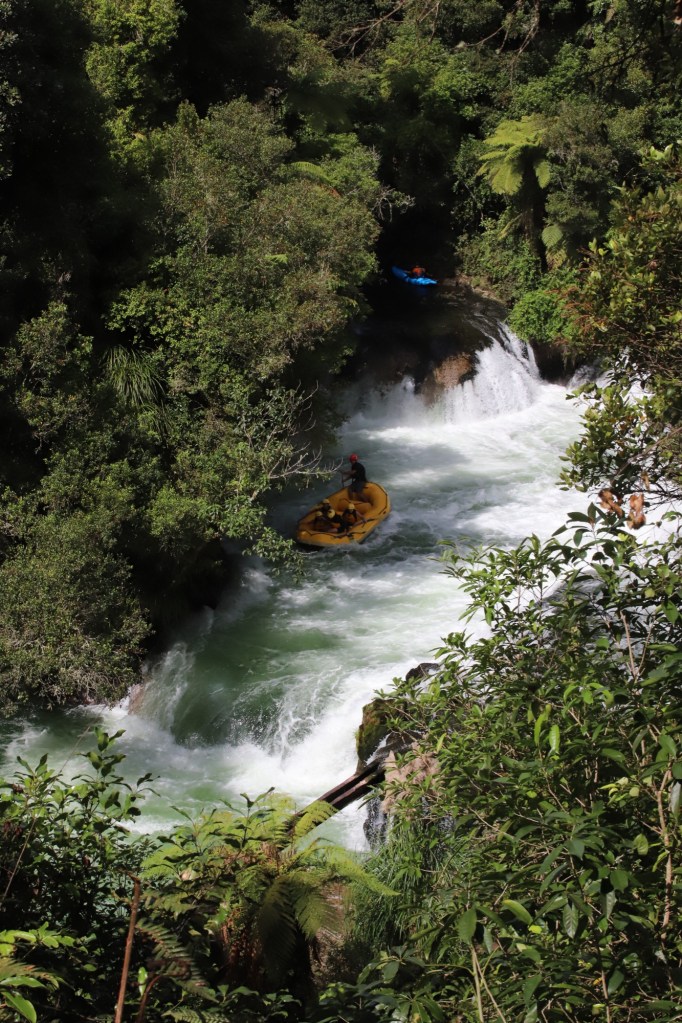
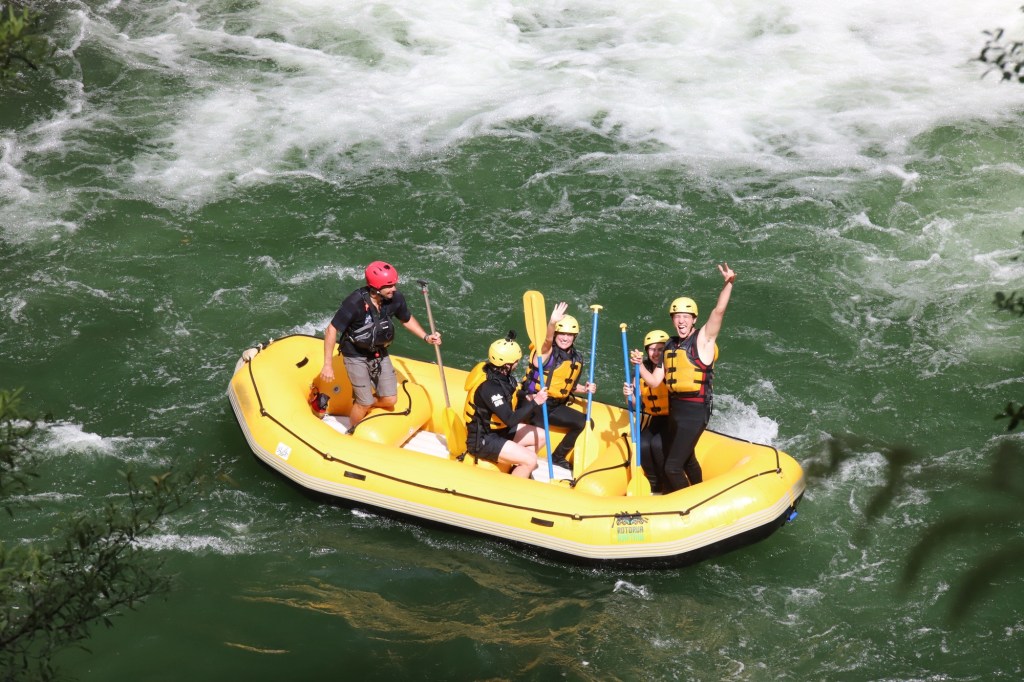
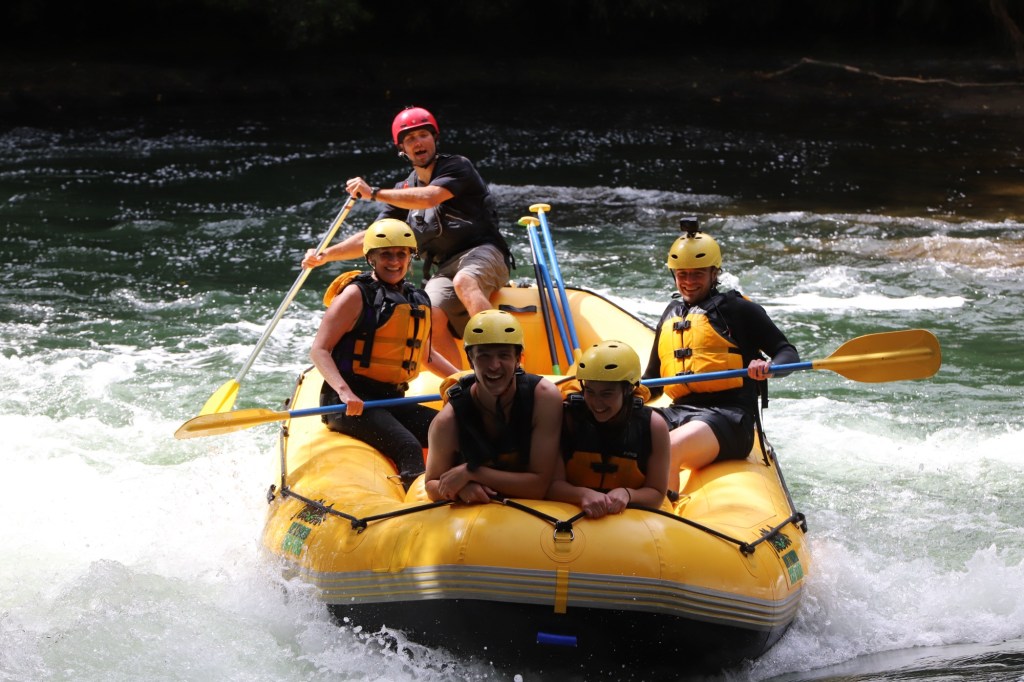
We did the most extreme thing I’ve ever done—white water rafting on the Kaituna River, charging through Class V rapids and a series of waterfalls you actually go over in a raft.
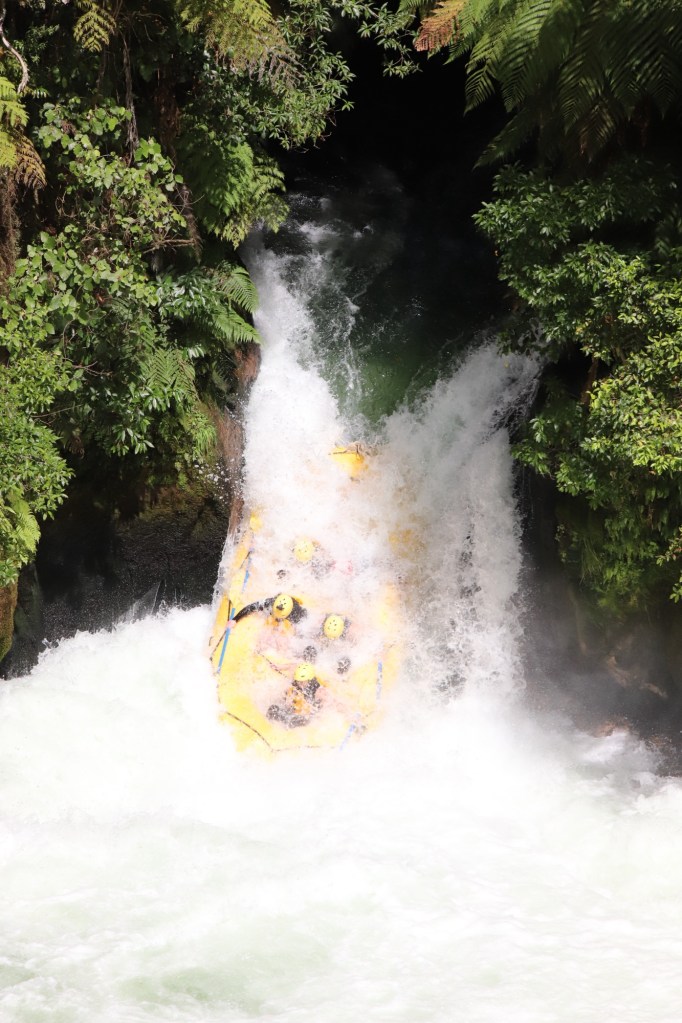
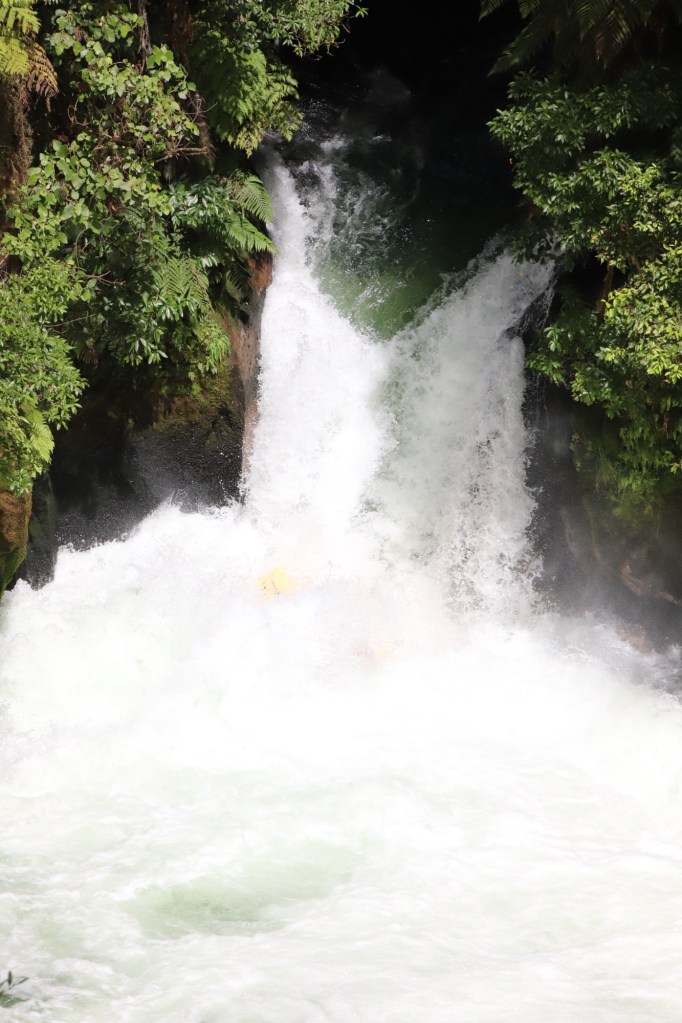
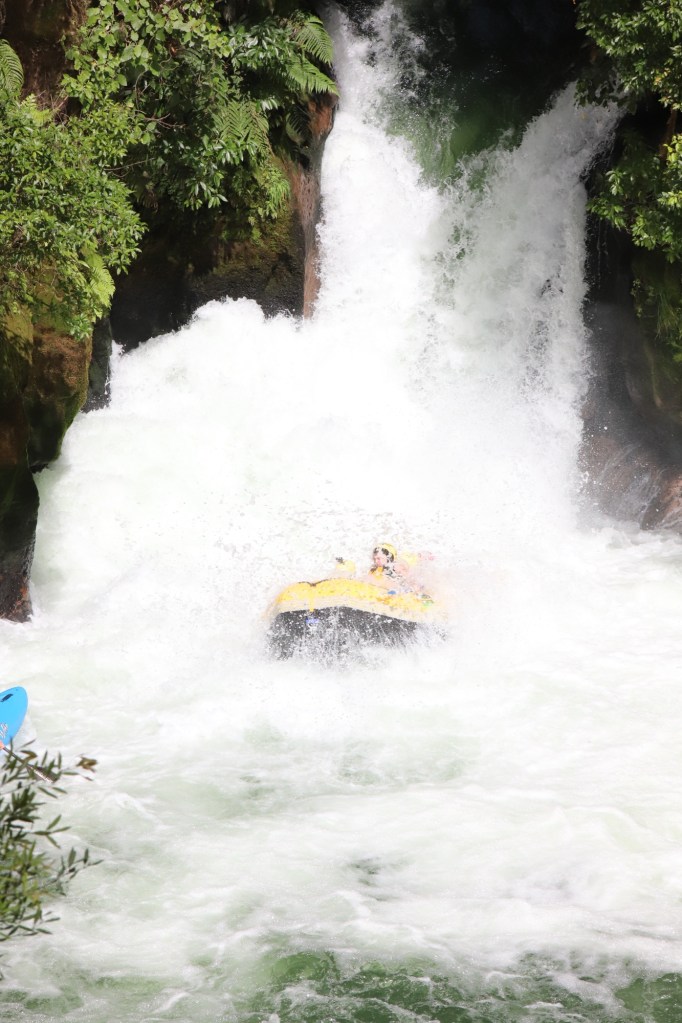
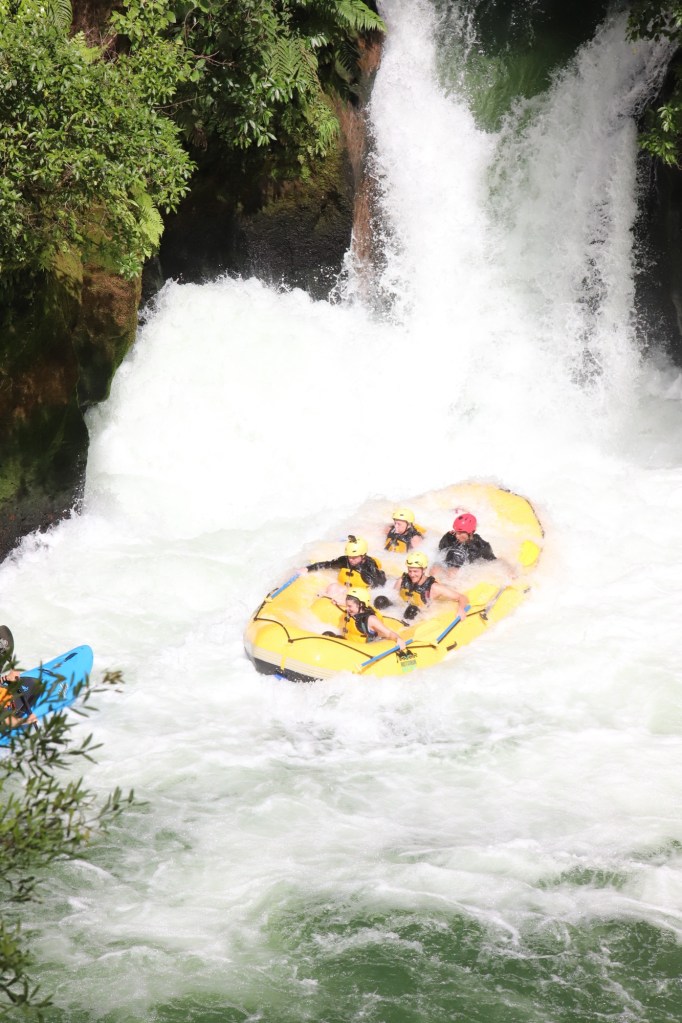
And then came the moment: Tutea Falls.
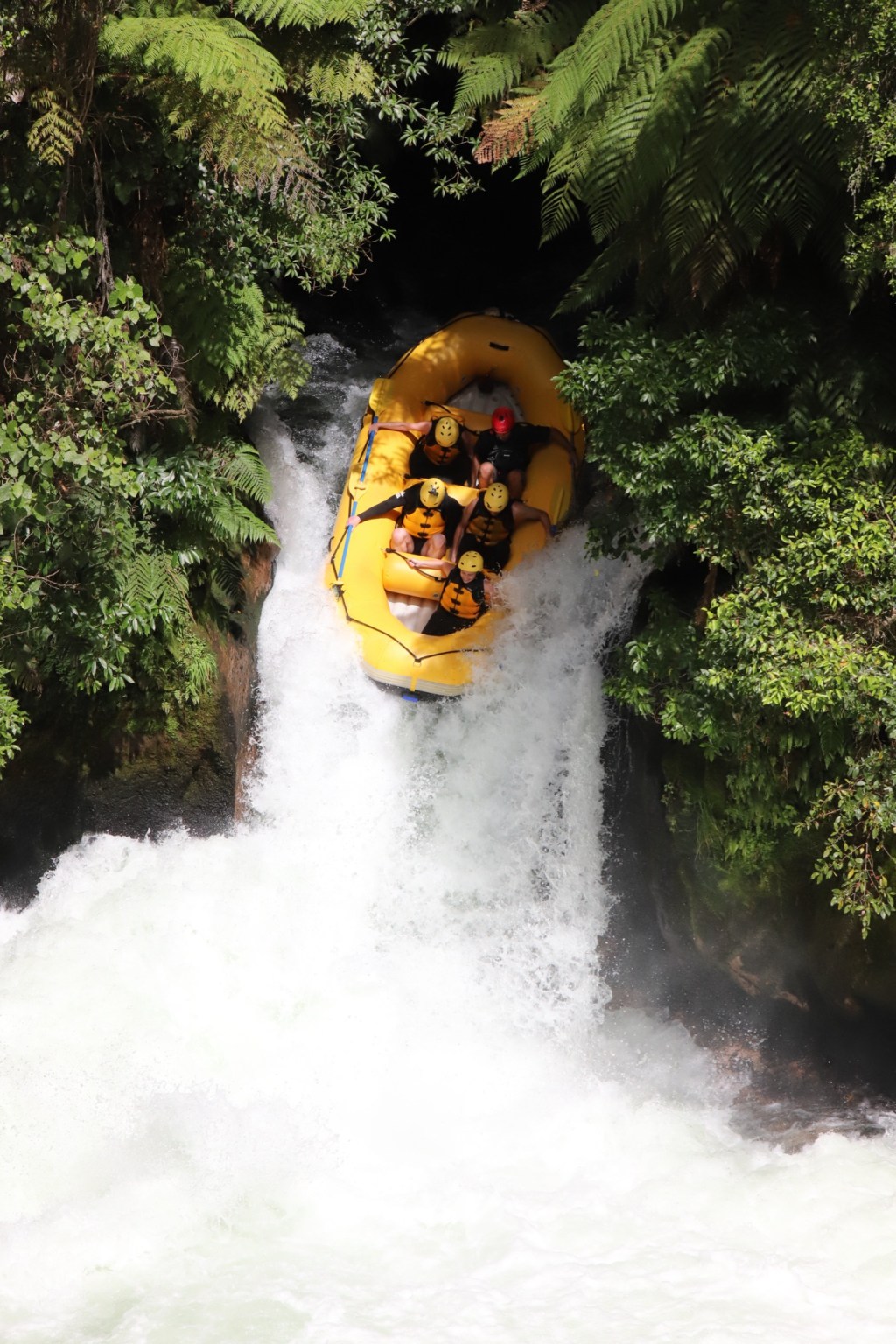
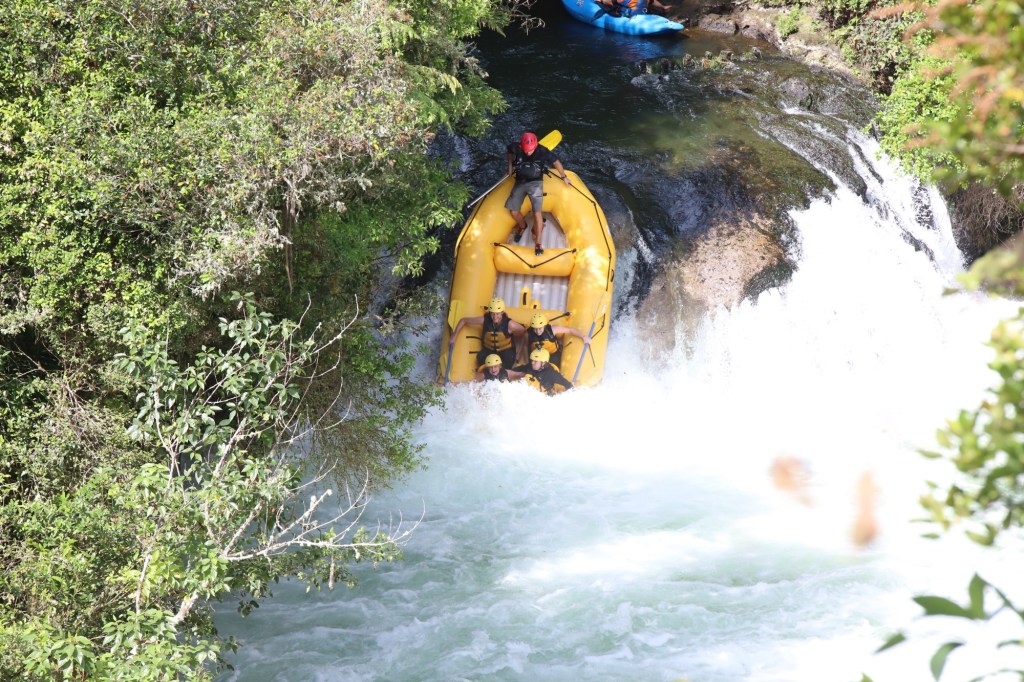
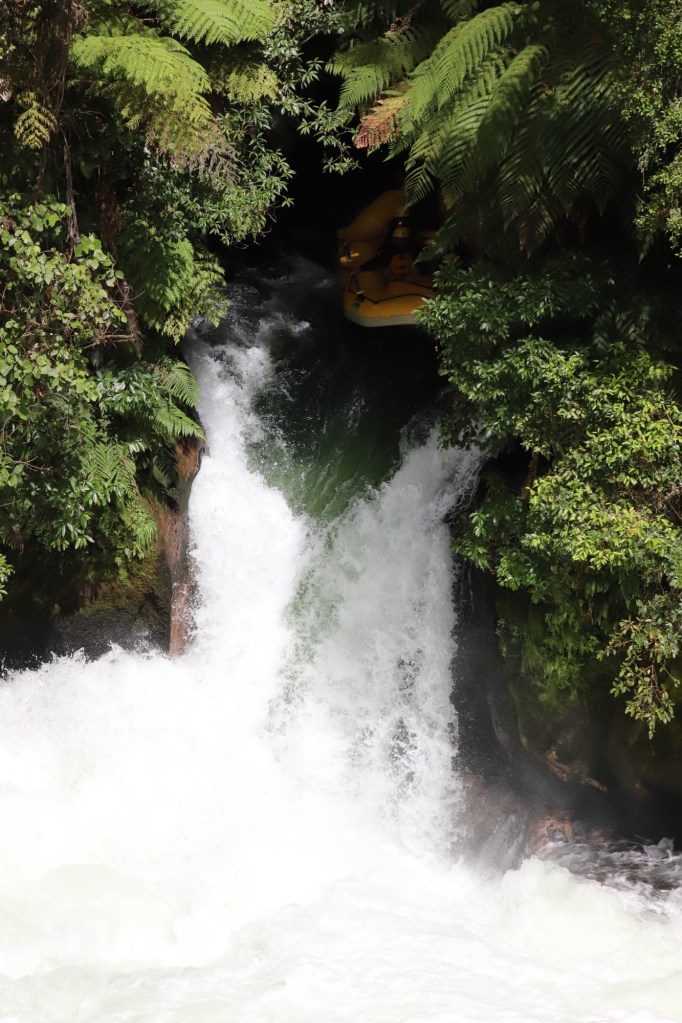
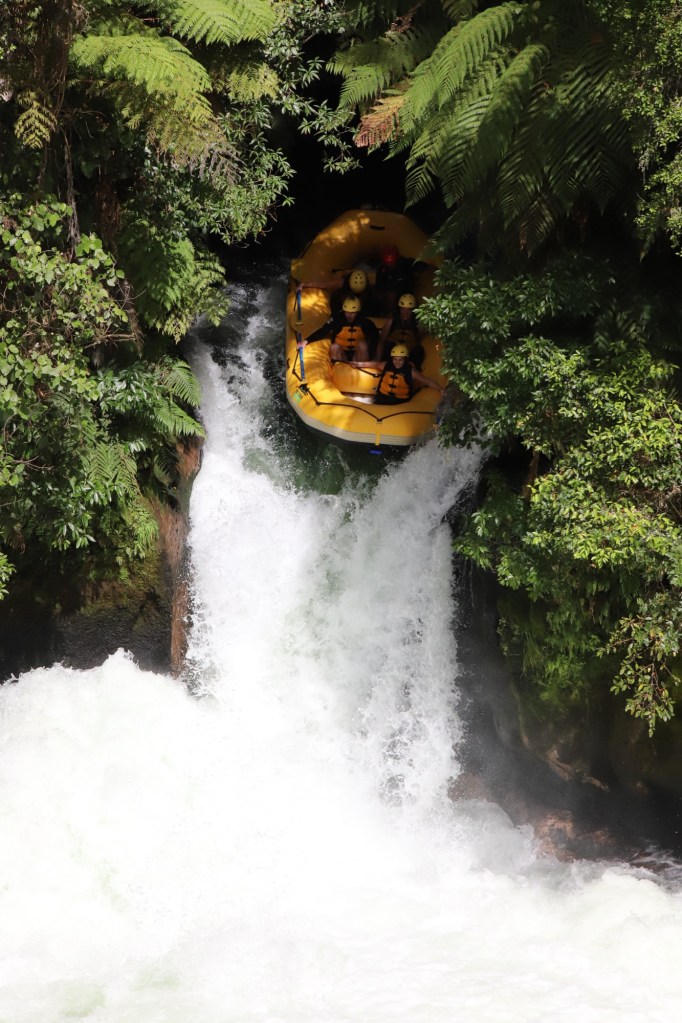
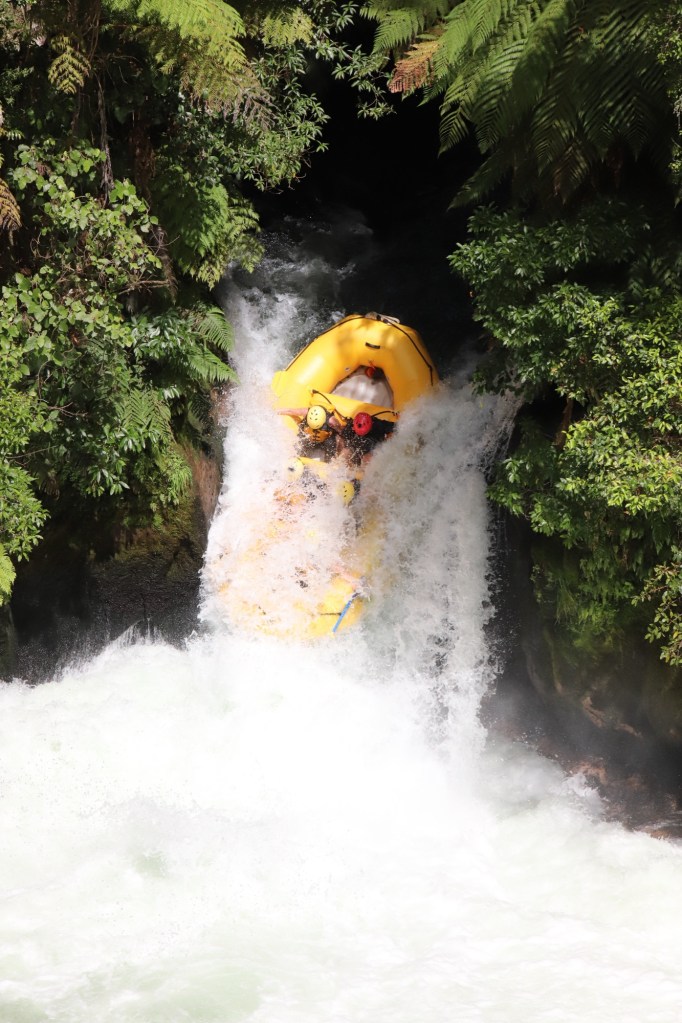
At 23 feet (7 meters), it’s the highest commercially rafted waterfall in the world…and yes, we went straight over the edge.
💥 The Experience
This was an adrenaline rush like no other.
For the first few falls (Maybe they were rapids?), I sat right up front—which meant taking the full force of every drop. Think: a wall of water straight to the face and more than a few unintended gulps of river water.
This was our entrance into the canyon and the first drop. I am front left having my first “oh sh*t” moment!😱About to get my first big gulp of river water. Close your mouth!We survived the first one only to see the second drop!
By the time we approached Tutea Falls, I made a strategic decision and moved to the back of the raft. When we plunged over and fully submerged, I held on for dear life—but this time, I knew enough to hold my breath. Progress. 😅
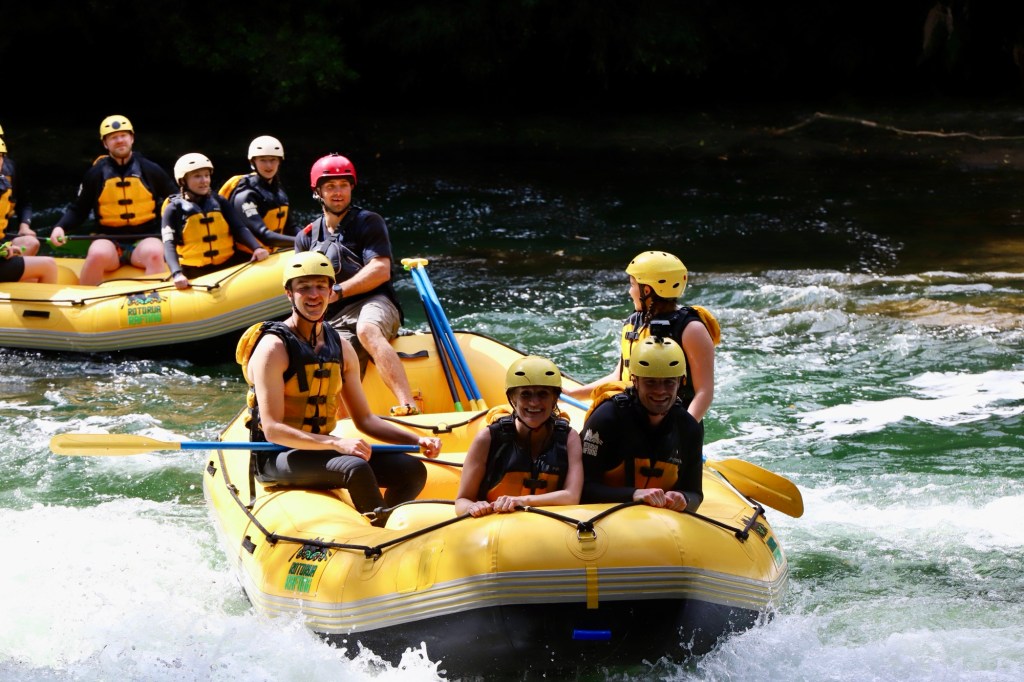
I will take you through a series of photos of us going down the waterfall. My son had on his GoPro and will post when he downloads it. We were a group of 3 rafts. We went first over the falls. The second raft flipped going over and everyone but 1 person fell out—all ok! The 3rd raft repeated our performance.
Approaching Tutea Falls!Tutea Falls – now I am back left, next to our guide in the red helmet, ducking my head as I was told to do, and getting ready for the 23 foot drop!Over we go!Water intake We are somewhere submerged below the fallsAnd here we are!I am pretty sure that is actual water coming out of my nose 👃Loved this arial shot at the base of the fallsCelebration!
🚣 The Crew
We went with Rotorua Rafting (through Viator), and they were fantastic.
• 3 rafts in our group. Brendan and I were with our guide and then two others (one happened to be a former guide).
• Our guide, Jure from Slovenia, was equal parts hilarious and incredibly skilled
• You could tell instantly we were in good hands, especially after the prayer for good luck before we headed over Tutea Falls.😂
👉 If you want a preview of just how wild this is, their Instagram says it all.
All smiles at the end!😅
🌿 Not Just Adrenaline
What surprised me most? The setting.
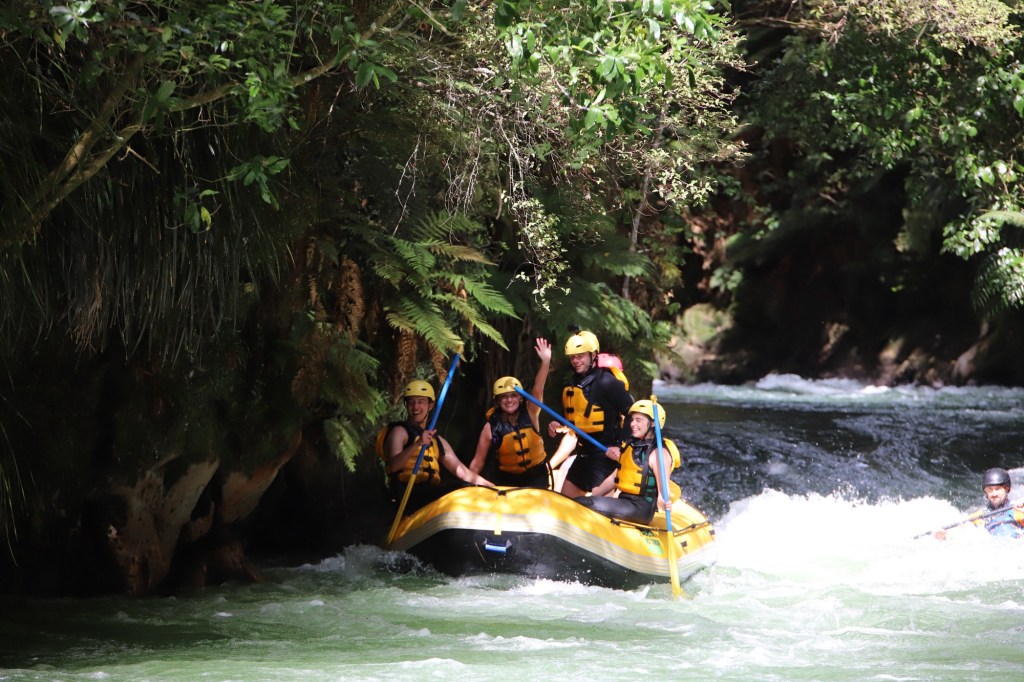
You’re not just battling rapids—you’re floating through what feels like a lush, jungle-like canyon with the rush of the water. It’s equal parts chaos and beauty.
At one point, we even got to jump out of the raft and swim down a smaller waterfall/rapids, which somehow felt both insane and completely unforgettable.
The surrounding landscape was breathtaking!
🤔 Would I Do It Again?
Heck yes.
Would I recommend it? That depends on your comfort level, but if you’re even considering it, take the leap—literally. This is the kind of experience that sticks with you… the kind I will be talking about for years to anyone who will listen.
TE PA TU – a living Māori cultural experience🥢
We slowed down the pace and went to Te Pā Tū this evening and the 4 hours was everything I expected plus more.
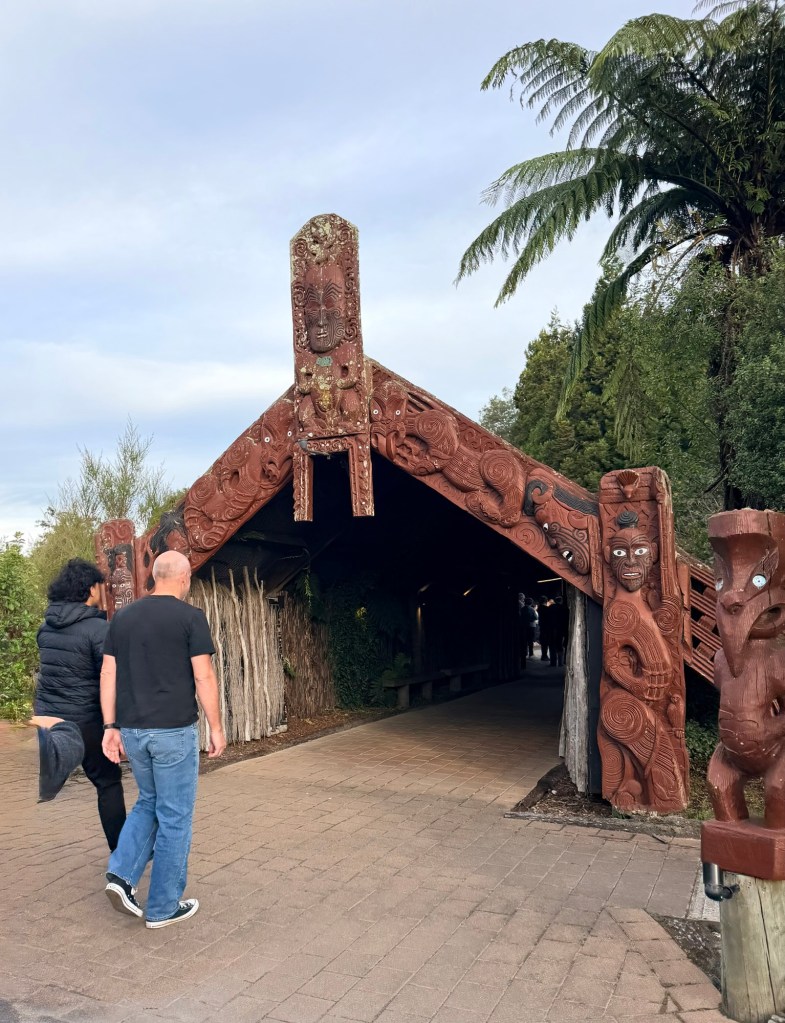
Te Pa Tu entrance
The acceptance and welcoming of the visitors. We picked a “chief” to represent the visitors. That chief then performed the hongi, which is a Māori greeting where you shake hands and then touch your foreheads and noses two times. This symbolizes the exchange of ha (breath of life) and the merging of the souls. It also meant we were then welcomed to enter the village.
Our time at Te Pā Tū is brought to life by the Tamaki family, who are storytellers, performers, and guardians of the Māori culture and traditions. The performers are all related (many cousins).
After the welcoming, it’s not just a show you sit and watch. You’re pulled into it pretty quickly, moving through different parts of the experience while the family shares Māori stories, traditions, games, and history in a meaningful way. We tried our hand at the Māori poi balls, which are weighted tethered balls that are used in performance and help hand-eye coordination.
The performers did the poi in a way that made it look easy. We know it wasn’t easy because we smacked ourselves in the head a few times. 
We also learned about the traditional Māori stick games like Titi Torea, where players throw short sticks to each other or ti rakau (long sticks) where you pass the sticks left and right. Both help with rhythmic coordination and focus.
Titi torea — the game is performed with wooden sticks known as tītī. We played the game where we moved right and left while catching the stick.
The performance ended with the Haka, an up close experience that is intense and way more powerful than anything you see on video.
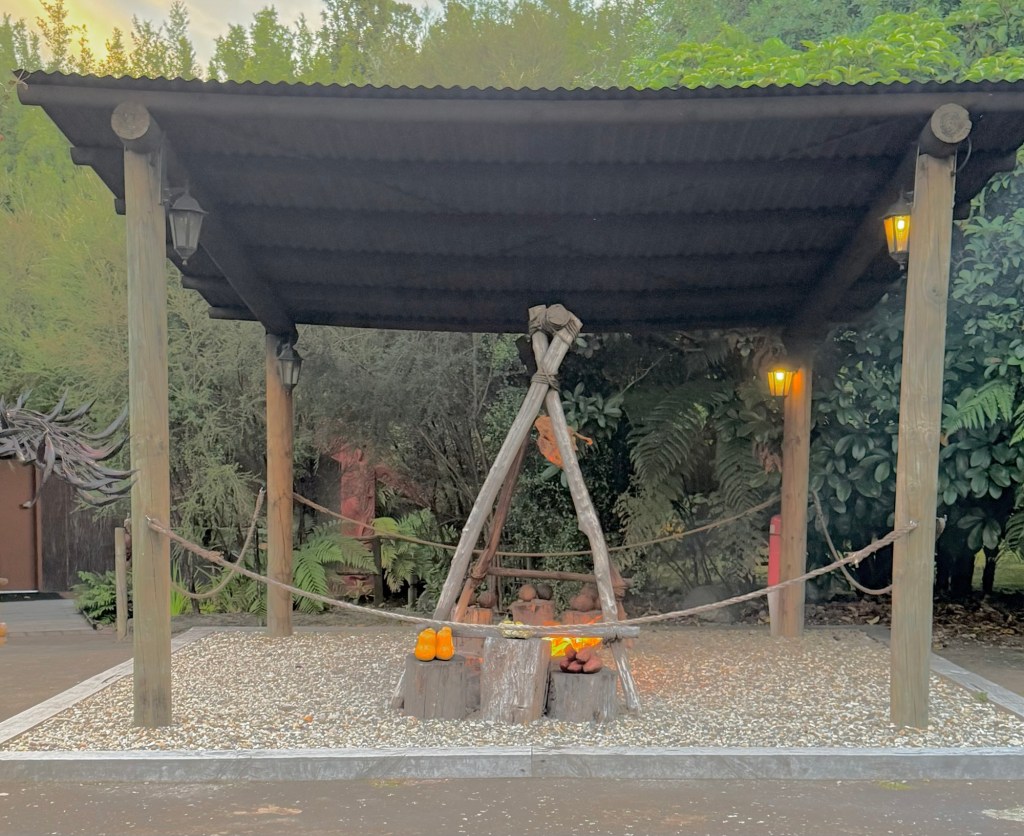
And the food… yum! The hāngī alone is worth it. Btw, hāngī is a traditional New Zealand Māori method of cooking food using heated rocks buried in a pit oven.
I left feeling like I learned so much about the Māori culture and left with a greater appreciation of just how special it is. ❤️
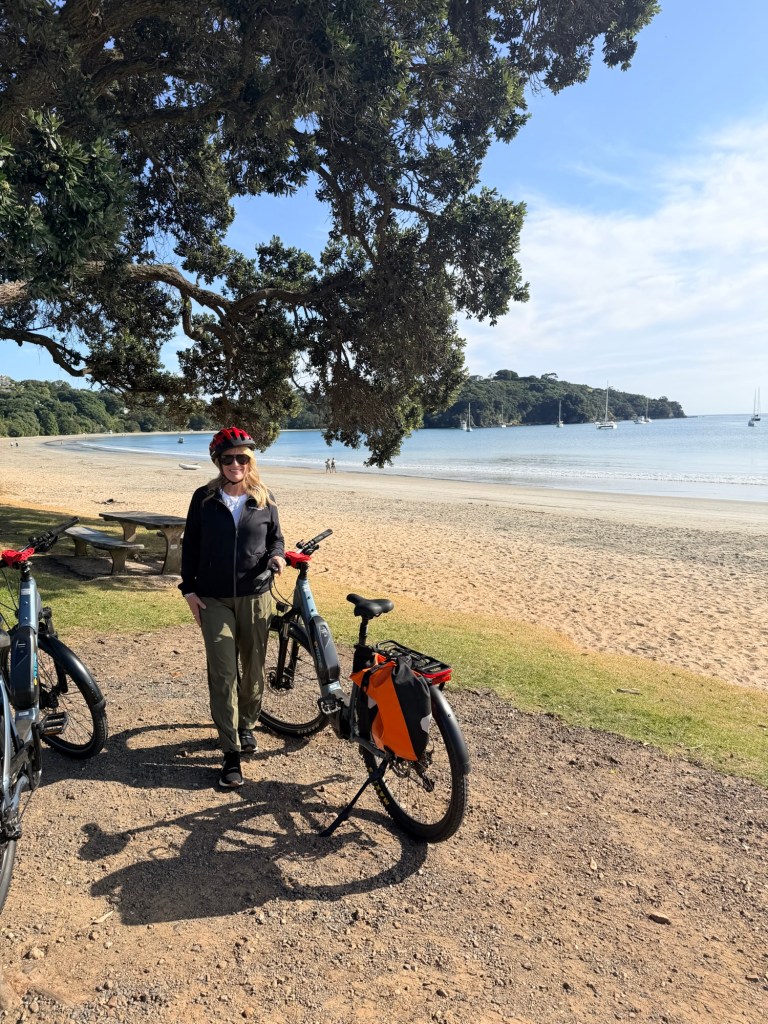
Today’s mission was simple—1. Have fun exploring Waiheke Island and; 2. Don’t die on the e-bike.
We picked up the bikes from the shop in the ferry terminal. This was my first time riding an e-bike.
Obviously, I didn’t die since I’m writing this. But did I have fun? Read on.😊
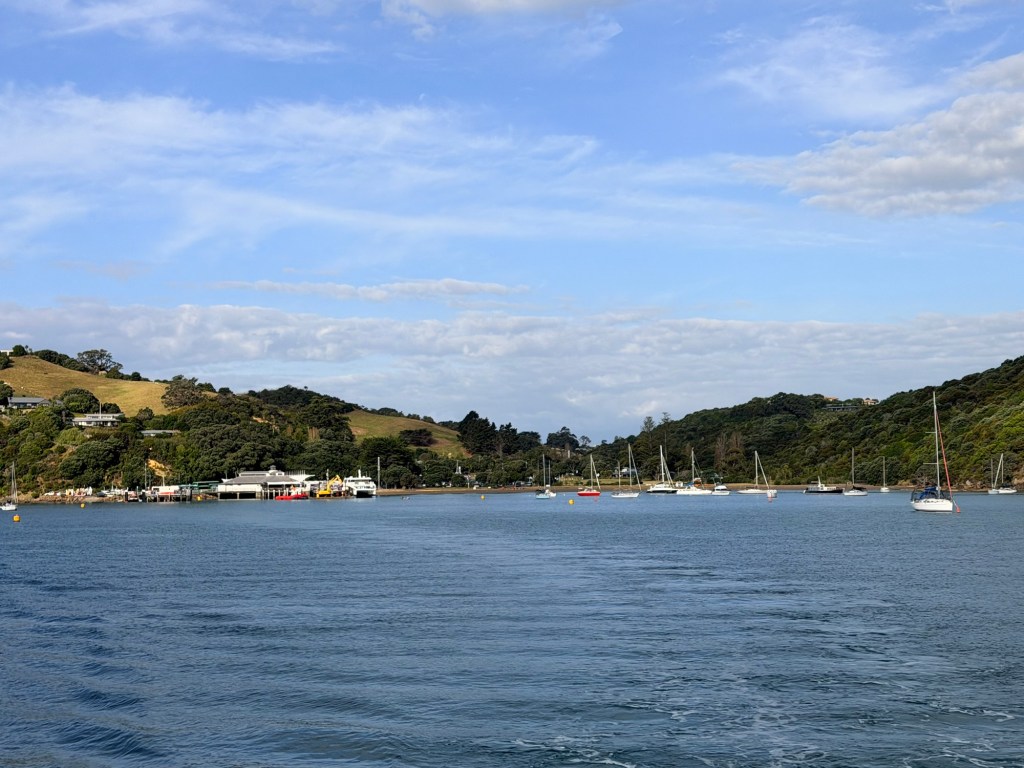
Located in the Hauraki Gulf, Waiheke Island spans about 36 square miles and is known for its rolling hills, vineyards, olive groves, and sandy beaches. Just 11 miles from downtown Auckland, it feels like a world away.
A gorgeous sunny day in Waiheke🍷
Brendan and I hopped on the morning ferry, about a 40-minute ride from Auckland, and arrived just before 10:00 am. We grabbed our reserved e-bikes and set off on our island adventure.
And what an adventure it was.
We rode from 10:00 am until 5:00 pm, winding our way across what felt like the entire island. We passed through vineyards, cruised along coastal roads, and stopped at some of the most beautiful beaches. Oneroa Beach and Onetangi Beach were instant favorites with their wide, peaceful, and impossibly blue water.
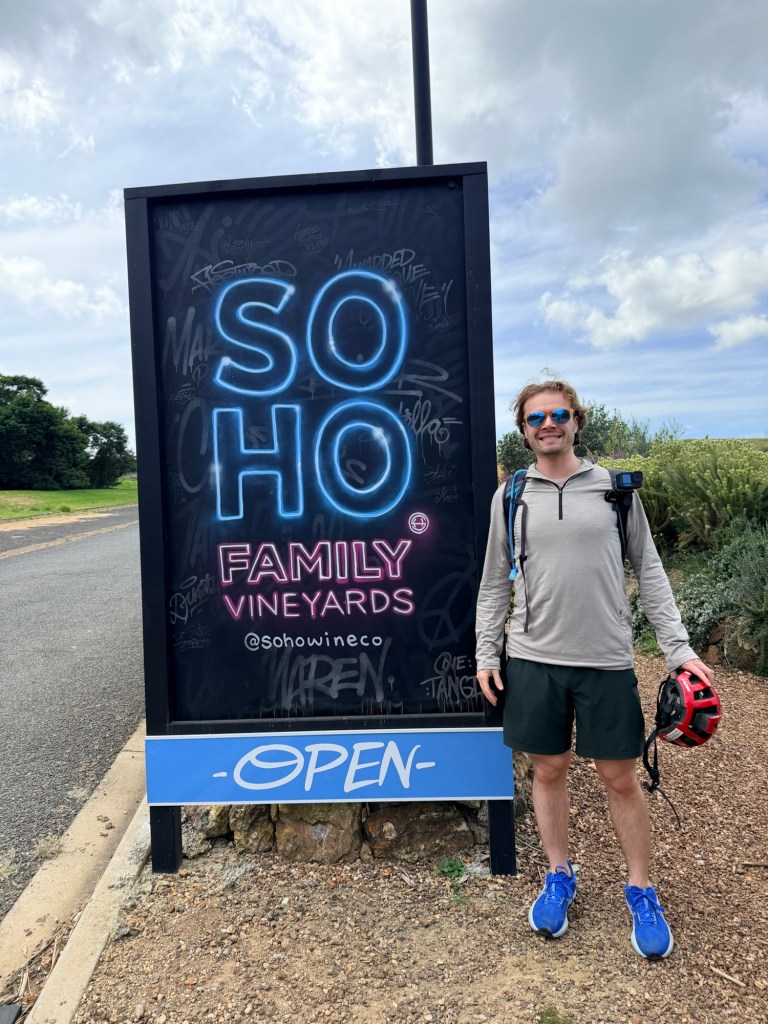
Lunch was at Charley Farley’s (Onetangi Bay), with the beach as our backdrop (hard to beat that view), followed by a stop at Soho Family Vineyards. From there, we pedaled our way past even more vineyards, each one picturesque and unique.
A “newer” boutique vineyard with a welcoming vibe that combines amazing wine with a stylish and social experience!
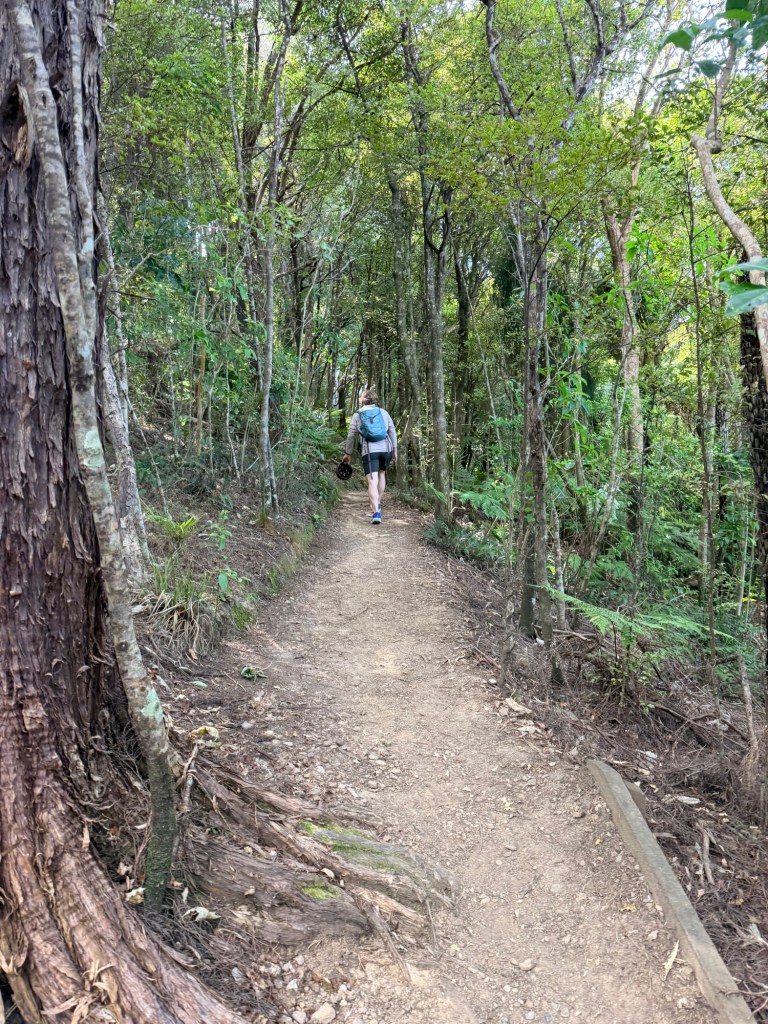
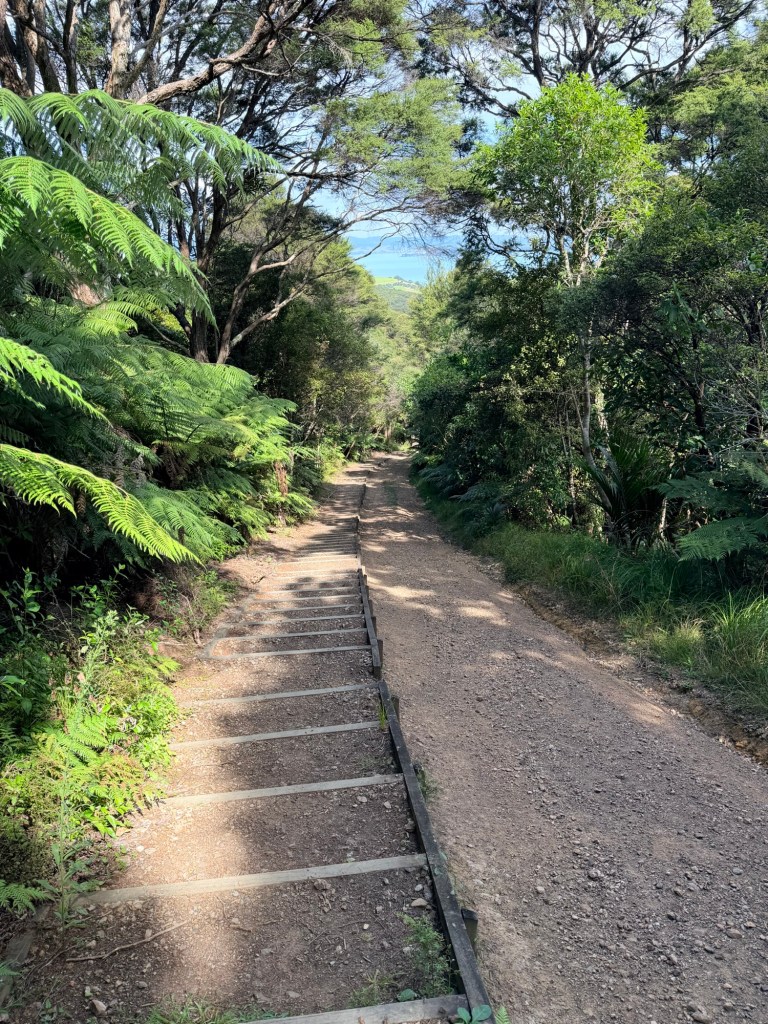
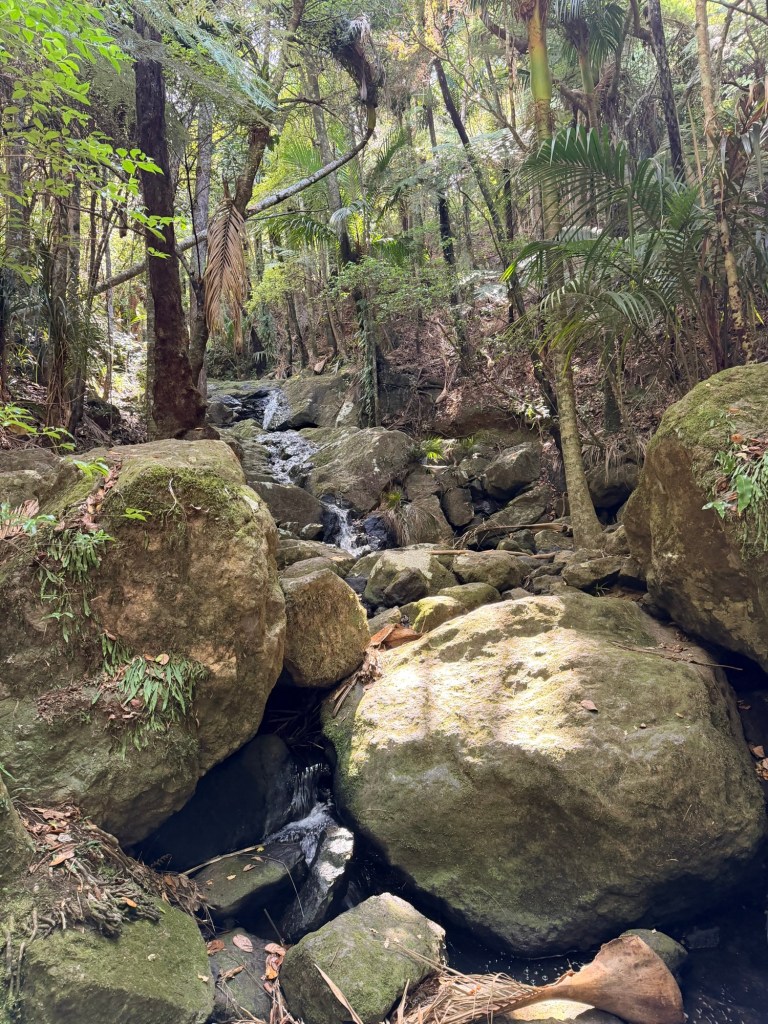
Plus we pulled over for a quick (but difficult as it went straight down, and then you had to climb back up!) hike to a little water fall.
Our short hike – it felt like we werewalking through a rain forest!What goes down, must come back up! Quick but steep hike to see the falls.The Cascades — Not a lot of water right now.
A quick note for anyone thinking of doing the e-bike: Do it! But, be aware that not all of the biking is on dedicated paths. A good portion is on roads, which means riding on the left side—something that definitely keeps you on your toes. And those hills? They are no joke. I genuinely don’t know how anyone does this without an e-bike assist.
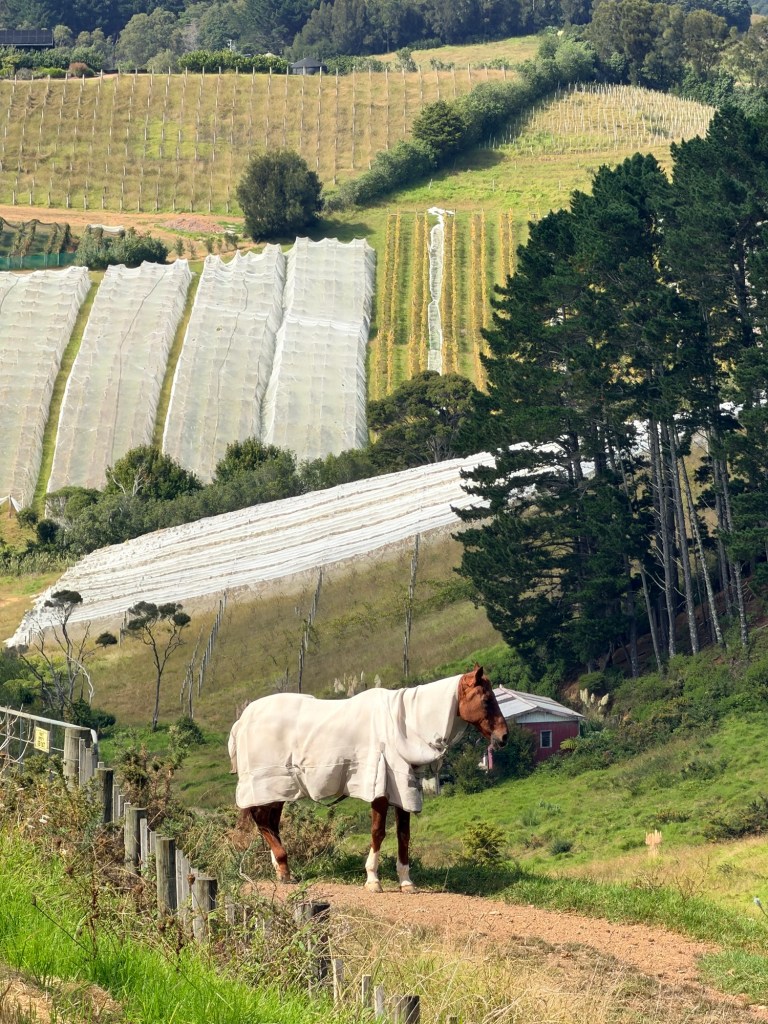
A horse, of course, plus rolling vineyards in the background.
We wrapped up the day the best way possible—with gelato in hand and a ferry ride back, sun-kissed, a little tired, and very proud to have survived the ride.
Welcome to New Zealand, Aotearoa in Māori, meaning the long white cloud
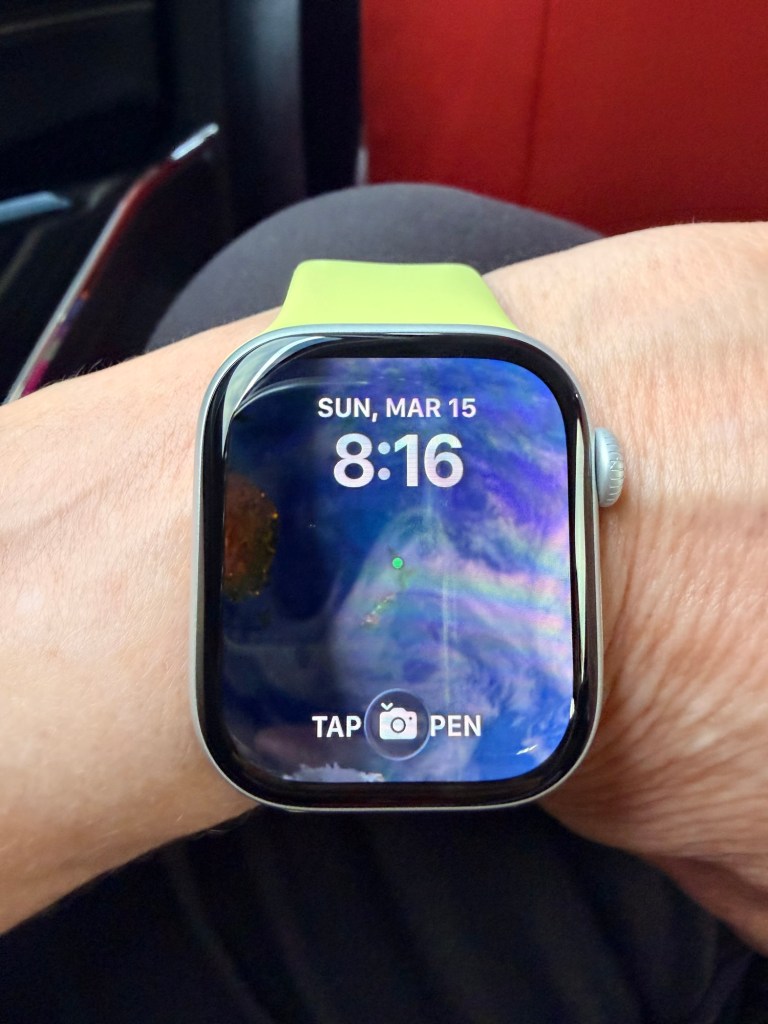
My apple watch was the first to grasp the reality – there’s something surreal about landing somewhere new at sunrise, especially when it’s on the other side of the world.
Yesterday was our first full day in Auckland, and from the moment we stepped off the plane, it was the start of a Christina and Brendan’s grand adventure. 🌎
We landed at sunrise, equal parts excited and exhausted after the long travel day. Since our room wasn’t ready yet, we dropped our bags at M Social Auckland and decided to start exploring.
And explore we did.
And we’re off to explore!
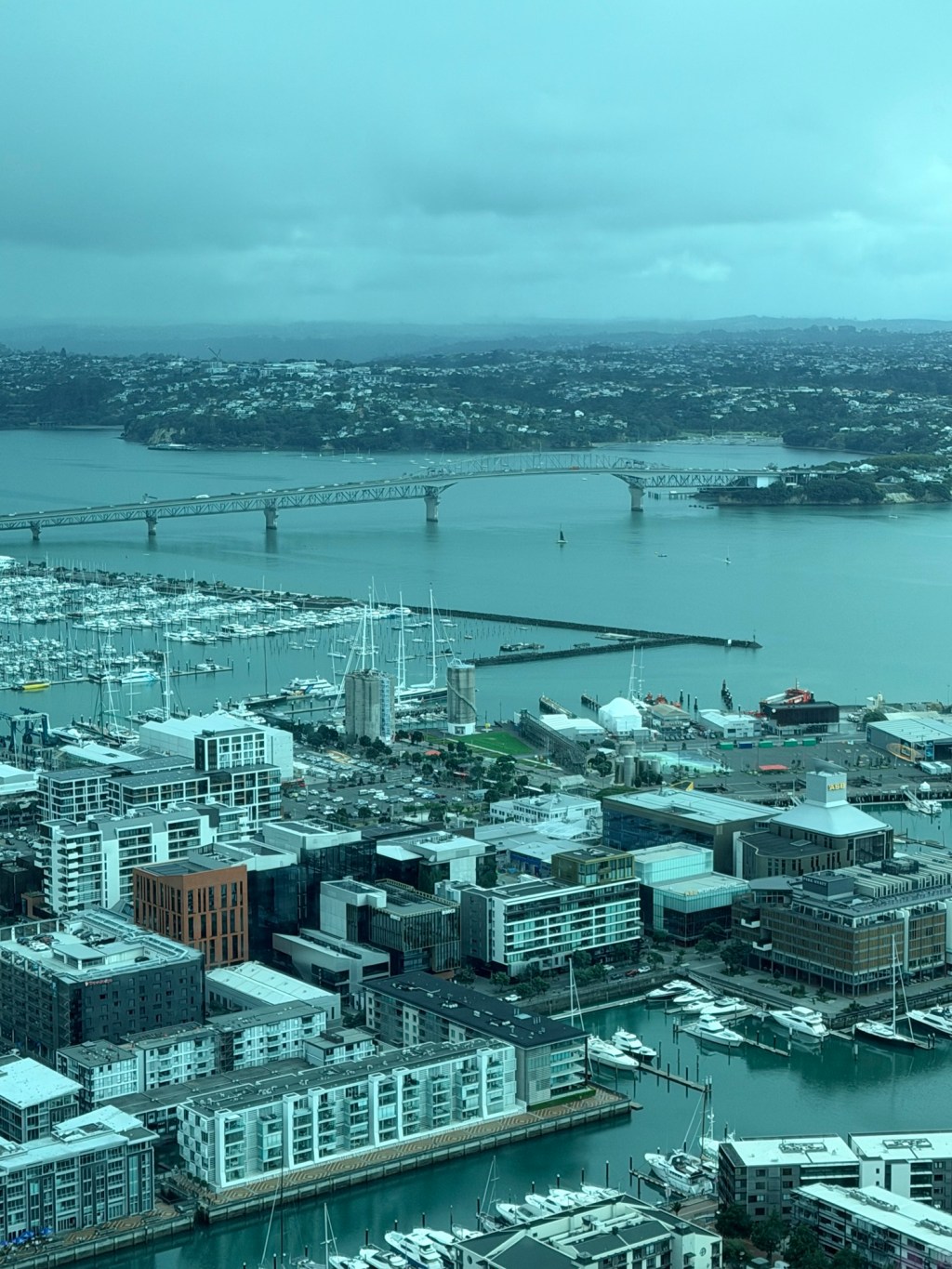
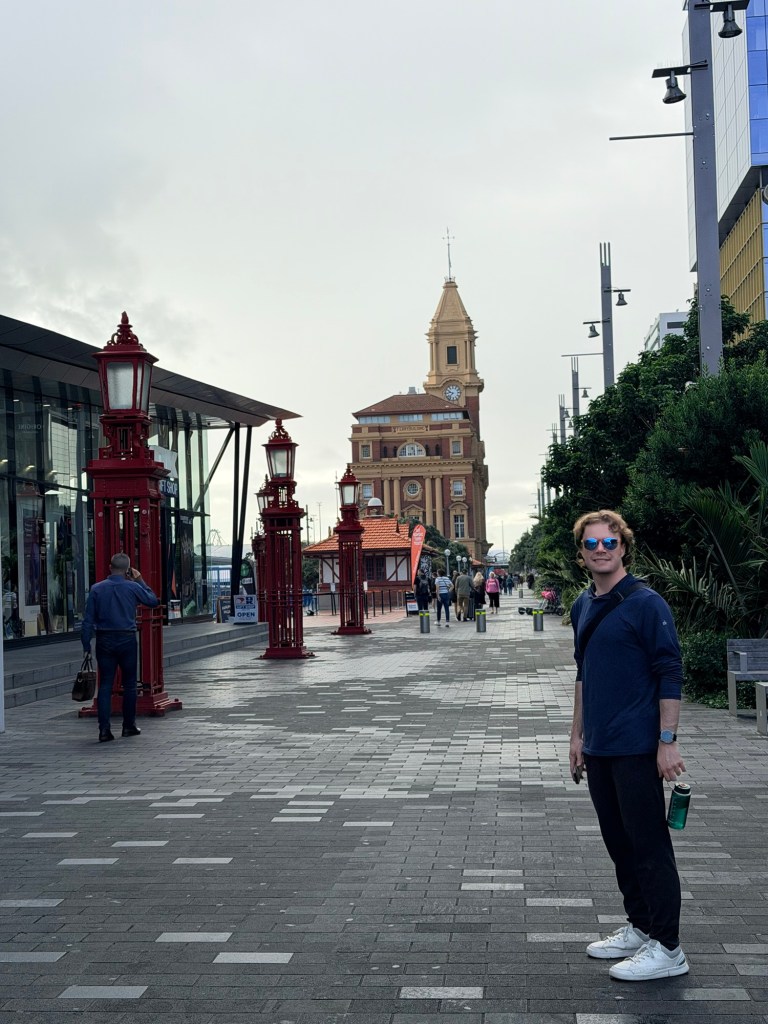
First view of the city – Auckland CBD (Central Business District)
One of the things I already love about Auckland is how connected it is to the water. We walked to the Auckland Ferry Terminal and bought our ferry tickets to Waiheke Island (Wednesday’s adventure).
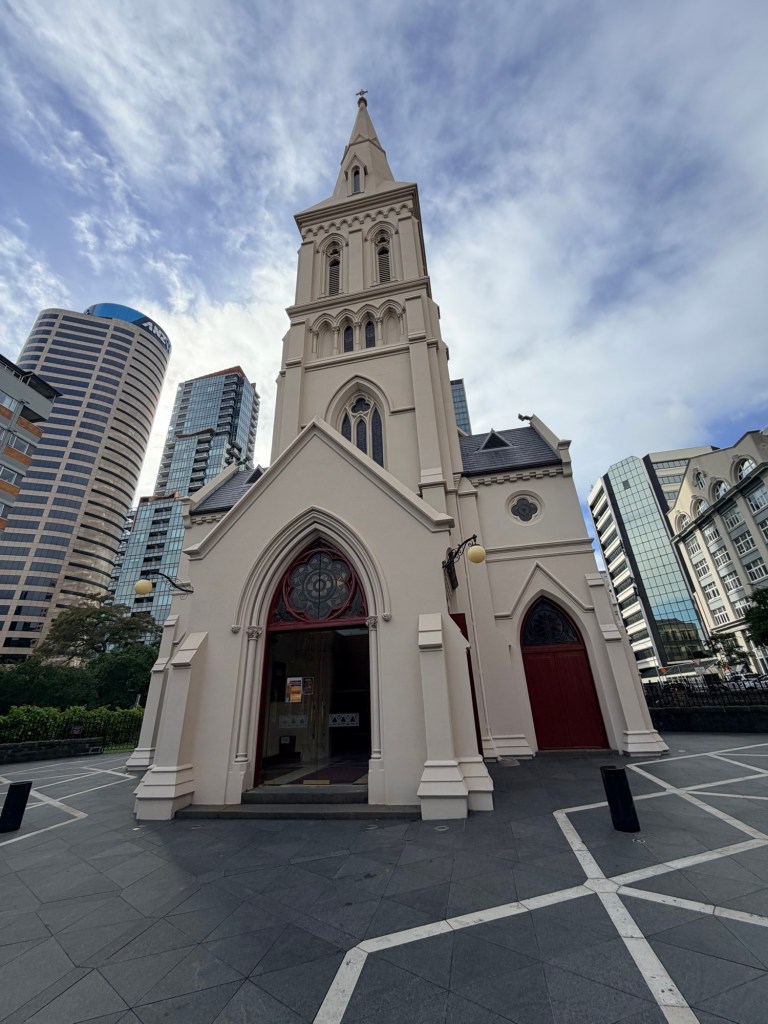
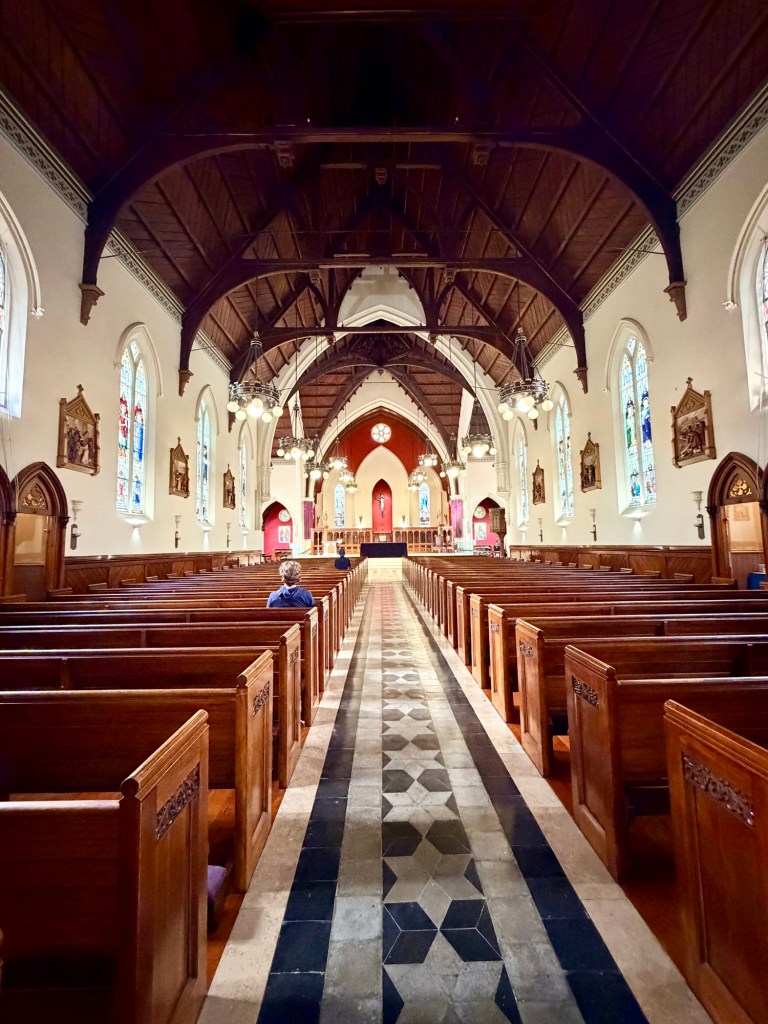
Then we stopped by St. Patrick’s Cathedral, established in 1842 and the seat of the bishop of Auckland.
Flat white first, of course.
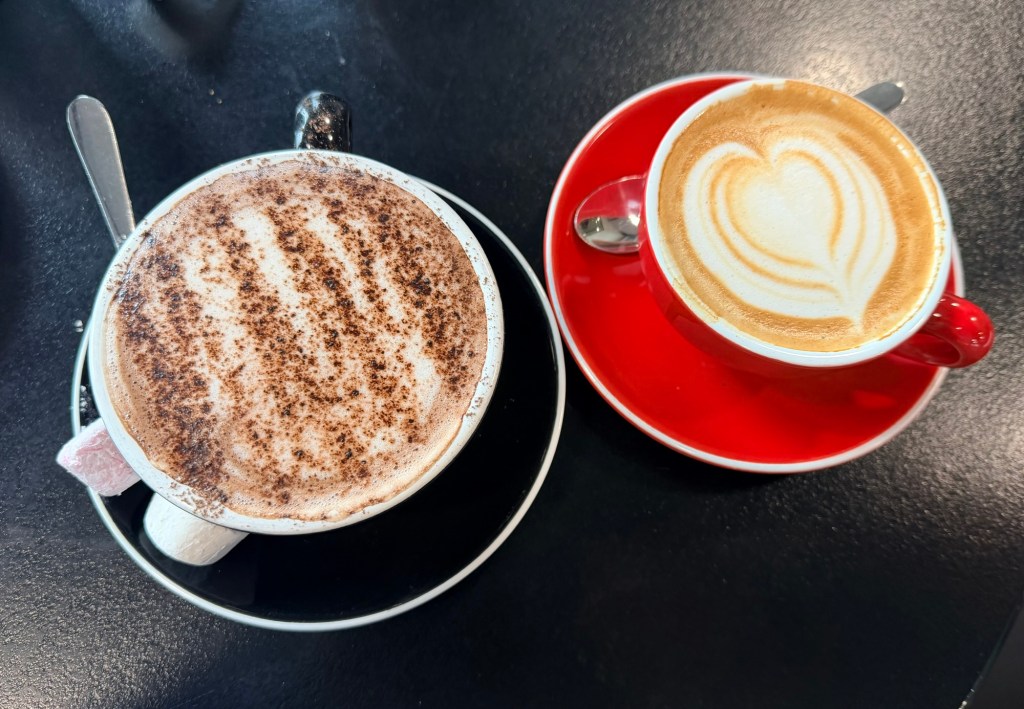
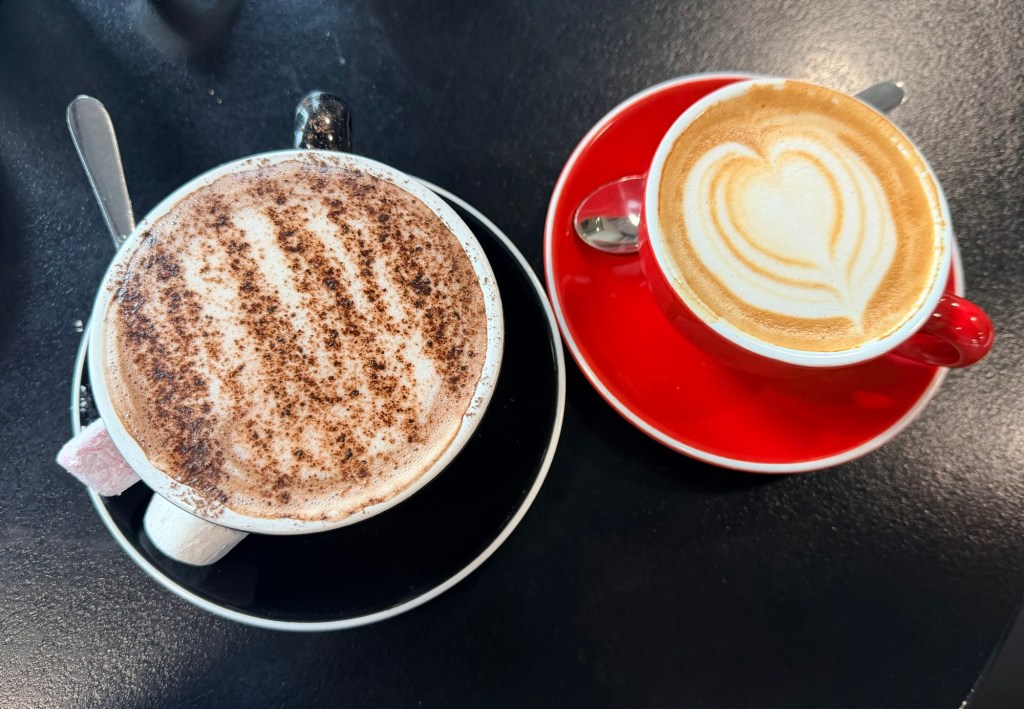
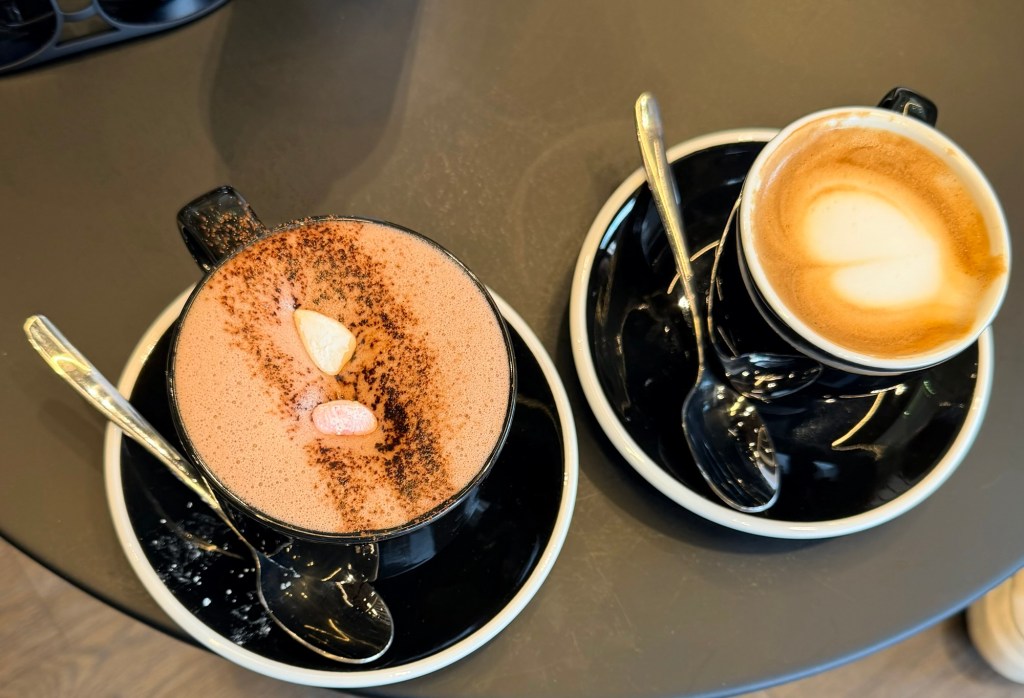
Hot chocolate with marshmallows on the left for me and flat right in the right for Brendan. A flat white is espresso-based coffee with steamed milk.
At a local café we ordered a flat white for Brendan (New Zealanders have this perfected) and a hot chocolate with marshmallows for me. People watching over a warm cup was the perfect way to energize our tired bodies into the day.
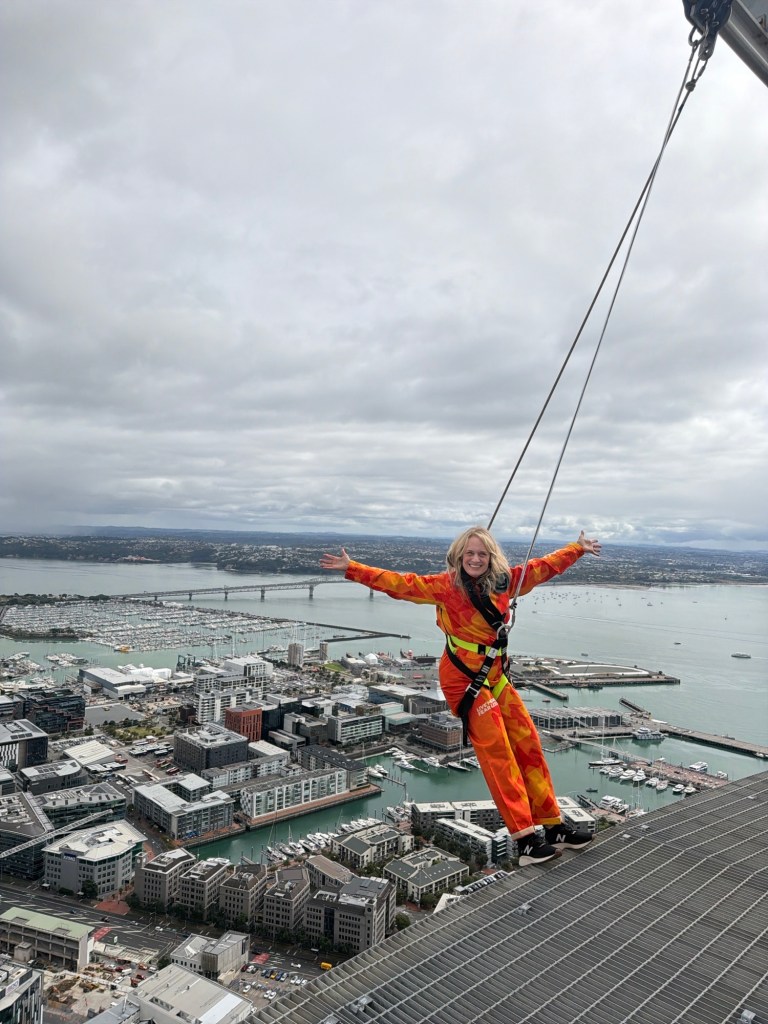
Leaning Over Auckland
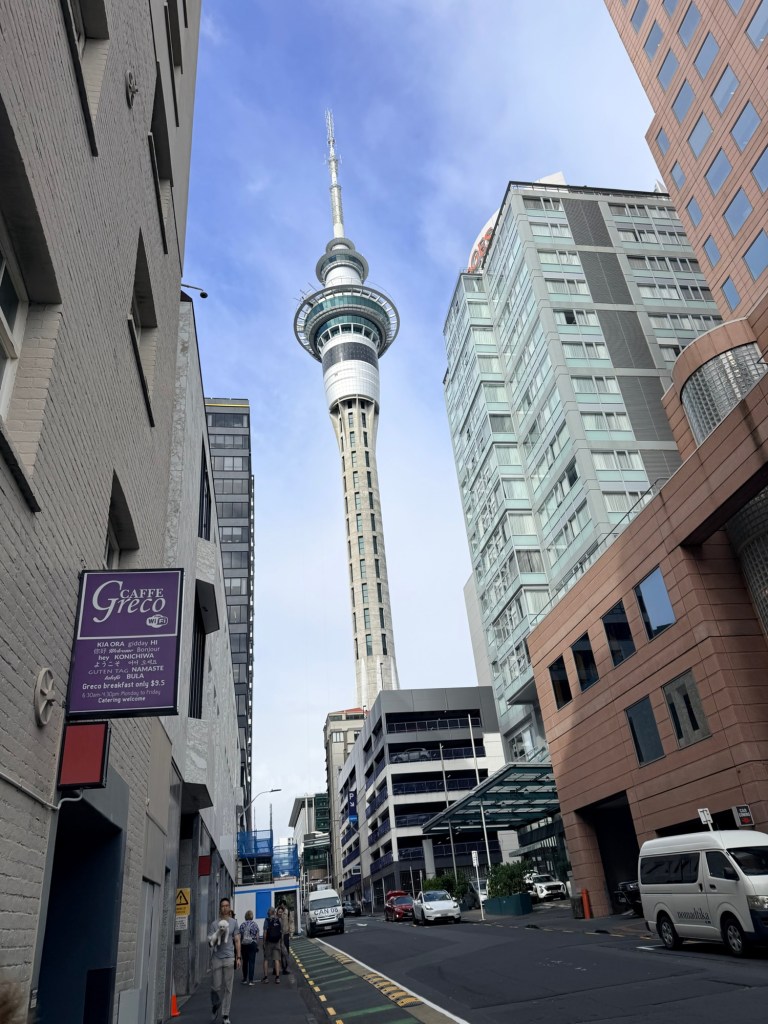
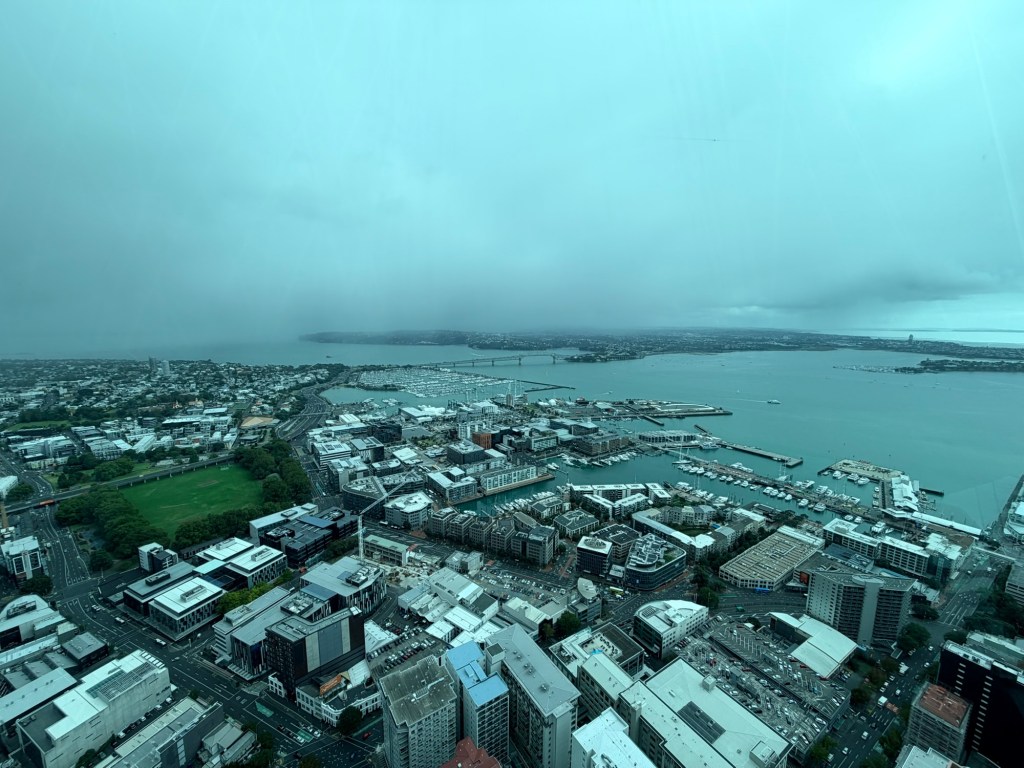
The Sky Tower stands 328 meters (1,076 feet) and is used for telecommunications and observation with panoramic views of the city, its harbors, and the volcanoes.
No visit to the city would be complete without a trip up the iconic Sky Tower. It’s one of the focal points of the city —ever lost? Look up and find the tower!
(In the background) The Auckland Harbour Bridge was constructed in 1959, has 8 lanes, and is 1,020 meters long. The bridge connects Auckland’s city center with the North Shore. And, if you want, you can plunge 40 meters (~131 feet) by bungee jumping!
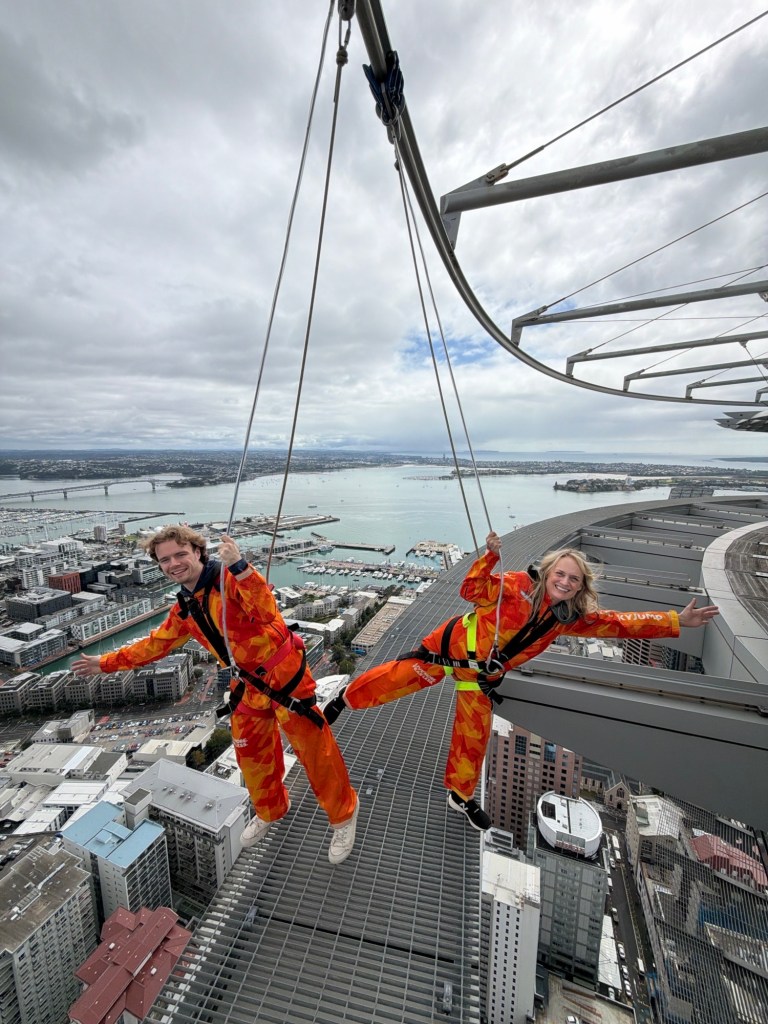
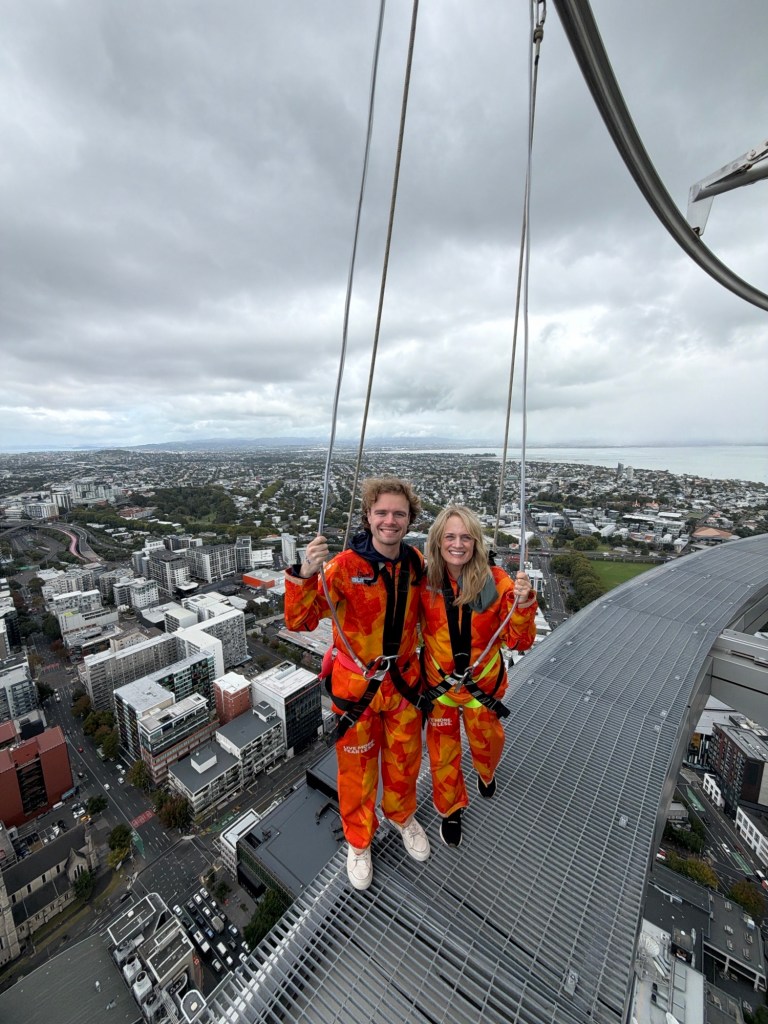
But we didn’t just go up to admire the view from the two observations decks…We did the SkyWalk and I have a free t-shirt and a lot of photos to prove it.
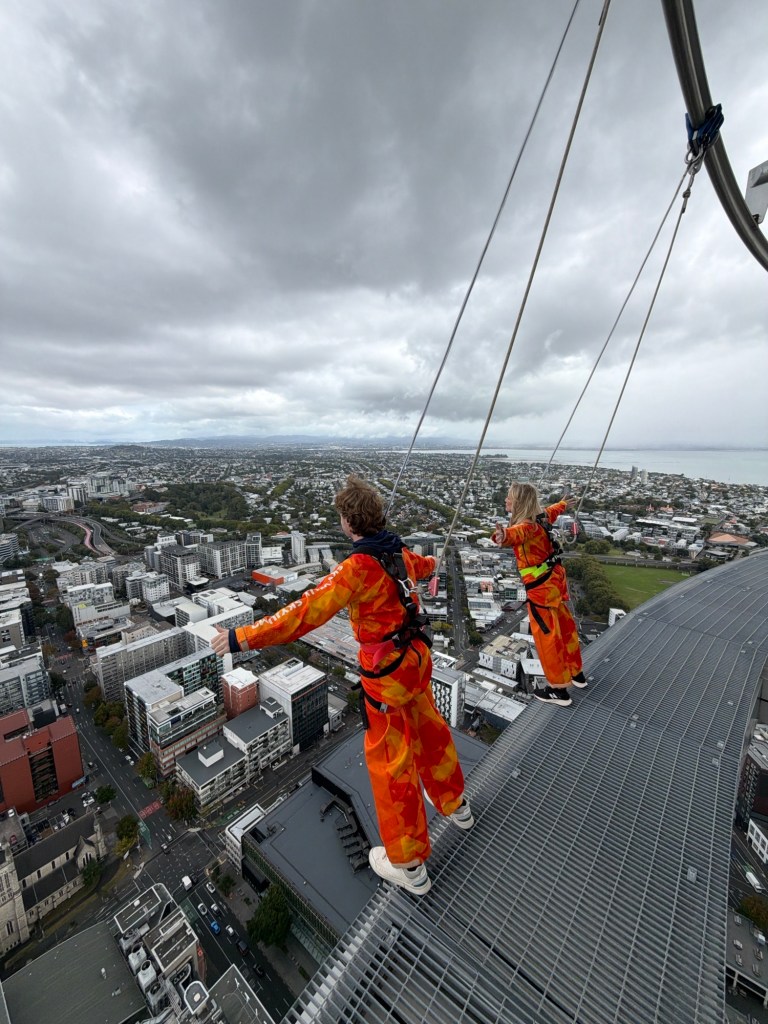
Picture this: A narrow platform circling the outside of the tower more than 1,000 feet above the city. No rails. Just a harness (two, actually), a lot of sky, and a big drop below.😳
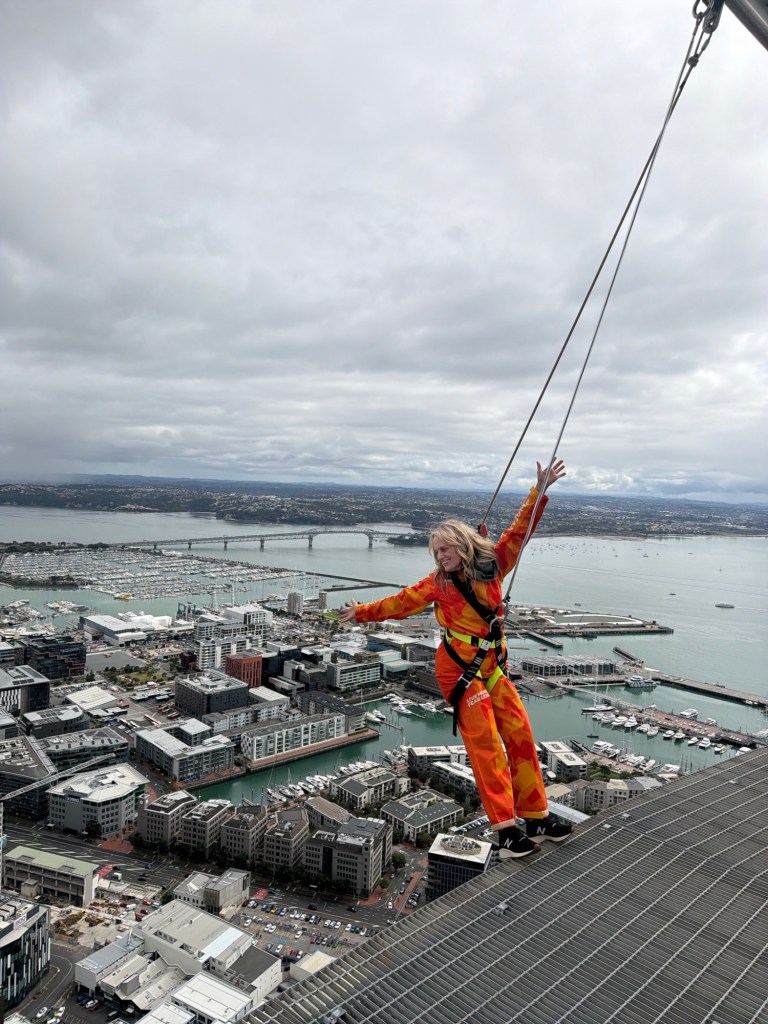
And while some people carefully shuffle along, we… leaned and did the challenges our guide gave us. Like hanging out over the ledge, walking backwards, and looking down.
Leaning out over the edge with Auckland stretching in every direction is one of those moments where you realize travel isn’t just about seeing places—it’s about experiencing them fully. Even when fully is out of your comfort zone.
And yes, my heart was definitely racing in the beginning but by the end, we were having fun with every challenge! (Note – safety is first and we felt so safe/secure the entire time with our knowledgeable guide, Logan.)
You can also bungee jump to off if you prefer! Remember that commercial bungee jumping was invented in New Zealand.
We headed off to a quick lunch of tapas at Depot Eatery. I had one of the best salads here and Brendan had delicious snapper sliders. For those seafood / fish fans, Auckland has you covered.
Stepping Into Rugby History
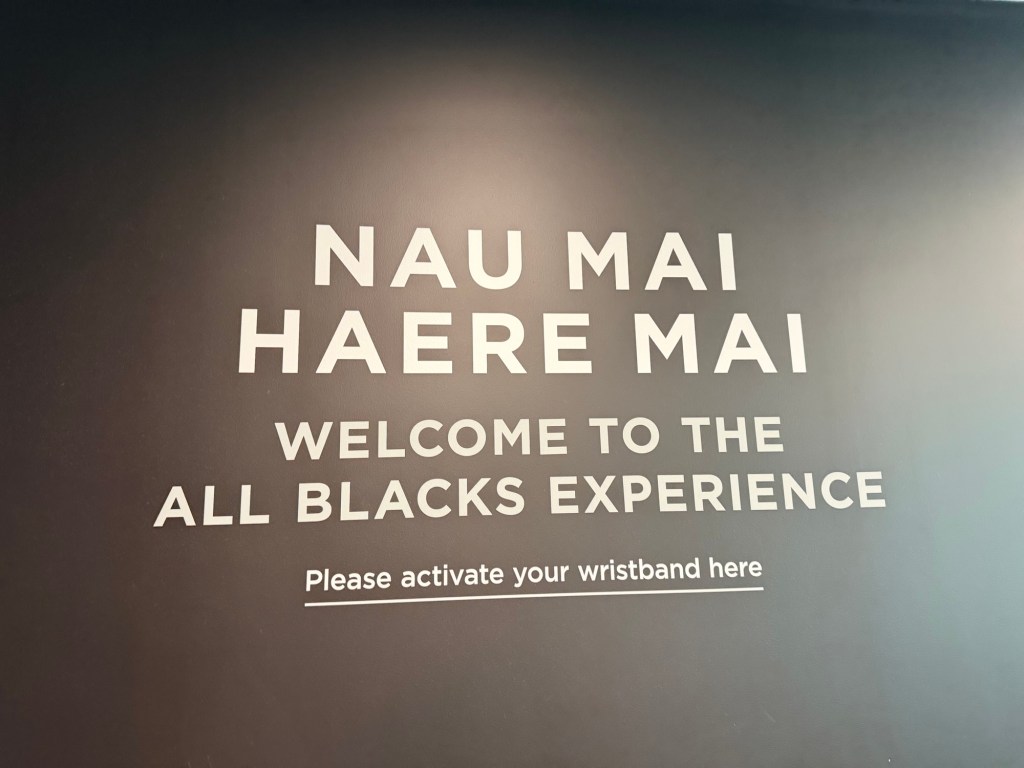
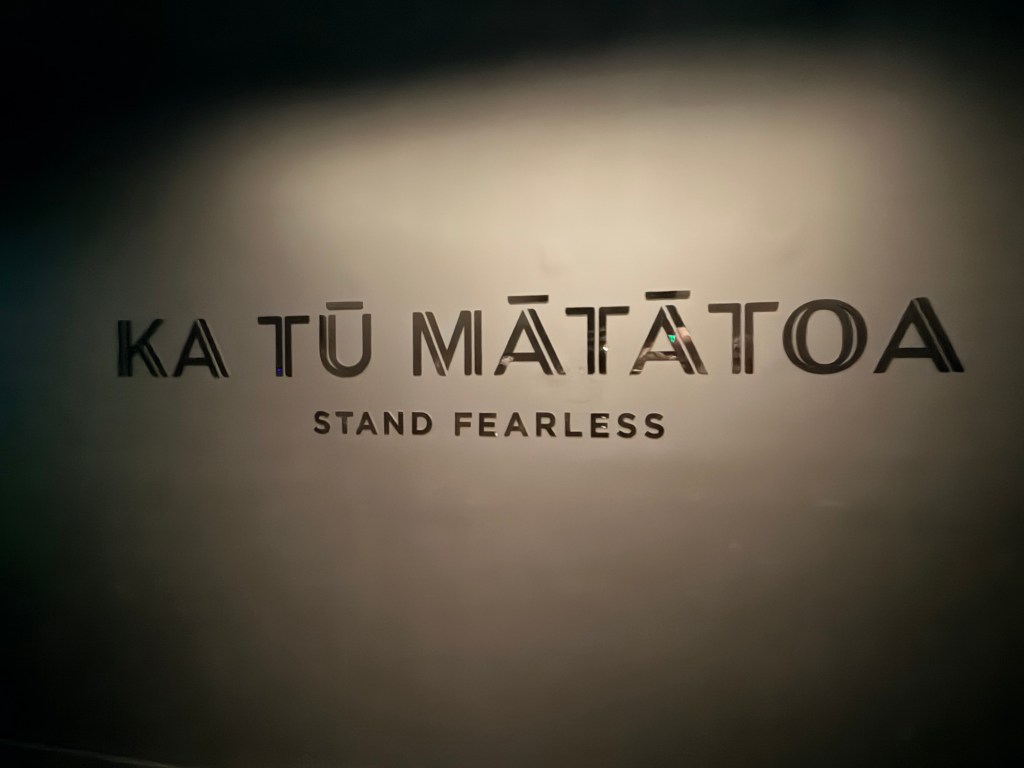
After our adrenaline rush and full bellies, we slowed things down with a visit to the All Blacks Experience.
Even if you’re not a die-hard rugby fan, the story of New Zealand’s legendary All Blacks is fascinating and inspirational. The interactive exhibits bring the history, pride, and intensity of this world class team to life.
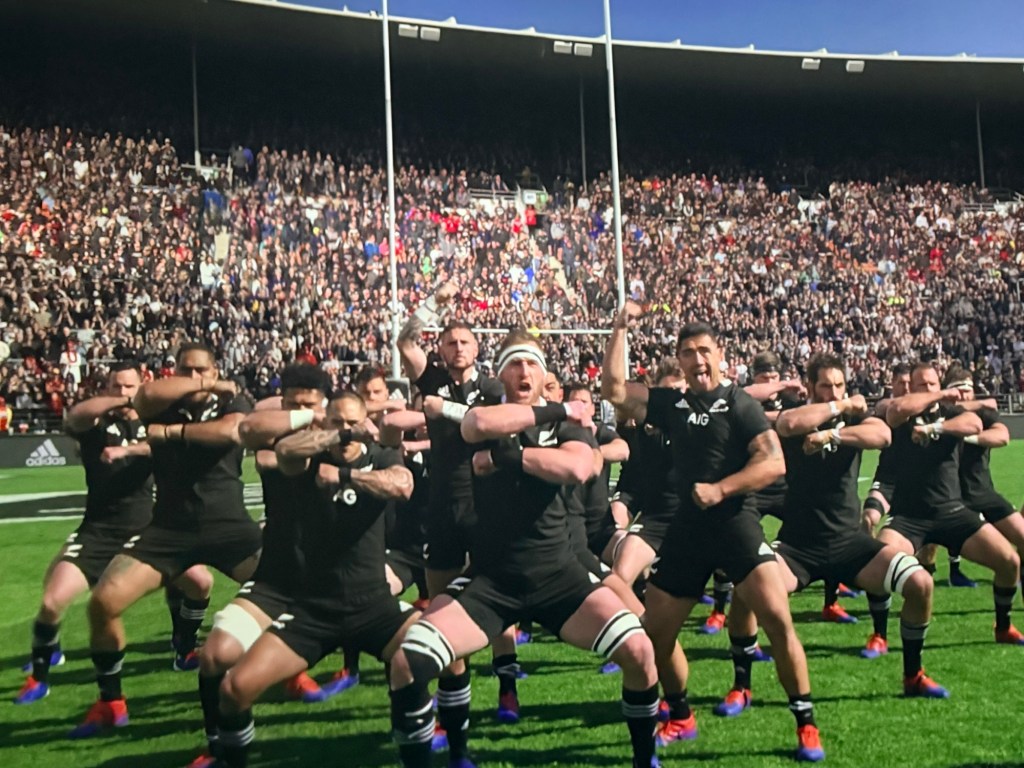
At the end of the tour, a hologram of both the All Blacks and the Black Ferns (women’s team) perform the Haka, the Maori ceremonial posture dance. The interactive experience put me as if I was on the opposing team—talk about equal parts intimidated and exhilarated! While it’s a rhythmic dance to challenge opponents, it also shows unity and welcomes the devoted All Blacks fans. 100% New Zealand.
It’s impossible to walk out of there without a deeper appreciation for how much rugby means here.
To end the day
By this point, the jet lag was starting to scream in our ears, so we returned to the hotel and finally checked in. After a quick reset, we headed back out for the evening.
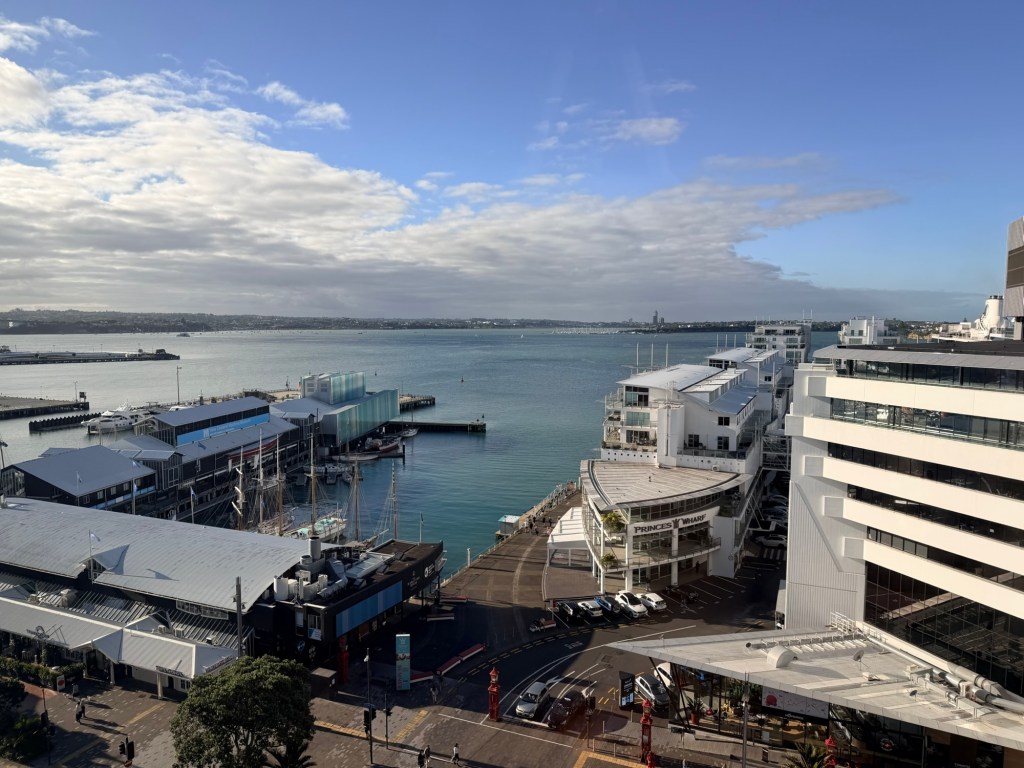
Our hotel sits on Princes Wharf and overlooks Waitemata Harbour, the main harbour in Auckland and gateway to the Pacific Ocean (via the Hauraki Gulf)
The sky turned shades of orange and pink while boats drifted across the water. Sitting there with my son, watching the light change over the city, was one of those quiet travel moments you wish you could freeze.
The Best Ice Cream and Cone (maybe ever!)
Then came dessert—and this was a very much anticipated event since researching places to eat in Auckland. I knew New Zealand would have my heart when I realized the country eats more ice cream per capita in the world! (And they’re the 3rd largest producer of milk and milk related products).
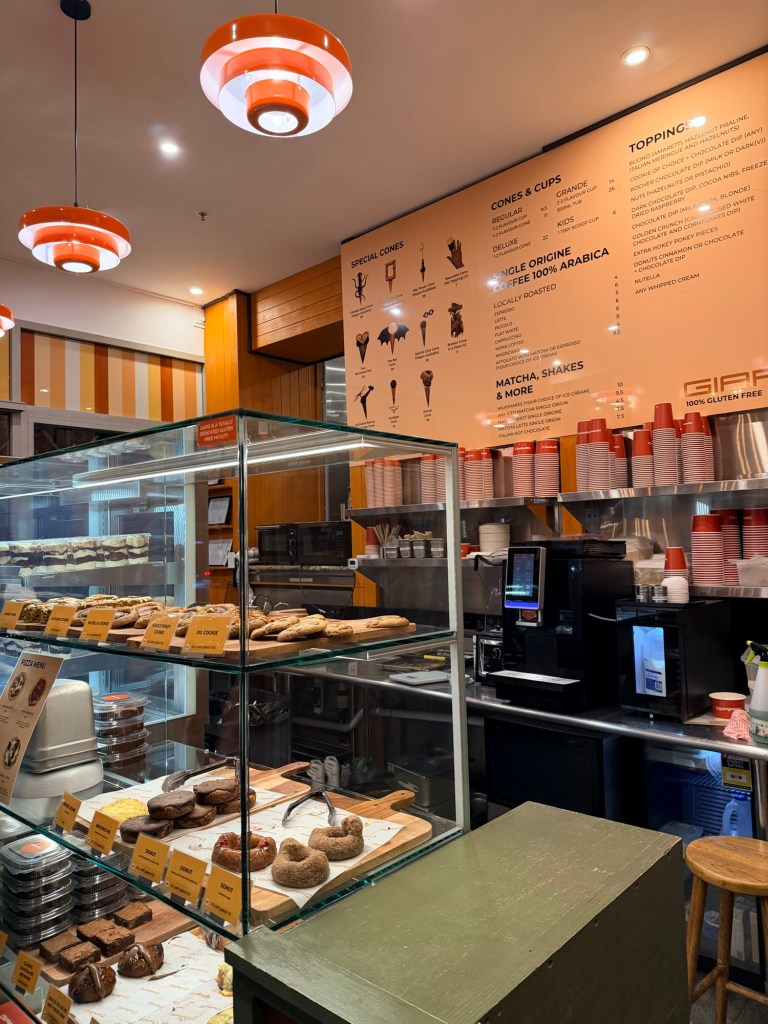
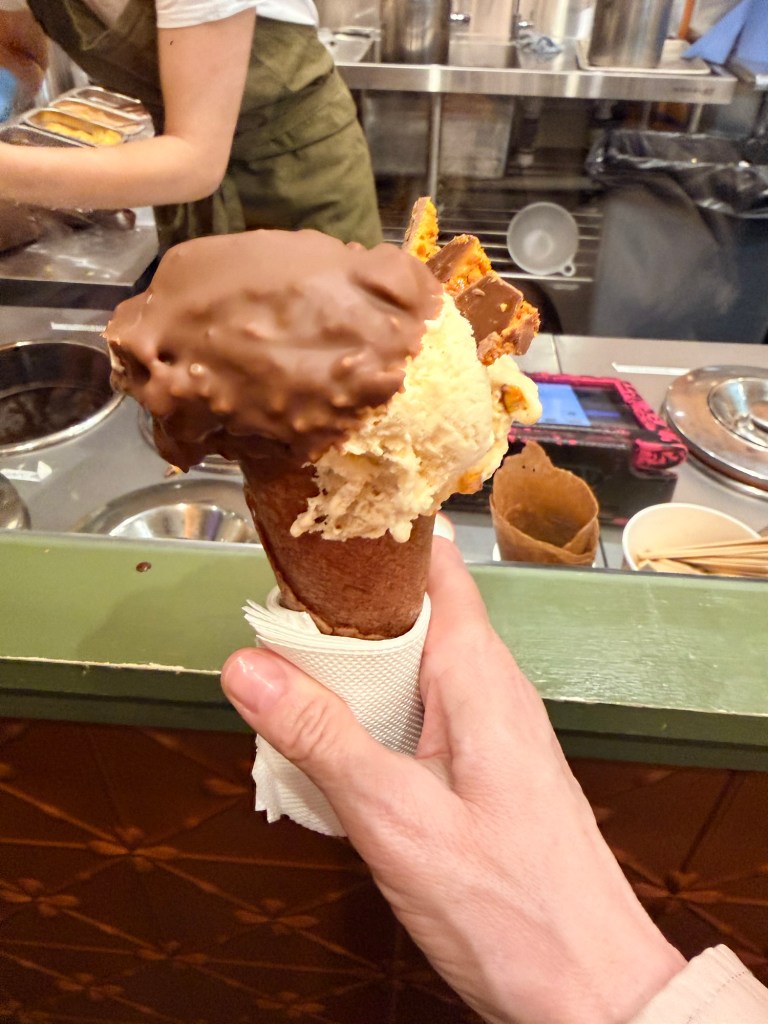
Welcome to Giapo, which may very well be the most creative ice cream shop on the planet. And, it’s 100% gluten free!! In addition to ice cream they have pastries and other GF sweets like cookies.🍪
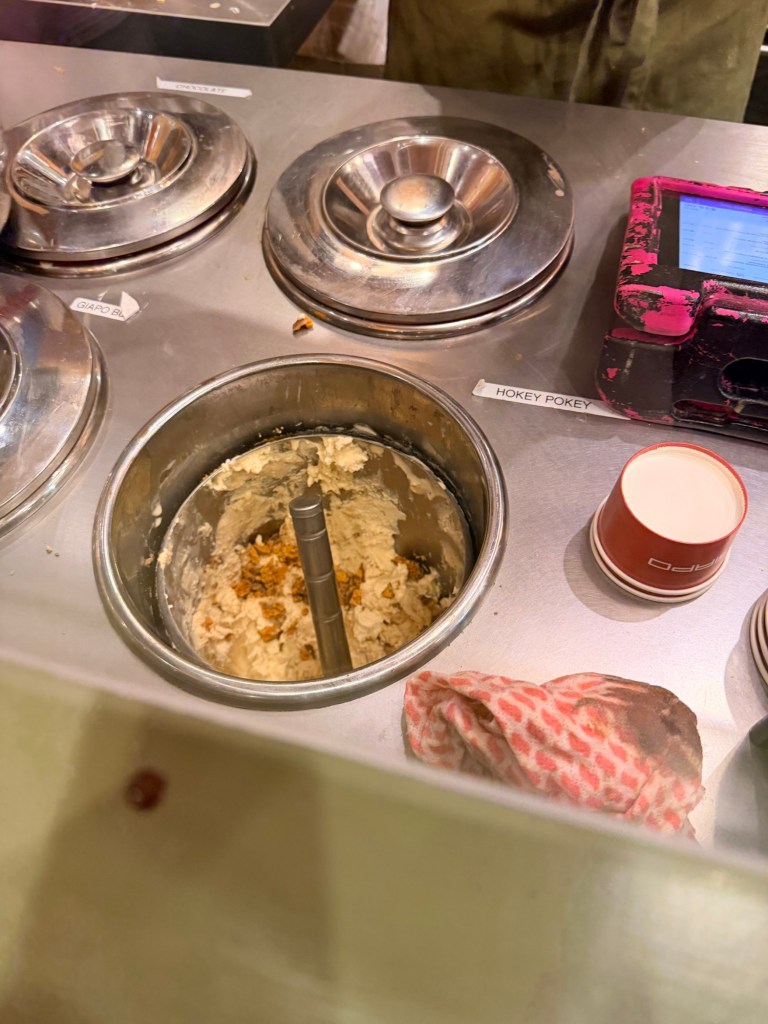
We decided this was the time to try the island classic, Hokey Pokey. It’s a creamy vanilla ice cream with crunchy honeycomb pieces. Brendan described it perfectly: “It’s like a Butterfinger… only much better.”
Oh and did I mention everything is gluten-free, even the cones! I honestly can’t remember the last time I had a really good ice cream cone, and this one absolutely delivered. Creative, delicious, and unforgettable.
Lights Out
I would say that today was a very good day. We finally called it a night and I feel asleep the moment my head hit the pillow. Tomorrow’s agenda? Get ready to experience Middle-Earth and some glow! The adventure is just getting started. ✨
I feel like a kid on Christmas morning about this adventure!
New Zealand🇳🇿
Home to 25 million sheep, that’s 5 sheep per every person.
Where “kiwi” is used to describe 3 things—a bird, fruit (always call it kiwi fruit), and people from New Zealand.
Where the landscapes are diverse and spectacular like the Southern Alps, fjords like Milford Sound, volcanic landscapes, geothermal fields, glacier lakes, and dramatic coastlines.
Where Middle-Earth was created (and filmed) for the Lord of the Rings movies and the Hobbiton really exists.
Where you find the incredible Māori culture, and rugby is almost a national religion. In fact, the All Blacks is one of most recognized teams in the sport and the haka is mesmerizing.
10 fun (and some surprising) facts from my research.
1️⃣ It’s one of the last landmasses humans settled on Earth when the Polynesians arrived between AD 1200-1300 🗺️. While the country is an archipelago of some 600 islands located in the Pacific Ocean, there are 3 main islands —North and South, where 99% of the population lives, and Stewart Island, which is primarily a protected national park. In fact, 30% of New Zealand is protected land. We will be traveling from the North Island, starting in Auckland, to the South Island. The two islands are separated by the Cook Strait. While in Auckland, we will we will venture to Waiheke Island.
2️⃣ In 1893 New Zealand became the first country where women could vote.🗳️ One of the dedicated women behind the movement, Kate Sheppard, appears on the $10 New Zealand banknote.
3️⃣ There were no native land mammals when humans arrived (except bats). Birds then evolved to fill those roles and for this reason, the Kiwi bird is flightless and ground-dwelling.
Let’s stay on the Kiwi bird for a minute because I find them fascinating and cannot wait to see one in the wild.
Say what?? The Kiwi’s nostrils are at the tip of their beak. Every other bird in the world has nostrils near the base of their beak, close to the face, because birds rely on vision to find food, touch, or vibration.
But Kiwis hunt by smell and evolved differently because…you guessed it, there were no land mammals. They are nocturnal forest foragers.
A momma Kiwi bird lays an egg that is 20 times her body weight😮. To put that into perspective, it would be the equivalent of a 150 pound woman giving birth to a 30 pound baby! The papa bird sits on the egg for 70-85 days, which is one of the longest incubation periods of any bird.
4️⃣ New Zealand is known as Aotearoa, the Māori name meaning “Land of the long white cloud”. There are 3 official languages: English, Māori, and New Zealand Sign Language (making it one of a few countries to designate sign language as an official national language).
5️⃣ There are glowworm caves and we will go to Waitomo to see thousands of these glowing larvae light up the cave. Starlight underground.🌟
6️⃣ Lollies! Which means candy. And when you have a sweet tooth like me, you get to know the various lollies you’ll encounter.😂 Get ready Pineapple Lumps🍍 and Jaffas🍊🍫…I am coming for you!
7️⃣ 🍷New Zealand produces less than 1% of the world’s wine but what they do produce is well known and dominated by the Sauvignon Blanc grape. The Marlborough region holds over 70% of the country’s vineyard area.
8️⃣ It’s a darned long flight! It is going to take ~12 hours from San Francisco. We cross the international date line and jump ahead to the future! For example, we’re leaving SFO on Saturday at 10:45 pm and arrive Monday morning at 8:00 am.
9️⃣ Driving is on the left and the driver sits on the right. And the seasons are opposite since we’re in the Southern Hemisphere. We’re getting ready for spring in the USA, and fall in NZ. Can’t wait to gaze at that Southern sky!
🔟 I learned a few new words and customs in anticipation of the trip:
Sweet as = awesome, no problem
Togs = swimsuit
Jandals = flip flops (my favorite)
Tramping = hiking (which we will do)
The Hongi = Māori greeting where two people exchange the breath of life (ha) by pressing their foreheads and noses together. It means unity, equality, and the exchange of mana (spiritual power). How beautiful.❤️
Now I sit back, relax, and fly✈️ to the home of world class wine, the flat white, commercial bungee jumping, Hokey Pokey ice cream (per capita, New Zealanders eat the most ice cream 🍨 in the world-my idols!), jet boating, Manuka honey, Whittaker’s chocolate, and pavlova (although disputed by Australia as to which country invented it). Oh, and New Zealand has no native snakes!
 Christina’s Journey Journal